Radiation Transport
Section 6 of 7
Radiation Pressure
Part 6: Radiation Pressure
Photons carry not only energy but momentum: . So when radiation is absorbed or scattered, it exerts a force on matter. In an isotropic thermal radiation field, the
This is why radiation transport is also a force problem.
Radiation pressure
The pressure exerted by a photon field through its momentum, for an isotropic thermal field. It grows as — negligible in the Sun, but dominant in very massive, hot stars.
Problem
Compare with the ideal-gas pressure at the solar core (, , mean molecular weight ).
StepRadiation pressure
StepGas pressure
Dimensional check
Both reduce to (a pressure) ✓.
Result
— radiation pressure is tiny in the Sun. But while (at fixed ), so radiation pressure grows far faster with temperature — which is why it dominates in very massive stars.
Deriving the Eddington luminosity
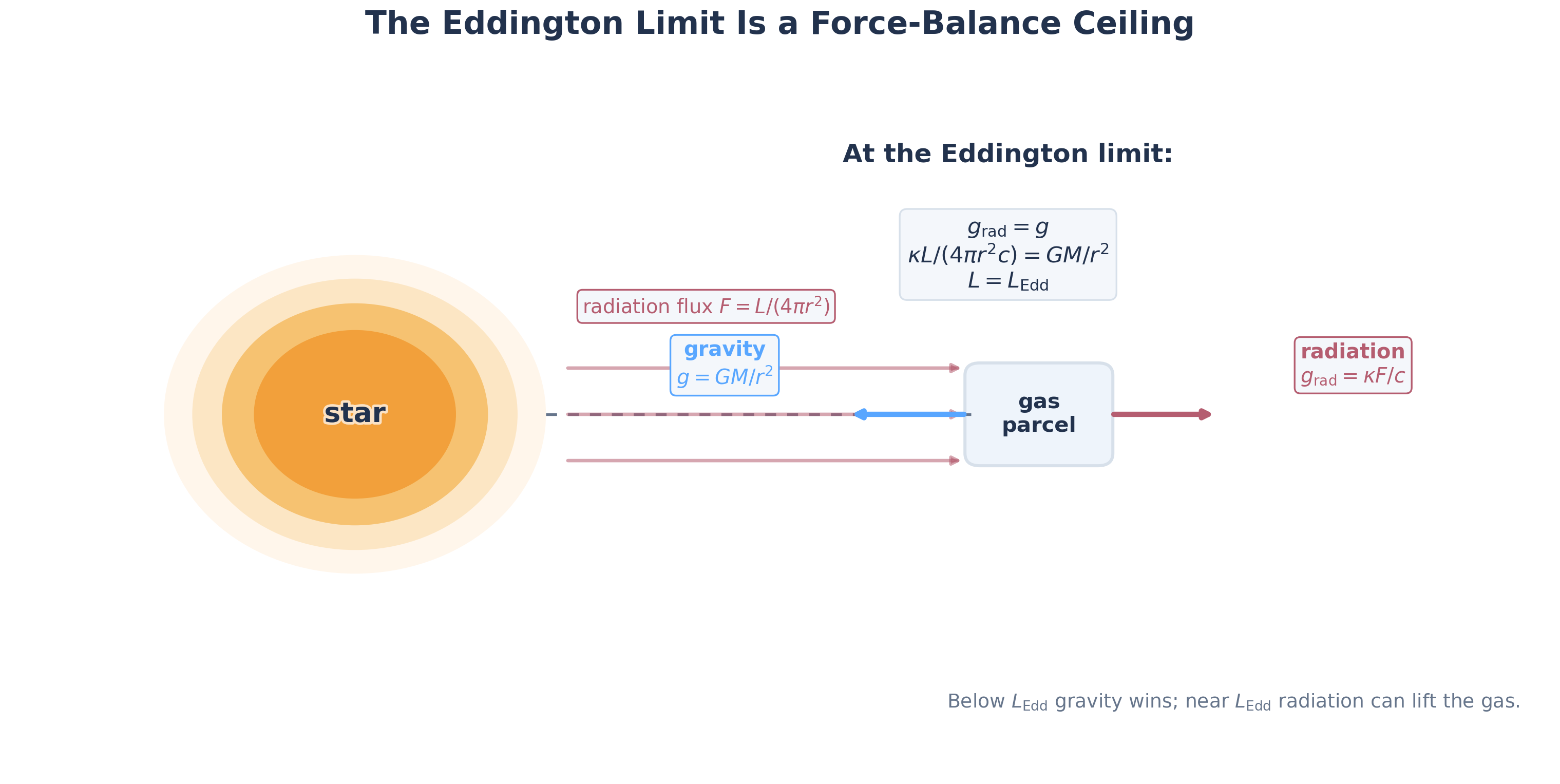
How luminous can a star become before radiation pushes outward as strongly as gravity pulls inward? Assume spherical symmetry, steady state, and electron-scattering opacity. The outward radiative acceleration on a shell is ; the inward gravitational acceleration is . Setting them equal (the cancels) gives the
A force-balance ceiling: below gravity wins; near it, radiation reshapes the envelope and drives strong winds; above it, hydrostatic balance becomes very hard to maintain.
Eddington luminosity
The luminosity at which radiation’s outward force balances gravity, (about for the Sun). A structural ceiling, not a hard cutoff — stars near it drive winds and instabilities.
Problem
Compute for the Sun with , .
StepPlug into 4πGMc/κ
Dimensional check
✓.
Result
. The Sun is far below this, so radiation pressure is dynamically negligible for solar structure — but massive stars come much closer because their luminosities rise faster than linearly with mass.
Problem
. (1) At fixed opacity, if stellar mass doubles, what happens to ? (2) Why do the most massive stars come closest to this limit even though rises with mass?
At fixed , , so doubling the mass doubles it. But the most massive stars still come closest because their actual luminosities rise much faster than linearly with mass, so catches up to as mass increases.