Radiation Transport
Section 4 of 7
Radiative Diffusion
Part 4: Radiative Diffusion — Energy Flow as a Leaking Fog
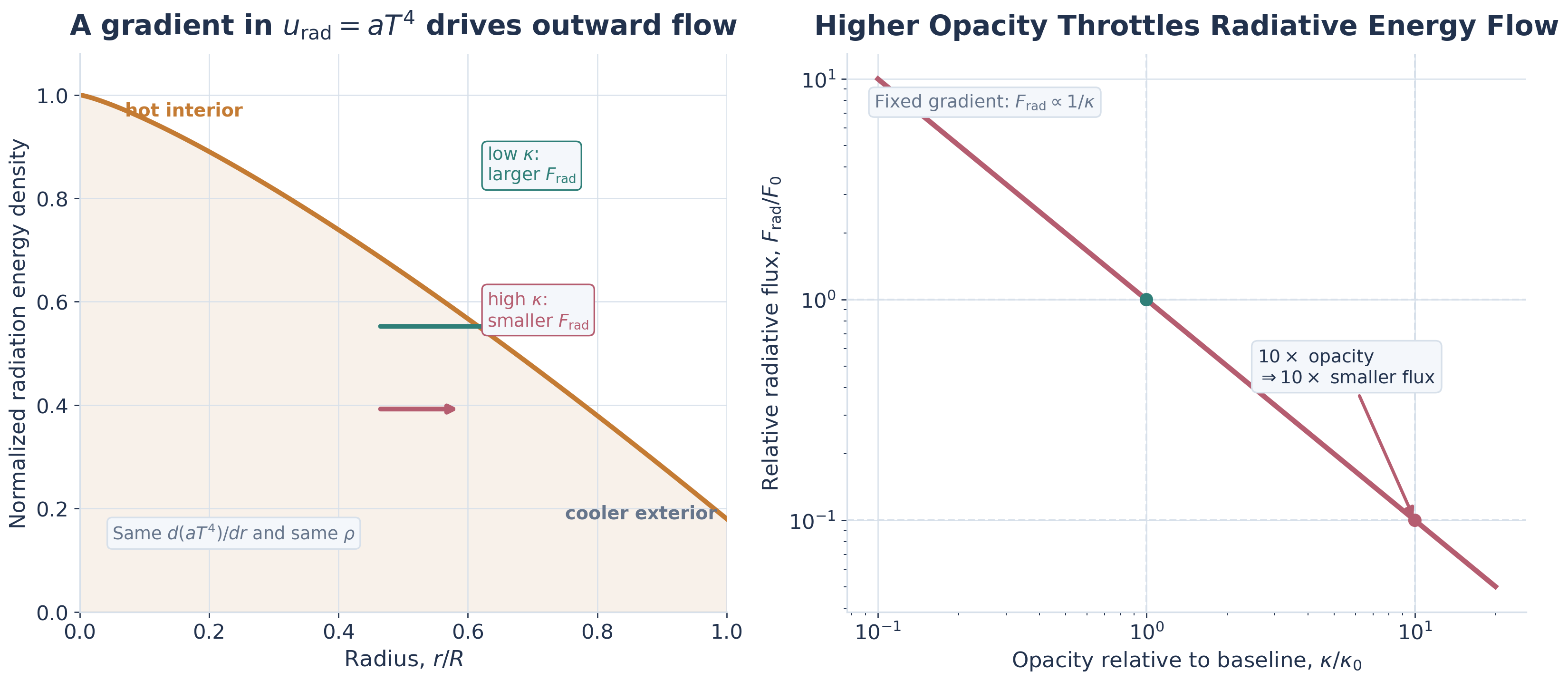
The random walk tells us why transport is slow; stellar structure needs a law for how much luminosity a temperature gradient can carry. A thermal radiation field has energy density (with ). If the interior is hotter than the exterior, decreases outward, and that gradient drives a net outward flux:
A steeper temperature gradient drives a larger flux; higher opacity or density suppress it; the minus sign means energy flows from hot to cool. Opacity acts like a resistance to energy flow — this is
Radiative diffusion
Energy transport by photons random-walking down a temperature gradient through an optically thick medium. The diffusive flux is — throttled by opacity, driven by the gradient.
Luminosity is flux times area, :
This treatment assumes the medium is optically thick, in local thermodynamic equilibrium, radiation-dominated, and close to isotropic.
Reading the Math: the diffusion luminosity
The flux law carries a derivative, , so we run the signature move again — now on the temperature profile — and read off how a star’s luminosity scales with its mass and radius.
① Approximate the derivative. Temperature falls from at the center to essentially nothing at the surface over a distance :
The coefficient out front, , is the radiative diffusion coefficient — Part 2’s tiny mean free path in one symbol. A small makes small, which is the random walk of Part 3.
② Extract the scaling. Substitute into , form the luminosity , and replace :
Read the exponents — but note is not free. Reading 5 substitutes the hydrostatic core temperature ; the four factors of cancel and one power of survives, leaving the headline mass–luminosity law . Hydrostatic equilibrium (Reading 2) built the first half of that result; this diffusion law is the second.
③ Name the assumption. The audit gains a transport row:
| We assumed | by replacing | What it costs |
|---|---|---|
| one temperature scale | , with | a scale, not the profile — fine for the exponents |
| constant opacity | real bends the slope of | |
| mean density | the same central-concentration error as Reading 2 | |
| optically thick + LTE | the diffusion approximation itself | fails in the thin outer layers, where transport is not diffusive |
Same deal as Reading 2: right exponents, approximate coefficient. The scaling is robust; the prefactor needs the true opacity and structure.
At fixed luminosity, high opacity makes radiative transport less efficient, so the star needs a steeper temperature gradient to carry the same energy. If the required gradient becomes too steep, radiation is no longer the preferred mechanism and convection can take over.
Multiple choice
At some radius, is fixed but increases by a factor of 10. To carry the same luminosity, what must the temperature gradient do?
Larger suppresses the flux, so transport becomes harder. To carry the same , the temperature gradient must become steeper.
The Sun's luminosity and surface temperature
and , both steady.
Radiative diffusion through an optically thick interior
The flux is set by the temperature gradient and opacity; opacity controls how hard energy is to move.
Luminosity and fusion rate are self-regulated
Opacity controls how hard it is for energy to escape; the fusion rate adjusts through the stellar thermostat until energy production matches energy loss.