Part I: The Hidden Physics in Every Astronomical Image
Why the Universe Looks the Way It Does | Statistical Thinking Module 4 | COMP 536
Learning Objectives
By the end of Part I, you will be able to:
- Explain how photon energy relates to physical processes through \(E = h\nu = hc/\lambda\)
- Calculate extinction effects on stellar observations using \(F_{\text{obs}} = F_{\text{intrinsic}} \times 10^{-0.4 A_\lambda}\)
- Quantify wavelength-dependent extinction and its impact on astronomical observations
- Connect different wavelengths to their underlying physical processes and temperatures
- Apply extinction corrections to determine true stellar distances and properties
- Recognize that astronomical images encode physics through photon energies and wavelengths
From Pretty Pictures to Profound Physics
You probably fell in love with astronomy through astronomical images – the ethereal Horsehead Nebula silhouetted against glowing gas, the jeweled splendor of the Orion Nebula, the delicate veils of the Veil Nebula. These images move us in ways that equations never could. But here’s what your introductory astronomy course might not have emphasized: those gorgeous colors aren’t just aesthetic choices by image processors. Every hue, every shadow, every glowing wisp is physics speaking to us across cosmic distances. Each photon that reaches our telescopes carries a story – a story of its birth in stellar furnaces or shocked gas, a story of its journey through cosmic dust and gas, and crucially, a story of its missing companions who never made it to our detectors.
- The reddish glow of a nebula? That’s hydrogen atoms cascading down energy levels at precisely 656.28 nanometers (nm = \(10^{-7}\) cm), releasing exactly 1.89 eV of energy per photon.
- The dark lanes cutting through star fields? That’s submicron-sized (\(\lesssim \mu\text{m} = 10^{-4}\) cm) interstellar dust grains filtering starlight.
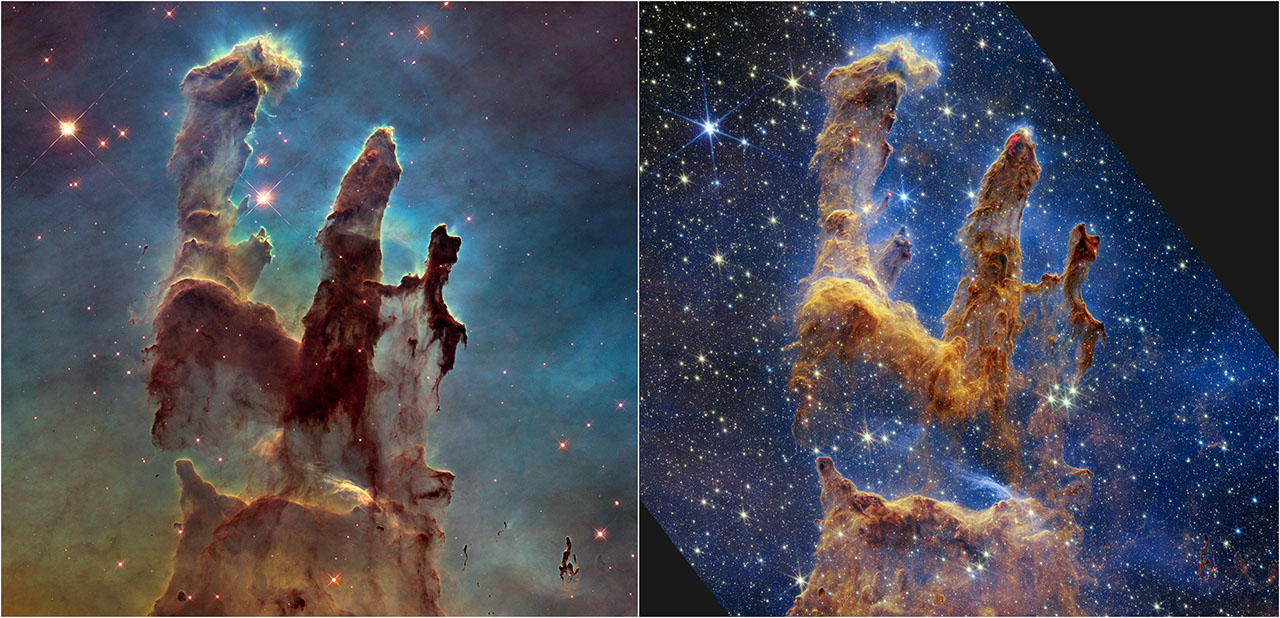
- The fact that JWST sees thousands of stars where Hubble sees only darkness? That’s infrared light navigating through obstacles that block visible wavelengths.
Look for: red filaments (hydrogen emission at 656 nm), dark lanes (dust extinction), and blue patches (hot star emission and reflected starlight).
![Rubin Observatory’s First Light on the Lagoon and Trifid Nebulae. This iconic first-release image from the Rubin Observatory captures the vivid interplay of nebulae, dust, and star clusters in Sagittarius. Notice how the rich reds and pinks trace hydrogen-alpha emission (656 nm), pinpointing regions of active star formation and ionized gas. Blue and turquoise tones correspond to reflected starlight and glowing oxygen ([OIII], 495–501 nm), while the dark lanes and golden clouds reveal dense, dusty regions where visible light is heavily absorbed, causing stars to appear reddened. The diversity of colors across the field demonstrates how visible wavelengths uncover the complex physics of ionization, scattering, and extinction in the galactic plane. (Image Credit: Rubin Observatory, First Public Release)](figures/rubin-nebulae.png) {#rubin-nebulae width=“100%” fig-align=“center”}
{#rubin-nebulae width=“100%” fig-align=“center”}
Astronomers never observe objects directly — we observe photons that have survived a journey through intervening matter. Understanding how that journey transforms light is the central problem of observational astrophysics, and the subject of this module.
Here’s the profound truth that transforms astronomy from stamp collecting to physics: we can only understand the universe because photons obey physical laws. The speed of light \((c)\), Planck’s constant \((h)\), and the laws of atomic physics aren’t abstract concepts – they’re the reason we can decode the cosmos. Without physics, those pretty pictures would be meaningless patterns of light. With physics, they become windows into stellar birth, galactic evolution, and cosmic history.
This module will (hopefully) transform how you see every astronomical image for the rest of your life. You’ll understand not just that the universe looks different at different wavelengths, but why it must look different – because different physical processes emit photons of different energies, and those energies determine wavelengths through the immutable relationship for a photon’s energy and its wavelength: \(E = h\nu = hc/\lambda\).
1.1 Light as Nature’s Messenger
Priority: 🔴 Essential.
Electromagnetic Radiation: Self-propagating waves of coupled electric and magnetic fields that travel at speed \(c\), characterized by wavelength \(\lambda\) and frequency \(\nu\) (where \(c = \lambda\nu\)). Carries energy and information across the entire spectrum from radio waves (km wavelengths) to gamma rays (pm wavelengths).
Photons: Massless particles of light that carry energy \(E = h\nu\) and momentum \(p = E/c\). Each photon is an indivisible packet of electromagnetic energy.
Speed of Light (c): The fundamental constant for electromagnetic wave propagation in vacuum. \(c = 2.998 \times 10^{10}\) cm/s. Nothing with mass can reach this speed.
Wavelength (\(\lambda\)): The spatial distance between successive wave crests of electromagnetic radiation, typically measured in cm, nm, or Å. Determines the “color” or type of light.
Frequency (\(\nu\)): The number of wave oscillations passing a fixed point per unit time, measured in Hz (s⁻¹). Related to wavelength by \(c = \lambda\nu\).
Everything we know about the universe beyond Earth’s atmosphere comes from decoding light. Not metaphorically – literally every piece of information about stars, galaxies, and cosmic evolution arrives as electromagnetic radiation. But here’s the key insight that makes astronomy possible: photons don’t just carry light, they carry information. The energy of each photon tells us about the physical conditions that created it. The pattern of missing wavelengths reveals what atoms it encountered. The subtle reddening exposes how much dust it traversed. Each photon is a messenger, and physics is the language it speaks.
Electromagnetic radiation carries virtually all information about the universe beyond Earth. Different wavelengths reveal different physics because interaction cross-sections vary dramatically with frequency.
Temperature Information:
- Thermal emission (blackbody): Peak wavelength via Wien’s law directly gives temperature of stellar surfaces and dust grains
- Free-free emission (bremsstrahlung): Radio/IR continuum from electron-ion encounters reveals gas temperature in HII regions and hot plasmas
- Spectral line ratios: Relative intensities of different transitions measure excitation temperature and ionization state
Composition and Density:
- Spectral lines: Specific absorption/emission energies identify which elements are present and their abundances
- Line profiles: Width and shape reveal density (pressure broadening), temperature (thermal broadening), and turbulence
- Thomson (electron) scattering: Cross-section \(\sigma_T = 6.65 \times 10^{-25}\) cm² measures electron density in hot plasmas
Magnetic Fields:
- Synchrotron radiation: Relativistic electrons spiraling in B-fields produce power-law spectra (\(F_\nu \propto \nu^{-\alpha}\)) revealing field strength and cosmic ray energies
- Zeeman splitting: Spectral lines split proportional to B-field strength, directly measuring magnetic field strength
- Polarization: Scattered light and magnetically aligned dust grains trace field orientation and geometry
Dynamics and Structure:
- Doppler shifts: Line wavelength changes reveal radial velocities and bulk motions
- Intensity variations: Time changes show pulsations, orbits, rotation periods, and transient events
- Spatial variations: Brightness gradients reveal jets, shocks, temperature gradients, and how transparent or opaque different regions are
These frequency-dependent cross-sections determine photon mean free paths: \(\ell = 1/(n\sigma)\) — the average distance a photon travels before being absorbed or scattered. This concept is the physical foundation of extinction: when many mean free paths lie between source and observer, most photons don’t survive the journey. Understanding why \(\sigma\) varies with \(\nu\) is essential for interpreting multi-wavelength observations.
1.1.1 Decoding an Astronomical Image: Physics Made Visible
Before diving into the mathematics, let’s see how this plays out in a real astronomical image. Look again at the Rubin Observatory image above – it’s not just a beautiful picture, it’s a physics textbook written in light.
What You See: Rich red and pink regions threading through the field.
What Physics Tells Us: These are hydrogen atoms in their second energy level absorbing photons at exactly 656.3 nm, then re-emitting that energy as the characteristic red glow of hydrogen-alpha \((\text{H}-\alpha)\). The intensity of this red light directly measures how many hydrogen atoms are being ionized by the high-energy (\(E>13.6\) eV) radiation emitted from nearby hot stars.
What You See: Dark lanes cutting through the bright regions.
What Physics Tells Us: These aren’t empty space – they’re dense concentrations of interstellar dust grains roughly 0.1 micrometers in size. These grains are the perfect size to scatter blue light (450 nm) while letting red light (650 nm) pass through more easily. The dark lanes appear dark because the blue end of starlight has been filtered out.
What You See: Blue and turquoise regions scattered throughout.
What Physics Tells Us: These trace doubly-ionized oxygen atoms ([OIII]) emitting at 495-501 nm. This requires photons with energies of 35 eV or more to strip oxygen of two electrons – revealing the presence of extremely hot stars (>35,000 K) in these regions.
This transformation – from “pretty colors” to “quantitative physics” – is the essence of astronomical spectroscopy. Every wavelength tells us about different physical processes. Every color encodes specific temperatures, densities, and chemical compositions. The image becomes a diagnostic tool for understanding cosmic physics.
Astronomical Spectroscopy: The technique of dispersing light into component wavelengths to measure spectra, revealing composition, temperature, velocity, and physical conditions of celestial objects through their spectral lines and continuum.
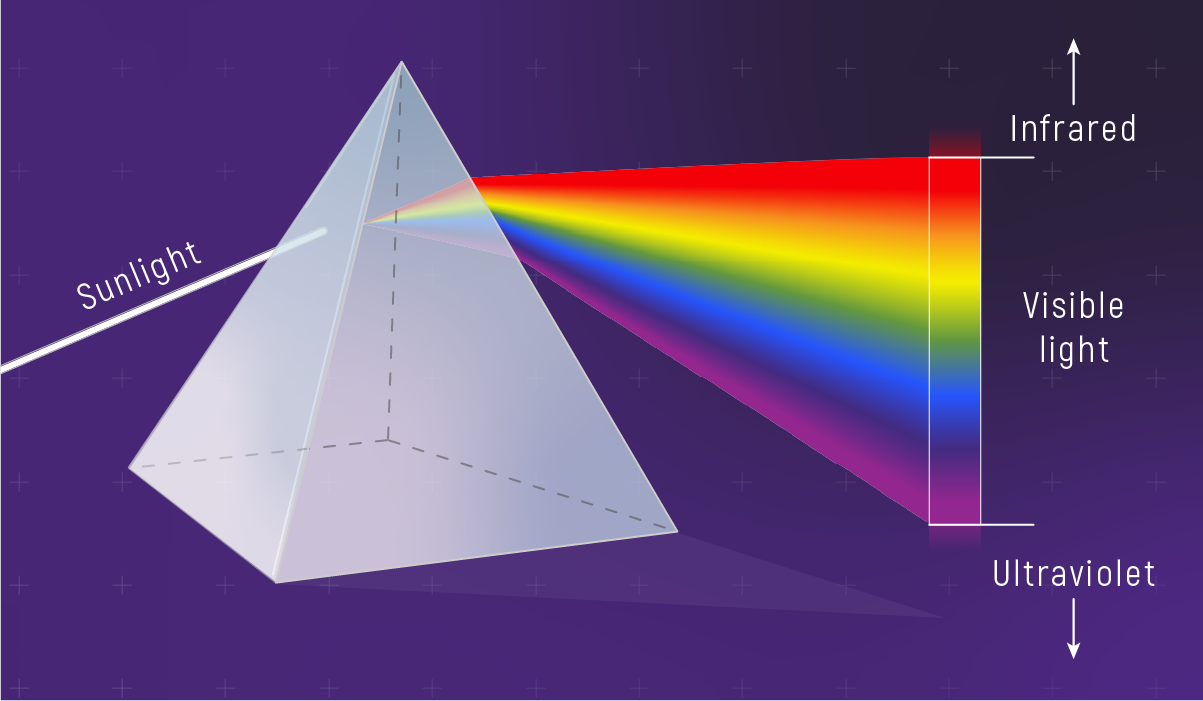 {#prism-spectrum width=“100%” fig-align=“center”}
1.1.2 The Fundamental Trinity: Speed, Wavelength, and Frequency
To decode the physics encoded in light, we need to understand the fundamental relationships governing electromagnetic radiation Let’s start with the relationship that governs all electromagnetic radiation:
\[\boxed{c = \lambda \nu}\]
where \(c = 2.998 \times 10^{10}\) cm/s is the speed of light (in vacuum), \(\lambda\) is the wavelength (in cm), and \(\nu\) is the frequency (in Hz or s\(^{-1}\)). This isn’t just a formula to memorize – it’s telling us something important. The speed of light is constant in a vacuum, so wavelength and frequency are inversely proportional to one another – when one increases, the other must decrease. Long wavelengths mean low frequencies; short wavelengths mean high frequencies. This relationship is why we can use wavelength and frequency interchangeably when describing light.
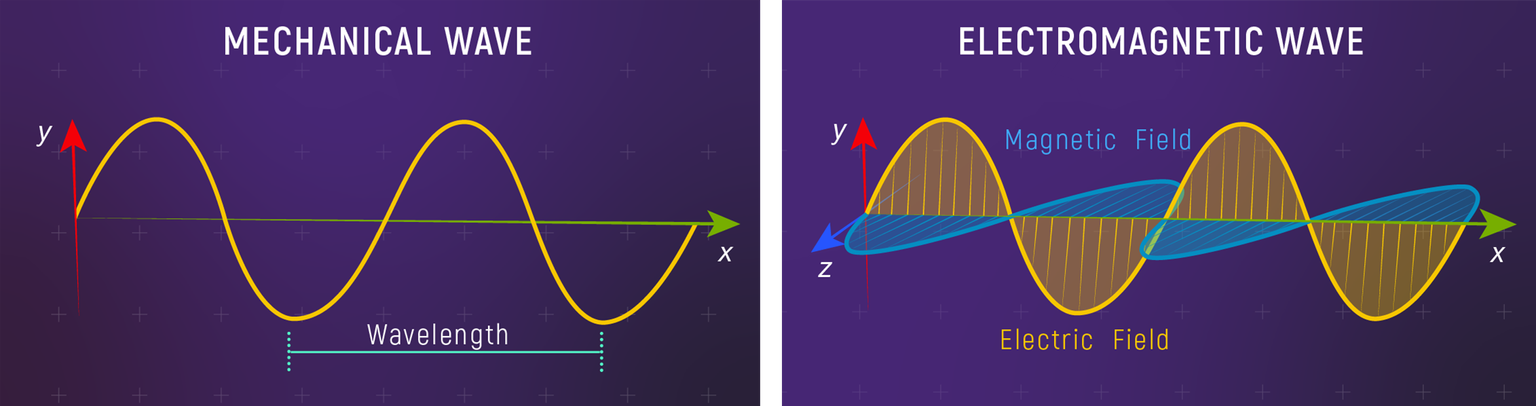 {#wave-comparison width=“100%” fig-align=“center”}
But the real physics emerges when we include Planck’s revolutionary insight:
\[\boxed{E = h\nu = \frac{hc}{\lambda}}\]
where \(h = 6.626 \times 10^{-27}\) erg·s is Planck’s constant, and \(E\) is the photon energy in ergs. This equation is the Rosetta Stone of astronomy. It tells us that photon energy is directly proportional to frequency and inversely proportional to wavelength. High-energy phenomena produce high-energy photons with short wavelengths. Low-energy processes emit low-energy photons with long wavelengths.
Photon Energy: The energy of a photon is given by \(E = h\nu = \frac{hc}{\lambda}\)
Energy Units in Astronomy: Astronomers often use electron volts (eV) for photon energies because they align with atomic transitions. Key conversions:
- 1 eV = \(1.602 \times 10^{-12}\) erg
- Optical photons: $$2-3 eV
- X-ray photons: 0.1-100 keV
- Gamma rays: >100 keV
1.1.3 The Electromagnetic Spectrum as a Physics Ladder
Now we can understand why different astronomical objects shine at different wavelengths. The electromagnetic spectrum isn’t just a list to memorize – it’s a ladder of physical processes, organized by energy.
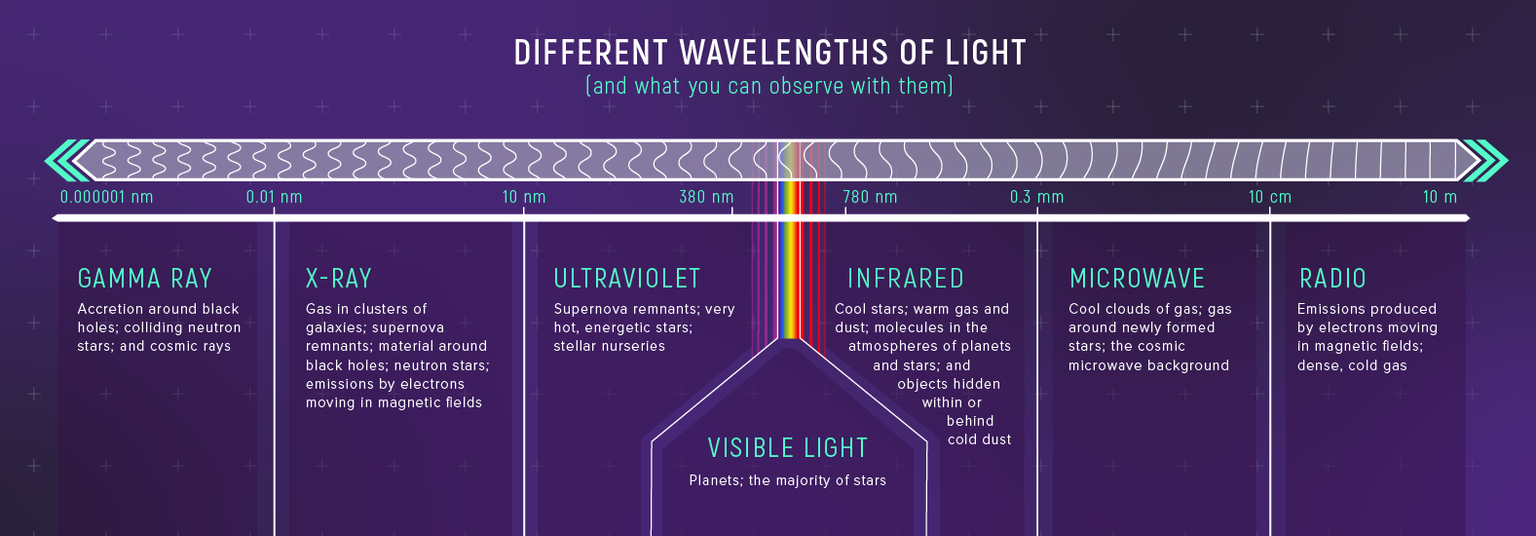 {#em-spectrum-objects width=“100%” fig-align=“center”}
Let’s work our way up this energy ladder, connecting each band to familiar astronomical phenomena:
Radio Waves and Microwaves (\(\lesssim 10^{-3}\) eV, \(\gtrsim 1\) mm)
What you know: Those gorgeous spiral arms in galaxy images, the 21-cm line of neutral hydrogen.
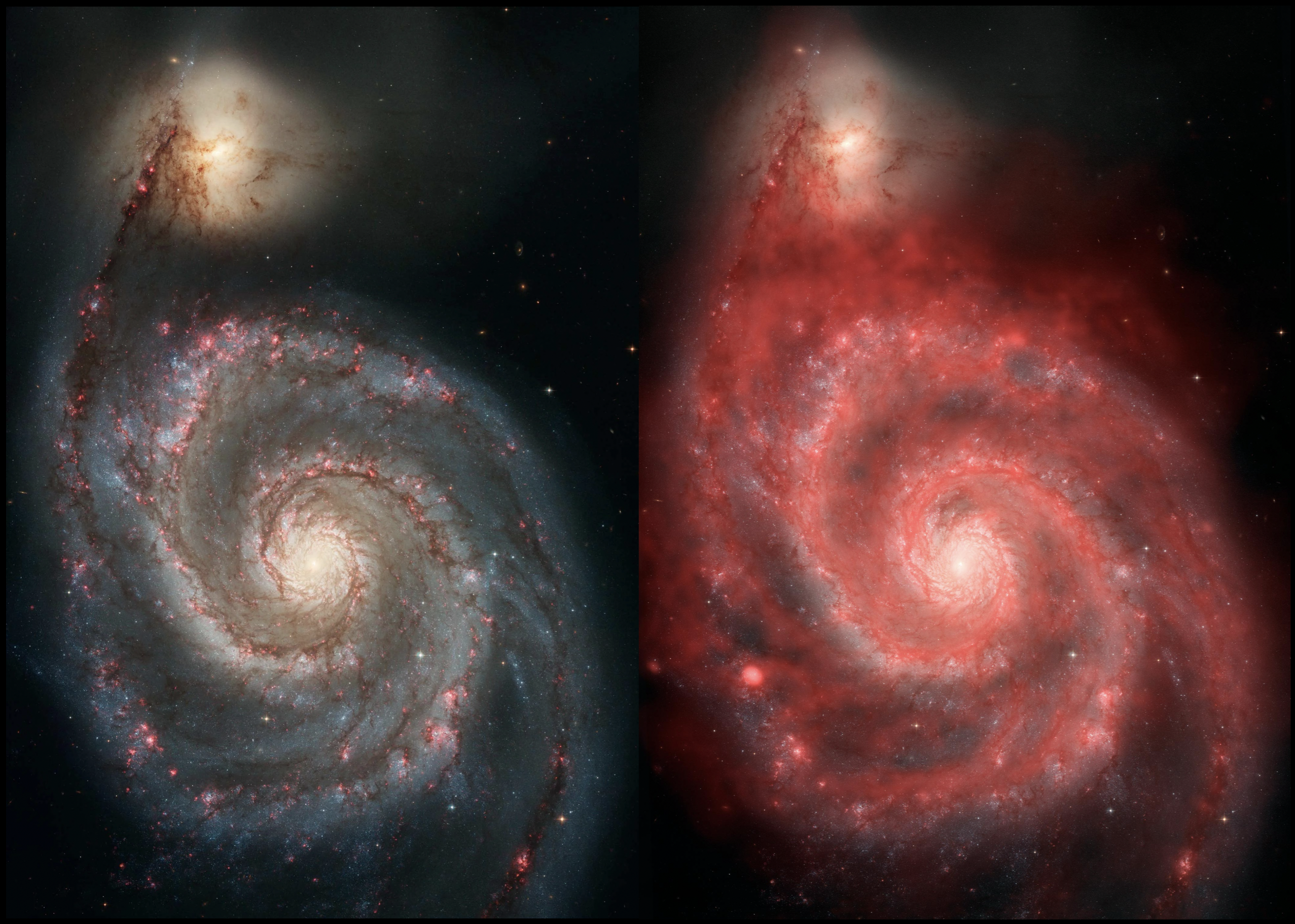 {#m51-optical-radio width=“100%” fig-align=“center”}
Starting our climb up the physics ladder: Cold gas clouds with temperatures of 10-100 K emit radio waves through magnetic field interactions and atomic spin flips. Radio photons carry the lowest energies on our ladder, revealing the coolest, most extended components of astronomical objects – the vast reservoirs of gas that will eventually form stars.
Infrared (IR) (0.001-1 eV, 1 \(\mu\mathrm{m}\)-3 mm)
What you know: JWST’s ability to see through dust, thermal images of planets and cool stars.
Look for: the dark silhouettes in Hubble’s optical view (left) vs. the revealed stars in JWST’s infrared (right) — same structure, completely different information.
 {#pillars-hst-jwst width=“100%” fig-align=“center”}
Climbing higher on our physics ladder: Warm dust and molecules (100-1000 K) radiate thermal energy as infrared photons. This is the glow of stellar nurseries, planet-forming disks, and the dust grains themselves as they absorb starlight and re-radiate it at longer wavelengths. Wien’s law tells us exactly why: cooler objects peak at longer wavelengths.
Optical (Visible Light; 1-3 eV, 400-700 nm)
What you know: The colors we see with our eyes, stellar classifications, nebular emission lines.
Continuing our climb: Stellar photospheres (3000-50,000 K) and electronic transitions in atoms. The hydrogen-alpha line at 656 nm corresponds to exactly 1.89 eV – the energy difference between the second and third energy levels of hydrogen. Our eyes evolved to see this wavelength range precisely because our Sun emits most of its energy here.
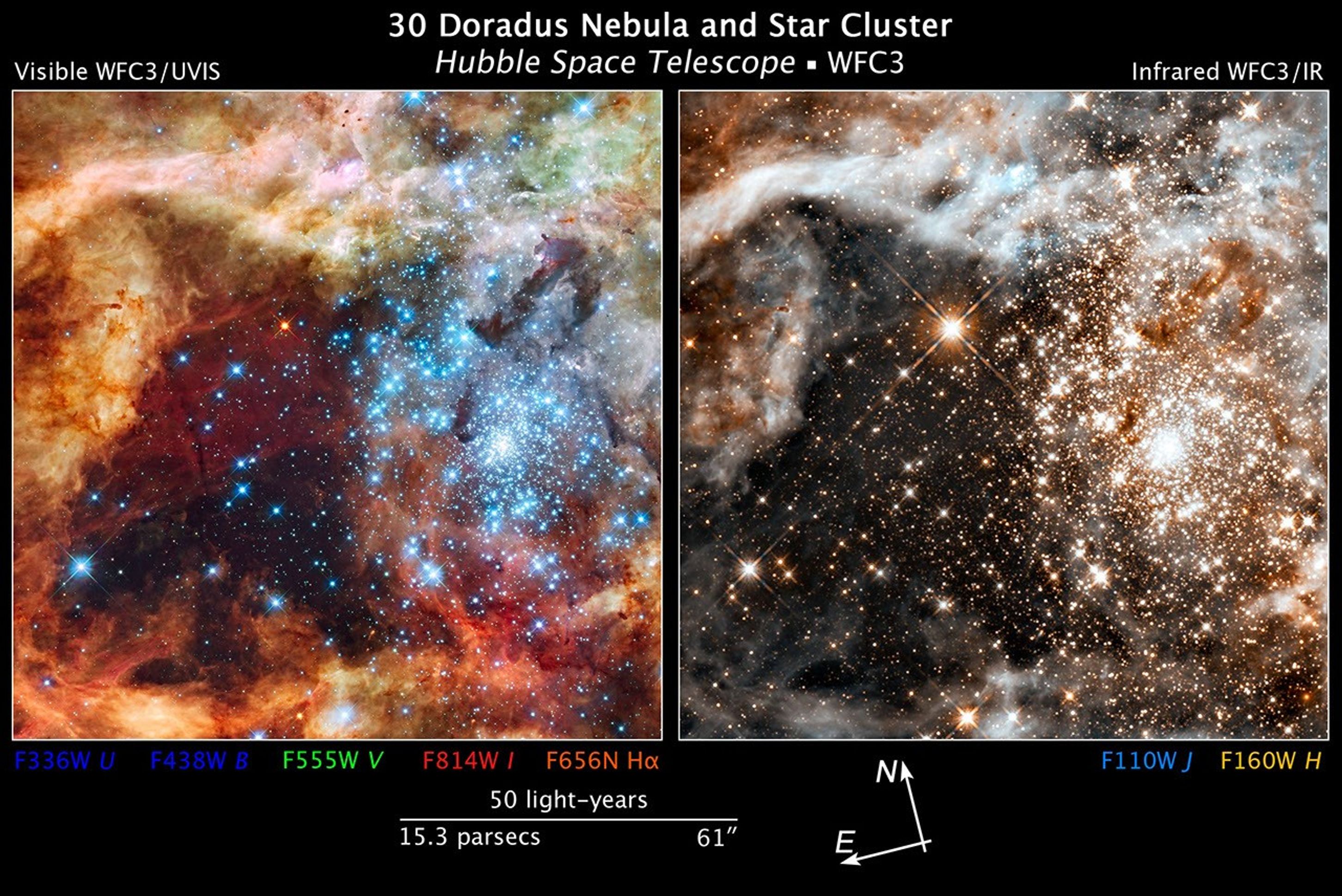
Ultraviolet (UV) (3-100 eV, 10-400 nm)
What you know: Young, hot stars; regions of active star formation invisible to optical telescopes.
 {#30dor-multiwavelength width=“100%” fig-align=“center”}
Higher up our physics ladder: Hot stellar atmospheres (>10,000 K) and high-energy atomic transitions. UV photons carry enough energy (>13.6 eV) to ionize hydrogen atoms, creating the glowing nebulae around massive stars. Only the most massive, shortest-lived stars produce significant UV radiation – making UV observations a direct tracer of recent star formation.
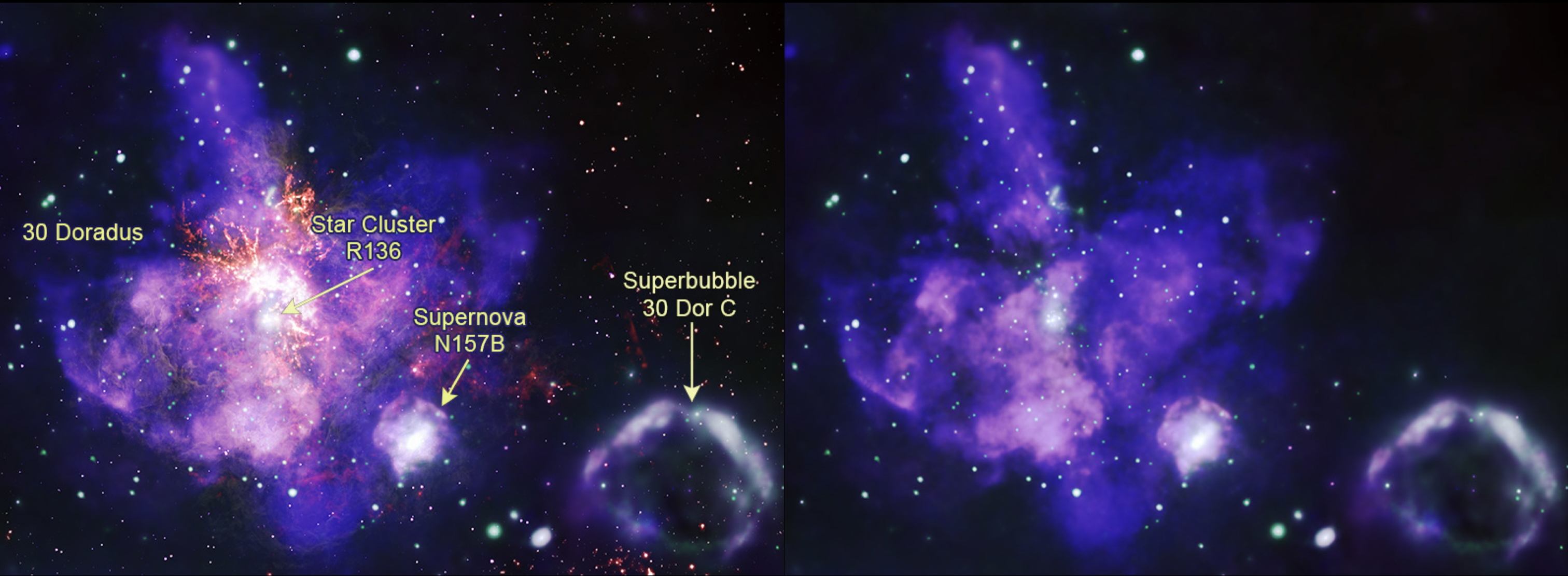
X-rays (100 eV-100 keV, 0.01-10 nm)
What you know: Accretion disks around black holes, supernova remnants, the hot gas between galaxies.
 {#30dor-xray width=“100%” fig-align=“center”}
Climbing higher on our physics ladder: We’ve reached the realm of million-degree plasmas and violent shock heating. When stellar winds (≳1000 km/s) and supernova ejecta (~10,000 km/s) slam into the surrounding ISM, their enormous kinetic energy thermalizes — creating shock-heated gas at 107-108 K that then adiabatically expands and cools to ≳10^6 K, still hot enough to emit X-rays. In accretion disks around neutron stars and black holes, gravitational energy converts to heat just as efficiently. X-ray photons carry 100+ times more energy than visible light, revealing these violent processes that shape galaxies through stellar feedback.
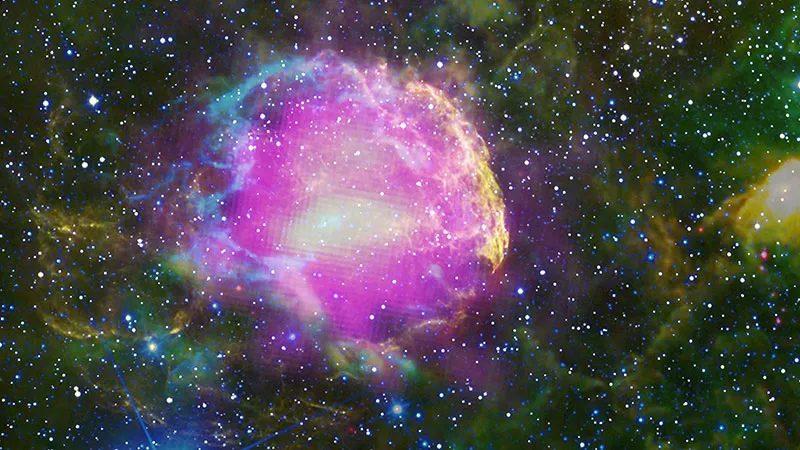
Gamma Rays (>100 keV, <0.01 nm)
What you know: Supernova Remnants, Gamma-ray bursts, pulsars, cosmic ray interactions.
 {#ic443-gamma-ray width=“100%” fig-align=“center”}
At the top of our physics ladder: Nuclear processes, matter-antimatter annihilation, and the most extreme magnetic fields. Gamma-ray photons carry so much energy that they can only be produced by the most violent events: stellar collapse, black hole mergers, or the decay of exotic particles. They’re the universe’s way of announcing its most dramatic moments.
The Pattern: As we move up the energy ladder, we’re probing increasingly violent and exotic physics:
- Radio \(\to\) Cold, extended gas reservoirs and magnetic fields
- Infrared \(\to\) Warm dust, stellar nurseries, and thermal processes
- Optical \(\to\) Stellar photospheres and ionized gas
- UV \(\to\) Hot stars and high-energy transitions
- X-ray \(\to\) Million-degree plasmas and violent processes
- Gamma-ray \(\to\) Nuclear furnaces and gravitational monsters
Each wavelength band reveals different components of the same astronomical objects.
1.1.4 Temperature’s Signature in Astrophysical Spectra
 {#blackbody-curves width=“100%” fig-align=“center”}
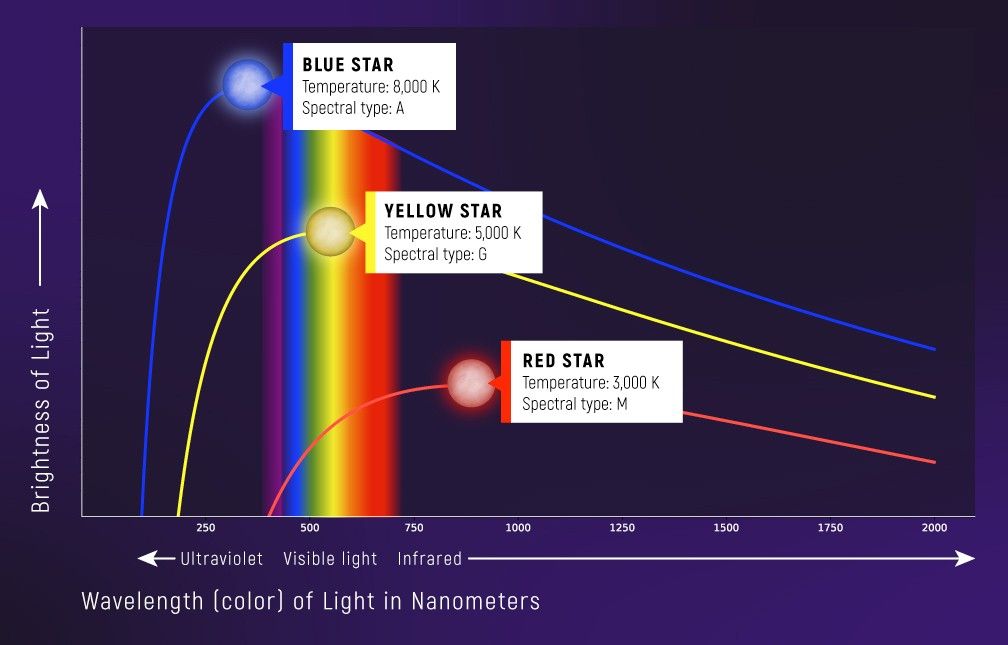
Wien’s displacement law connects an object’s temperature directly to its peak emission wavelength:
\[\boxed{\lambda_{\text{peak}} = \frac{0.2898 \text{ cm} \cdot \text{K}}{T}}\]
This isn’t an approximation — it’s exact physics emerging from Planck’s law.
Planck’s law describes the intensity of radiation emitted by a perfect blackbody at temperature \(T\) across all wavelengths:
\[B_\lambda(T) = \frac{2hc^2}{\lambda^5} \frac{1}{e^{hc/(\lambda kT)} - 1}\]
where \(k = 1.381 \times 10^{-16}\) erg/K is Boltzmann’s constant. In Project 3, you’ll integrate \(B_\lambda(T)\) over wavelength bands to compute Planck-weighted opacities for each star — the effective dust opacity “seen” by that star’s spectrum.
The shape of the blackbody curve depends only on temperature, and its peak shifts to shorter wavelengths as temperature increases.
Wien’s law tells us that hotter objects emit more total energy and peak at shorter wavelengths. Cooler objects emit less energy and peak at longer wavelengths. Not all radiation is thermal — synchrotron emission, spectral lines, and bremsstrahlung produce photons at energies unrelated to temperature. Wien’s law applies only to thermal (blackbody) sources.
Let’s see what this tells us about familiar objects:
The Sun (\(T_\text{eff} = 5780\) K): \[\lambda_{\text{peak}} = \frac{0.2898 \text{ cm} \cdot \text{K}}{5780 \text{ K}} = 5.01 \times 10^{-5} \text{ cm} = 501 \text{ nm}\]
This is green light! Our Sun peaks in the green, which is why human eyes evolved maximum sensitivity around 550 nm. We’re literally adapted to see our star’s peak output.
Red giant surface (\(T = 3500\) K): \[\lambda_{\text{peak}} = \frac{0.2898 \text{ cm} \cdot \text{K}}{3500 \text{ K}} = 8.28 \times 10^{-5} \text{ cm} = 828 \text{ nm}\]
This peaks in the near-infrared! Red giants appear red not just because they’re cool, but because their peak emission is beyond what our eyes can see.
Other key temperatures:
- Warm dust in nebulae (\(T = 100\) K): \(\lambda_{\text{peak}} = 29\,\mu\mathrm{m}\) (far-infrared)
- Cosmic microwave background (\(T = 2.7\) K): \(\lambda_{\text{peak}} = 1.1\) mm (microwave)
The key insight: When we observe an object’s spectrum and find its peak, we immediately know its temperature. But more profoundly, that temperature tells us what physical processes dominate. The spectrum reveals not just temperature but which physics matters – the dominant processes that shape what we observe.
This would be the end of the story if space were empty. But here’s where astronomy becomes truly challenging: the universe between us and every distant object is filled with gas and dust that fundamentally alters the light we receive. Understanding this transformation isn’t optional — it’s essential for interpreting any observation beyond our solar system. Not all photons emitted by distant objects reach our telescopes unchanged, and this intervening material leaves its own signature on the light…
Fundamental Equations (CGS units throughout):
- Wave equation: \(c = \lambda \nu\)
- \(c = 2.998 \times 10^{10}\) cm/s (speed of light)
- \(\lambda\) in cm (wavelength)
- \(\nu\) in Hz or s\(^{-1}\) (frequency)
- Photon energy: \(E = h\nu = \frac{hc}{\lambda}\)
- \(h = 6.626 \times 10^{-27}\) erg·s (Planck’s constant)
- \(E\) in ergs (energy)
- Wien’s law: \(\lambda_{\text{max}} = \frac{0.2898 \text{ cm} \cdot \text{K}}{T}\)
- \(T\) in K (temperature)
- \(\lambda_{\text{max}}\) in cm (peak wavelength)
- Extinction: \(F_{\text{obs}} = F_{\text{intrinsic}} \times 10^{-0.4 A_\lambda}\)
- \(F\) in erg cm\(^{-2}\) s\(^{-1}\) (flux)
- \(A_\lambda\) in magnitudes (extinction)
- Optical depth: \(\tau_\lambda = 0.921 \times A_\lambda\)
- \(\tau_\lambda\) dimensionless (optical depth)
Key Conversions:
- 1 nm = \(10^{-7}\) cm
- 1 \(\mu\mathrm{m}\) = \(10^{-4}\) cm
- 1 eV = \(1.602 \times 10^{-12}\) erg
- 1 Å = \(10^{-8}\) cm
Dimensional Analysis Check: Before calculating photon energy, let’s verify our units work out correctly:
\[\begin{align} E &= \frac{hc}{\lambda} \\ &= \frac{[\text{erg} \cdot \text{s}] \times [\text{cm/s}]}{[\text{cm}]} \\ &= \frac{[\text{erg} \cdot \text{s} \cdot \text{cm/s}]}{[\text{cm}]} \\ &= \frac{[\text{erg} \cdot \text{cm}]}{[\text{s}]} \times \frac{1}{[\text{cm}]} \\ &= \text{erg} ~\checkmark \end{align}\]
The seconds cancel, the cm cancel, leaving us with energy in ergs as expected.
Sample Calculation - Green Light Photon Energy: For \(\lambda = 550\) nm = \(5.5 \times 10^{-5}\) cm:
\[E = \frac{hc}{\lambda} = \frac{(6.626 \times 10^{-27} \text{ erg·s}) \times (2.998 \times 10^{10} \text{ cm/s})}{5.5 \times 10^{-5} \text{ cm}} = 3.61 \times 10^{-12} \text{ erg} = 2.25 \text{ eV}\]
Notice that this 2.25 eV energy is typical for visible light — this isn’t coincidental, it matches the energy scale of outer electron transitions in atoms. The key insight: Photon energies and atomic physics are perfectly matched.
1.2 The Imperfect Journey: When Light Meets Matter
Priority: 🔴 Essential.
Interstellar Medium (ISM): The matter and radiation between stars within a galaxy, consisting of ~99% gas (mostly hydrogen and helium) and ~1% dust by mass. Typical densities range from 0.1-1000 particles/cm³, with temperatures spanning 10-10⁶ K across different phases (molecular, atomic, ionized).
Interstellar Dust: Solid grains of silicates and carbonaceous material, typically 0.01-1 \(\mu\mathrm{m}\) in size, comprising ~1% of the ISM by mass in the Milky Way. These grains absorb and scatter light (causing extinction and reddening), catalyze H₂ formation, and reprocess ~30% of stellar UV/optical radiation into infrared.
If space were truly empty, astronomy would be straightforward. A 30,000 K star would always appear brilliant blue-white, its spectrum perfectly encoding its surface conditions. We could determine distances from apparent brightness using the inverse square law, and stellar colors would directly reveal stellar temperatures. But space isn’t empty — between us and every celestial object lies the interstellar medium (ISM), a tenuous but crucial mix of gas and interstellar dust that fundamentally alters the light passing through it.
This isn’t a minor correction — it’s a complete transformation that can make a hot blue supergiant appear as cool and red as the Sun. Understanding this transformation isn’t optional; it’s essential for interpreting any astronomical observation beyond our solar system.
Before diving into extinction effects, you need to understand how astronomers measure brightness and color — the magnitude system that forms the foundation of photometric astronomy. Magnitudes exist because human eyes perceive brightness logarithmically — a system that turns multiplicative attenuation into additive arithmetic.
The Magnitude System: Astronomical magnitudes are a logarithmic brightness scale where fainter objects have larger magnitude values:
\[m = -2.5 \log_{10}\left(\frac{F}{F_0}\right)\]
where \(m\) is apparent magnitude, \(F\) is measured flux, and \(F_0\) is a reference flux.
Deriving the flux ratio: For two objects with magnitudes \(m_1\) and \(m_2\): \[m_1 - m_2 = -2.5 \log_{10}\left(\frac{F_1}{F_0}\right) + 2.5 \log_{10}\left(\frac{F_2}{F_0}\right)\]
\[m_1 - m_2 = -2.5 \log_{10}\left(\frac{F_1/F_0}{F_2/F_0}\right) = -2.5 \log_{10}\left(\frac{F_1}{F_2}\right)\]
Rearranging for the flux ratio: \[\log_{10}\left(\frac{F_1}{F_2}\right) = -\frac{(m_1 - m_2)}{2.5}\]
\[\frac{F_1}{F_2} = 10^{-(m_1 - m_2)/2.5} = 10^{-0.4(m_1 - m_2)}\]
Therefore, if \(m_1 - m_2 = -1\) (object 1 is 1 magnitude brighter): \[\frac{F_1}{F_2} = 10^{0.4} = 2.512...\]
Key relationships:
1 magnitude difference = 2.512\(\times\) flux ratio
5 magnitude difference = \(10^{0.4 \times 5} = 10^2 = 100\)$$ flux ratio
10 magnitude difference = 10,000\(\times\) flux ratio
Apparent magnitude (m): Brightness as observed from Earth
Absolute magnitude (M): Intrinsic brightness if object were at 10 parsecs distance
Distance modulus: \(\mu = m - M = 5 \log_{10}(d/10 \text{ pc})\)
Color Indices: Colors measure the flux ratio between two wavelength bands:
\[(B-V) = m_B - m_V = -2.5 \log_{10}\left(\frac{F_B}{F_V}\right)\]
- Blue objects: \((B-V) < 0\) (more flux in B-band than V-band)
- Red objects: \((B-V) > 0\) (more flux in V-band than B-band)
- The Sun: \((B-V) = 0.65\) (slightly yellow)
Physical meaning: Color directly relates to temperature via Wien’s law and is distance-independent — both magnitudes in the color index include the same distance modulus, which cancels when subtracted. Hot stars (\(T > 10,000\) K) have \((B-V) < 0\), while cool stars (\(T < 4,000\) K) have \((B-V) > 1.5\). This distance independence makes colors powerful for determining stellar properties regardless of how far away the star is — a crucial advantage for studying distant stellar populations.
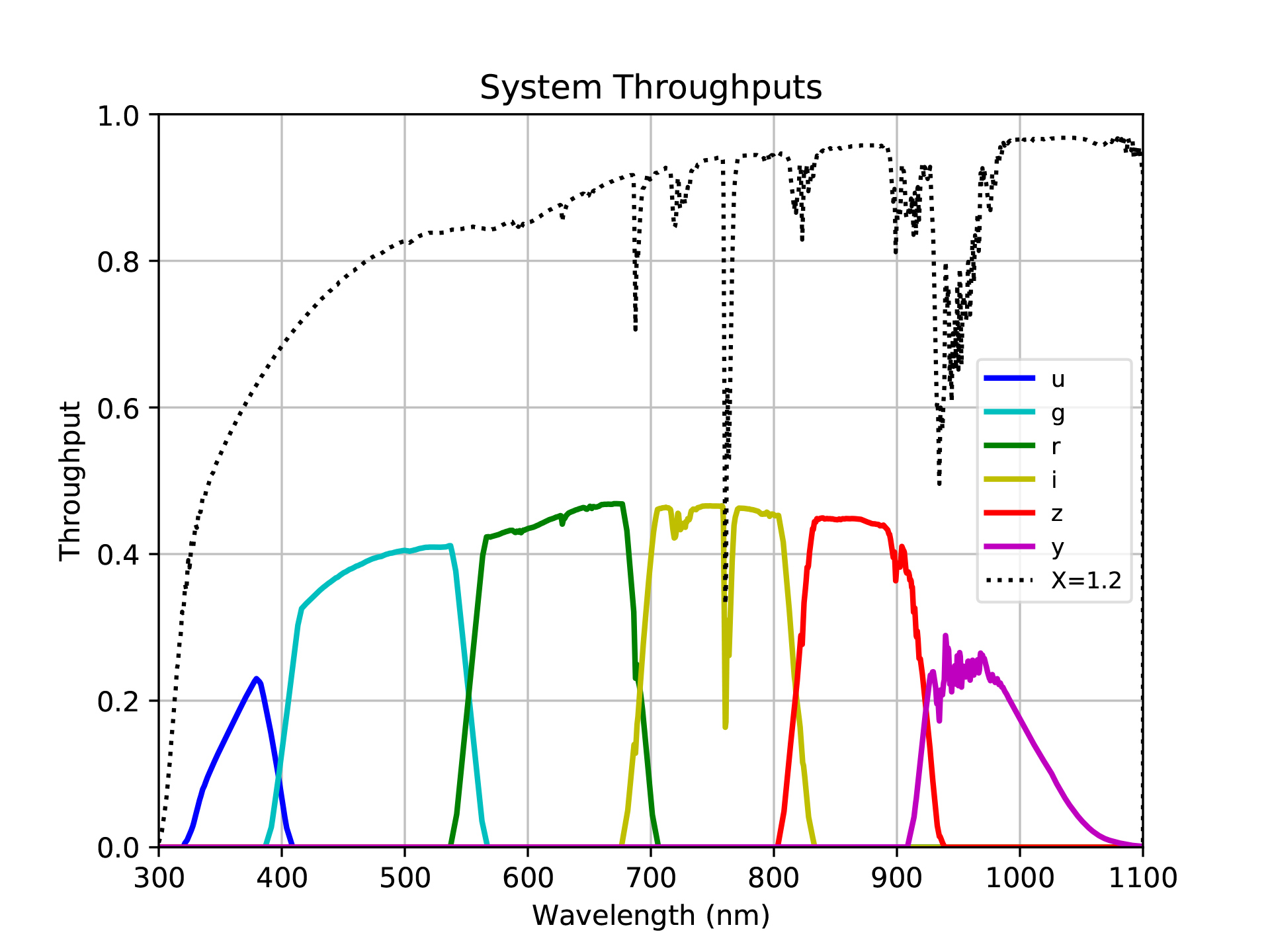
Standard bands: U (365 nm), B (445 nm), V (551 nm), R (658 nm), I (806 nm), plus infrared J, H, K bands.
 {#rubin-filters-box width=“100%” fig-align=“center”}
1.2.1 The Great Deception: When Hot Stars Masquerade as Cool Ones
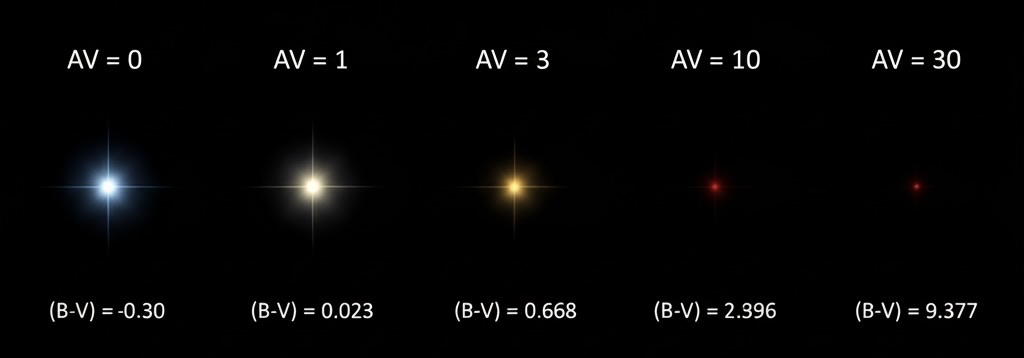
Let’s start with a dramatic demonstration of dust’s transformative power. Consider a single B0V star — a stellar powerhouse with surface temperature $$30,000 K that should appear blue-white in color. Let’s see what happens as we observe it through increasing amounts of interstellar dust.
The Harvard Spectral Classification organizes stars by their photospheric temperature, revealed through their absorption line patterns. Originally alphabetical (A, B, C…), the sequence was reordered by temperature after physical understanding emerged.
The Modern Sequence (Hot \(\to\) Cool):
| Class | Temperature | Color | Key Features | Example Stars |
|---|---|---|---|---|
| O | >30,000 K | Blue | Ionized He II lines, weak H | Alnitak (ζ Ori) |
| B | 10,000-30,000 K | Blue-white | Neutral He I, stronger H | Rigel, Spica |
| A | 7,500-10,000 K | White | Strongest H lines (Balmer) | Vega, Sirius |
| F | 6,000-7,500 K | Yellow-white | Weaker H, metals appear | Canopus, Procyon |
| G | 5,200-6,000 K | Yellow | Ca II H&K prominent | Sun, α Cen A |
| K | 3,700-5,200 K | Orange | Metals dominate, molecular bands | Arcturus, Aldebaran |
| M | 2,400-3,700 K | Red | TiO molecular bands | Betelgeuse, Proxima Cen |
Mnemonics: “Oh Be A Fine Girl/Guy, Kiss Me” (traditional) or “Only Bad Astronomers Forget Generally Known Mnemonics” (modern)
Luminosity Classes (added to letter):
- I: Supergiants (Ia/Ib for bright/normal)
- II: Bright giants
- III: Giants
- IV: Subgiants
- V: Main sequence (dwarfs)
Example: The Sun is a G2V star (G-type, slightly hotter than mid-G, main sequence). Betelgeuse is M2Iab (cool red supergiant).
Physical Basis: Temperature determines which atoms/ions exist in the photosphere and which energy levels are populated, creating characteristic absorption patterns. Hot O-stars ionize hydrogen and helium. Cool M-stars allow molecules like TiO to form. The sequence represents a continuous temperature gradient, not discrete categories.
For this module: When we discuss extinction making a “B0V star appear like a K-star,” we mean its blue light (characteristic of 30,000 K) is so preferentially absorbed that its color mimics a 4,500 K star — a temperature error of 6\(\times\)!
Look for: how the star’s color changes from blue-white to red as extinction increases — this is the physical basis of interstellar reddening.
 {#extinction-reddening-demo width=“100%” fig-align=“center”}
The transformation is startling:
- No dust (\(A_V = 0\)): Brilliant blue-white, \((B-V) = -0.30\), blazing with the light of 40,000 Suns
- Light dust (\(A_V = 1\)): Slightly dimmer and redder, but still recognizably a hot star
- Moderate dust (\(A_V = 3\)): Now appears yellow-white like a Sun-like star, \((B-V) \approx 0.5\)
- Heavy dust (\(A_V = 10\)): Looks like a cool red giant, \((B-V) \approx 2\)
- Extreme dust (\(A_V = 30\)): Completely invisible in optical light
This isn’t science fiction — it’s the reality of Galactic astronomy. That “red giant” you observe might actually be a blue supergiant in disguise. The average extinction in the Galactic plane is about 1.8 magnitudes per kiloparsec in the V band. A star 10 kpc away experiences \(A_V = 18\) magnitudes of extinction — it appears 160 million times fainter than it actually is!
Our example cluster NGC 3603 demonstrates this deception perfectly. Its massive O and B stars, with surface temperatures around 40,000 K and intrinsic colors \((B-V) = -0.32\), suffer approximately \(A_V = 5\) magnitudes of extinction. This shifts their observed colors to \((B-V)_{\text{obs}} \approx 1.3\) — they appear to have the colors of K-type stars (0.6-0.9 solar masses, 3,900-5,300 K surface temperature) instead of the blue supergiants they actually are!
Without understanding extinction, we would:
- Classify them as cool K-dwarfs instead of hot O/B supergiants
- Underestimate their masses by factors of 10-50 (mistaking 20-50 \(M_\odot\) stars for <1 \(M_\odot\) stars)
- Get their ages completely wrong (K-dwarfs live >10 Gyr, O-stars live <10 Myr — a 1000\(\times\) error!)
- Miss their role as cosmic powerhouses driving stellar winds and ionizing nebulae
This is why the physics of light’s journey is essential — not optional — for astronomical understanding.
1.2.2 The Physics Behind the Transformation
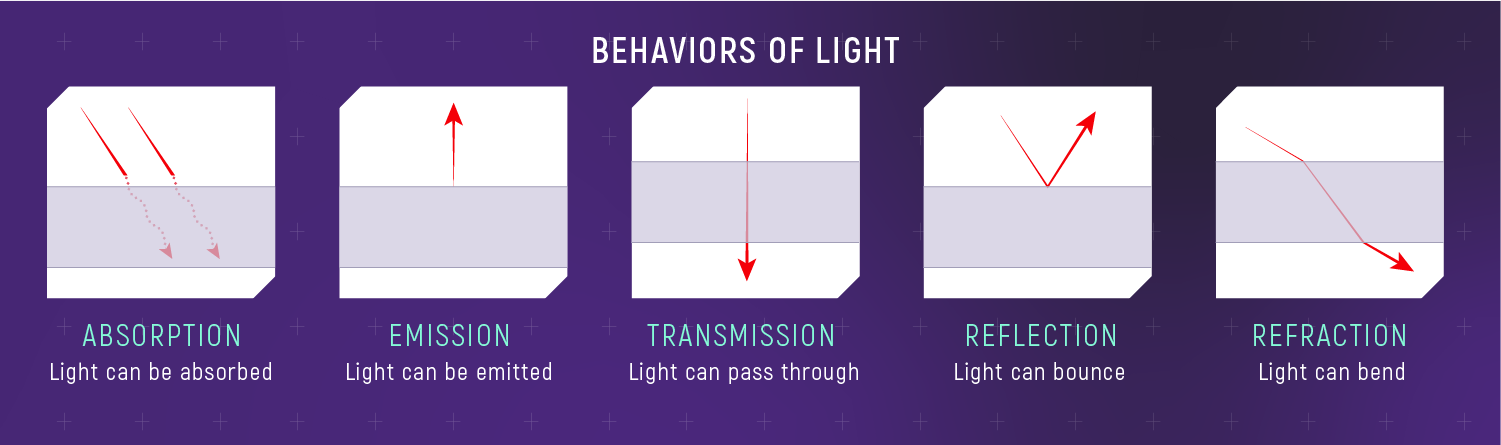
When starlight encounters interstellar dust, two fundamental processes remove photons from our line of sight:
Absorption: The photon is captured and its energy converted to thermal energy, heating the dust grain. The grain then re-radiates this energy as thermal emission at far-infrared wavelengths — crucially, in random directions. The original photon heading toward us is gone, replaced by infrared photons scattered to the cosmic void.
Scattering: The photon interacts with electrons in the grain and is re-radiated in a different direction. The photon survives with its energy unchanged, but it’s no longer heading toward us. From our perspective, it might as well have been destroyed.
Both processes remove photons from the direct beam, creating extinction — the combined dimming effect that makes objects appear fainter than they actually are.
 {#light-matter width=“100%”}
The key physics lies in how grain size relates to wavelength. Interstellar dust grains follow a size distribution roughly \(dn/da \propto a^{-3.5}\) , where \(a\) is the grain radius. This power law means smaller grains vastly outnumber larger ones. Most grains range from 0.005 to 1 \(\mu\mathrm{m}\), with a characteristic size around 0.1 \(\mu\mathrm{m}\) that dominates optical scattering (cross-sectional area \(\sigma \sim \pi a^2 \approx 3 \times 10^{-10}\) cm²). Notice that this 0.1 \(\mu\mathrm{m}\) size is about one-fifth the wavelength of blue light — this size relationship is crucial for understanding why dust affects different colors differently.
When light wavelengths become comparable to grain size, we enter the Mie scattering regime where the interaction becomes most efficient. This size-wavelength relationship is the key to understanding why different colors of light interact differently with dust.
Here’s how this plays out for different wavelengths:
- Blue light (450 nm) interacts strongly with abundant 0.1 \(\mu\mathrm{m}\) grains
- Red light (650 nm) interacts moderately with the same grains
- Infrared light (2.2 \(\mu\mathrm{m}\)) barely notices grains smaller than 1 \(\mu\mathrm{m}\)
This creates wavelength-dependent extinction following approximately:
\[\boxed{A_\lambda \propto \lambda^{-\beta}}\]
where \(\beta \approx 1.3\) for typical interstellar dust. Blue photons suffer much more extinction than red ones, creating the interstellar reddening effect — stars appear redder than their intrinsic colors because blue photons are preferentially removed from the beam.
The same physics that makes dust redden starlight also explains Earth’s blue sky!
Air molecules (N\(_2\) and O\(_2\), size ~0.0001 \(\mu\mathrm{m}\)) are much smaller than visible light wavelengths (0.4-0.7 \(\mu\mathrm{m}\)). In this Rayleigh scattering regime where particle size ≪ wavelength, scattering efficiency scales as \(\sigma \propto \lambda^{-4}\) — even stronger than dust’s \(\sigma \propto \lambda^{-1.3}\) dependence.
The result: Blue light (450 nm) scatters ~5\(\times\) more than red light (650 nm) by air molecules. When sunlight enters Earth’s atmosphere:
- Blue photons scatter repeatedly, filling the sky with blue light from all directions
- Red photons travel straight through, barely scattering
- At sunset, the longer path through the atmosphere preferentially scatters away blue photons, leaving a greater excess of red photons.
The cosmic connection: Interstellar dust grains are ~1000\(\times\) larger than air molecules, so they follow Mie scattering \((\lambda^{-1.3})\) rather than Rayleigh \((\lambda^{-4})\), but the principle is the same: shorter wavelengths scatter more. Whether it’s Earth’s atmosphere making the sky blue or interstellar dust making stars appear red, it’s all about the size of the scatterer relative to the wavelength of light!
Extinction (\(A_\lambda\)): Total dimming of light in magnitudes, combining both absorption and scattering. Measured as
\[A_\lambda = -2.5 \log_{10}(F_{\text{obs}}/F_{\text{intrinsic}})\]
Interstellar Reddening: The preferential extinction of blue light over red, making objects appear redder than their intrinsic color. Not a Doppler shift — wavelengths are unchanged, just fewer blue photons survive.
Color Excess E(B-V): The difference between observed and intrinsic color:
\[E(B-V) = (B-V)_{\text{obs}} - (B-V)_{\text{intrinsic}}.\]
This is distance-independent and directly measurable.
Dust Grains: Solid particles, mostly silicates (rocky minerals) and carbonaceous material (carbon-based), with sizes 0.005-1 \(\mu\mathrm{m}\). Formed in stellar outflows and destroyed by shocks.
Optical Depth \((\tau)\): Dimensionless measure of opacity, related to extinction by
\[\tau_\lambda = 0.921 \times A_\lambda.\]
When \(\tau = 1\), about 37% of photons survive (\(e^{-1} \approx 0.37\)).
1.2.3 Quantifying the Deception: The Mathematics of Correction
Here’s where astronomy becomes forensic science. Given what we observe, how do we determine what’s actually there? Let’s work through the standard procedure with a concrete example.
Before diving into extinction calculations, you need to master the terminology that appears throughout the literature:
Extinction (\(A_\lambda\)):
The total dimming of light at wavelength \(\lambda\), measured in magnitudes:
\[A_\lambda = m_{\text{obs}} - m_{\text{intrinsic}} = -2.5 \log_{10}\left(\frac{F_{\text{obs}}}{F_{\text{intrinsic}}}\right)\]
where \(F\) is the flux (erg cm\(^{-2}\) s\(^{-1}\)) and the obs and intrinsic denote values for the observed and true (emitted) values.
- \(A_V\): Extinction in V-band (551 nm) - the standard reference
- \(A_B\): Extinction in B-band (445 nm)
- \(A_K\): Extinction in K-band (2.17 \(\mu\mathrm{m}\))
The Extinction Equation: The fundamental relationship between the observed and intrinsic flux:
\[F_{\text{obs}} = F_{\text{intrinsic}} \times 10^{-0.4 A_\lambda}\]
This shows that extinction follows an exponential attenuation law.
Color Excess \(E(B-V)\):
The difference between observed and intrinsic color:
\[E(B-V) = (B-V)_{\text{obs}} - (B-V)_{\text{intrinsic}} = A_B - A_V\]
Key insight: Color excess is distance-independent — it depends only on the dust column density along the sight line.
Total-to-Selective Extinction Ratio:
\[R_V = \frac{A_V}{E(B-V)} = \frac{A_V}{A_B - A_V}\]
For typical diffuse ISM dust: \(R_V = 3.1\)
This ratio characterizes the dust grain size distribution.
Optical Depth (\(\tau_\lambda\)):
Related to extinction by: \(\tau_\lambda = 0.921 \times A_\lambda\)
When \(\tau = 1\), about 37% of photons survive (\(e^{-1} \approx 0.37\)).
Path Length and Extinction in Action:
The reddening of sunsets perfectly demonstrates how path length affects extinction — the same principle behind interstellar reddening.
At noon: Sunlight travels through ~100 km of atmosphere (vertical path)
- Blue light optical depth: \(\tau_{\text{blue}} \approx 0.3\) (70% transmitted)
- Red light optical depth: \(\tau_{\text{red}} \approx 0.06\) (94% transmitted)
- Result: Sun appears white/yellow, sky is blue from scattered light
At sunset: Sunlight travels through ~1000 km of atmosphere (oblique path) — 10\(\times\) longer!
- Blue light optical depth: \(\tau_{\text{blue}} \approx 3\) (only 5% transmitted)
- Red light optical depth: \(\tau_{\text{red}} \approx 0.6\) (55% transmitted)
- Result: Sun appears deep red/orange as blues are completely scattered away
The key insight: The atmosphere’s “\(R_V\) equivalent” is fixed by molecular properties (Rayleigh scattering gives very strong wavelength dependence), but the total extinction \(A_V\) increases linearly with path length. At sunset, you’re seeing the same effect as looking at a star through progressively more interstellar dust — except you’re watching it happen in real-time as the Sun sets!
This is why astronomers use “airmass” corrections: observing at zenith (airmass = 1) vs near horizon (airmass = 3-4) changes both the brightness and color of stars, just like varying amounts of interstellar dust.
Imagine you’re studying a star in our galaxy and want to determine its true distance and properties. You observe a star with:
- Apparent V-band magnitude: \(V = 15.0\)
- Observed color: \((B-V)_{\text{obs}} = 1.5\)
From its spectrum, you identify it as an A0V star, which should have:
- Absolute magnitude: \(M_V = 0.7\)
- Intrinsic color: \((B-V)_0 = 0.0\)
Step 1 - Calculate the color excess:
This measures how much redder the star appears than it should:
\[E(B-V) = (B-V)_{\text{obs}} - (B-V)_0 = 1.5 - 0.0 = 1.5 \text{ magnitudes}\]
The star appears 1.5 magnitudes redder than it should — clear evidence of dust!
Step 2 - Connect reddening to total dimming:
Color excess tells us about the relative effect on different wavelengths, but we need the total dimming in the V-band to correct our distance. This requires understanding that the same dust causing reddening also causes overall dimming. The total-to-selective extinction ratio \(R_V\) provides this crucial connection:
Step 3 - Determine total extinction:
\[R_V = \frac{A_V}{E(B-V)}\]
For typical diffuse interstellar dust, \(R_V = 3.1\). This ratio varies with environment:
- Dense molecular clouds: \(R_V = 5.0-5.5\) (larger grains from coagulation)
- Near hot stars: \(R_V = 2.1-2.5\) (smaller grains, large ones destroyed)
- Galactic center: \(R_V = 2.0-2.5\) (harsh radiation environment)
Using the standard value: \[A_V = R_V \times E(B-V) = 3.1 \times 1.5 = 4.65 \text{ magnitudes}\]
Step 4: Correct the distance The true distance modulus accounts for extinction:
\[\mu = V - M_V - A_V = 15.0 - 0.7 - 4.65 = 9.65 \text{ magnitudes}\]
Converting to distance: \[d = 10^{(\mu + 5)/5} = 10^{(9.65 + 5)/5} = 10^{2.93} = 851 \text{ parsecs}\]
The consequence of ignoring dust: Without extinction correction, we would calculate: \[d_{\text{wrong}} = 10^{(15.0 - 0.7 + 5)/5} = 10^{3.86} = 7,244 \text{ parsecs}\]
We’d overestimate the distance by a factor of 8.5! This error cascades through everything:
- Luminosity wrong by factor of \((8.5)^2 = 72\)
- Stellar mass estimates completely off
- Age determinations meaningless
- Galaxy structure maps distorted
This isn’t just an academic exercise. This exact calculation is performed thousands of times daily by astronomers worldwide. Every time you:
- Read about a star’s mass or age in a paper
- See a distance to a star-forming region
- Look at a map of our galaxy’s structure
- Compare theory to observations of stellar populations
…these calculations were used. Without extinction corrections:
- The cosmic distance ladder would collapse
- We’d think our galaxy is much smaller than it is
- Star formation rates would be underestimated by factors of 10-100
- The history of stellar evolution would be completely wrong
Master these concepts, and you’ll never be fooled by cosmic dust again.
Physics isn’t optional in astronomy — it’s essential for getting the right answer.
In practice, astronomers use several techniques to measure extinction:
Color-Color Diagrams: Plot \((U-B)\) vs \((B-V)\) for stellar populations. Stars follow a main sequence locus when unreddened. Dust shifts them along a “reddening vector” with predictable slope. The displacement directly gives the color excess.
Spectroscopic Parallax: Identify stellar type from spectral features, look up the absolute magnitude for that type, compare with observed magnitude. The difference (beyond distance modulus) equals extinction.
The Pair Method: Find two stars of identical spectral type, one reddened and one not. The color difference directly yields \(E(B-V)\).
Standard Candles: RR Lyrae variables and Type Ia supernovae have known intrinsic luminosities. Compare expected vs observed brightness at multiple wavelengths to map dust along the sight line.
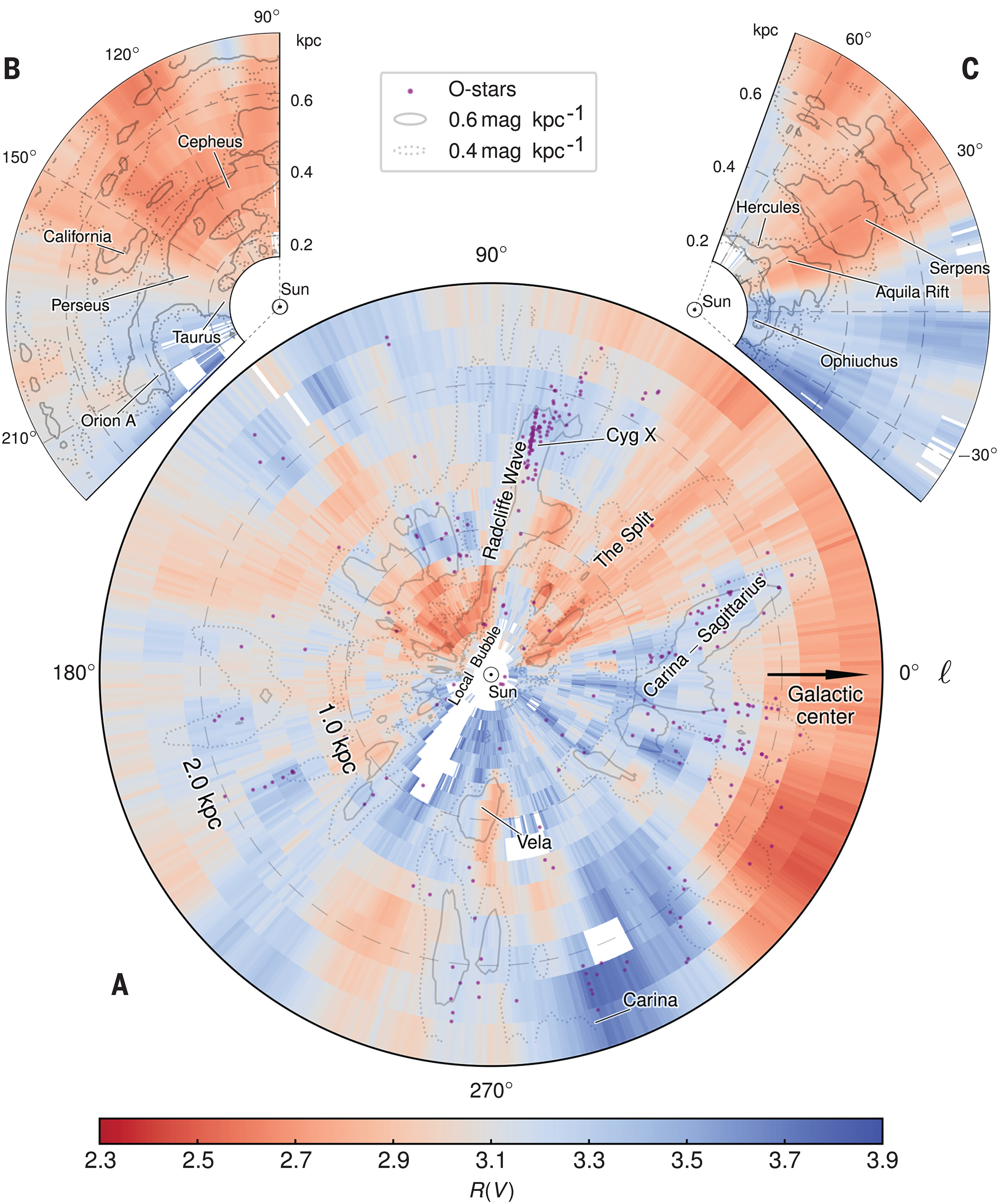
Modern Implementation: The figure below shows the culmination of these techniques — by measuring extinction toward 130 million stars, astronomers have now mapped how dust properties (\(R_V\)) vary throughout our entire galaxy, revolutionizing our ability to correct observations for dust effects.
 {#rv-map-milky-way width=“75%” fig-align=“center”}
These techniques built the 3D dust maps that revolutionized our understanding of Milky Way structure. Without these corrections, we’d still think our galaxy is much smaller than it actually is!
The mathematical framework we’ve developed — color excess, extinction ratios, distance corrections — provides the foundation for correcting what we observe to reveal what’s actually there. But there’s an even more profound implication of wavelength-dependent extinction: it means the universe literally looks different when observed at different wavelengths. This isn’t just a pretty effect for making colorful images — it’s a fundamental tool for understanding astrophysical phenomena…
Test your understanding of extinction and reddening:
Warmup: If blue light is scattered more than red light by dust, what color will a dust cloud appear when illuminated by white light from behind? What about when viewed from the side?
Simple Calculation: A B5V star has intrinsic color \((B-V)_0 = -0.15\). After passing through dust, you observe \((B-V)_{\text{obs}} = 0.85\). What is the color excess \(E(B-V)\)? If \(R_V = 3.1\), what is \(A_V\)?
Conceptual Understanding: For \(A_V = 10\) mag toward a star-forming region, what fraction of V-band photons survive their journey? If infrared observations show \(A_K/A_V = 0.11\), what fraction of K-band photons survive? Explain the dramatic difference.
Application: You want to study a young star cluster but can only see 50 stars in V-band due to dust extinction.
Before calculating: Do you expect to see more, fewer, or about the same number of stars in infrared K-band observations? Why?
Now calculate: Based on the infrared advantage, approximately how many cluster members might be detectable in K-band observations?
Warmup: From behind, the cloud appears reddish (blue light removed, red transmitted). From the side, it appears bluish (scattered blue light reaches us, like Earth’s sky).
1. Color excess: \(E(B-V) = 0.85 - (-0.15) = 1.00\) magnitudes
Total extinction: \(A_V = 3.1 \times 1.00 = 3.1\) magnitudes
2. V-band survival: \(f_V = 10^{-0.4 \times 10} = 10^{-4} = 0.01\%\) (only 1 in 10,000 photons!)
K-band extinction: \(A_K = 0.11 \times 10 = 1.1\) magnitudes
K-band survival: \(f_K = 10^{-0.4 \times 1.1} = 10^{-0.44} = 36\%\)
The dramatic difference (factor of 3,600) occurs because K-band wavelength (2.2 \(\mu\mathrm{m}\)) is much larger than typical grain sizes, so dust interaction is much weaker.
3. The brightness advantage in K-band is \(10^{0.4 \times (A_V - A_K)} = 10^{0.4 \times 8.9} = 10^{3.56} \approx 3,600\) times brighter! If you can detect stars 100 times fainter (reasonable for modern IR detectors), you might see \(50 \times 36 = 1,800\) cluster members — revealing the cluster’s true population.
1.3 The Multi-Wavelength Universe: Many Faces of Reality
Different Wavelengths Reveal Different Physics in Sagittarius B2. This massive star-forming region located near the Galactic center (distance \(\sim 8.3\) kpc) suffers extreme extinction (\(A_V\) reaching 50+ mag in dense regions), making it invisible in optical light. JWST’s MIRI (mid-infrared, 5-28 \(\mu\mathrm{m}\)) detects thermal emission from warm dust (~100-300 K) heated by young stars, with only the hottest stars bright enough to shine through, while NIRCam (near-infrared, 0.6-5 \(\mu\mathrm{m}\)) sees stellar photospheres and can penetrate dust to reveal thousands of stars. The dramatic difference occurs because MIR traces dust emission while NIR traces stellar emission, demonstrating why infrared observations are essential for understanding heavily obscured regions.
Priority: 🔴 Essential.
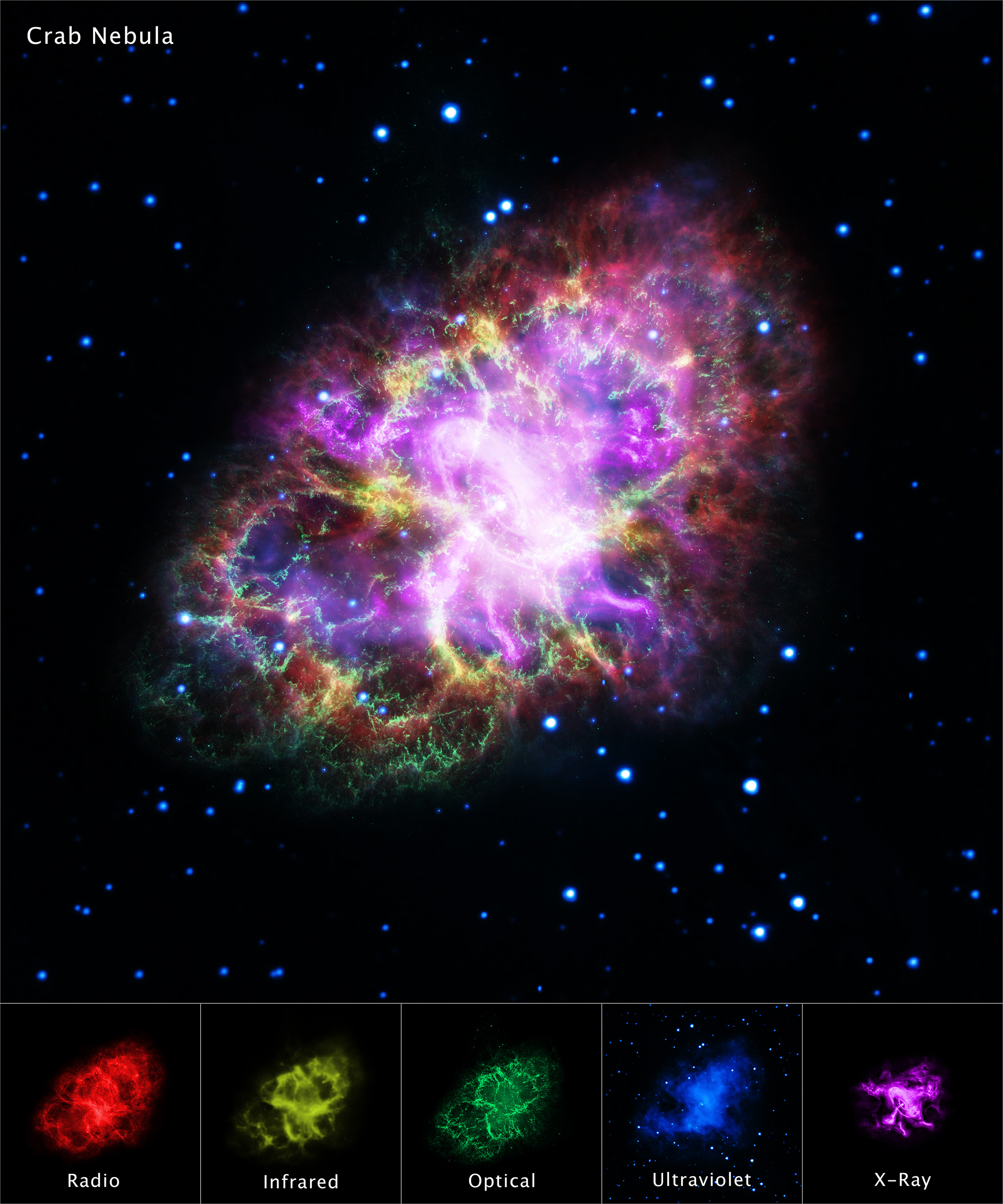
Here’s the revelation that transforms astronomy from pretty pictures to profound physics: the universe has many faces, and each wavelength shows us a different one. This isn’t poetic metaphor — it’s literal physical truth. When we observe an object like the Crab Nebula across the electromagnetic spectrum, we’re not seeing the same thing at different wavelengths; we’re seeing different physical components that happen to occupy the same space.
The Crab Nebula perfectly demonstrates this principle. The radio reveals relativistic electrons spiraling in magnetic fields, the optical shows ionized gas and stellar emission, the X-rays trace million-degree shocked plasma. Each wavelength is a window into different physics, and only by looking through all windows can we understand what we’re really seeing.
 {#crab-multiwavelength width=“100%” fig-align=“center”}
1.3.1 Same Object, Different Physics: The Crab Nebula Revealed
Let’s examine the Crab Nebula — the remnant of a star that exploded in 1054 AD — across the electromagnetic spectrum to see how different wavelengths reveal different physics:
Synchrotron Radiation
Emission from relativistic charged particles spiraling in magnetic fields. The radiated power \(P \propto \gamma^2 B^2\) where \(\gamma\) is the Lorentz factor and \(B\) is magnetic field strength. For a power-law electron distribution \(N(E) \propto E^{-p}\), the resulting spectral index is \(\alpha = -(p-1)/2\). Produces polarized, non-thermal spectra.
Radio (GHz to MHz frequencies, meter to cm wavelengths): We see synchrotron emission from electrons with Lorentz factors \(\gamma \sim 10^3\) spiraling in ~100 \(\mu\mathrm{G}\) magnetic fields. The emission traces the full extent of the nebula — about 11 light-years across. The radio spectral index \(\alpha = -0.3\) (where \(F_\nu \propto \nu^\alpha\)) tells us the electron energy distribution.
Physics revealed: Magnetic field structure, particle acceleration efficiency, total energy in relativistic particles.
Infrared (1-100 \(\mu\mathrm{m}\), 0.01-1 eV): Two components appear: synchrotron from lower-energy electrons and thermal emission from ~40 K dust formed in the supernova ejecta. About 0.1 \(M_\odot\) of dust — a significant fraction of the ISM’s dust budget comes from supernovae.
Physics revealed: Dust formation in extreme environments, continuation of the synchrotron spectrum.
Optical (400-700 nm, 2-3 eV): Beautiful filamentary structure appears — dense knots of gas at ~10,000 K emitting hydrogen Balmer lines, [O III], and other forbidden transitions. The famous blue-white glow comes from synchrotron emission from electrons with \(\gamma \sim 10^6\).
Physics revealed: Gas temperature and density, elemental abundances, highest-energy electrons.
X-ray (0.1-10 keV): A completely different structure emerges — a ring with jet-like features powered by the pulsar wind. The torus and jets show particles accelerated to \(\gamma > 10^8\) (relativistic Lorentz factor). The pulsar itself pulses 30 times per second in X-rays.
Physics revealed: Pulsar wind termination shock, particle acceleration to extreme energies, magnetic reconnection sites.
Gamma-ray (\(> 100\) MeV): Only the pulsar is visible — a lighthouse beaming gamma rays as it spins. Pulsed emission up to GeV energies requires particles accelerated in the pulsar magnetosphere to Lorentz factors \(\gamma > 10^9\).
Physics revealed: Extreme particle acceleration, pulsar emission mechanisms, potential for producing cosmic rays (relativistic charged particles).
Each wavelength isn’t just providing a different view — it’s revealing different physical components and processes. Without radio, we’d miss the magnetic field structure. Without X-rays, the pulsar wind would be invisible. Without optical, we wouldn’t know the gas composition. The complete picture requires the complete spectrum.
Multi-Wavelength Synthesis: The Whole is Greater Than the Parts
Here’s the crucial insight that elevates observational astronomy to quantitative astrophysics: combining wavelengths reveals the physical mechanisms driving what we observe, not just what things look like. Multi-wavelength synthesis transforms catalogs of objects into maps of physical processes — and crucially, lets us test whether our theories match reality. When radio reveals magnetic fields, X-rays trace shocks, and optical shows ionized gas all in the predicted locations with the right energies, we know our models likely work. Consider determining the 3D structure and dynamics of the Crab’s pulsar wind nebula — impossible from any single wavelength:
Radio polarization observations \(\to\) Magnetic field direction and strength throughout the nebula
Optical proper motion measurements \(\to\) Expansion velocity vectors (1,500 km/s radially)
X-ray morphology and spectroscopy \(\to\) Shock front locations and particle acceleration sites
Combined 3D analysis \(\to\) Complete reconstruction of the relativistic flow pattern
Only by synthesizing all three can we map how the pulsar injects \(10^{38}\) erg/s into the surrounding medium, creating the complex torus-and-jet structure visible in X-rays. This synthesis reveals the pulsar wind’s 3D dynamics and energy transport mechanisms — physics no single wavelength could demonstrate.
The power of multi-wavelength synthesis transforms astronomy from “collecting pretty pictures” to “reconstructing 3D astrophysical processes.”
This qualitative understanding of different physics becomes even more powerful when we make it quantitative.
The Transparency Revolution: Quantifying Wavelength Advantage
The power of multi-wavelength astronomy becomes quantitative when we consider how dust transparency changes with wavelength. As we saw in Section 1.2, the extinction follows \(A_\lambda \propto \lambda^{-\beta}\), creating dramatic differences in transparency.
Let’s apply this transparency revolution to our threading example NGC 3603 with its \(A_V = 5\) mag of dust:
Optical (V-band, 551 nm):
- Extinction: \(A_V = 5.0\) mag
- Transmission: \(10^{-0.4 \times 5} = 0.01\) (only 1% of light gets through!)
- We see: ~100 brightest blue supergiants, miss most of the cluster
Near-IR (K-band, 2.17 \(\mu\mathrm{m}\)):
- Extinction: \(A_K = 0.11 \times 5.0 = 0.55\) mag
- Transmission: \(10^{-0.4 \times 0.55} = 0.42\) (42% gets through)
- We see: >10,000 stars including solar-mass members
Mid-IR (10 \(\mu\mathrm{m}\)):
- Extinction: \(A_{10} = 0.02 \times 5.0 = 0.10\) mag
- Transmission: \(10^{-0.4 \times 0.10} = 0.91\) (91% gets through!)
- We see essentially the complete cluster plus embedded protostars.
The 91\(\times\) transparency gain from V to 10 \(\mu\mathrm{m}\) transforms NGC 3603 from a sparse group of blue stars into one of the Milky Way’s most massive young clusters!
Wavelength Advantage: A Professional Astronomer’s Guide
Understanding dust transparency isn’t just academic — it guides every observational decision. Here’s how working astronomers think about wavelength selection:
Optical: The Traditional View (Limited by Dust)
| Band | λ | \(A_\lambda/A_V\) | Advantage | Professional Use |
|---|---|---|---|---|
| U | 365 nm | 1.53 | 0.30\(\times\) worse | Hot star detection, age dating |
| B | 445 nm | 1.32 | 0.48\(\times\) worse | Color-magnitude diagrams |
| V | 551 nm | 1.00 | 1\(\times\) (ref.) | Standard photometric reference |
| R | 658 nm | 0.75 | 1.8\(\times\) better | H-α emission, reddening studies |
| I | 806 nm | 0.48 | 4.3\(\times\) better | Cool stars, stellar populations |
Near-Infrared: The Stellar Census Bands.
| Band | λ | \(A_\lambda/A_V\) | Advantage | Professional Use |
|---|---|---|---|---|
| J | 1.25 \(\mu\mathrm{m}\) | 0.28 | 13\(\times\) better | Brown dwarf surveys, stellar populations |
| H | 1.65 \(\mu\mathrm{m}\) | 0.18 | 31\(\times\) better | Circumstellar disks, stellar masses |
| K | 2.17 \(\mu\mathrm{m}\) | 0.11 | 81\(\times\) better | Red giants, dust penetration, AGB stars |
Mid-Infrared: The Thermal Universe.
| Band | λ | \(A_\lambda/A_V\) | Advantage | Professional Use |
|---|---|---|---|---|
| L | 3.4 \(\mu\mathrm{m}\) | 0.06 | 280\(\times\) better | Planetary atmospheres, cool stars |
| M | 4.6 \(\mu\mathrm{m}\) | 0.04 | 630\(\times\) better | Dust temperatures, star formation |
| N | 10 \(\mu\mathrm{m}\) | 0.02 | 2,500\(\times\) better | AGN dusty tori, protoplanetary disks |
The Professional Reality: A 10 \(\mu\mathrm{m}\) observation sees 2,500\(\times\) more flux through dust than V-band. This isn’t just “better” — it’s accessing different astrophysics entirely.
This isn’t just about “seeing through” dust — each wavelength genuinely samples different dust optical depths. Consider observing toward the Galactic center with \(A_V = 30\) mag:
Optical V-band: \(\tau_V = 27.6\), transmission = \(e^{-27.6} = 10^{-12}\)
Only one in a trillion photons survives. The Galactic center is utterly invisible.
Near-IR K-band: \(\tau_K = 3.0\), transmission = \(e^{-3.0} = 0.05\)
One in 20 photons survives. The Galactic center is observable but dimmed.
Mid-IR 10 \(\mu\mathrm{m}\): \(\tau_{10} = 0.6\), transmission = \(e^{-0.6} = 0.55\)
Over half the photons survive. The Galactic center shines clearly.
This is why JWST, operating at 1-28 \(\mu\mathrm{m}\), revolutionizes our view of dusty regions. It’s not just a better telescope — it’s exploiting fundamental physics to see what’s literally invisible to optical telescopes.
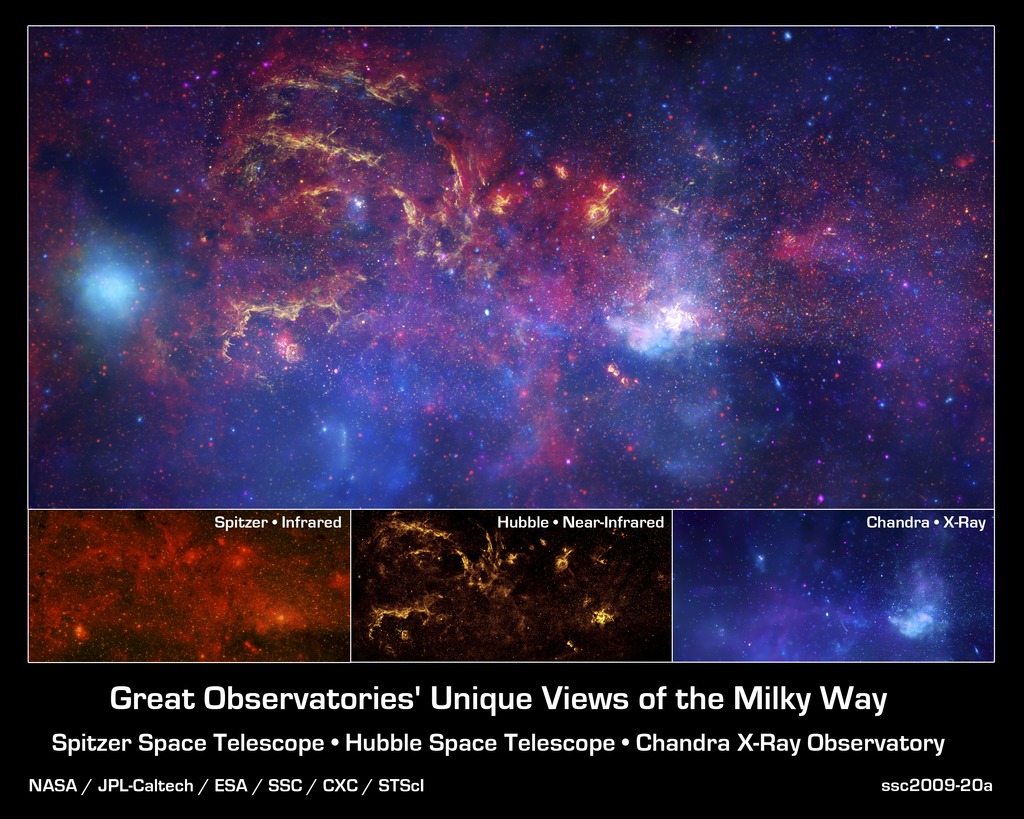
When the Spitzer Space Telescope first observed the Galactic center at infrared wavelengths (3.6-160 \(\mu\mathrm{m}\)), it detected over 30 million stars in a region where the best optical telescopes see virtually nothing — just a few hundred of the very brightest giants scattered across dark lanes.
 {#spitzer-galactic-center width=“100%” fig-align=“center”}
This wasn’t just “better sensitivity” — it was accessing a fundamentally different universe. The 100,000\(\times\) increase in detected sources (from ~300 to 30,000,000) completely revolutionized our understanding of the Milky Way’s central bulge structure, stellar population, and formation history.
The professional lesson: This is why every major ground-based observatory built in the last 30 years prioritizes infrared capabilities, and why space missions like JWST cost $10 billion. You’re not just learning physics principles — you’re understanding the technological and financial decisions that drive modern astronomy.
When you see infrared observations in papers, remember: you’re often seeing 99.9% of the sources that optical astronomy missed entirely.
Your Learning Transformation: From Pictures to Physics
Take a moment to recognize how dramatically your perception has evolved through this module. When you started Section 1.1, an astronomical image was simply a beautiful picture. Now you see something fundamentally different:
What you now see in every astronomical image:
- Red nebular glow \(\to\) Hydrogen recombination at precisely 656.3 nm, revealing 10,000 K ionized gas
- Dark dust lanes \(\to\) 0.1 \(\mu\mathrm{m}\) grains creating wavelength-dependent extinction following \(A_\lambda \propto \lambda^{-1.3}\)
- Blue star-forming regions \(\to\) 35+ eV photons ionizing oxygen, tracing massive stars >30 \(M_\odot\)
- Multi-wavelength composites \(\to\) Different physical components occupying the same space
You’ve developed the professional astronomer’s eye — the ability to decode quantitative physics from photons. This transformation from aesthetic appreciation to physical understanding is the essence of scientific literacy.
The deeper insight: Every wavelength tells a physics story. Every color encodes temperature, density, and composition. Every shadow reveals dust properties. The universe’s first galaxies, exoplanet atmospheres, and stellar nurseries all reveal their secrets through the same wavelength-dependent physics you’ve just conquered.
The transformation from cataloging celestial positions to understanding cosmic physics happened remarkably quickly — within a human lifetime.
The Catalyst: Two technologies converged to revolutionize astronomy:
1. Spectroscopy (1814-1859): Fraunhofer’s dark lines in the Sun’s spectrum gained meaning when Kirchhoff and Bunsen showed they matched laboratory spectra of elements — we could determine stellar composition from light alone.
2. Photographic Plates (1880s onward): Unlike human eyes that forget, photographic emulsions accumulated light over hours, revealing faint stars and capturing spectra permanently. Suddenly astronomy became data-rich — Harvard Observatory alone accumulated 500,000+ glass plates containing millions of stellar spectra. This data avalanche required an army of workers to analyze.
The Harvard Computers (1880s-1920s): Director Edward Pickering hired women as “computers” because, as he stated, “a smart young woman could do the work as well as a man, at half the pay.” Women with college degrees earned 25-50 cents per hour — less than Harvard’s secretaries. Pickering reportedly claimed “even my Scottish maid could do better” than his male assistants, then hired that maid, Williamina Fleming, who discovered 310 variable stars, 10 novae, and the Horsehead Nebula.
 {#harvard-computers-photo width=“75%” fig-align=“center”}
This hiring practice reflected complex social realities. For Pickering, it was economics — he could hire twice as many workers. He also genuinely praised women’s patience, attention to detail, and reliability for the meticulous work. For educated women in the 1880s-1920s, options were severely limited: teaching, nursing, or marriage. Harvard offered rare access to cutting-edge scientific data and intellectual engagement, even if without recognition or advancement opportunities. Many had astronomy degrees but couldn’t use university telescopes (women were banned from observing at night for “propriety”).
Working within these constraints, these women transformed astronomy:
- Annie Jump Cannon classified 350,000+ stars at ~3 stars per minute, developing the OBAFGKM temperature sequence. Despite her deafness and the discrimination she faced, she became the first woman officer of the American Astronomical Society.
- Henrietta Swan Leavitt discovered Cepheid period-luminosity relation (1912) from photographic plates, enabling cosmic distance measurements. Her work was crucial for Hubble’s later discovery of the expanding universe.
- Williamina Fleming discovered white dwarfs and developed the first photographic spectral classification system. From maid to astronomer, she eventually became Harvard’s Curator of Astronomical Photographs.
- Antonia Maury noticed spectral line widths varied systematically — later understood as luminosity classification. Her insistence on physical interpretation often clashed with Pickering’s emphasis on rapid classification.
These women weren’t just data processors — they discovered the patterns in photographic data that demanded physical explanation, laying the observational foundation for 20th-century astrophysics.
The Breakthrough Era (1920s-1930s):
- 1925: Cecilia Payne-Gaposchkin used the Harvard spectral classifications to prove stars are mostly hydrogen (her advisor tried to dissuade her from this “clearly impossible” conclusion)
- 1920s: Eddington’s stellar interior models finally explained the OBAFGKM sequence as a temperature progression
- 1938: Hans Bethe’s fusion theory validated why stars of different temperatures produce different spectra
The Key Insight: Quantum mechanics (1900-1930) explained why atoms produce the spectral lines captured on those photographic plates. Every spectrum became a physics experiment.
The Transformation: Photographic plates turned astronomy from a science of moments (what you see tonight) to a science of archives (comparing observations across decades). The Harvard Computers’ systematic analysis of this photographic treasure trove provided the observational foundation for theoretical astrophysics.
The Acceleration (1940s-1960s): WWII technologies turbocharged astrophysics. Radar became radio astronomy, revealing neutral hydrogen’s 21-cm line (1951). Nuclear weapons research provided fusion cross-sections needed for stellar models. Electronic detectors from military applications replaced photographic plates, increasing sensitivity 100-fold. Rockets designed for warfare carried the first X-ray detectors above Earth’s atmosphere.
The Societal Return: This transformation from astronomy to astrophysics hasn’t just satisfied human curiosity — it’s driven technological revolutions.
- CCDs developed for astronomy became digital cameras. Adaptive optics for telescopes enabled laser eye surgery.
- WiFi uses techniques from radio astronomy for detecting weak signals. Medical imaging (MRI, PET scans) employs reconstruction algorithms from aperture synthesis.
- GPS requires relativistic corrections discovered through pulsar timing.
- The same radiative transfer equations you’re learning model climate change, optimize solar panels, and design radiation therapy.
When we fund astrophysics, we’re not just understanding distant stars — we’re developing the technologies and training the problem-solvers who transform society.
Today’s multi-wavelength astronomy — from radio to gamma rays — completes this transformation. Where the Harvard Computers had glass plates of optical spectra, we now have space telescopes capturing the full electromagnetic spectrum. The questions evolved from “What’s out there?” (1800s) to “What’s it made of?” (1920s) to today’s “How does it evolve and why?” Modern astronomy is experimental astrophysics at cosmic scales, testing fundamental physics with the universe as our laboratory.
Self-Assessment Checklist
Before proceeding to Part II, verify your understanding of these essential concepts:
✅ Section 1.1: Light as Nature’s Messenger
✅ Section 1.2: The Imperfect Journey
✅ Section 1.3: The Multi-Wavelength Universe
✅ Cross-cutting Concepts
If you checked all boxes: You’re well-prepared to continue!
If some boxes are unchecked: Review those concepts and work through the Quick Check problems again. These ideas are fundamental to everything that follows.
Carry this forward: Observed \(\neq\) intrinsic. Dust tilts spectra and dimming is exponential in magnitudes. Every astronomical measurement must be corrected for what happened to the light on its journey.
What Comes Next
To recover the true properties of astronomical objects, we need a quantitative theory of how photons propagate through matter. That theory is the radiative transfer equation — and it’s what Part II will build from first principles.