Spectra & Composition
Section 2 of 8
Source Geometry
Part 1: Kirchhoff’s Laws — Why Stars Show Absorption Spectra
Three Types of Spectra
In Lecture 4 (Module 1), you saw a preview of spectral types. Now we formalize the physics. Light sources produce three distinct spectral signatures, depending on their structure:
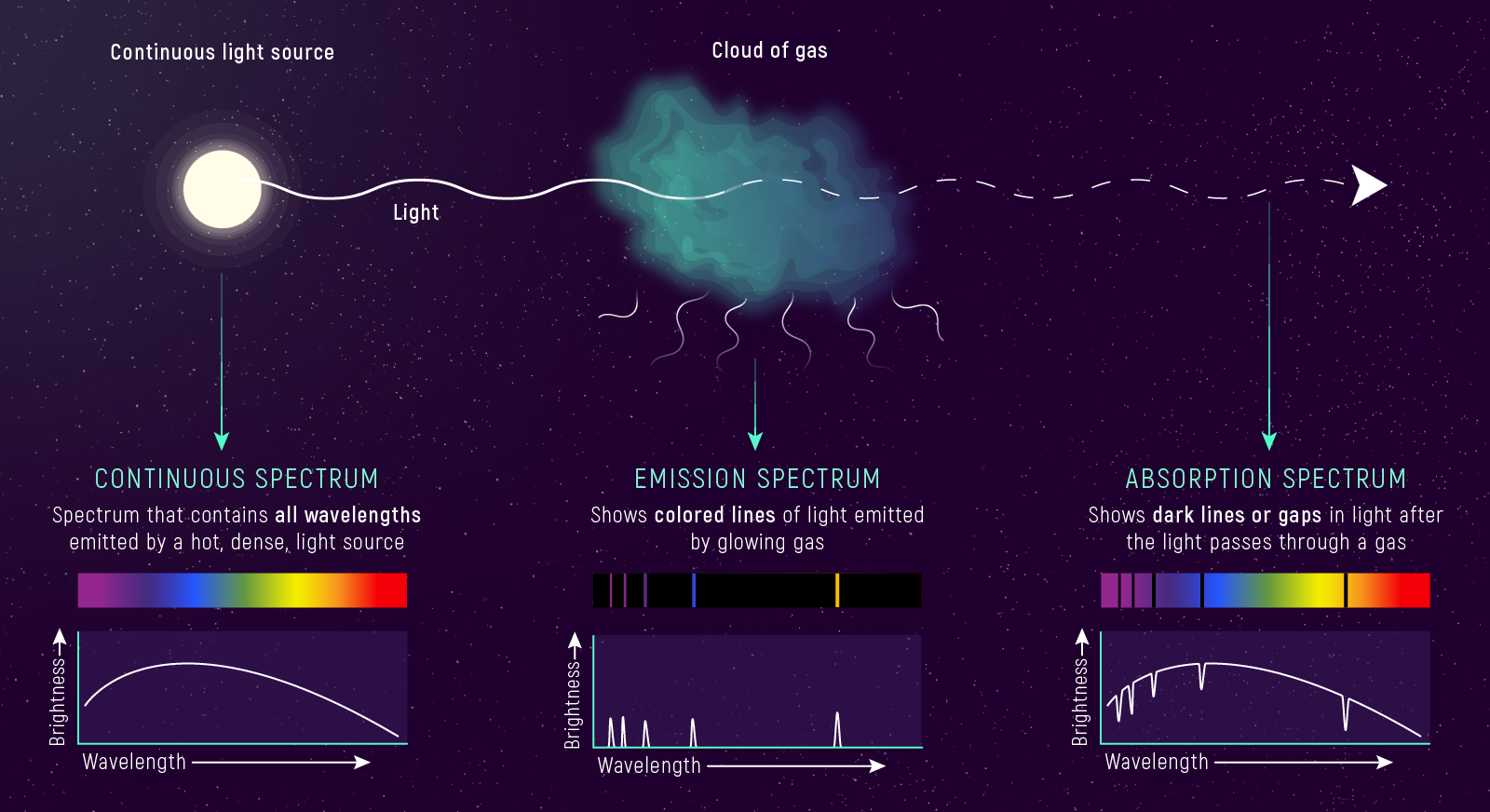
Continuous spectrum (blackbody continuum): a hot, dense source — a solid, liquid, or dense gas — emits light at all wavelengths, producing a smooth rainbow. The shape follows the Planck function you studied in Lecture 4 (Module 1). Examples: the Sun’s photosphere, an incandescent filament, the interior of a kiln.
Emission spectrum (bright lines on a dark background): a hot, low-density gas emits photons only at specific wavelengths — those corresponding to transitions between its atoms’ energy levels. The background is dark; you see isolated bright lines. Examples: nebulae excited by nearby hot stars, neon signs, gas discharge tubes.
Absorption spectrum (dark lines in a continuous rainbow): a cooler gas in front of a hotter continuum source absorbs photons from the continuum at exactly the wavelengths it would emit if heated. You see the rainbow interrupted by dark lines — a photographic negative of the emission spectrum. Examples: stellar spectra, the solar spectrum (Fraunhofer lines).
Kirchhoff’s Laws of Spectroscopy
These three observations codify into
- A hot, dense object emits a continuous spectrum — all wavelengths, shaped by .
- A hot, low-density gas emits an emission-line spectrum — bright lines at wavelengths determined by its atomic composition.
- A cooler gas in front of a hot continuum source produces an absorption-line spectrum — the continuum minus specific wavelengths, at the same positions the gas would emit if heated.
Kirchhoff's laws
Three rules linking the appearance of a spectrum to the physical conditions of its source: (1) a hot dense object yields a continuous spectrum; (2) a hot low-density gas yields bright emission lines; (3) a cool gas in front of a hotter continuum yields dark absorption lines at the same wavelengths it would emit. Worked backward, a spectrum’s appearance reveals the source’s configuration.
Dark lines at specific wavelengths in a star's spectrum
A stellar spectrum is a continuous rainbow scored by dark absorption lines at precise, repeatable wavelengths.
Kirchhoff's third law
A cooler gas in front of a hotter continuum source absorbs at its characteristic wavelengths — the star’s atmosphere absorbs from the photosphere below.
A hot interior wrapped in a cooler atmosphere
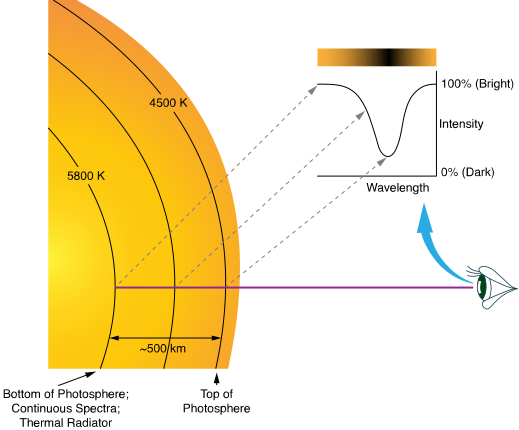
The star has a hot, dense continuum source (the photosphere) surrounded by a cooler absorbing layer (the atmosphere) — the two-layer structure that produces every stellar absorption line.
Why Stars Show Absorption Spectra: The Two-Layer Model
A star has a steep temperature gradient. Deep in the interior, temperatures reach millions of kelvin. The
Photosphere
The visible “surface” of a star — the depth at which it becomes opaque (optical depth ) and from which the continuous spectrum escapes. For the Sun it sits near 5,800 K; the slightly cooler atmosphere just above it carves the absorption lines.
The light we observe is emitted by the photosphere (Kirchhoff’s law 1, a continuous spectrum). As this light travels outward through the cooler atmosphere, atoms there absorb photons at their characteristic wavelengths (Kirchhoff’s law 3, dark absorption lines appear). The result: a continuous spectrum scored by dark absorption lines.
Quick check
- You observe a smooth rainbow with no dark lines. What type of source are you looking at?
- You observe bright colored lines on a dark background. What produces this?
- You observe a rainbow interrupted by dark lines at specific wavelengths. What’s happening physically?
- A hot, dense source (Kirchhoff’s law 1) — like an incandescent filament or a star’s photosphere viewed without its atmosphere.
- A hot, low-density gas (Kirchhoff’s law 2) — like a nebula or gas discharge tube.
- A cooler gas absorbing from a hotter continuum (Kirchhoff’s law 3) — like a stellar atmosphere in front of its photosphere. The dark lines tell you which atoms are in the cool gas.
Part 1 takeaway: Kirchhoff’s three laws connect the appearance of a spectrum to the physical conditions of the source. Stars produce absorption spectra because their cooler atmospheres absorb from the hotter photosphere — and those dark lines are the key to everything that follows.