Spectra & Composition
Section 7 of 8
Planetary Spectroscopy
Part 6: Spectroscopy Meets Climate — Why CO₂ Warms Planets
Everything you’ve learned about spectral absorption applies not only to stars but to planetary atmospheres. The same quantum physics that creates stellar absorption lines also creates the greenhouse effect — one of the most consequential applications of spectroscopy in all of science.
Planetary Energy Balance: Stefan-Boltzmann Applied to Planets
In Lecture 2, you learned the Stefan-Boltzmann law . It applies to any blackbody — and, to first approximation, a planet is one. A planet doesn’t generate its own luminosity; it absorbs sunlight and re-radiates that energy as thermal (blackbody) radiation in the infrared. The Sun and Earth are both approximate blackbodies, but at very different temperatures: the Sun’s Planck curve peaks in visible light (~0.5 μm), Earth’s in the thermal infrared (~10 μm). These two blackbody spectra barely overlap — and that spectral separation is what makes the greenhouse effect possible.
At energy balance, the planet radiates exactly as much as it absorbs. The power absorbed is built from three factors: the stellar flux at the planet’s distance ; the intercepted cross-section (the area of the shadow the planet casts, not its full surface); and the albedo correction , where the
This is — the blackbody temperature the planet would have with no atmosphere. The planet’s radius cancels entirely; only , , and remain.
Albedo
The fraction of incident light a surface or planet reflects rather than absorbs. is perfect absorption; is a perfect mirror. The Moon has , Earth , Venus . Only the absorbed fraction heats the planet.
Equilibrium temperature
The temperature at which a planet radiates exactly as much energy as it absorbs from its star, assuming no atmosphere: . The greenhouse effect raises the real surface temperature above this baseline.
The Greenhouse Effect: Absorption Lines in the Atmosphere
Earth’s surface radiates as an approximate blackbody at 288 K. Wien’s law gives the peak wavelength:
This is deep in the thermal infrared — far from the visible band where sunlight arrives. The figure below makes the separation vivid: the Sun’s incoming Planck curve (peaking near 0.5 μm) and Earth’s outgoing curve (peaking near 10 μm) barely overlap.
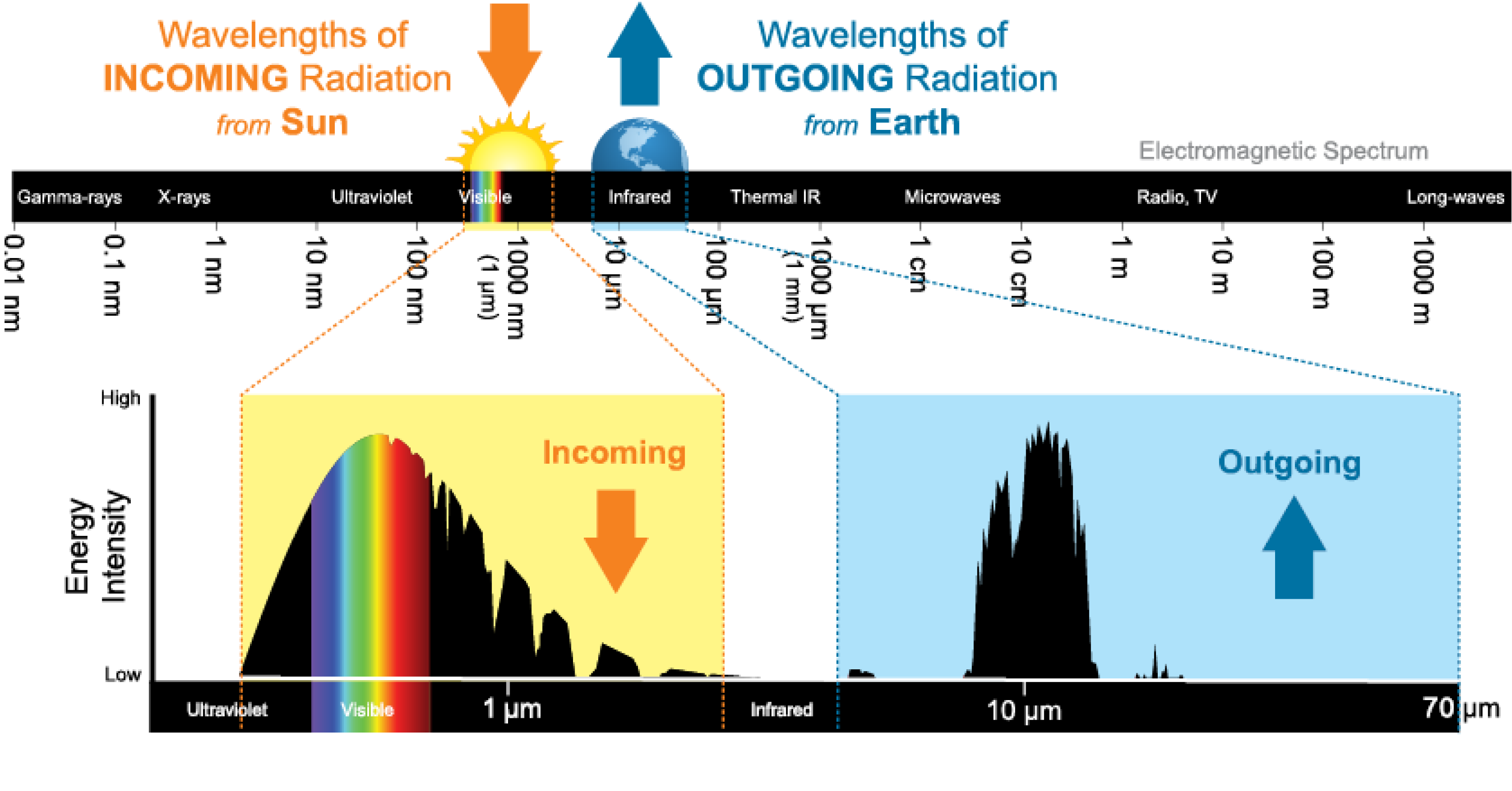
For Earth to maintain balance, this outgoing infrared must escape to space. But greenhouse gases — CO₂, H₂O, CH₄, N₂O — have molecular absorption bands in the infrared, precisely where Earth’s blackbody curve radiates. These molecules absorb outgoing infrared photons and re-emit them in random directions — some back downward. The surface receives extra energy and warms until it radiates enough to compensate.
Greenhouse effect
Warming of a planet’s surface caused by atmospheric gases absorbing outgoing infrared radiation and re-emitting part of it back downward. It is Kirchhoff’s third law applied to a planet: a cool atmosphere absorbing from the warm surface continuum.
A Tale of Three Planets
Venus, Earth, and Mars orbit the same star and formed from the same disk — yet their surface temperatures are wildly different. Spectroscopy tells us why:
| Planet | Distance (AU) | Albedo | (K) | Actual (K) | Greenhouse warming (K) | Dominant greenhouse gas |
|---|---|---|---|---|---|---|
| Venus | 0.72 | 0.77 | 227 | 735 | +508 | CO₂ (96.5% of atmosphere) |
| Earth | 1.00 | 0.30 | 255 | 288 | +33 | H₂O + CO₂ (0.04%) |
| Mars | 1.52 | 0.25 | 210 | 210 | ~0 | CO₂ (95%, but very thin) |
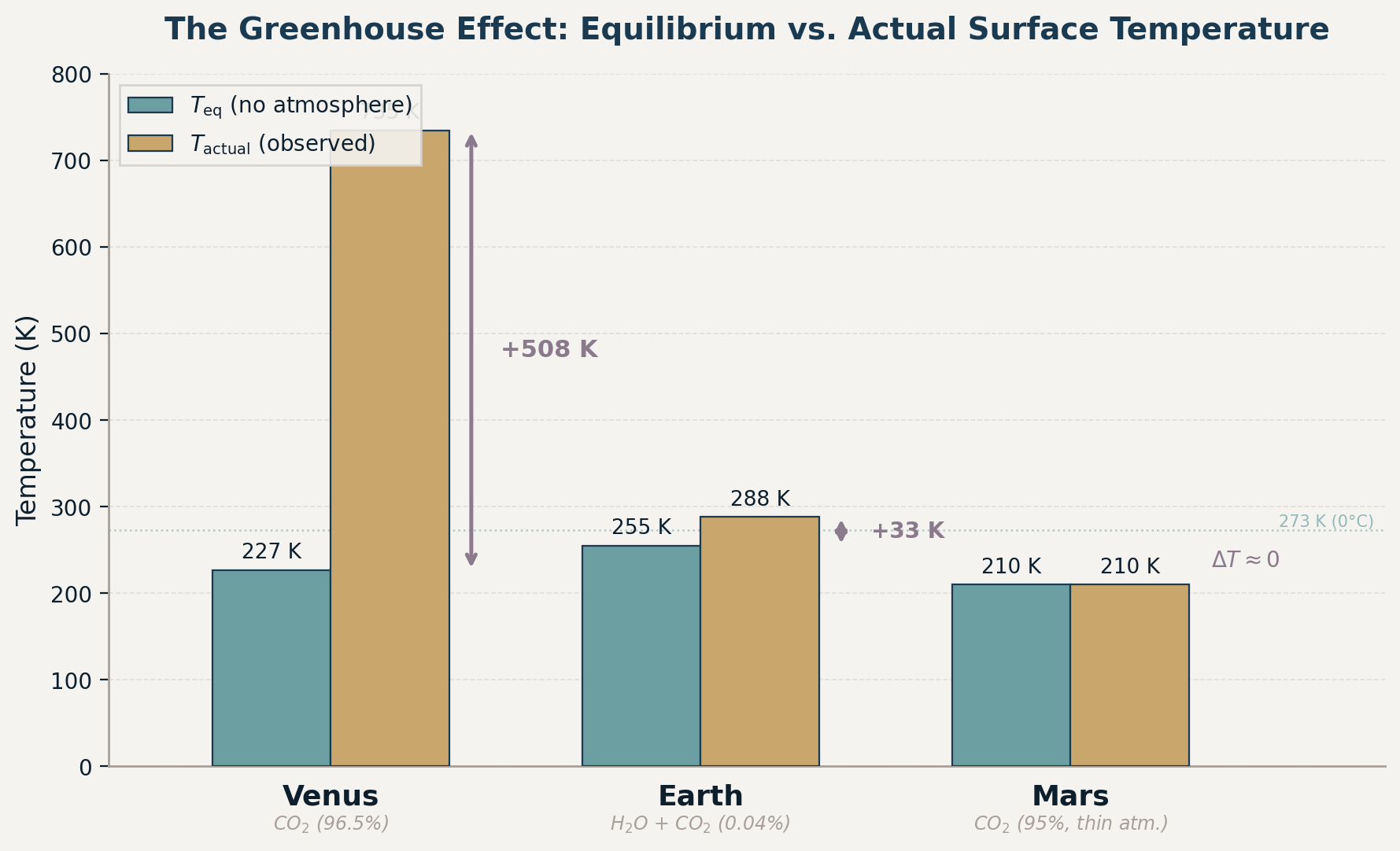
Venus is closer to the Sun than Earth, yet its equilibrium temperature is lower (227 K vs. 255 K). How? Albedo. Venus’s thick sulfuric-acid clouds reflect 77% of incoming sunlight before it can be absorbed. The factor means only the absorbed fraction matters: Venus absorbs just 23%, Earth 70%. The higher albedo more than compensates for the shorter distance — making the +508 K greenhouse warming even more staggering. Venus’s massive CO₂ atmosphere creates a runaway greenhouse: surface temperatures hot enough to melt lead (735 K = 462°C). Mars has a CO₂-dominated atmosphere too, but it’s so thin (0.6% of Earth’s surface pressure) that its greenhouse effect is negligible. Earth sits in between — a modest greenhouse that makes the planet habitable.
Problem
Calculate Earth’s equilibrium temperature assuming no atmosphere. Use , , and .
StepNumerator
StepDenominator
StepSolve for $T_{\text{eq}}$
Dimensional check
✓.
Result
. Without an atmosphere, Earth would be a frozen world. The observed average of 288 K (+15°C) means the greenhouse effect warms Earth by 33 K — the difference between a habitable planet and an ice ball, supplied by the infrared absorption bands of water vapor, CO₂, and other trace gases.
Predict First
Think about Kirchhoff's third law applied to a planet.
The 15-micron band below is the key.
Why CO₂ Matters: The 15-Micron Band
Carbon dioxide has a particularly strong absorption band centered at (15,000 nm). This sits right near the peak of Earth’s outgoing thermal radiation. When CO₂ concentration increases, this band deepens and broadens — blocking more outgoing infrared and forcing the surface to warm until the planet radiates enough through the remaining transparent windows.
The physics has been understood since John Tyndall’s experiments (1861) and Svante Arrhenius’s calculations (1896): CO₂ absorbs infrared at specific wavelengths set by its molecular energy levels — the same quantum mechanics that produces hydrogen Balmer lines. Adding CO₂ to the atmosphere is, spectroscopically, equivalent to adding more absorbing atoms to a stellar atmosphere: the absorption features deepen.
Part 6 takeaway: the greenhouse effect is Kirchhoff’s third law applied to a planet — atmospheric molecules absorb infrared from the warm surface at specific wavelengths set by quantum mechanics. CO₂’s strong 15 μm band sits squarely in Earth’s thermal emission window. Increasing CO₂ deepens this absorption, traps more outgoing radiation, and warms the surface. The same spectroscopy that tells us what stars are made of tells us why our planet is warming.