Spectra & Composition
Section 5 of 8
Line Shifts
Part 4: The Doppler Shift — Reading Stellar Motion from Light
The Doppler Effect for Light
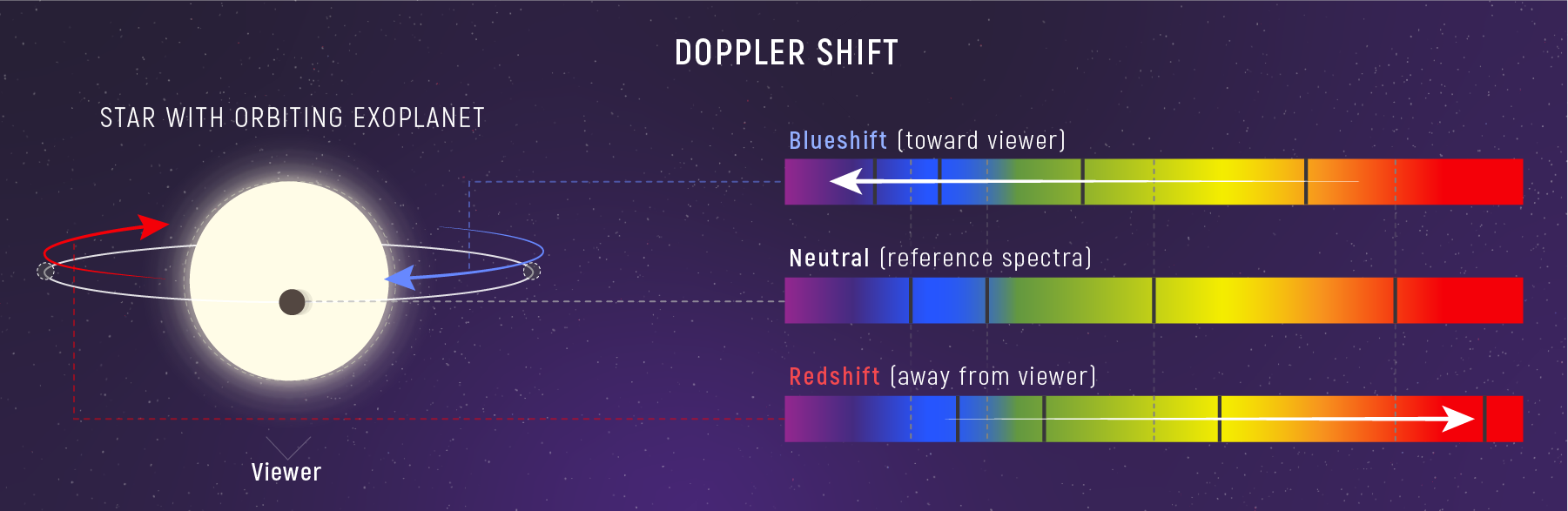
You’ve experienced the Doppler effect with sound: an ambulance siren rises in pitch as it approaches and drops as it recedes. Light does the same. When a source moves toward or away from an observer, the observed wavelength shifts.
If a source has radial velocity (positive = receding, negative = approaching), the observed wavelength relates to the laboratory rest wavelength by the
Here , valid for (the non-relativistic limit), which covers virtually all stellar velocities in our galaxy.
Doppler shift
The change in observed wavelength caused by a source’s motion along the line of sight: . Receding sources shift to longer wavelengths (redshift); approaching sources shift to shorter wavelengths (blueshift).
Interpretation — shifts tell you direction:
Redshift Blueshift
Redshift
A shift of spectral lines to longer wavelengths (), indicating the source is receding from the observer.
Blueshift
A shift of spectral lines to shorter wavelengths (), indicating the source is approaching the observer.
Typical stellar radial velocities are 10–100 km/s; the speed of light is 300,000 km/s. The ratio to — tiny shifts, but measurable with precision spectrographs. For relativistic speeds (galaxies, jets, cosmology), a full relativistic formula is needed, and for the expanding universe the interpretation becomes cosmological redshift — a stretch of space itself, not simple motion. One crucial diagnostic: a real Doppler shift moves all lines by the same fractional amount . If only one line is shifted, it’s not motion — it’s a misidentification.
Problem
A nearby star’s Hα absorption line is observed at . The rest wavelength is . Is the star approaching or receding, and at what speed?
StepDetermine direction
Since exceeds , the line is redshifted — the star is receding.
StepWavelength shift, then solve for $v_r$
StepPlug in numbers
Dimensional check
✓.
Result
The star recedes at about 91 km/s — typical for the galactic disk. A shift of only 0.2 nm out of 656.3 nm (0.03%) translates to nearly 100 km/s because light is so fast. Modern spectrographs detect shifts 1,000 times smaller, reaching velocities of — precise enough to feel the tug of an orbiting exoplanet.
Lines shifted from their laboratory wavelengths
Absorption lines in a stellar spectrum appear at slightly different wavelengths than laboratory measurements — and all lines shift by the same fractional amount.
The non-relativistic Doppler effect
Motion along the line of sight shifts wavelengths by , valid for .
The star's radial velocity
The measured shift gives — the component of motion directly toward or away from us. Blueshift means approach; redshift means recession.
What Doppler Shifts Cannot Tell Us
The Doppler effect measures only the
Radial velocity
The component of a star’s velocity along the observer’s line of sight, measured from the Doppler shift of its spectral lines. The perpendicular (transverse) motion produces no shift and must be measured astrometrically.
Also, if a star is rotating, one limb moves toward you and the other away. This doesn’t shift the line center — it broadens the line symmetrically. Line broadening tells us about rotation speed and turbulence, but it’s a separate measurement from the Doppler shift of the line center.
Problem
- A star’s Hβ line (rest 486.1 nm) is observed at 485.9 nm. Is the star approaching or receding?
- Calculate the radial velocity for the star in question 1.
- Can we determine a star’s rotation rate from a single Doppler shift? Why or why not?
- Approaching — , so the light is blueshifted.
- . The negative sign confirms approach; the speed is .
- No — rotation broadens lines symmetrically (one limb approaches, the other recedes). A single shift of the line center gives only the bulk radial motion; rotation comes from the line width.
Doppler Applied: Detecting an Unseen Companion
So far we’ve measured a single Doppler shift — one velocity at one moment. But suppose you observe the same star night after night and its radial velocity changes periodically: the Hα line oscillates back and forth around the rest wavelength on a regular cycle. What could cause that? If the star has an orbiting companion — another star or a planet — gravitational tugs pull it toward us during part of the orbit and away during the rest. The result is a periodic Doppler oscillation whose amplitude tells you how fast the star moves and whose period tells you the orbital period.
Problem
You monitor a star over several weeks. Its Hα line () oscillates between 656.25 nm and 656.35 nm with a period of 4.0 days. (a) What is the velocity amplitude of the wobble? (b) What does the periodicity tell you?
Step(a) Convert the wavelength swing to a velocity
The line oscillates by around rest, so
Dimensional check
✓.
Result
(a) The radial velocity oscillates between (receding) and (approaching) — an amplitude of 23 km/s. (b) A periodic oscillation means the star orbits an unseen companion; the 4.0-day period is the orbital period. This is how the first exoplanet around a Sun-like star, 51 Pegasi b, was found in 1995 — its host wobbled with a 56 m/s amplitude over 4.23 days, 400 times smaller than this example. Repeated Doppler measurements reveal orbits, and orbits — through Kepler’s laws — give masses. This is the bridge to Lecture 4.
Part 4 takeaway: the Doppler shift formula converts tiny wavelength shifts into stellar velocities. Blueshifts mean approach; redshifts mean recession. This tool unlocks binary star masses in Lecture 4 and, on cosmological scales, reveals the expansion of the universe.