The Death of Giants
Section 2 of 6
The Iron Catastrophe
Part 2: The Iron Catastrophe
Why Iron Is the End of the Line
The relevant graph is the binding energy per nucleon, , versus mass number . A nuclear reaction releases energy only if the final nuclei have a larger than the initial nuclei.
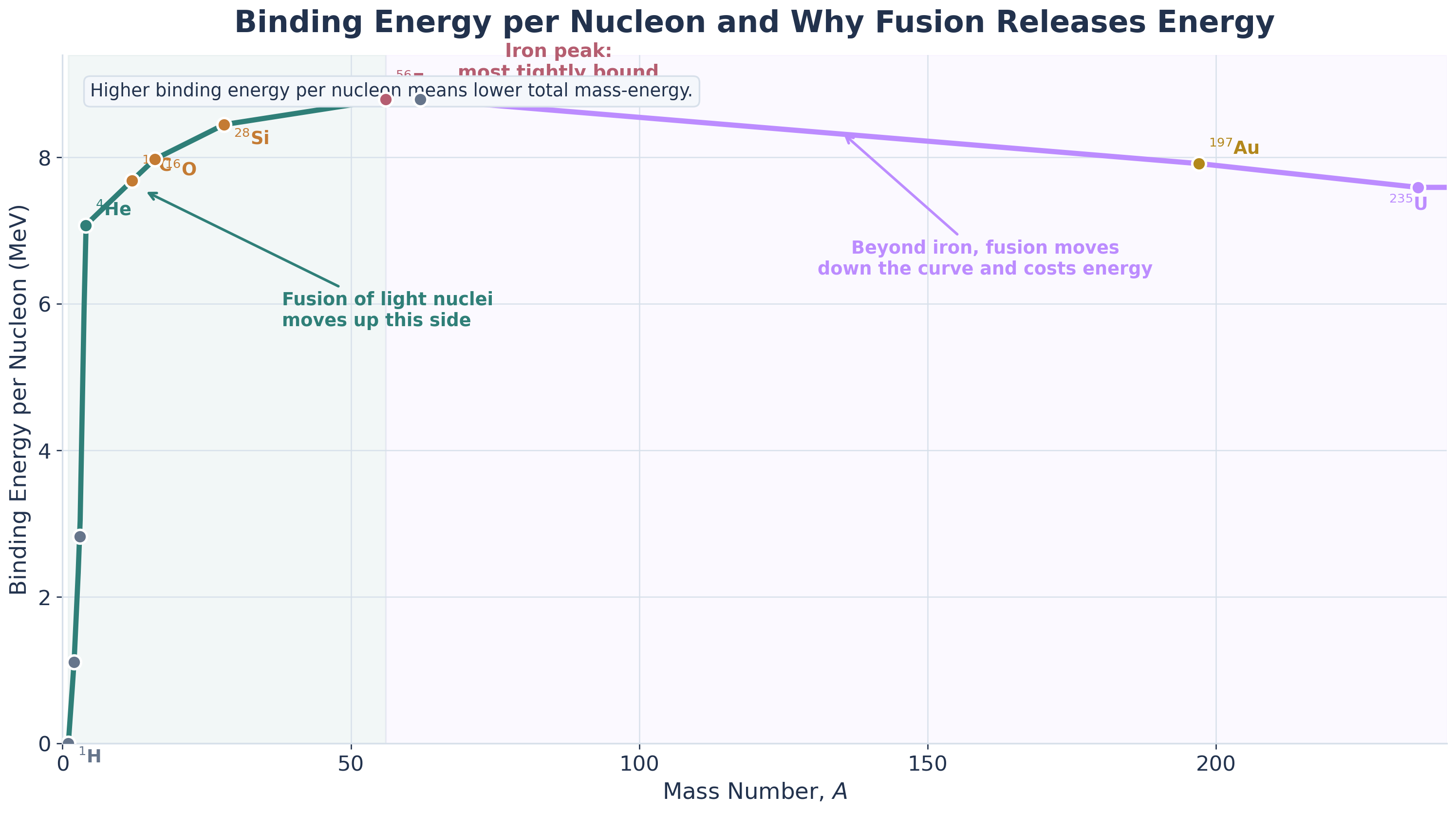
This gives the rule immediately: for nuclei lighter than the iron-group peak, fusion moves matter toward larger , so energy is released; for nuclei heavier than the peak, fusion moves toward smaller , so energy must be supplied. So when we say “iron is the endpoint of fusion,” the precise statement is that the broad maximum of lies in the
Iron peak
The broad maximum of the binding-energy-per-nucleon curve, in the iron/nickel group (). Nuclei here are the most tightly bound, so fusing lighter nuclei toward the peak releases energy while fusing past it costs energy — which is why ordinary stellar fusion stops once a core is iron-dominated.
The Iron Core Grows
During silicon burning, the center fills with iron-group nuclei (mainly Fe/Ni isotopes). The iron core grows in mass as silicon burning continues in shells around it, becomes hotter and denser as the overlying layers compress it, and is supported mainly by electron degeneracy pressure, not thermal gas pressure. So the inner core is physically like a white-dwarf-like degenerate core embedded inside a massive star — and its stability is controlled by the Chandrasekhar mass:
For a carbon-oxygen composition , so ( is dimensionless, so the result keeps units of ).
In an iron core, electron capture reduces , so the effective Chandrasekhar mass can be somewhat smaller. For ASTR 201, the important statement is that collapse begins once the degenerate iron core reaches a mass of order . At that point, no stable electron-degeneracy-supported solution remains, and the core collapses.
Multiple choice
Two degenerate cores have equal mass but and . Which reaches instability first, and why?
Because , lowering lowers the maximum mass electron degeneracy can support. The core with therefore reaches instability first. Electron capture is dangerous not only because it produces neutrinos, but also because it lowers the pressure-support ceiling.
Multiple choice
Once silicon burning begins, could the star stay stable by “choosing” not to burn silicon to iron?
No — a star is not choosing among options. If the core contracts, the virial theorem implies the central temperature rises. Once silicon-rich material reaches silicon-burning temperatures, reactions proceed at the rate set by nuclear physics, and the overlying layers keep compressing the core so the temperature does not drop below ignition. Silicon burning therefore continues, building an iron-group core. The real issue is whether any stable pressure source remains once the core is iron-rich — and it does not.