The Death of Giants
Complete lesson
Onion-Shell Burning
By the end of this reading, you will be able to:
Guiding question: massive stars build iron cores and then catastrophically collapse. Why iron? Why collapse? And how does that build the rest of the periodic table?
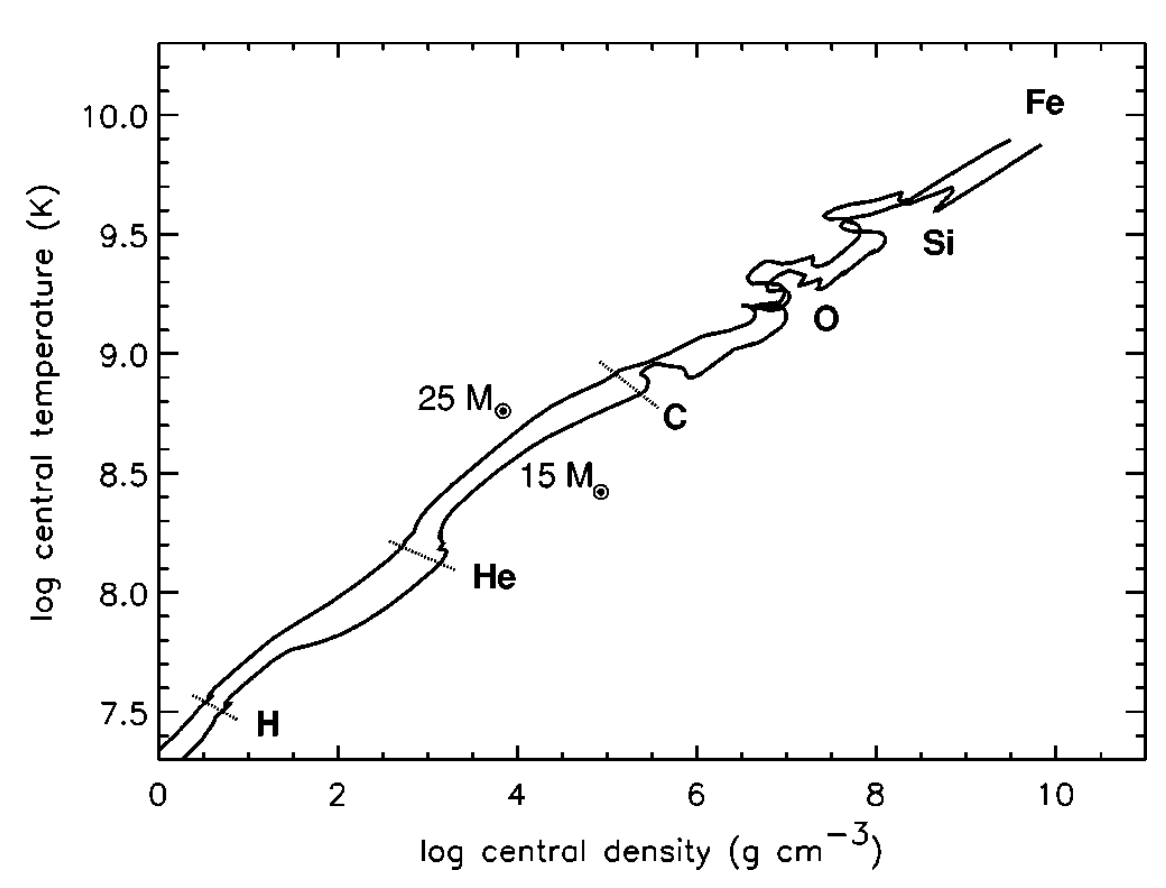
A star lives fast and dies violently. It burns hydrogen in its core for about , but the later stages shrink dramatically: helium burning lasts about , carbon burning about , neon burning about , oxygen burning about months, and silicon burning about day. That pattern is the point. Each new fuel requires a higher temperature, releases less energy per unit mass, and is consumed while neutrino losses become increasingly severe. The star therefore builds an onion-like structure of burning shells around an inert iron-group core.
This reading follows one causal chain from beginning to end: (1) successive burning stages build heavier elements; (2) the binding-energy curve makes iron-group nuclei the endpoint of exothermic fusion; (3) loss of pressure support triggers collapse; (4) collapse releases gravitational energy, mostly in neutrinos; (5) the explosion and neutron-capture processes enrich later generations of stars and planets. The central question is not just what happens in a massive star, but why gravity eventually wins.
Part 1: Onion-Shell Burning
The observational clue is that supernovae are not just bright flashes. Their spectra reveal heavy elements, their remnants reveal expanding layered ejecta, and in one famous case a burst of neutrinos arrived before the light. This reading explains how those measurements point back to an iron core, a collapse, and an explosion that rearranges the periodic table.
After the Main Sequence: Massive Stars
Low-mass stars () end as white dwarfs — they never get hot enough to burn carbon (Reading 2). But massive stars are different: their larger gravitational potential wells compress the core to higher temperatures after helium exhaustion, igniting carbon fusion at .
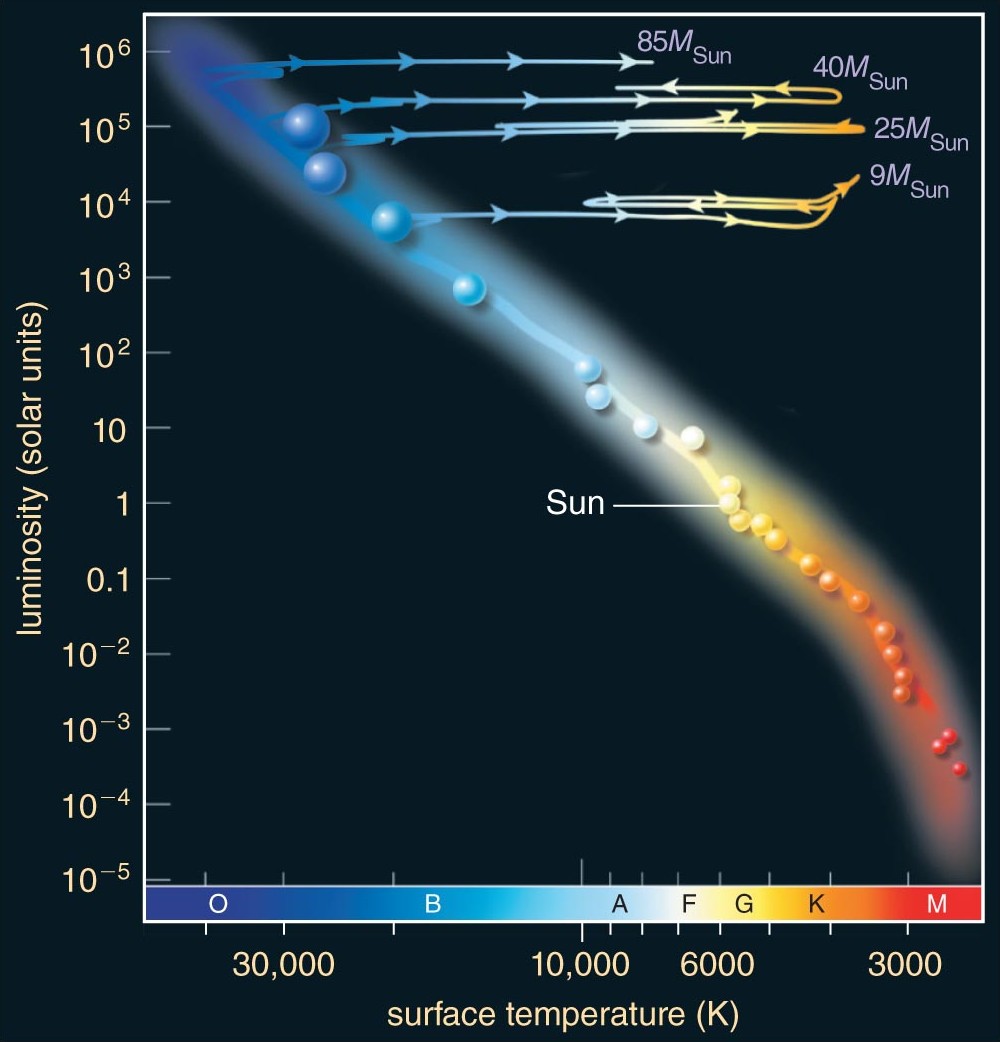
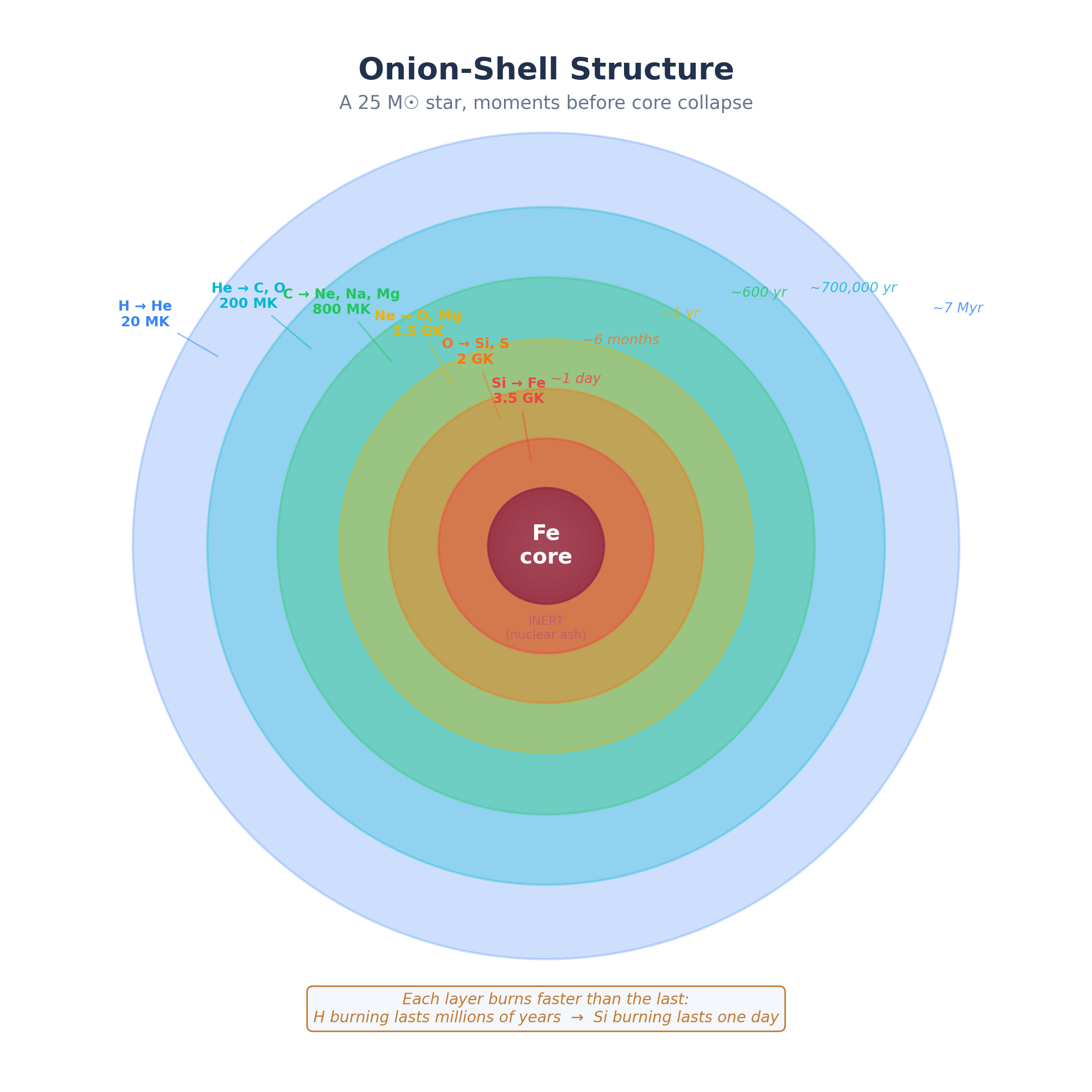
And they don’t stop there. Each time a fuel is exhausted, the core contracts further (virial theorem), heats up, and ignites the next fuel. The star builds a nested series of burning shells — like an onion, with the heaviest elements at the center. This is
Onion-shell burning
The layered interior of an evolved massive star, in which concentric shells fuse progressively heavier fuels (H, He, C, Ne, O, Si) at higher temperatures inward, surrounding an inert iron-group core. Each inner shell burns hotter and faster than the one outside it.
| Stage | Fuel to product | Duration ( star) | |
|---|---|---|---|
| 1. Hydrogen | |||
| 2. Helium | |||
| 3. Carbon | |||
| 4. Neon | |||
| 5. Oxygen | |||
| 6. Silicon |
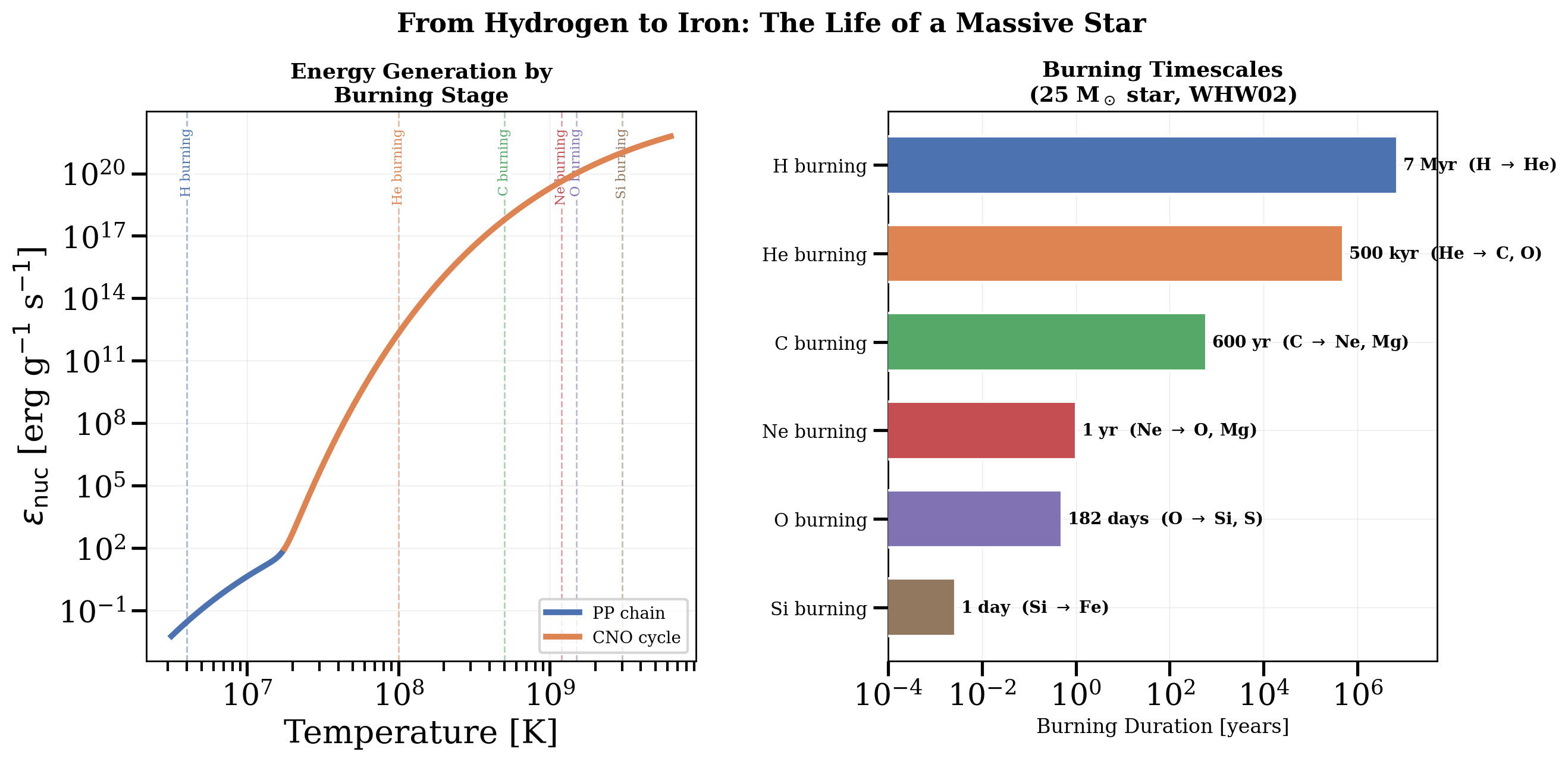
Why Each Stage Is Shorter
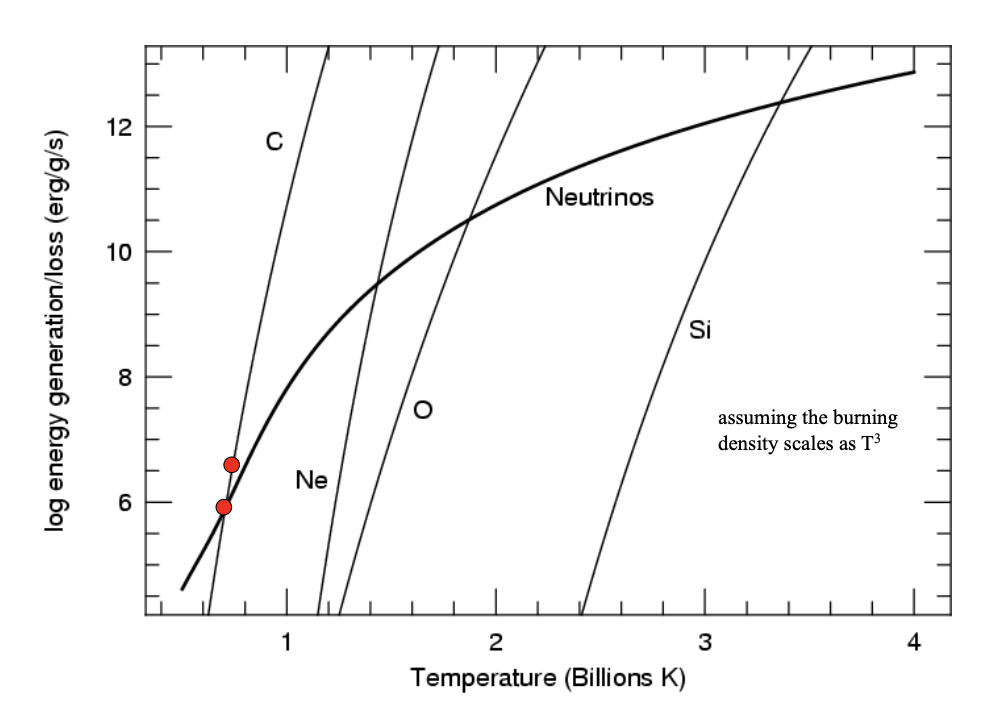
The accelerating timescale needs a causal explanation, not just a list of durations. A burning stage lasts roughly
where is the energy released per unit mass of fuel (), is the fuel mass (), is the photon luminosity, and is the neutrino luminosity (). The numerator has units of energy and the denominator units of power, so the ratio has units of time: .
Each successive stage is shorter for three connected reasons:
- The Coulomb barrier is higher. Heavier nuclei have larger charge, so the core must reach a higher temperature before tunneling makes fusion fast enough to matter.
- The energy payoff is smaller. As nuclei approach the iron peak, the gain in binding energy per nucleon shrinks, so less energy is released per kilogram of fuel.
- Neutrino losses become enormous. In advanced stages the core is hot enough that neutrino-producing processes carry energy away directly. Unlike photons, neutrinos escape almost immediately, so this energy is lost instead of supporting the star.
These effects all push downward: the star gets less useful energy from each kilogram of fuel while losing energy faster.
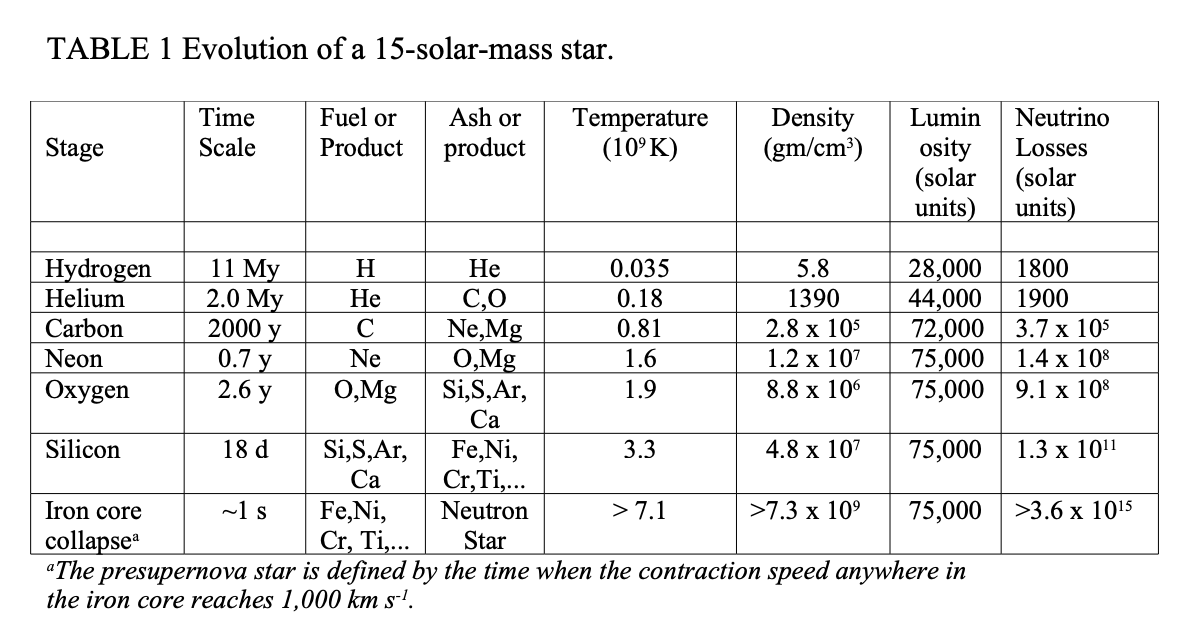
For a star, the contrast is extreme. Converting one day to years, , so
The years cancel, so the ratio is dimensionless. Silicon burning lasts less than one-billionth of the hydrogen-burning lifetime.
Multiple choice
If neutrino losses were turned off during the late burning stages, would carbon/oxygen/silicon burning last longer, shorter, or about the same?
They would last longer. With and in advanced stages, neutrinos dominate the denominator. Remove them and the star need not burn fuel so fast to maintain pressure support. The late stages would still be shorter than hydrogen burning (higher Coulomb barrier, smaller energy release), but far less compressed in time — the same energy reservoir divided by a much smaller loss rate gives a longer .
Quick check
Why does each successive burning stage require a higher ignition temperature?
Each successive fuel has nuclei with larger atomic number — carbon (), oxygen (), silicon () — and the Coulomb barrier scales as . For carbon-carbon fusion (versus for proton-proton), so the barrier is much higher. Even with quantum tunneling the probability drops exponentially with barrier height, so each stage needs a substantially higher temperature to reach a meaningful rate. That is why the onion layers run hottest at the center.
The Iron Catastrophe
Part 2: The Iron Catastrophe
Why Iron Is the End of the Line
The relevant graph is the binding energy per nucleon, , versus mass number . A nuclear reaction releases energy only if the final nuclei have a larger than the initial nuclei.
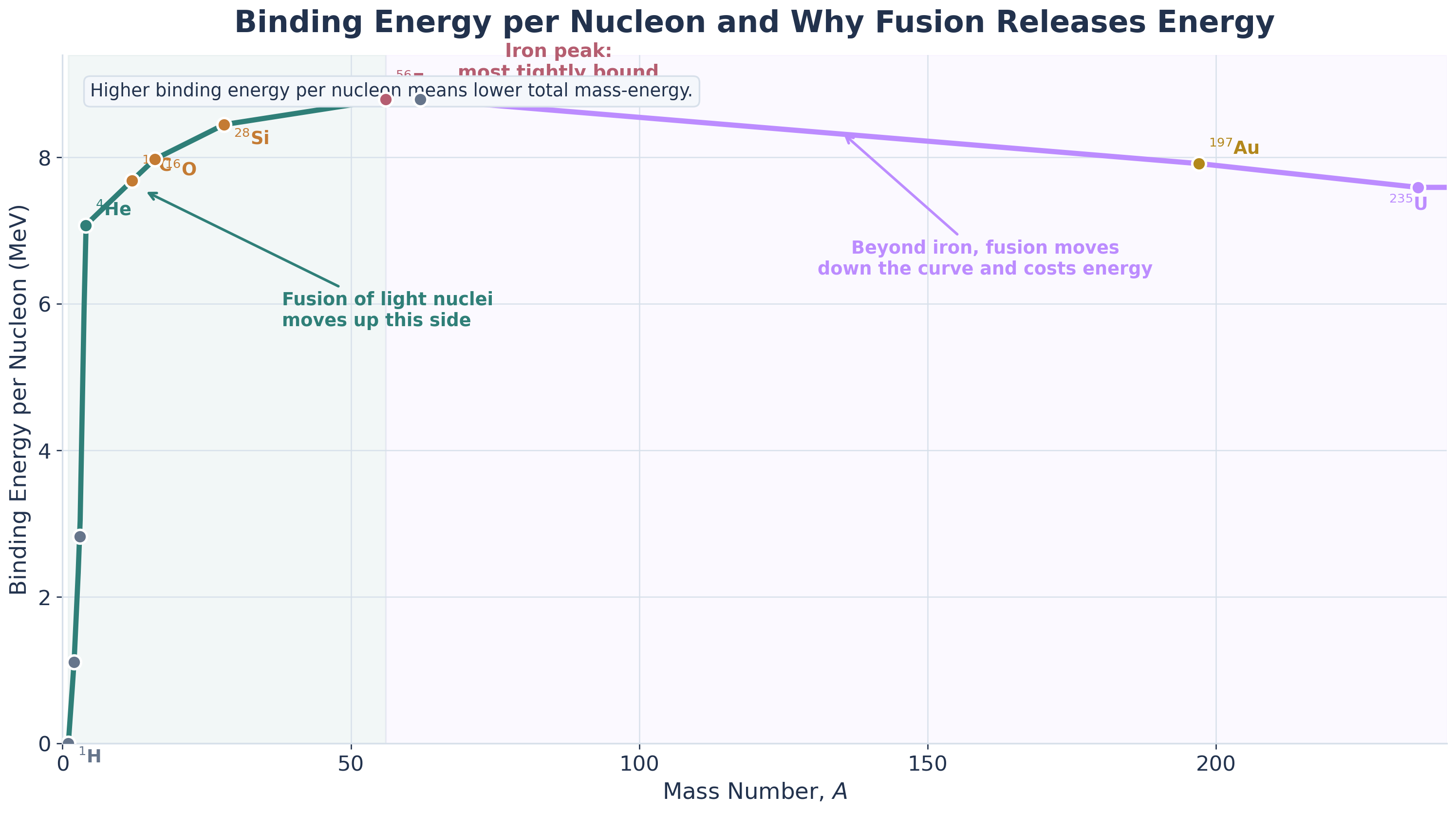
This gives the rule immediately: for nuclei lighter than the iron-group peak, fusion moves matter toward larger , so energy is released; for nuclei heavier than the peak, fusion moves toward smaller , so energy must be supplied. So when we say “iron is the endpoint of fusion,” the precise statement is that the broad maximum of lies in the
Iron peak
The broad maximum of the binding-energy-per-nucleon curve, in the iron/nickel group (). Nuclei here are the most tightly bound, so fusing lighter nuclei toward the peak releases energy while fusing past it costs energy — which is why ordinary stellar fusion stops once a core is iron-dominated.
The Iron Core Grows
During silicon burning, the center fills with iron-group nuclei (mainly Fe/Ni isotopes). The iron core grows in mass as silicon burning continues in shells around it, becomes hotter and denser as the overlying layers compress it, and is supported mainly by electron degeneracy pressure, not thermal gas pressure. So the inner core is physically like a white-dwarf-like degenerate core embedded inside a massive star — and its stability is controlled by the Chandrasekhar mass:
For a carbon-oxygen composition , so ( is dimensionless, so the result keeps units of ).
In an iron core, electron capture reduces , so the effective Chandrasekhar mass can be somewhat smaller. For ASTR 201, the important statement is that collapse begins once the degenerate iron core reaches a mass of order . At that point, no stable electron-degeneracy-supported solution remains, and the core collapses.
Multiple choice
Two degenerate cores have equal mass but and . Which reaches instability first, and why?
Because , lowering lowers the maximum mass electron degeneracy can support. The core with therefore reaches instability first. Electron capture is dangerous not only because it produces neutrinos, but also because it lowers the pressure-support ceiling.
Multiple choice
Once silicon burning begins, could the star stay stable by “choosing” not to burn silicon to iron?
No — a star is not choosing among options. If the core contracts, the virial theorem implies the central temperature rises. Once silicon-rich material reaches silicon-burning temperatures, reactions proceed at the rate set by nuclear physics, and the overlying layers keep compressing the core so the temperature does not drop below ignition. Silicon burning therefore continues, building an iron-group core. The real issue is whether any stable pressure source remains once the core is iron-rich — and it does not.
Core Collapse
Part 3: Core Collapse
The Collapse Sequence
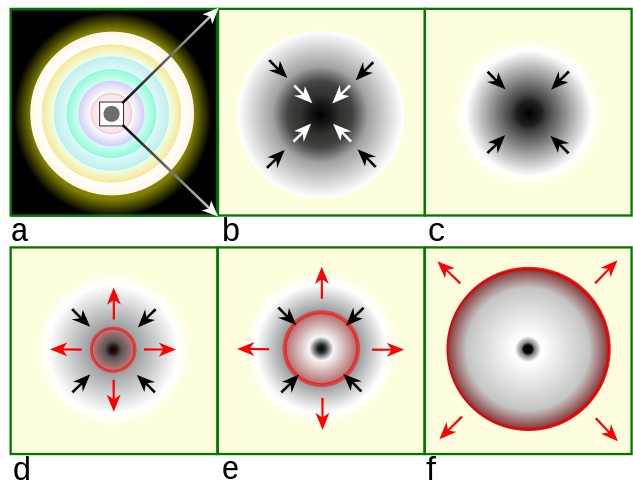
The collapse happens on a dynamical timescale, so before following the sequence, estimate the timescale directly using the dynamical-timescale estimate from Reading 1:
With for the collapsing iron core, , so has units of seconds.
Evaluating the scale,
So once pressure support fails, collapse on a timescale of is completely reasonable. The causal sequence is then:
- Electron capture (). At densities above , electrons are captured by protons, . This removes electrons that were providing degeneracy pressure and emits neutrinos — both push the core toward faster collapse.
- Photodisintegration of iron (). Above , energetic photons break iron-group nuclei apart, . This
photodisintegration - Free-fall collapse (). With both degeneracy and thermal support reduced, the inner core collapses rapidly, reaching infall speeds of order (free-fall onto a core, , climbs from at km to near km, approaching the bounce).
- Core bounce (). When the inner core reaches nuclear density , the equation of state stiffens sharply, neutron degeneracy pressure becomes important, and the inner core halts and rebounds, launching a shock into the still-infalling outer core.
- Shock stall and neutrino heating (–). The outgoing shock loses energy dissociating infalling nuclei and stalls. Neutrinos streaming out of the hot proto-neutron star deposit a small fraction of their energy behind the shock, which can help revive it.
- Explosion (). The revived shock propagates outward, ejecting much of the star’s outer layers at –.
Photodisintegration
The breakup of nuclei by energetic thermal photons — e.g. above . It is endothermic, so it drains thermal energy from the collapsing iron core and accelerates the collapse.
The Energy Budget
The gravitational energy released by core collapse is enormous — and, as we will see, most of it never appears as light.
Problem
The iron core collapses from to , releasing . Show the final radius dominates, estimate the energy for a core, and compare it to a solar rest energy.
StepThe small final radius dominates
so the term contributes only — the final radius sets the scale.
StepEvaluate (M = 1.4 Msun = 2.8e33 g, R_f = 10 km = 1e6 cm)
Dimensional check
✓.
Result
With a solar rest energy , — about a fifth of the core’s own rest energy, released in under a second. (General relativity softens this Newtonian estimate; the realistic neutron-star binding energy is –, still staggering.) For comparison, the Sun radiates only over its entire life — one collapse releases hundreds of solar lifetimes of energy in a heartbeat.
Because this is an order-of-magnitude estimate, it is standard to summarize the release as a few . Where does it go? A representative energy budget is:
| Channel | Typical energy | Approximate fraction | Timescale |
|---|---|---|---|
| Neutrinos | |||
| Kinetic energy of ejecta | days–months | ||
| Photons (light) | weeks–months |
So the most luminous optical event in the universe is not where most of the energy goes. The optical display is spectacular because photons are easy to detect, not because they carry the dominant share of the energy. The visible light curve is powered largely by radioactive decay, especially the chain .
Quick check
A supernova can briefly outshine its host galaxy in visible light. Does that imply visible light carries most of the explosion energy? Use the table above to justify your answer quantitatively.
No. Comparing channels, , so only a few hundred-thousandths of the total energy comes out as light. Neutrinos dominate the energy budget by about four orders of magnitude. The light output is observationally dramatic but energetically tiny.
Building the Periodic Table
Part 4: Building the Periodic Table
Nucleosynthesis Capstone
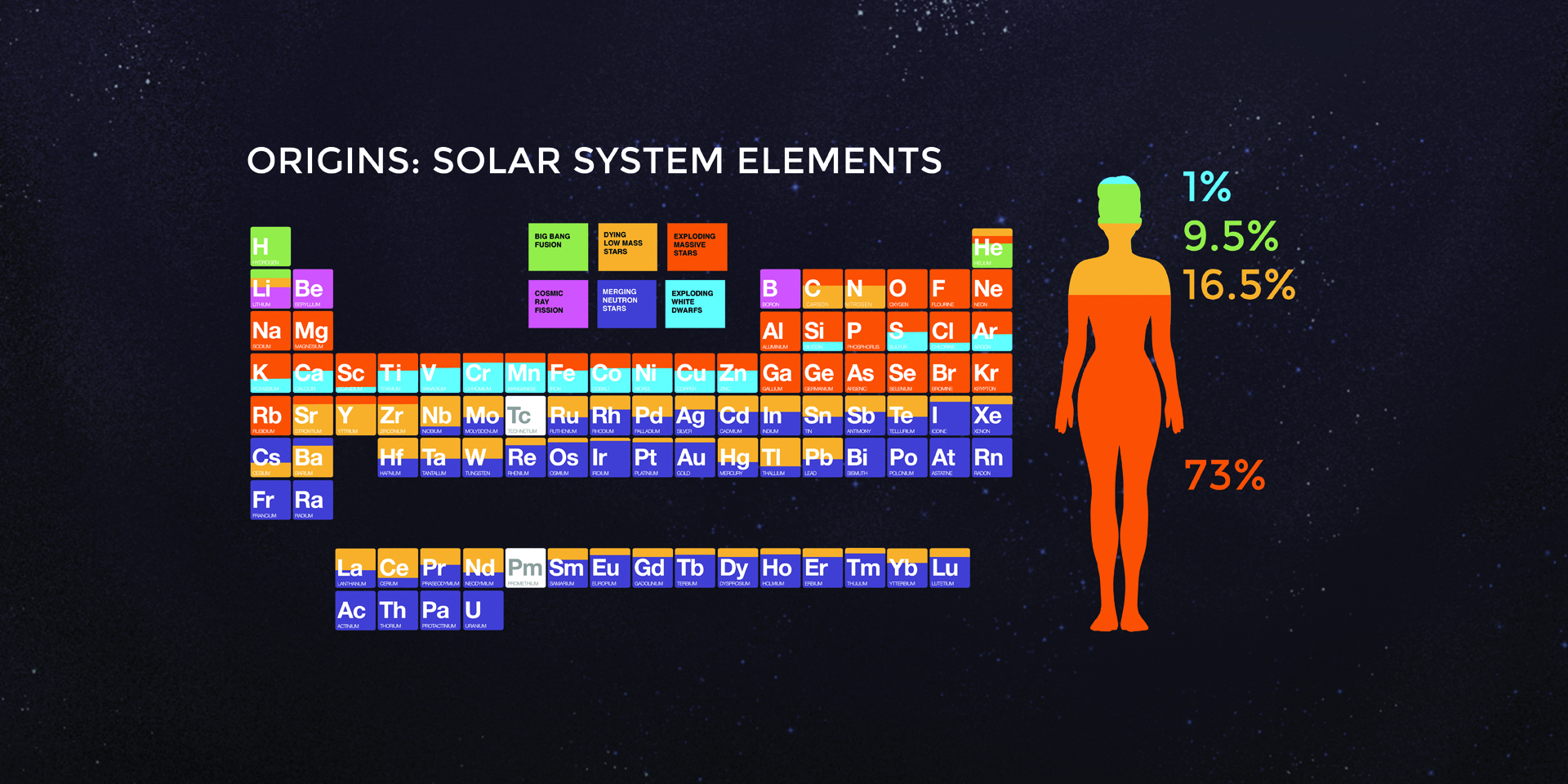
This is the payoff of the nucleosynthesis story — we can now connect broad classes of elements to the environments that make them:
| Elements | Main process | Main astrophysical site(s) | Comment |
|---|---|---|---|
| H, He (most) | Big Bang nucleosynthesis | Early universe | Primordial |
| He (additional) | pp-chain, CNO cycle | Main-sequence stars | Hydrogen-burning products |
| C, O | Triple-alpha, alpha capture | Helium-burning stars | Red giants and massive stars |
| Ne, Na, Mg | Carbon burning | Massive-star cores | Advanced burning products |
| O, Mg (additional) | Neon burning | Massive-star cores | Advanced burning products |
| Si, S, Ca | Oxygen and silicon burning | Massive stars and their explosions | Late-stage plus explosive burning |
| Fe-group (Fe, Co, Ni) | Silicon and explosive burning | Core-collapse and Type Ia supernovae | This reading focuses on the massive-star channel |
| Beyond Fe | s-process | AGB stars | Slow neutron capture |
| Beyond Fe | r-process | Neutron-star mergers, possibly rare explosions | Rapid neutron capture |
The r-Process: Beyond Iron
Fusion is not the only way to build nuclei. In a neutron-rich environment, a nucleus can capture neutrons without paying a Coulomb-barrier penalty: . If neutron captures happen faster than beta decays, the nucleus is driven to very neutron-rich isotopes; after the neutron flood ends, those isotopes beta-decay back toward stability, producing heavy elements such as Au, Pt, and U. This is the
r-process
Rapid neutron capture: in an intensely neutron-rich environment, nuclei capture neutrons faster than they can beta-decay, building very neutron-rich isotopes that later decay back to stable heavy elements (Au, Pt, U). Neutron-star mergers are the favored dominant site.
s-process
Slow neutron capture: neutron captures occur slower than beta decay, so the nucleus stays near the valley of stability as it climbs in mass. It operates in AGB stars and builds many elements between iron and lead.
Historically, ordinary core-collapse supernovae were treated as a leading r-process site. The cleaner modern statement: neutron-star mergers are strongly favored as the dominant source of the heavy r-process elements, while some supernova-like channels may still contribute, especially for lighter r-process nuclei.
Quick check
Fusion releases no net energy past the iron peak, yet gold and uranium exist.
- (a) Why can neutron capture build nuclei heavier than iron when fusion cannot?
- (b) What does “rapid” mean in the r-process — what is the race, and what does winning it produce?
(a) The iron peak is about fusion energetics: fusing two positively charged nuclei past costs energy and must also overcome a Coulomb barrier. Neutron capture pays no Coulomb-barrier penalty — neutrons are uncharged, so a nucleus can absorb one regardless of how heavy it already is. Capture is not energy-releasing fusion, so the binding-energy peak does not block it.
(b) “Rapid” means neutron captures happen faster than beta decays. The race is capture versus decay: when captures win, a nucleus is driven to very neutron-rich isotopes far from the valley of stability before it can decay. When the intense neutron flux ends, those unstable isotopes beta-decay back toward stability, yielding heavy elements like Au, Pt, and U. (In the slow s-process, decay wins the race, so the path hugs stability and stops near lead.)
Your Body Is Stellar Ash
Be careful about what is being measured. Abundances can be quoted by mass or by number of atoms — these are not the same. The table below gives approximate mass fractions for the human body:
| Element | Mass fraction in body | Stellar origin |
|---|---|---|
| Hydrogen | 10% | Big Bang |
| Oxygen | 65% | Helium burning in massive stars, dispersed by winds and supernovae |
| Carbon | 18% | Triple-alpha in helium-burning stars, dispersed by winds and ejecta |
| Nitrogen | 3% | CNO cycle processing in massive stars |
| Calcium | 1.5% | Advanced burning in massive stars |
| Phosphorus | 1% | Advanced burning in massive stars |
| Iron | 0.006% | Iron-group nucleosynthesis in supernovae |
| Iodine | trace | Neutron-capture nucleosynthesis |
| Gold | trace | Heavy r-process, likely dominated by neutron-star mergers |
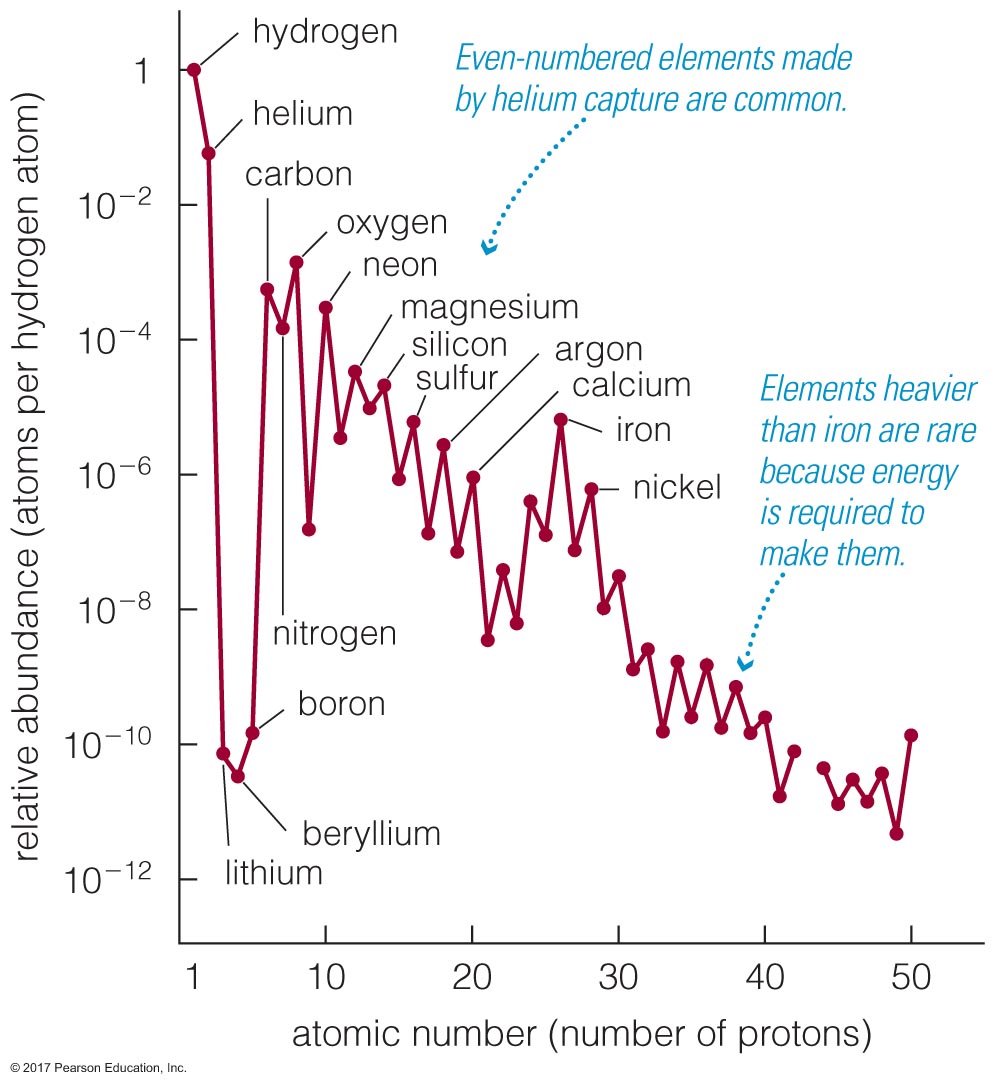
Aside from hydrogen (and most helium), the atoms in your body were manufactured in earlier generations of stars and stellar explosions before the Sun formed. In that precise sense, you are made of stellar ash.
The solar photosphere shows 67 heavier elements in specific relative abundances
The measured “solar abundance pattern” spans nearly the whole periodic table.
Nucleosynthesis theory predicts those abundances
Big Bang + stellar fusion (pp, CNO, triple-alpha, successive burning) + neutron capture (s-process, r-process) predict relative abundances.
The periodic table is a record of stellar nucleosynthesis
The predicted pattern matches observations to remarkable precision; the few discrepancies (Li, Be, B) are explained by extra processes such as cosmic-ray spallation.
Multiple choice
Why are Li, Be, B much rarer than C and O — hard to make, easy to destroy, or both?
Both. These nuclei have relatively low binding energies and are broken apart efficiently at stellar-interior temperatures, and they are bypassed by the main fusion chains because of the mass-5 and mass-8 bottlenecks. Most of the Li, Be, and B in the universe is therefore attributed to non-stellar processes such as cosmic-ray spallation rather than ordinary stellar fusion.
Supernova Remnants and the Next Generation
Part 5: Supernova Remnants and the Next Generation
What’s Left Behind
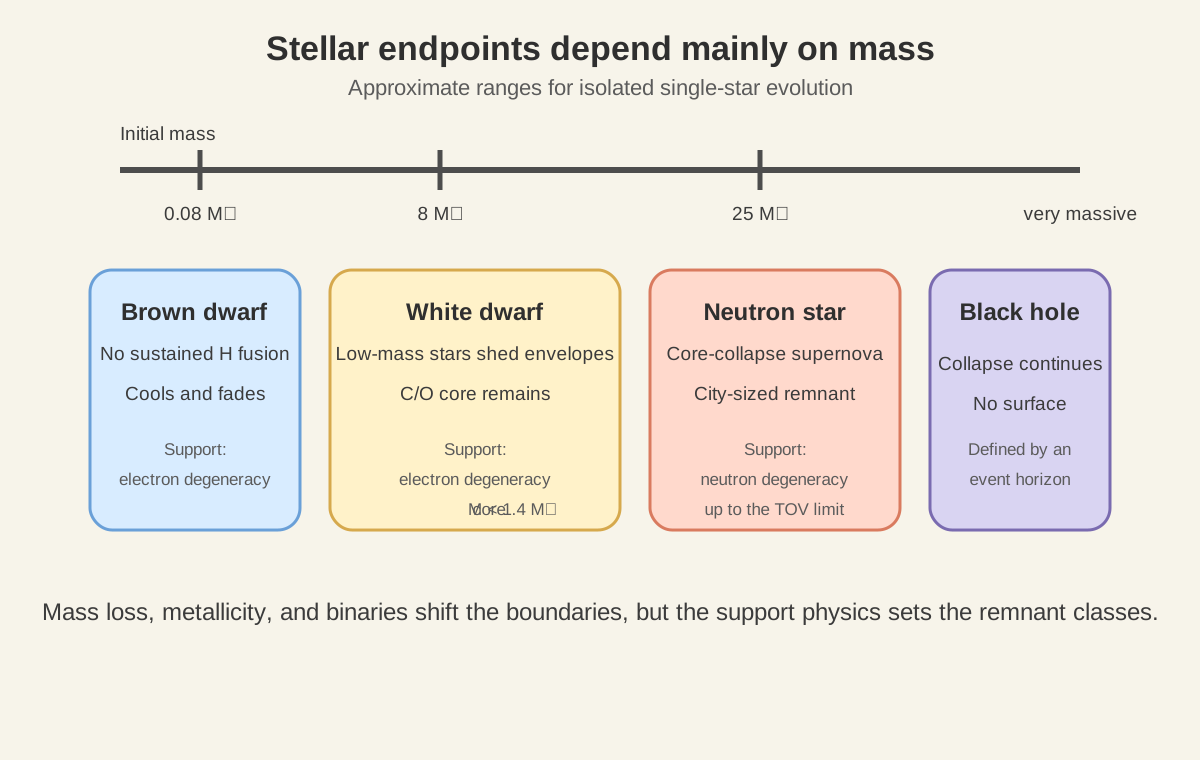
After the explosion, two things remain. First, a compact remnant — either a neutron star (–) or a black hole (); we study these in Reading 5. Second, a
Supernova remnant
The expanding, heavy-element-rich shell of gas ejected by a supernova, which sweeps up and shocks the surrounding interstellar medium and radiates across X-ray, optical, and radio bands for – years before dispersing. It is the debris field, distinct from the compact remnant (neutron star or black hole) left at the center.
Seeding the Next Generation
Supernova remnants disperse into the interstellar medium over , enriching it with metals (everything heavier than helium). This enriched gas eventually collapses into new molecular clouds, forming new stars and planetary systems. The Sun formed from gas enriched by multiple generations of nucleosynthesis: its metallicity ( — about of its mass is heavier than helium) records of Galactic chemical evolution, and the Earth condensed from that enriched gas and dust.
Stars are born from the ashes of dead stars. This is cosmic recycling on the grandest scale — and it means the first generation of stars (formed from pure hydrogen and helium) was fundamentally different. Those Population III stars had no metals, no planets, and likely no life. Everything that makes the universe interesting today was built inside stars that came after. This is the
Core-collapse supernova
The explosion of a massive star () whose iron core exceeds the effective Chandrasekhar mass and collapses on a dynamical timescale. Most of the released gravitational energy () escapes as neutrinos; a neutrino-revived shock ejects the heavy-element-enriched envelope, leaving a neutron star or black hole.
Reference and Synthesis
Reference Tables
Burning Stages of a Star
| Stage | Fuel to ash | (K) | (g/cm³) | Duration | Energy (MeV/nucleon) |
|---|---|---|---|---|---|
| H | 6.7 | ||||
| He | 0.6 | ||||
| C | 0.5 | ||||
| Ne | 0.3 | ||||
| O | 0.5 | ||||
| Si | 0.2 |
Core-Collapse Supernova Energy Budget
| Channel | Energy (erg) | Fraction | Timescale |
|---|---|---|---|
| Neutrinos | |||
| Kinetic (ejecta) | days–months | ||
| Photons (light) | weeks–months |
Symbol Legend
| Symbol | Meaning | Units |
|---|---|---|
| Iron-56 (most common iron isotope) | — | |
| Nickel-56 (radioactive; decays to ) | ||
| Electron neutrino | — | |
| r-process | Rapid neutron capture process | — |
| s-process | Slow neutron capture process | — |
| SNR | Supernova remnant | — |
Summary: Gravity’s Most Violent Victory
The most important ideas from this reading:
- Massive stars burn through fuel on an accelerating timescale. Each successive stage requires a higher temperature, releases less energy per unit mass, and is shortened further by increasing neutrino losses.
- Iron-group nuclei mark the end of exothermic fusion in stellar cores. Once the core is iron-dominated, fusion no longer provides a net pressure source against gravity.
- When the degenerate iron core reaches an effective Chandrasekhar mass of order , collapse begins on a dynamical timescale. Electron capture and photodisintegration accelerate it.
- Core collapse releases a few , mostly in neutrinos. The visible supernova is spectacular but energetically subdominant.
- The periodic table records multiple nucleosynthesis channels. Stellar fusion builds elements up to the iron group; neutron-capture processes build many beyond it; later generations inherit that enriched material.
A supernova briefly outshines a galaxy, yet the light is a rounding error in its energy budget — and “iron is the end of fusion” but heavier elements still exist. Resolve both apparent paradoxes in a sentence each.
Energy budget: ~99% of the leaves as neutrinos (which barely interact) and only ~0.003% as light, so the optical display is dramatic to observe but energetically tiny. Iron endpoint: ordinary fusion stops releasing energy past the iron peak of the binding-energy curve, but heavier elements are still built by neutron capture (s-process in AGB stars, r-process in neutron-star mergers), which pays no Coulomb-barrier penalty.
Glossary
- Core-collapse supernova
The explosion of a massive star () whose iron core exceeds the effective Chandrasekhar mass and collapses on a dynamical timescale. Most of the released gravitational energy () escapes as neutrinos; a neutrino-revived shock ejects the heavy-element-enriched envelope, leaving a neutron star or black hole.
- Iron peak
The broad maximum of the binding-energy-per-nucleon curve, in the iron/nickel group (). Nuclei here are the most tightly bound, so fusing lighter nuclei toward the peak releases energy while fusing past it costs energy — which is why ordinary stellar fusion stops once a core is iron-dominated.
- Onion-shell burning
The layered interior of an evolved massive star, in which concentric shells fuse progressively heavier fuels (H, He, C, Ne, O, Si) at higher temperatures inward, surrounding an inert iron-group core. Each inner shell burns hotter and faster than the one outside it.
- Photodisintegration
The breakup of nuclei by energetic thermal photons — e.g. above . It is endothermic, so it drains thermal energy from the collapsing iron core and accelerates the collapse.
- r-process
Rapid neutron capture: in an intensely neutron-rich environment, nuclei capture neutrons faster than they can beta-decay, building very neutron-rich isotopes that later decay back to stable heavy elements (Au, Pt, U). Neutron-star mergers are the favored dominant site.
- s-process
Slow neutron capture: neutron captures occur slower than beta decay, so the nucleus stays near the valley of stability as it climbs in mass. It operates in AGB stars and builds many elements between iron and lead.
- Supernova remnant
The expanding, heavy-element-rich shell of gas ejected by a supernova, which sweeps up and shocks the surrounding interstellar medium and radiates across X-ray, optical, and radio bands for – years before dispersing. It is the debris field, distinct from the compact remnant (neutron star or black hole) left at the center.