The Death of Giants
Section 4 of 6
Building the Periodic Table
Part 4: Building the Periodic Table
Nucleosynthesis Capstone
This is the payoff of the nucleosynthesis story — we can now connect broad classes of elements to the environments that make them:
| Elements | Main process | Main astrophysical site(s) | Comment |
|---|---|---|---|
| H, He (most) | Big Bang nucleosynthesis | Early universe | Primordial |
| He (additional) | pp-chain, CNO cycle | Main-sequence stars | Hydrogen-burning products |
| C, O | Triple-alpha, alpha capture | Helium-burning stars | Red giants and massive stars |
| Ne, Na, Mg | Carbon burning | Massive-star cores | Advanced burning products |
| O, Mg (additional) | Neon burning | Massive-star cores | Advanced burning products |
| Si, S, Ca | Oxygen and silicon burning | Massive stars and their explosions | Late-stage plus explosive burning |
| Fe-group (Fe, Co, Ni) | Silicon and explosive burning | Core-collapse and Type Ia supernovae | This reading focuses on the massive-star channel |
| Beyond Fe | s-process | AGB stars | Slow neutron capture |
| Beyond Fe | r-process | Neutron-star mergers, possibly rare explosions | Rapid neutron capture |
The r-Process: Beyond Iron
Fusion is not the only way to build nuclei. In a neutron-rich environment, a nucleus can capture neutrons without paying a Coulomb-barrier penalty: . If neutron captures happen faster than beta decays, the nucleus is driven to very neutron-rich isotopes; after the neutron flood ends, those isotopes beta-decay back toward stability, producing heavy elements such as Au, Pt, and U. This is the
r-process
Rapid neutron capture: in an intensely neutron-rich environment, nuclei capture neutrons faster than they can beta-decay, building very neutron-rich isotopes that later decay back to stable heavy elements (Au, Pt, U). Neutron-star mergers are the favored dominant site.
s-process
Slow neutron capture: neutron captures occur slower than beta decay, so the nucleus stays near the valley of stability as it climbs in mass. It operates in AGB stars and builds many elements between iron and lead.
Historically, ordinary core-collapse supernovae were treated as a leading r-process site. The cleaner modern statement: neutron-star mergers are strongly favored as the dominant source of the heavy r-process elements, while some supernova-like channels may still contribute, especially for lighter r-process nuclei.
Quick check
Fusion releases no net energy past the iron peak, yet gold and uranium exist.
- (a) Why can neutron capture build nuclei heavier than iron when fusion cannot?
- (b) What does “rapid” mean in the r-process — what is the race, and what does winning it produce?
(a) The iron peak is about fusion energetics: fusing two positively charged nuclei past costs energy and must also overcome a Coulomb barrier. Neutron capture pays no Coulomb-barrier penalty — neutrons are uncharged, so a nucleus can absorb one regardless of how heavy it already is. Capture is not energy-releasing fusion, so the binding-energy peak does not block it.
(b) “Rapid” means neutron captures happen faster than beta decays. The race is capture versus decay: when captures win, a nucleus is driven to very neutron-rich isotopes far from the valley of stability before it can decay. When the intense neutron flux ends, those unstable isotopes beta-decay back toward stability, yielding heavy elements like Au, Pt, and U. (In the slow s-process, decay wins the race, so the path hugs stability and stops near lead.)
Your Body Is Stellar Ash
Be careful about what is being measured. Abundances can be quoted by mass or by number of atoms — these are not the same. The table below gives approximate mass fractions for the human body:
| Element | Mass fraction in body | Stellar origin |
|---|---|---|
| Hydrogen | 10% | Big Bang |
| Oxygen | 65% | Helium burning in massive stars, dispersed by winds and supernovae |
| Carbon | 18% | Triple-alpha in helium-burning stars, dispersed by winds and ejecta |
| Nitrogen | 3% | CNO cycle processing in massive stars |
| Calcium | 1.5% | Advanced burning in massive stars |
| Phosphorus | 1% | Advanced burning in massive stars |
| Iron | 0.006% | Iron-group nucleosynthesis in supernovae |
| Iodine | trace | Neutron-capture nucleosynthesis |
| Gold | trace | Heavy r-process, likely dominated by neutron-star mergers |
Aside from hydrogen (and most helium), the atoms in your body were manufactured in earlier generations of stars and stellar explosions before the Sun formed. In that precise sense, you are made of stellar ash.
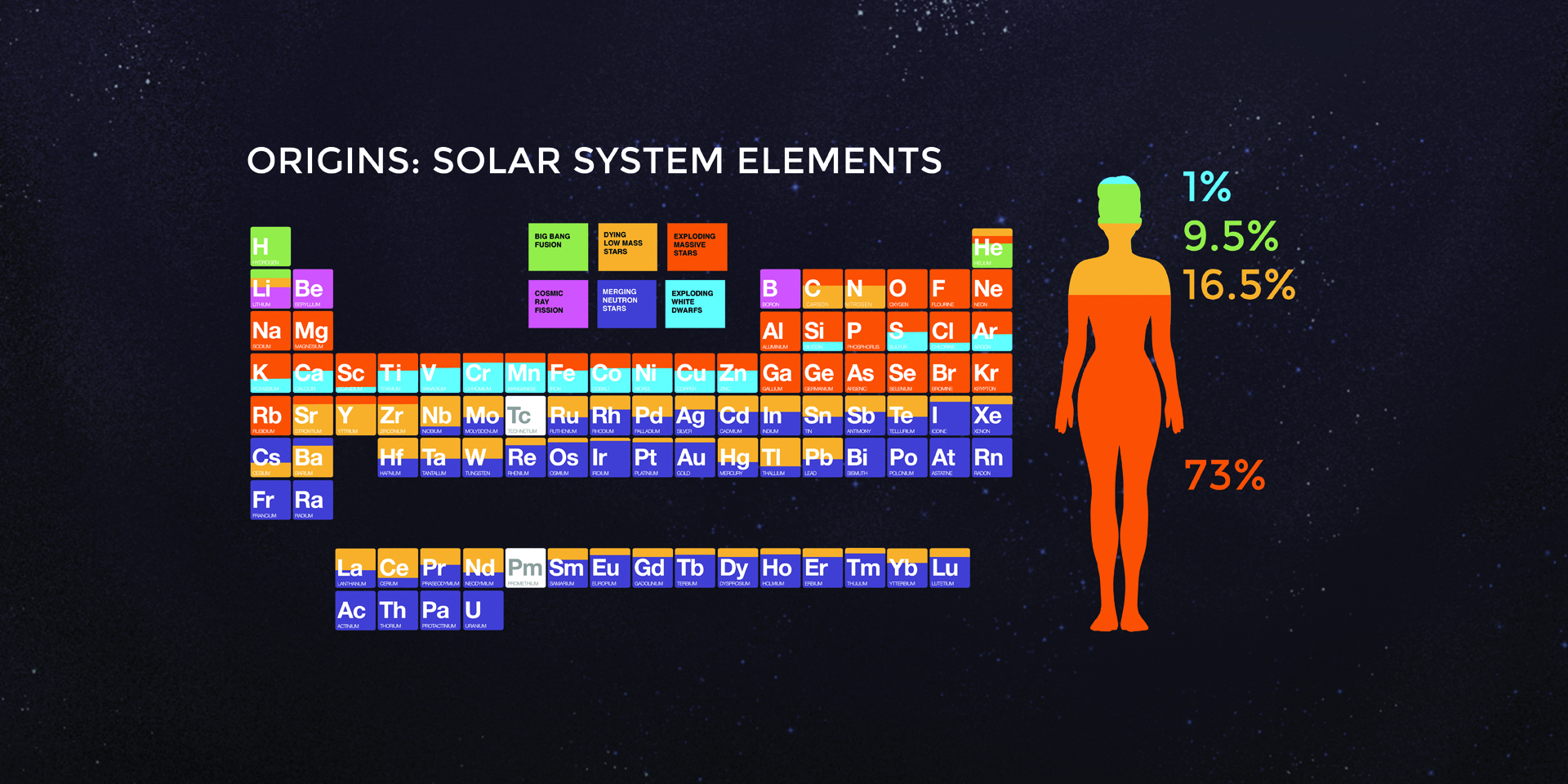
The solar photosphere shows 67 heavier elements in specific relative abundances
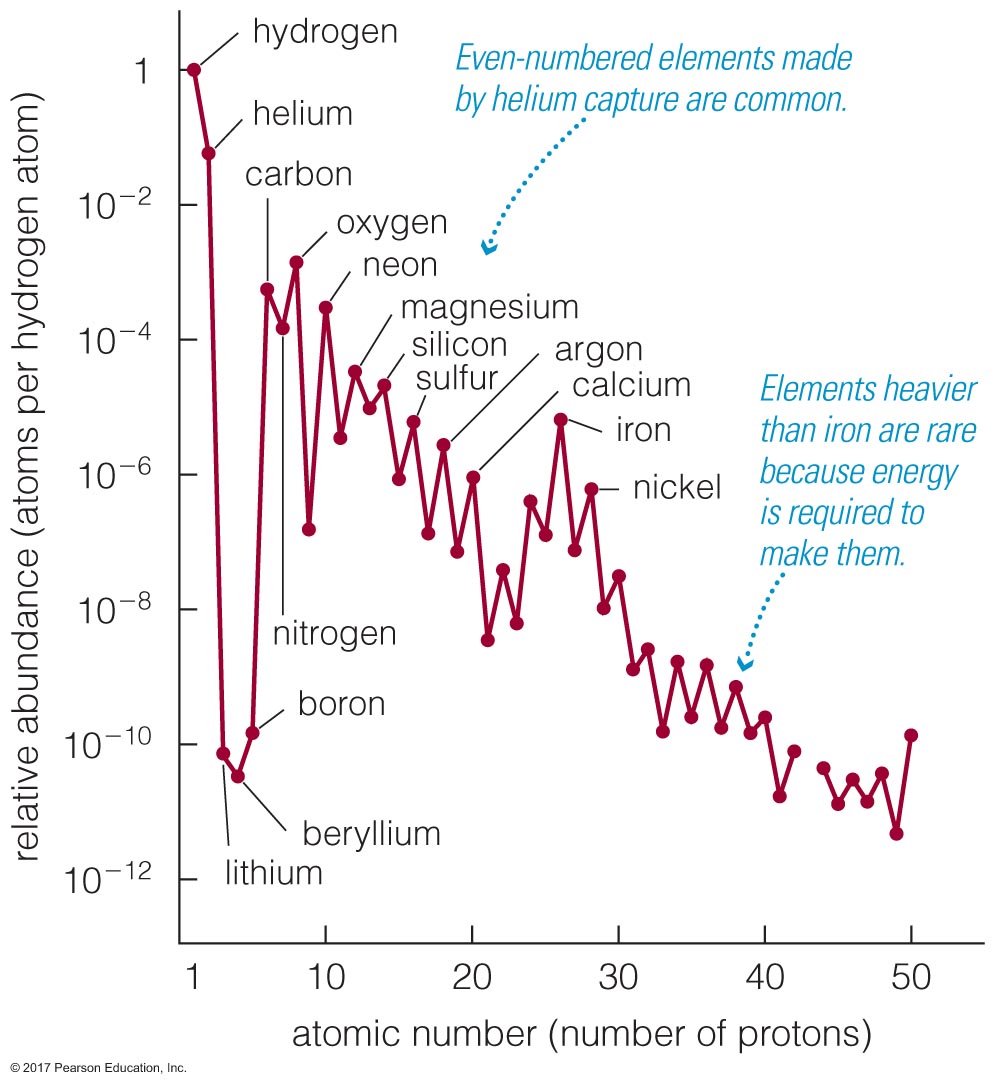
The measured “solar abundance pattern” spans nearly the whole periodic table.
Nucleosynthesis theory predicts those abundances
Big Bang + stellar fusion (pp, CNO, triple-alpha, successive burning) + neutron capture (s-process, r-process) predict relative abundances.
The periodic table is a record of stellar nucleosynthesis
The predicted pattern matches observations to remarkable precision; the few discrepancies (Li, Be, B) are explained by extra processes such as cosmic-ray spallation.
Multiple choice
Why are Li, Be, B much rarer than C and O — hard to make, easy to destroy, or both?
Both. These nuclei have relatively low binding energies and are broken apart efficiently at stellar-interior temperatures, and they are bypassed by the main fusion chains because of the mass-5 and mass-8 bottlenecks. Most of the Li, Be, and B in the universe is therefore attributed to non-stellar processes such as cosmic-ray spallation rather than ordinary stellar fusion.