The Death of Giants
Section 6 of 6
Reference and Synthesis
Reference Tables
Burning Stages of a Star
| Stage | Fuel to ash | (K) | (g/cm³) | Duration | Energy (MeV/nucleon) |
|---|---|---|---|---|---|
| H | 6.7 | ||||
| He | 0.6 | ||||
| C | 0.5 | ||||
| Ne | 0.3 | ||||
| O | 0.5 | ||||
| Si | 0.2 |
Core-Collapse Supernova Energy Budget
| Channel | Energy (erg) | Fraction | Timescale |
|---|---|---|---|
| Neutrinos | |||
| Kinetic (ejecta) | days–months | ||
| Photons (light) | weeks–months |
Symbol Legend
| Symbol | Meaning | Units |
|---|---|---|
| Iron-56 (most common iron isotope) | — | |
| Nickel-56 (radioactive; decays to ) | ||
| Electron neutrino | — | |
| r-process | Rapid neutron capture process | — |
| s-process | Slow neutron capture process | — |
| SNR | Supernova remnant | — |
Summary: Gravity’s Most Violent Victory
The most important ideas from this reading:
- Massive stars burn through fuel on an accelerating timescale. Each successive stage requires a higher temperature, releases less energy per unit mass, and is shortened further by increasing neutrino losses.
- Iron-group nuclei mark the end of exothermic fusion in stellar cores. Once the core is iron-dominated, fusion no longer provides a net pressure source against gravity.
- When the degenerate iron core reaches an effective Chandrasekhar mass of order , collapse begins on a dynamical timescale. Electron capture and photodisintegration accelerate it.
- Core collapse releases a few , mostly in neutrinos. The visible supernova is spectacular but energetically subdominant.
- The periodic table records multiple nucleosynthesis channels. Stellar fusion builds elements up to the iron group; neutron-capture processes build many beyond it; later generations inherit that enriched material.
A supernova briefly outshines a galaxy, yet the light is a rounding error in its energy budget — and “iron is the end of fusion” but heavier elements still exist. Resolve both apparent paradoxes in a sentence each.
Energy budget: ~99% of the leaves as neutrinos (which barely interact) and only ~0.003% as light, so the optical display is dramatic to observe but energetically tiny. Iron endpoint: ordinary fusion stops releasing energy past the iron peak of the binding-energy curve, but heavier elements are still built by neutron capture (s-process in AGB stars, r-process in neutron-star mergers), which pays no Coulomb-barrier penalty.
Glossary
- Core-collapse supernova
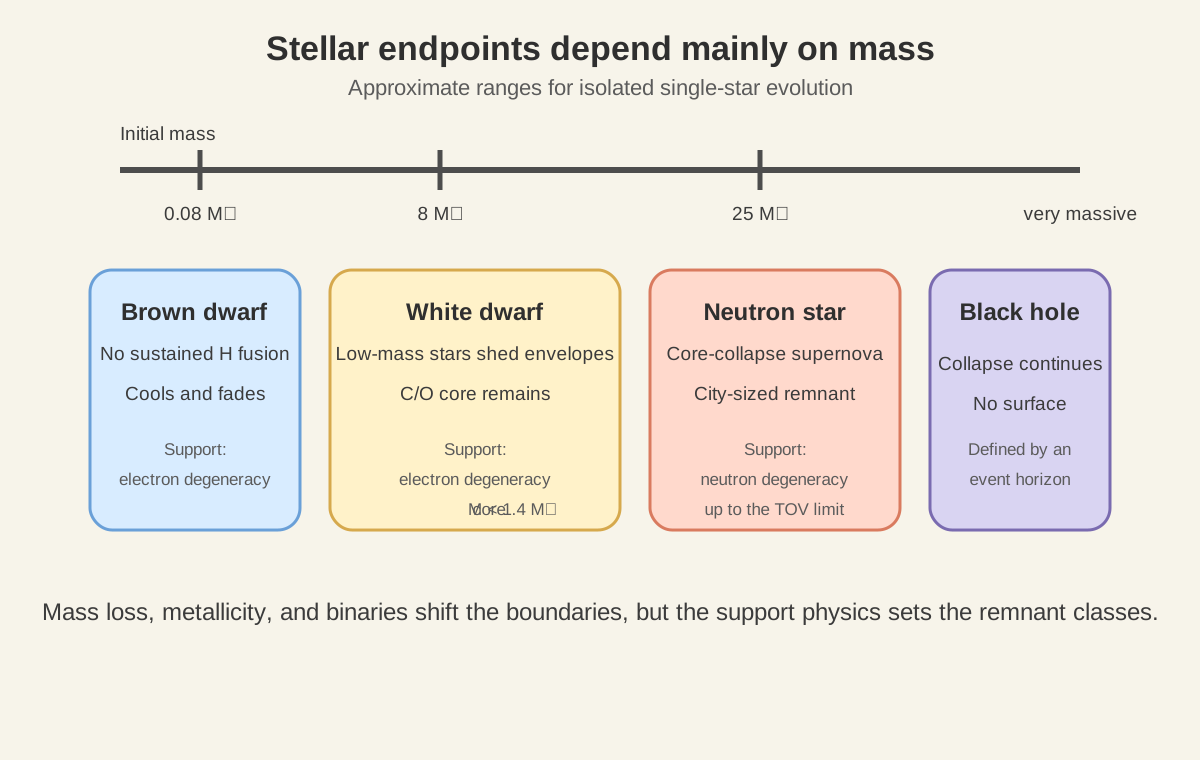
The explosion of a massive star () whose iron core exceeds the effective Chandrasekhar mass and collapses on a dynamical timescale. Most of the released gravitational energy () escapes as neutrinos; a neutrino-revived shock ejects the heavy-element-enriched envelope, leaving a neutron star or black hole.
- Iron peak
The broad maximum of the binding-energy-per-nucleon curve, in the iron/nickel group (). Nuclei here are the most tightly bound, so fusing lighter nuclei toward the peak releases energy while fusing past it costs energy — which is why ordinary stellar fusion stops once a core is iron-dominated.
- Onion-shell burning
The layered interior of an evolved massive star, in which concentric shells fuse progressively heavier fuels (H, He, C, Ne, O, Si) at higher temperatures inward, surrounding an inert iron-group core. Each inner shell burns hotter and faster than the one outside it.
- Photodisintegration
The breakup of nuclei by energetic thermal photons — e.g. above . It is endothermic, so it drains thermal energy from the collapsing iron core and accelerates the collapse.
- r-process
Rapid neutron capture: in an intensely neutron-rich environment, nuclei capture neutrons faster than they can beta-decay, building very neutron-rich isotopes that later decay back to stable heavy elements (Au, Pt, U). Neutron-star mergers are the favored dominant site.
- s-process
Slow neutron capture: neutron captures occur slower than beta decay, so the nucleus stays near the valley of stability as it climbs in mass. It operates in AGB stars and builds many elements between iron and lead.
- Supernova remnant
The expanding, heavy-element-rich shell of gas ejected by a supernova, which sweeps up and shocks the surrounding interstellar medium and radiates across X-ray, optical, and radio bands for – years before dispersing. It is the debris field, distinct from the compact remnant (neutron star or black hole) left at the center.