The Death of Giants
Section 3 of 6
Core Collapse
Part 3: Core Collapse
The Collapse Sequence
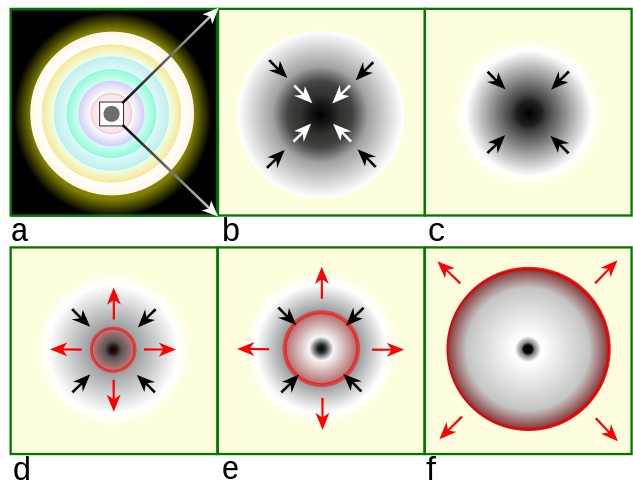
The collapse happens on a dynamical timescale, so before following the sequence, estimate the timescale directly using the dynamical-timescale estimate from Reading 1:
With for the collapsing iron core, , so has units of seconds.
Evaluating the scale,
So once pressure support fails, collapse on a timescale of is completely reasonable. The causal sequence is then:
- Electron capture (). At densities above , electrons are captured by protons, . This removes electrons that were providing degeneracy pressure and emits neutrinos — both push the core toward faster collapse.
- Photodisintegration of iron (). Above , energetic photons break iron-group nuclei apart, . This
photodisintegration - Free-fall collapse (). With both degeneracy and thermal support reduced, the inner core collapses rapidly, reaching infall speeds of order (free-fall onto a core, , climbs from at km to near km, approaching the bounce).
- Core bounce (). When the inner core reaches nuclear density , the equation of state stiffens sharply, neutron degeneracy pressure becomes important, and the inner core halts and rebounds, launching a shock into the still-infalling outer core.
- Shock stall and neutrino heating (–). The outgoing shock loses energy dissociating infalling nuclei and stalls. Neutrinos streaming out of the hot proto-neutron star deposit a small fraction of their energy behind the shock, which can help revive it.
- Explosion (). The revived shock propagates outward, ejecting much of the star’s outer layers at –.
Photodisintegration
The breakup of nuclei by energetic thermal photons — e.g. above . It is endothermic, so it drains thermal energy from the collapsing iron core and accelerates the collapse.
The Energy Budget
The gravitational energy released by core collapse is enormous — and, as we will see, most of it never appears as light.
Problem
The iron core collapses from to , releasing . Show the final radius dominates, estimate the energy for a core, and compare it to a solar rest energy.
StepThe small final radius dominates
so the term contributes only — the final radius sets the scale.
StepEvaluate (M = 1.4 Msun = 2.8e33 g, R_f = 10 km = 1e6 cm)
Dimensional check
✓.
Result
With a solar rest energy , — about a fifth of the core’s own rest energy, released in under a second. (General relativity softens this Newtonian estimate; the realistic neutron-star binding energy is –, still staggering.) For comparison, the Sun radiates only over its entire life — one collapse releases hundreds of solar lifetimes of energy in a heartbeat.
Because this is an order-of-magnitude estimate, it is standard to summarize the release as a few . Where does it go? A representative energy budget is:
| Channel | Typical energy | Approximate fraction | Timescale |
|---|---|---|---|
| Neutrinos | |||
| Kinetic energy of ejecta | days–months | ||
| Photons (light) | weeks–months |
So the most luminous optical event in the universe is not where most of the energy goes. The optical display is spectacular because photons are easy to detect, not because they carry the dominant share of the energy. The visible light curve is powered largely by radioactive decay, especially the chain .
Quick check
A supernova can briefly outshine its host galaxy in visible light. Does that imply visible light carries most of the explosion energy? Use the table above to justify your answer quantitatively.
No. Comparing channels, , so only a few hundred-thousandths of the total energy comes out as light. Neutrinos dominate the energy budget by about four orders of magnitude. The light output is observationally dramatic but energetically tiny.