Nuclear Fusion and the Four Forces
Section 7 of 7
Fusion Limits and Synthesis
Part 6: Why Fusion Stops Releasing Energy
Fusion releases energy only when it moves nuclei toward higher binding energy per nucleon — which means lower total mass-energy. For a nucleus with protons and neutrons, the binding energy is , and the
Binding energy per nucleon
The total nuclear binding energy divided by the number of nucleons, . It measures how tightly bound each nucleon is on average; it rises from light nuclei to a broad maximum at the iron/nickel peak, which is why exothermic fusion ends there.
Think first
If fusion means combining smaller nuclei into larger ones, should it always release energy? Commit before looking at the curve.
Then read on.
Light nuclei have relatively low binding energy per nucleon; it rises toward intermediate-mass nuclei and reaches a broad maximum in the iron/nickel peak.
| Nucleus | Binding energy per nucleon |
|---|---|
| iron/nickel region | – |
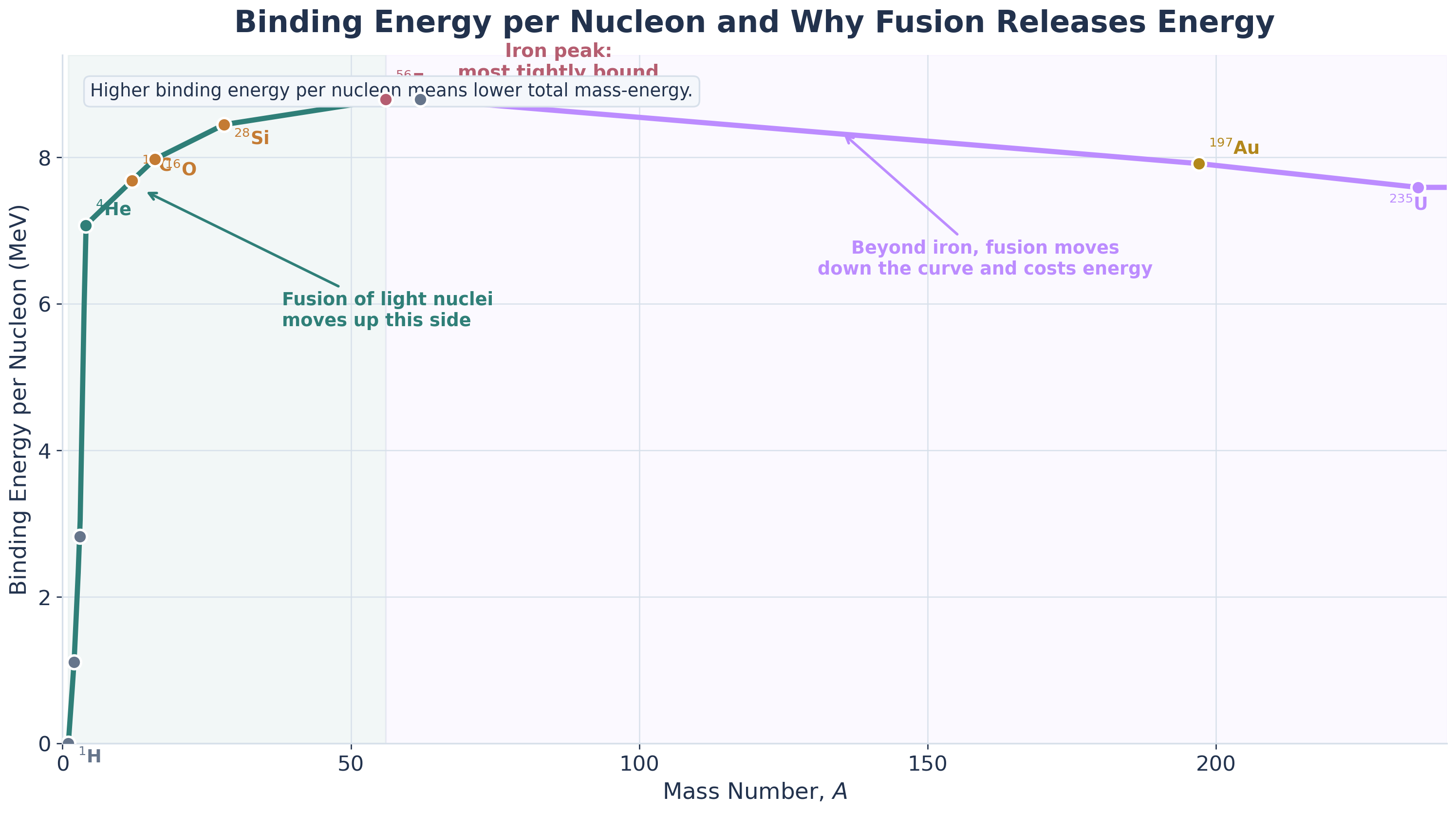
For nuclei lighter than the iron/nickel region, fusion moves matter upward on this curve, releasing energy. Beyond it, further fusion would move nuclei downward in binding energy per nucleon, so energy must be supplied — which is why ordinary exothermic stellar fusion stops near iron.
Quick check
A massive star has burned hydrogen to helium and helium to carbon and oxygen. If it starts fusing carbon, is energy still released? What about iron?
Carbon fusion can still release energy because carbon lies well below the iron/nickel region. Iron is different: nuclei near the iron/nickel peak are already among the most tightly bound, so further fusion is generally endothermic. That is why an iron core cannot support a star by ordinary exothermic fusion.
Enrichment: The CNO Cycle and Temperature Sensitivity
In Sun-like stars the pp-chain dominates hydrogen burning; in hotter, more massive stars the
CNO cycle
A hydrogen-burning pathway in which carbon, nitrogen, and oxygen act as catalysts (returned at the end) while four protons become one helium-4. Its rate is far more temperature-sensitive than the pp-chain ( vs ), so it dominates in hot, massive cores.
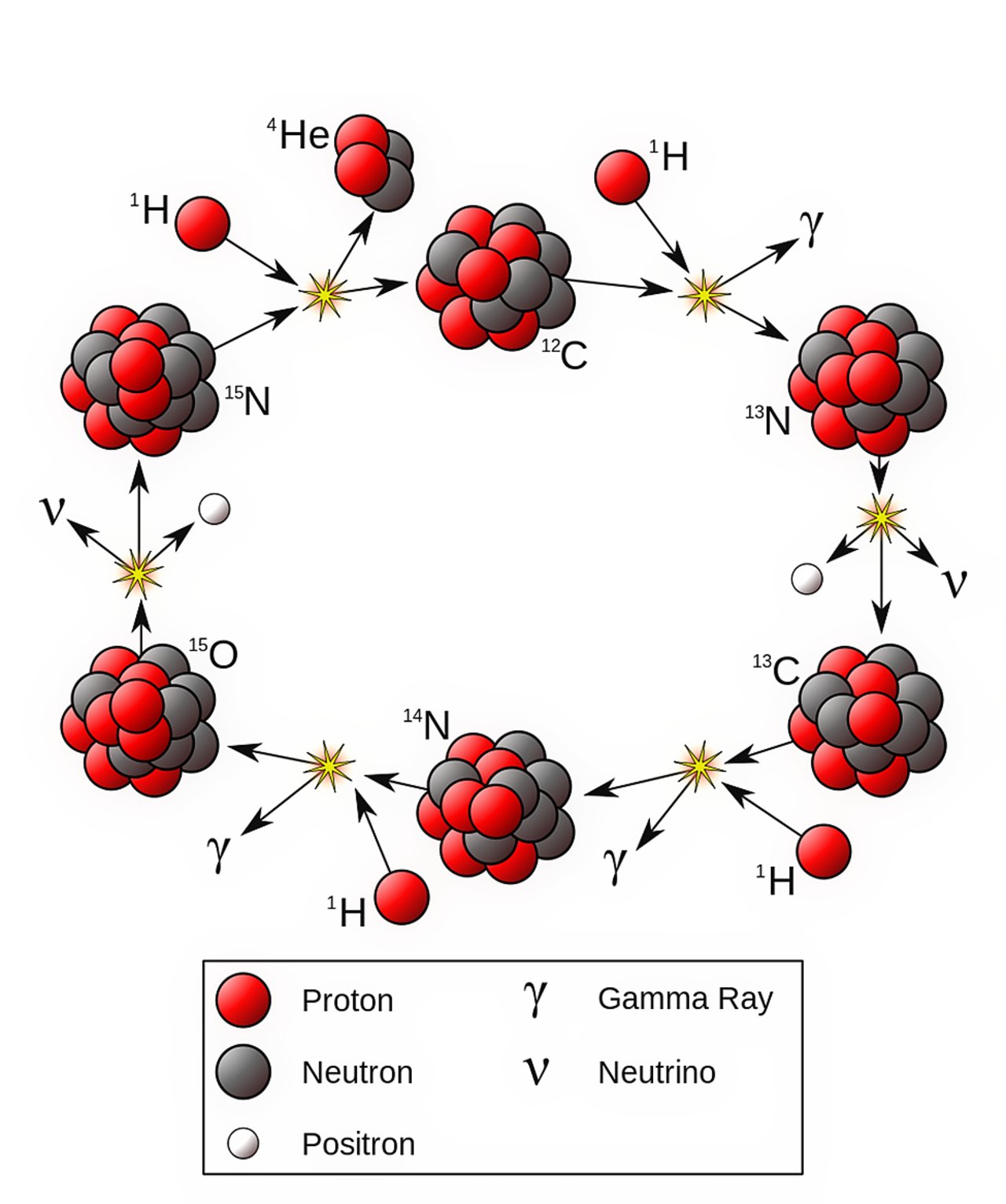
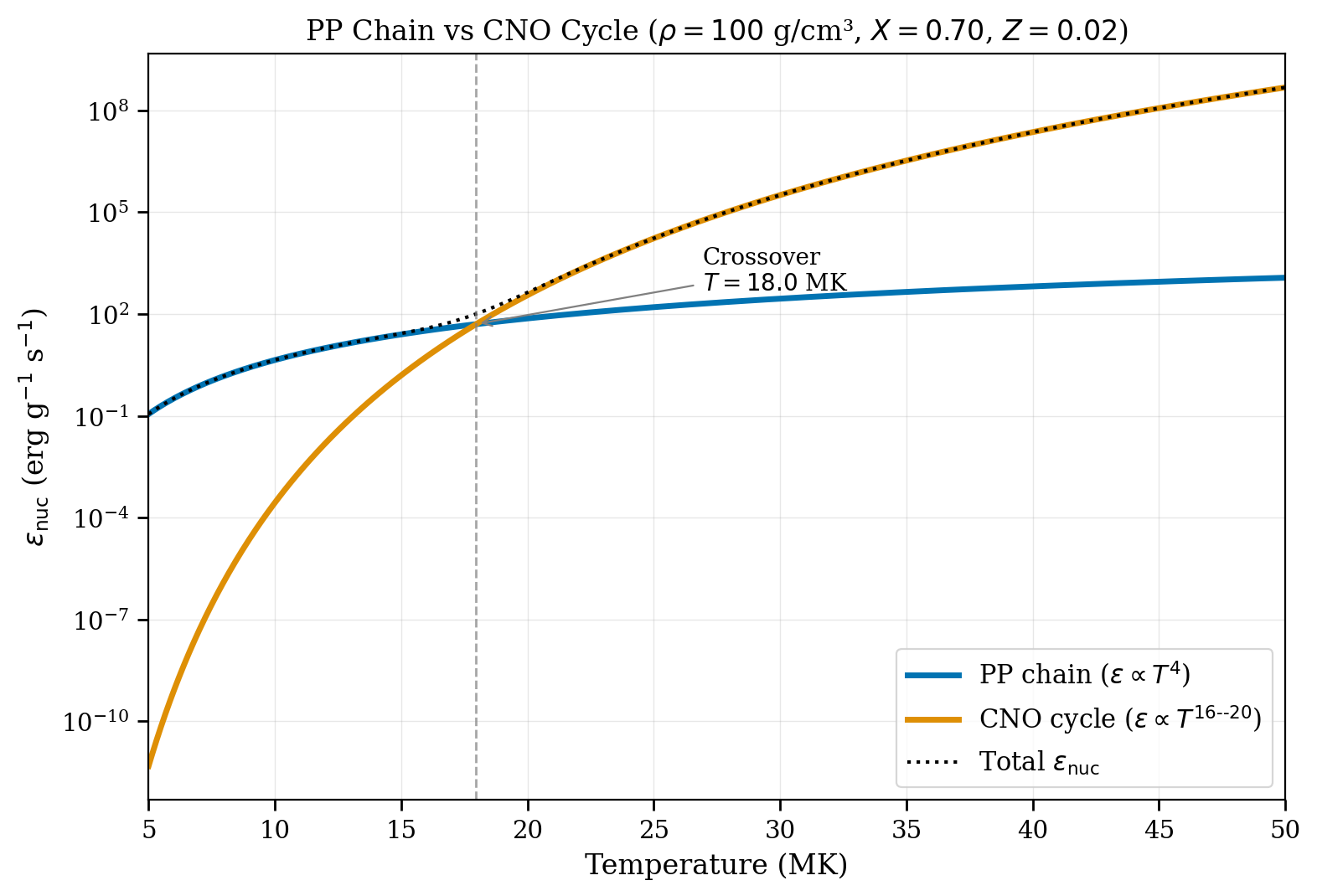
Near solar-core conditions a standard pedagogical approximation is , while for CNO burning a common rule of thumb is . That difference matters: once the core becomes hot enough, the CNO curve rises past the pp curve and the dominant pathway changes.
Problem
If the core temperature rises by 10%, estimate the change in rate for (1) pp burning with and (2) CNO burning with . Which responds more dramatically?
pp: — up about 46%. CNO: — up about a factor of 5–6. CNO burning responds far more dramatically, one reason massive-star cores have a different structure from the Sun’s.
Quick check
The first stars formed from nearly pure hydrogen and helium with essentially no carbon, nitrogen, or oxygen. Could they still fuse hydrogen? If so, which pathway had to start the burning?
Yes — the pp-chain does not require C, N, or O catalysts, so primordial stars had to begin hydrogen burning through the pp-chain. Without initial CNO material the CNO cycle cannot start the burning; once a trace of carbon formed, very massive stars could later switch to CNO because of its steep temperature sensitivity.
Synthesis
- Gravity compresses the core and sets a temperature of order .
- Electromagnetism creates a Coulomb barrier of order .
- A classical thermal gas at solar-core temperatures should fail to cross it.
- Quantum tunneling allows rare close approaches anyway.
- The weak interaction throttles the first pp reaction.
- The strong interaction binds nucleons once they are close enough.
- The mass deficit becomes released energy through .
- Fusion remains exothermic only up to the iron/nickel region.
| Step | Reaction | Dominant physics | Role in the timescale |
|---|---|---|---|
| 1 | tunneling + weak + strong | slow bottleneck | |
| 2 | EM approach + strong | fast once deuterium exists | |
| 3 | EM approach + strong | completes the chain | |
| net | all four forces | set mainly by Step 1 |
Quick check
Four symptoms, one per fundamental force. For each, name the force that is the key actor — and say which step would stall if that force were slightly weaker:
- A more massive star reaches a hotter core and fuses faster.
- Doubling a nucleus’s charge makes it far harder to fuse.
- Two nuclei merge into and release energy.
- The Sun’s hydrogen lasts ten billion years rather than minutes.
- Gravity — it sets the compression and core temperature; weaken it and the core never reaches fusion conditions. 2. Electromagnetism — the Coulomb barrier scales as ; weaken it and every barrier drops. 3. The strong force — it binds the final nucleus and supplies the mass-deficit energy; weaken it and fusion releases less (or nothing). 4. The weak force — it throttles the first conversion; weaken it and the bottleneck step stalls, lengthening or preventing the burn. The move is reading each symptom back to its force, not reciting the list.
Without looking back: the solar core is ~1000x too cool for classical proton-proton fusion. What two pieces of physics make fusion happen anyway, and which one makes it slow?
Quantum tunneling lets protons penetrate the Coulomb barrier despite sub-barrier energies, so fusion is possible. The first reaction also requires a weak-interaction proton-to-neutron conversion (making deuterium), which is rare — so the weak interaction makes fusion slow, setting the Sun’s multi-billion-year main-sequence lifetime.
Summary: All Four Forces, One Star
- Gravity alone can make stars hot, but not hot enough for classical proton-proton fusion.
- The Coulomb barrier is of order ; the solar-core thermal scale is only of order .
- The Boltzmann tail explains why classical high-energy particles are rare — it is not the tunneling law.
- Quantum tunneling makes close approach possible, but the first pp reaction is slow because it requires a weak-interaction proton-to-neutron conversion.
- A complete net pp-chain reaction releases about , most of which stays in the star.
- Fusion releases energy only while moving nuclei upward in binding energy per nucleon, which is why exothermic stellar fusion ends near the iron/nickel region.
Glossary
- Binding energy per nucleon
The total nuclear binding energy divided by the number of nucleons, . It measures how tightly bound each nucleon is on average; it rises from light nuclei to a broad maximum at the iron/nickel peak, which is why exothermic fusion ends there.
- CNO cycle
A hydrogen-burning pathway in which carbon, nitrogen, and oxygen act as catalysts (returned at the end) while four protons become one helium-4. Its rate is far more temperature-sensitive than the pp-chain ( vs ), so it dominates in hot, massive cores.
- Coulomb barrier
The electrostatic potential-energy barrier two like-charged nuclei must overcome (or tunnel through) to reach nuclear distance, . For two protons at it is of order — about a thousand times the solar-core thermal energy.
- de Broglie wavelength
The wavelength associated with a particle of momentum . When it is large compared with the relevant distance scale, wave behavior (interference, tunneling) dominates and the classical point-particle picture fails.
- Deuterium
The hydrogen isotope with one proton and one neutron ( or ). Its formation in the first pp reaction is the rate-limiting, weak-interaction-controlled step of solar hydrogen burning.
- Gamow window
The narrow band of collision energies — above the mean thermal energy but below the barrier — where the product of thermal abundance and tunneling probability peaks. Most fusion reactions occur here, not at the average thermal energy.
- Mass deficit
The difference between the total rest mass of the separate reactants and the bound product, . By it sets the energy released in fusion; for hydrogen-to-helium it is 0.71% of the mass, or about per net reaction.
- Quantum tunneling
The penetration of a wavefunction into and beyond a classically forbidden barrier, giving a small but nonzero probability of finding the particle on the far side even when its energy is below the barrier. It is what makes stellar fusion possible at .
- Strong interaction
The strongest fundamental force, but effective only at nuclear distances (). It binds quarks into protons and neutrons and binds nucleons into nuclei once they are close enough to overcome Coulomb repulsion.
- Uncertainty principle
— a position spread and a momentum spread cannot both be made arbitrarily small. It is a structural consequence of describing particles as waves, not a measurement limitation.
- Weak interaction
The fundamental force that converts one particle type into another — e.g. a proton into a neutron. In the pp-chain it enables the first reaction (); because weak conversions are rare, it sets the slow pace of solar hydrogen burning.