The Final States
Section 2 of 6
Pulsars
Part 2: Pulsars — Cosmic Lighthouses
The observational puzzle
Some radio sources pulse so regularly they act like cosmic clocks. The first known
Pulsar
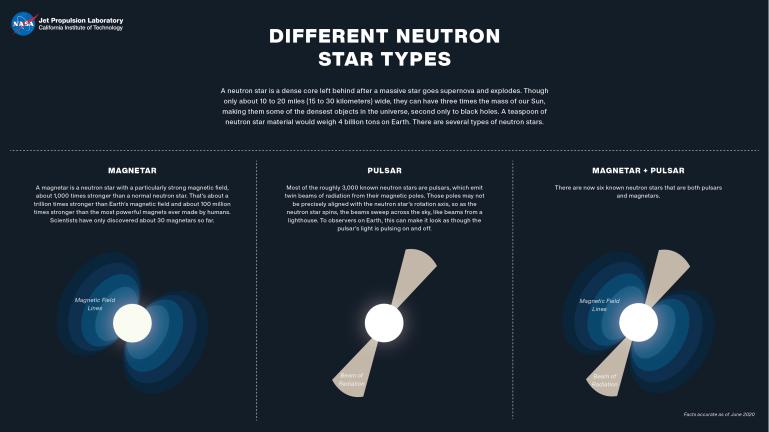
A rotating, magnetized neutron star observed through regular pulses of radiation as its beam crosses our line of sight. The pulse period is the star’s rotation period — not a blinking on and off.
The Lighthouse Model
In the
Lighthouse model
The model in which a pulsar’s radiation beam sweeps across Earth because the neutron star’s magnetic axis is misaligned with its rotation axis. We see a pulse each time the beam points at us — the pulse period is the rotation period.
Compactness from pulse periods
A rotating object cannot have its surface moving faster than light. The equatorial speed is ; requiring it to stay below gives a maximum radius . For a millisecond pulsar with ,
A millisecond pulsar must be only tens of kilometers across — neutron-star scale, not normal-star scale.
Problem
A pulsar has . (1) Should its maximum radius be larger or smaller than the case? (2) Use to estimate it. (3) Why does this rule out a normal star?
Larger, because the object has more time to rotate once. Since the period is five times larger, the radius limit is five times larger: . Even this is far smaller than a normal star, so the source must be a compact remnant.
Pulsar spin-down
Most isolated pulsars gradually slow down, losing rotational energy through magnetic fields, particle winds, and radiation, so their periods increase over time. Young pulsars tend to spin rapidly; old isolated pulsars spin more slowly; and old neutron stars in binaries can be spun back up by accreting matter from a companion. These spun-up old neutron stars are
Millisecond pulsar
A rapidly rotating neutron star with a period of a few milliseconds, typically an old neutron star spun back up by accreting matter from a binary companion.