The Final States
Section 3 of 6
The TOV Limit
Part 3: The TOV Limit — The End of Neutron-Star Support
Another maximum mass
White dwarfs have a maximum mass (the Chandrasekhar limit, ). Neutron stars also have one: the Tolman-Oppenheimer-Volkoff limit.
TOV limit
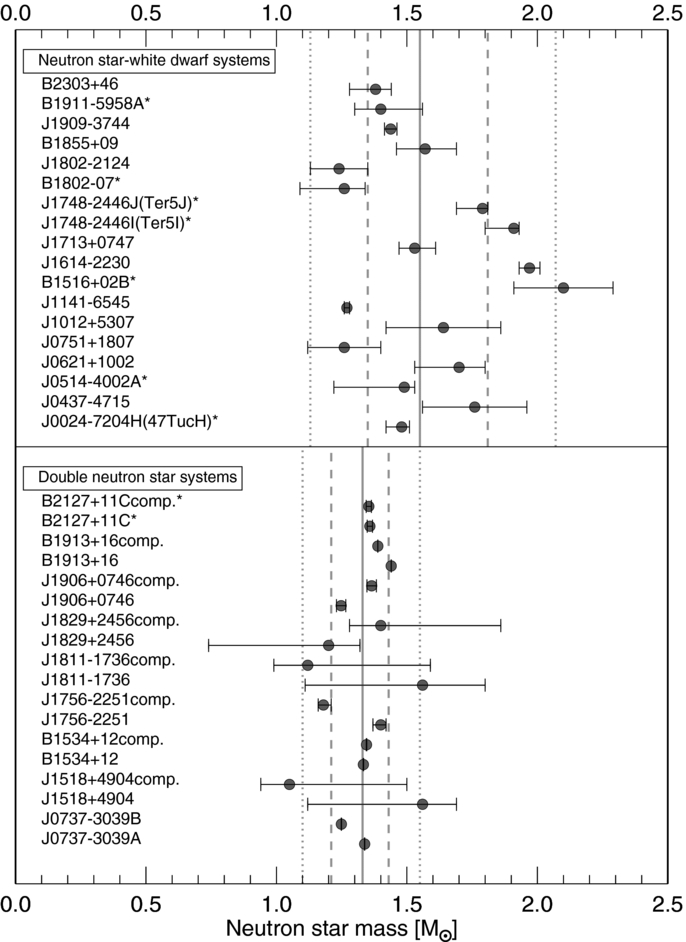
The Tolman-Oppenheimer-Volkoff limit: the maximum mass of a stable neutron star, set by general relativity and the equation of state of dense nuclear matter. In this course treat it as roughly – — less precisely known than the Chandrasekhar limit.
Why the TOV limit is not a single clean number
The Chandrasekhar limit is relatively clean because it depends on electron degeneracy pressure. The TOV limit is harder because neutron-star interiors involve general relativity (gravity is strong), nuclear-density matter with an uncertain
Equation of state
A relationship between pressure, density, temperature, and composition. For neutron stars the high-density equation of state is uncertain, which is the main reason the TOV limit is imprecise.
For this course, use the order-of-magnitude statement:
When we need a simple dividing value, use — a useful course-level boundary, not an exact universal constant.
| Object | Main support | Approximate maximum mass | Above the limit? |
|---|---|---|---|
| White dwarf | electron degeneracy pressure | collapse toward neutron-star densities | |
| Neutron star | dense nuclear matter + neutron degeneracy | – | collapse to a black hole |
The physical meaning
The TOV limit does not mean “neutrons suddenly disappear.” It means that for a sufficiently massive neutron star, adding mass increases gravity faster than pressure can respond — and in general relativity, pressure itself contributes to gravity, making the instability worse. So a remnant below allows a stable neutron star, while one above implies black-hole formation.
Quick check
An unseen compact object in a binary has a securely measured mass of . (1) Why unlikely a white dwarf? (2) Why unlikely a neutron star? (3) What model is left? (4) What assumption about the TOV limit are you making?
A compact object is above the Chandrasekhar limit (too massive for a white dwarf) and above the course-level TOV range of – (unlikely a stable neutron star). The remaining model is a black hole, assuming the true TOV limit is below .
Above the TOV limit
If the remnant exceeds the maximum stable neutron-star mass, the known pressure sources have all failed: thermal pressure cannot help permanently (the remnant cools), electron degeneracy already failed at the Chandrasekhar limit, and neutron-star matter cannot support it. The collapse forms an event horizon; in classical general relativity, continued collapse inside leads toward a singularity, and a full quantum theory of gravity would be needed to describe the innermost endpoint.