The Final States
Section 6 of 6
The Gravity Scoreboard
Part 6: The Gravity Scoreboard — Final Entry
The complete compact-remnant picture
The outcome of stellar evolution depends most directly on the final core mass, not just the initial mass. Initial mass still matters, but mass loss, metallicity, rotation, and binary interaction can shift the boundaries.
| Approximate initial mass | Typical final remnant | Physical support |
|---|---|---|
| brown dwarf | electron degeneracy, no sustained hydrogen fusion | |
| white dwarf | electron degeneracy pressure | |
| neutron star | dense nuclear matter and neutron degeneracy pressure | |
| black hole | no stable pressure support outside an event horizon |
Gravity’s opponents
| Opponent | What it does | When it fails |
|---|---|---|
| Thermal pressure | gas pressure pushes outward | fuel is exhausted and the star cools |
| Nuclear fusion | replaces lost thermal energy | fusion reaches iron-group nuclei |
| Radiation pressure | supports massive stars | contributes to instability and mass loss |
| Electron degeneracy pressure | supports white dwarfs | fails near |
| Dense nuclear matter | supports neutron stars | fails above roughly – |
| Nothing known | no stable support | black hole forms |
Compact Objects at a Glance
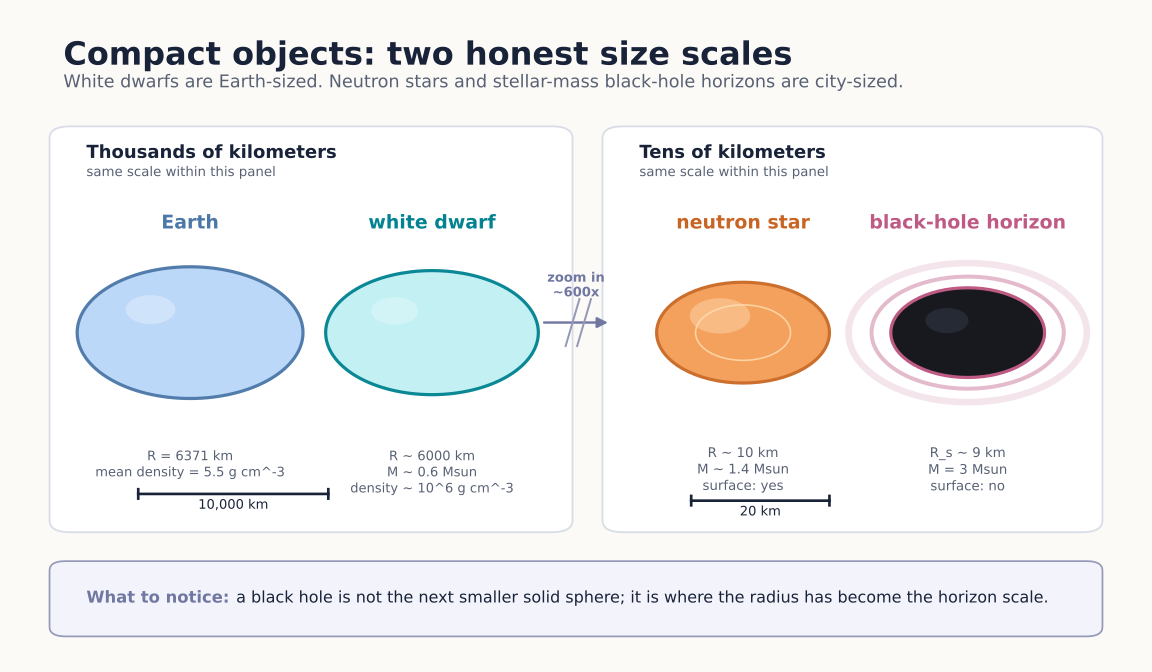
| Property | White dwarf | Neutron star | Black hole |
|---|---|---|---|
| Mass | – | for stellar remnants | |
| Radius | |||
| Density | – | no material density at a surface | |
| Compactness | at the event horizon | ||
| Support | electron degeneracy | no stable material surface | |
| Surface? | yes | yes | no; event horizon |
Dense nuclear matter
Matter compressed to densities comparable to or above an atomic nucleus, where
Neutron degeneracy pressure
Quantum pressure from densely packed neutrons, the neutron analog of electron degeneracy pressure. In a real neutron star it is only part of the support; nuclear interactions and relativistic effects also contribute.
Symbol Legend
| Symbol | Meaning | Typical units |
|---|---|---|
| Schwarzschild radius | or | |
| maximum stable neutron-star mass | ||
| pulsar period | ||
| magnetic flux | ||
| angular velocity | ||
| compactness | dimensionless |
Summary: Gravity Wins
The most important ideas from this reading:
- Neutron stars are nuclear-density remnants — roughly a solar mass in a radius of about , supported by dense nuclear matter.
- Pulsars are rotating neutron stars — short periods require compact objects, and the lighthouse model explains the pulses without the star turning on and off.
- The TOV limit is the neutron-star maximum mass — roughly –, but its exact value depends on the uncertain dense-matter equation of state and on general relativity.
- The Schwarzschild radius sets the black-hole scale — .
- Compactness tells us when gravity becomes relativistic — is tiny for Earth and the Sun, but large for neutron stars and equal to at an event horizon.
- Black holes are causal boundaries, not material surfaces — the event horizon is the boundary beyond which no signal escapes.
- The evidence is convergent — pulsars, X-ray binaries, gravitational waves, stellar orbits, and horizon-scale imaging all point to compact remnants governed by dense matter and general relativity.
A black hole emits no light from inside its horizon, yet astronomers are confident black holes exist. In two or three sentences, explain how indirect evidence makes that case — and why a compact accretor is read as a black hole rather than a neutron star.
Independent lines of evidence — companion-star orbits (mass), X-rays from accretion (a compact object), the absence of surface emission (an event horizon, not a surface), gravitational-wave chirps, and horizon-scale images — converge on the same model, and convergence of independent measurements is what makes an inference strong, not directness. A accretor is above both the Chandrasekhar limit (so not a white dwarf) and the – TOV limit (so not a stable neutron star), leaving a black hole as the only remaining compact-object model.
Glossary
- Accretion
The process in which gas falls onto a compact object. As the gas loses gravitational potential energy it heats up and can emit X-rays — the glow that lets us detect otherwise-invisible neutron stars and black holes in binaries.
- Black hole
A region of spacetime bounded by an event horizon, formed when collapse exceeds all known pressure support. It is not a material surface or solid object; its mass curves spacetime so strongly that nothing inside the horizon can send signals out.
- Compactness
The dimensionless ratio of an object’s Schwarzschild radius to its actual radius — a measure of how close it is to being a black hole. Tiny for Earth and the Sun, for neutron stars, and exactly at a black-hole event horizon. Large compactness means general relativity is essential.
- Dense nuclear matter
Matter compressed to densities comparable to or above an atomic nucleus, where
neutron degeneracy pressure, nuclear interactions, and general relativity all matter. It is the pressure source that supports a neutron star.- Equation of state
A relationship between pressure, density, temperature, and composition. For neutron stars the high-density equation of state is uncertain, which is the main reason the TOV limit is imprecise.
- Event horizon
The causal boundary of a black hole: inside it, every future-directed path leads inward and no signal can escape to distant observers. It is a property of spacetime geometry, not a material surface. For a non-rotating black hole it sits at the Schwarzschild radius.
- Gravitational redshift
The stretching of light to longer wavelengths as it climbs out of a gravitational field, for a static compact object. It comes from spacetime curvature, not from motion, and grows without bound as the emitter approaches the event horizon.
- Lighthouse model
The model in which a pulsar’s radiation beam sweeps across Earth because the neutron star’s magnetic axis is misaligned with its rotation axis. We see a pulse each time the beam points at us — the pulse period is the rotation period.
- Millisecond pulsar
A rapidly rotating neutron star with a period of a few milliseconds, typically an old neutron star spun back up by accreting matter from a binary companion.
- Neutron degeneracy pressure
Quantum pressure from densely packed neutrons, the neutron analog of electron degeneracy pressure. In a real neutron star it is only part of the support; nuclear interactions and relativistic effects also contribute.
- Neutron star
A compact remnant with roughly a solar mass compressed into a radius of order , supported by dense nuclear matter (neutron degeneracy pressure plus nuclear interactions). Densities reach –, comparable to an atomic nucleus.
- Pulsar
A rotating, magnetized neutron star observed through regular pulses of radiation as its beam crosses our line of sight. The pulse period is the star’s rotation period — not a blinking on and off.
- Schwarzschild radius
The event-horizon radius of a non-rotating, uncharged black hole, . Compress a mass inside its Schwarzschild radius and it becomes a black hole; the ratio measures how relativistic an object’s gravity is.
- TOV limit
The Tolman-Oppenheimer-Volkoff limit: the maximum mass of a stable neutron star, set by general relativity and the equation of state of dense nuclear matter. In this course treat it as roughly – — less precisely known than the Chandrasekhar limit.