The Final States
Complete lesson
Neutron Stars
By the end of this reading, you will be able to:
Guiding question: when even neutron-star matter cannot resist gravity, what is left — and how do we know it is there?
We have followed gravity through every stage of stellar evolution. First it was opposed by thermal pressure; then nuclear fusion replaced lost thermal energy; in massive stars radiation pressure mattered; after fusion ended, electron degeneracy supported white dwarfs below the Chandrasekhar limit. Now we reach the final two possibilities. If collapse reaches nuclear density and the remnant mass is not too large, neutron-rich matter forms a neutron star — roughly a solar mass in a city-sized object. If even that support fails, collapse forms a black hole — not a solid object, not a surface, but a region of spacetime bounded by an event horizon. The main skill here is not memorizing object names; it is reasoning from observed behavior to a compact-object model to a physical inference.
Part 1: Neutron Stars — Nuclear-Density Objects
Neutron star
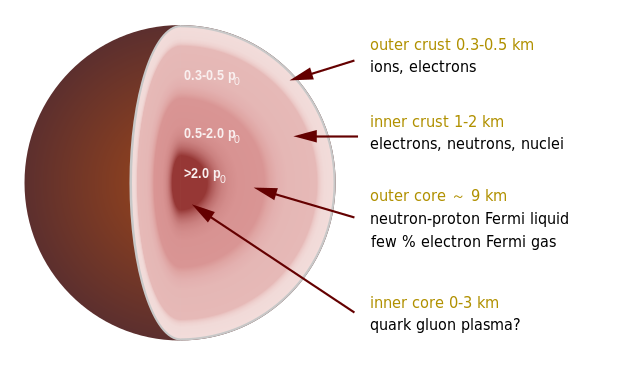
A compact remnant with roughly a solar mass compressed into a radius of order , supported by dense nuclear matter (neutron degeneracy pressure plus nuclear interactions). Densities reach –, comparable to an atomic nucleus.
Pulses, massive X-ray accretors, and dense-object mergers
Pulsars pulse with periods from milliseconds to seconds; some X-ray binaries hold compact accretors near or above a solar mass; gravitational-wave events show mergers of extremely dense objects.
A compact remnant of city scale
A normal star cannot rotate hundreds of times per second without tearing apart, but a remnant of radius can.
Stellar remnants far denser than white dwarfs
Neutron stars are the model that explains compactness, rapid rotation, strong magnetic fields, and nuclear-density matter.
Formation
During core collapse in a massive star: (1) the iron core grows past the effective Chandrasekhar mass; (2) electron degeneracy pressure can no longer support it; (3) electrons are captured by protons, ; (4) the core becomes neutron-rich and collapses toward nuclear density, ; (5) the collapse halts only if dense nuclear matter can supply enough pressure before an event horizon forms. This produces a proto-neutron star: hot, compact, neutrino-bright, and only tens of kilometers across.
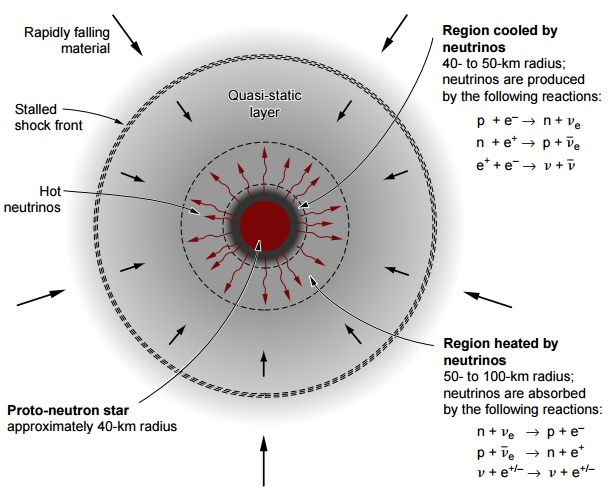
Neutron-star formation is not a quiet compression process. It is tied to neutrino transport, nuclear-density matter, and the explosion mechanism.
Extreme Properties
| Property | Typical neutron star | Physical meaning |
|---|---|---|
| Mass | – | Comparable to the Sun |
| Radius | Comparable to a city | |
| Density | Comparable to nuclear density | |
| Surface gravity | times Earth gravity | |
| Newtonian escape speed | A substantial fraction of light speed | |
| Magnetic field | – | Trillions to quadrillions of gauss |
| Rotation period | – | Milliseconds to seconds |
The Density Calculation
A good compact-object calculation always carries units. With and a teaspoon volume , the mass is . Converting, — about 2.5 billion tonnes in a teaspoon-sized volume. This is a scale analogy, not a laboratory scenario: neutron-star matter exists only because it is compressed by the gravity of an entire star.
Multiple choice
If the density is , a sample has a mass closest to which value?
, which is closest to (the coefficient does not push it up to , and it is well above ). The distractors are the adjacent powers of ten, so you have to actually carry the multiplication, not just eyeball the exponent.
Why So Fast? Conservation of Angular Momentum
Neutron stars often rotate rapidly because collapse shrinks the radius enormously. Angular momentum is approximately conserved during collapse, and for a uniform sphere . With mass roughly fixed, , so , giving . Since , a larger means a shorter period: .
Comparing a Sun-sized object () to a neutron star (), the radius ratio is and the spin-up factor is . Starting from the Sun’s gives
Real neutron stars lose angular momentum during collapse and are not uniform spheres; the point is the scaling — shrinking the radius by can increase the rotation rate by .
Problem
A star collapses from radius to . (1) Should its rotation period become larger or smaller? (2) By what factor does it change if angular momentum is conserved? (3) What assumption did you make about the mass?
Smaller — the star spins faster. With , , so the period is one million times shorter, assuming the mass is approximately unchanged and angular momentum is conserved.
Pulsars
Part 2: Pulsars — Cosmic Lighthouses
The observational puzzle
Some radio sources pulse so regularly they act like cosmic clocks. The first known
Pulsar
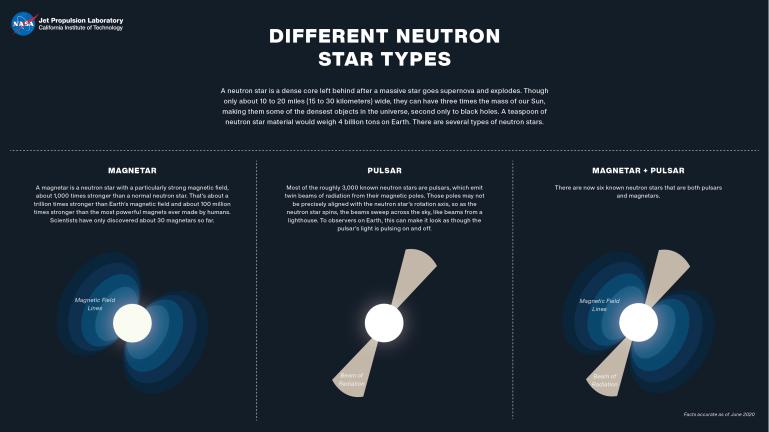
A rotating, magnetized neutron star observed through regular pulses of radiation as its beam crosses our line of sight. The pulse period is the star’s rotation period — not a blinking on and off.
The Lighthouse Model
In the
Lighthouse model
The model in which a pulsar’s radiation beam sweeps across Earth because the neutron star’s magnetic axis is misaligned with its rotation axis. We see a pulse each time the beam points at us — the pulse period is the rotation period.
Compactness from pulse periods
A rotating object cannot have its surface moving faster than light. The equatorial speed is ; requiring it to stay below gives a maximum radius . For a millisecond pulsar with ,
A millisecond pulsar must be only tens of kilometers across — neutron-star scale, not normal-star scale.
Problem
A pulsar has . (1) Should its maximum radius be larger or smaller than the case? (2) Use to estimate it. (3) Why does this rule out a normal star?
Larger, because the object has more time to rotate once. Since the period is five times larger, the radius limit is five times larger: . Even this is far smaller than a normal star, so the source must be a compact remnant.
Pulsar spin-down
Most isolated pulsars gradually slow down, losing rotational energy through magnetic fields, particle winds, and radiation, so their periods increase over time. Young pulsars tend to spin rapidly; old isolated pulsars spin more slowly; and old neutron stars in binaries can be spun back up by accreting matter from a companion. These spun-up old neutron stars are
Millisecond pulsar
A rapidly rotating neutron star with a period of a few milliseconds, typically an old neutron star spun back up by accreting matter from a binary companion.
The TOV Limit
Part 3: The TOV Limit — The End of Neutron-Star Support
Another maximum mass
White dwarfs have a maximum mass (the Chandrasekhar limit, ). Neutron stars also have one: the Tolman-Oppenheimer-Volkoff limit.
TOV limit
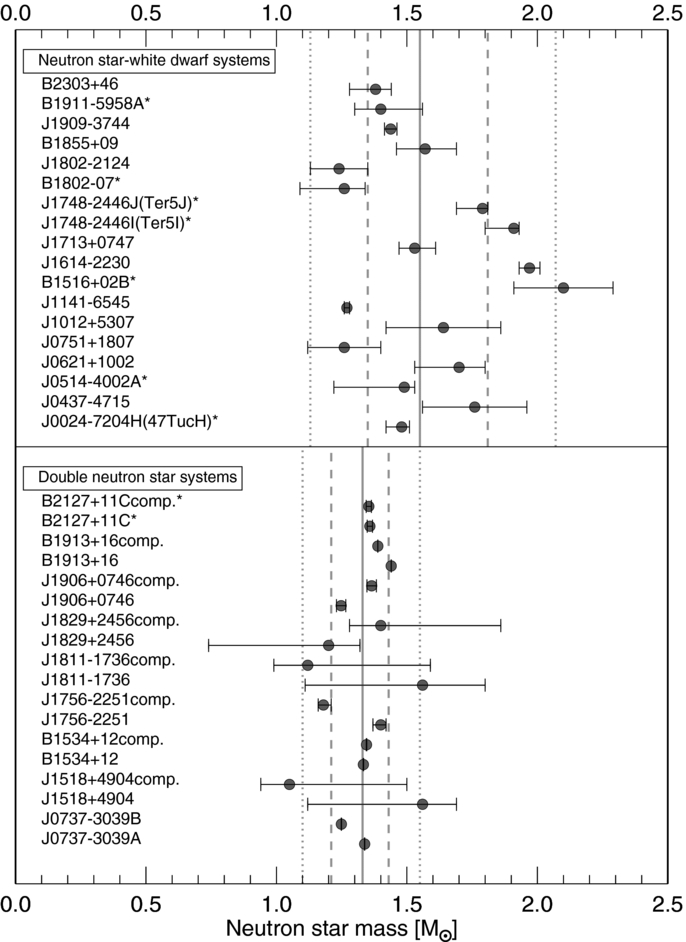
The Tolman-Oppenheimer-Volkoff limit: the maximum mass of a stable neutron star, set by general relativity and the equation of state of dense nuclear matter. In this course treat it as roughly – — less precisely known than the Chandrasekhar limit.
Why the TOV limit is not a single clean number
The Chandrasekhar limit is relatively clean because it depends on electron degeneracy pressure. The TOV limit is harder because neutron-star interiors involve general relativity (gravity is strong), nuclear-density matter with an uncertain
Equation of state
A relationship between pressure, density, temperature, and composition. For neutron stars the high-density equation of state is uncertain, which is the main reason the TOV limit is imprecise.
For this course, use the order-of-magnitude statement:
When we need a simple dividing value, use — a useful course-level boundary, not an exact universal constant.
| Object | Main support | Approximate maximum mass | Above the limit? |
|---|---|---|---|
| White dwarf | electron degeneracy pressure | collapse toward neutron-star densities | |
| Neutron star | dense nuclear matter + neutron degeneracy | – | collapse to a black hole |
The physical meaning
The TOV limit does not mean “neutrons suddenly disappear.” It means that for a sufficiently massive neutron star, adding mass increases gravity faster than pressure can respond — and in general relativity, pressure itself contributes to gravity, making the instability worse. So a remnant below allows a stable neutron star, while one above implies black-hole formation.
Quick check
An unseen compact object in a binary has a securely measured mass of . (1) Why unlikely a white dwarf? (2) Why unlikely a neutron star? (3) What model is left? (4) What assumption about the TOV limit are you making?
A compact object is above the Chandrasekhar limit (too massive for a white dwarf) and above the course-level TOV range of – (unlikely a stable neutron star). The remaining model is a black hole, assuming the true TOV limit is below .
Above the TOV limit
If the remnant exceeds the maximum stable neutron-star mass, the known pressure sources have all failed: thermal pressure cannot help permanently (the remnant cools), electron degeneracy already failed at the Chandrasekhar limit, and neutron-star matter cannot support it. The collapse forms an event horizon; in classical general relativity, continued collapse inside leads toward a singularity, and a full quantum theory of gravity would be needed to describe the innermost endpoint.
Black Holes
Part 4: Black Holes — Where Gravity Wins
Black hole
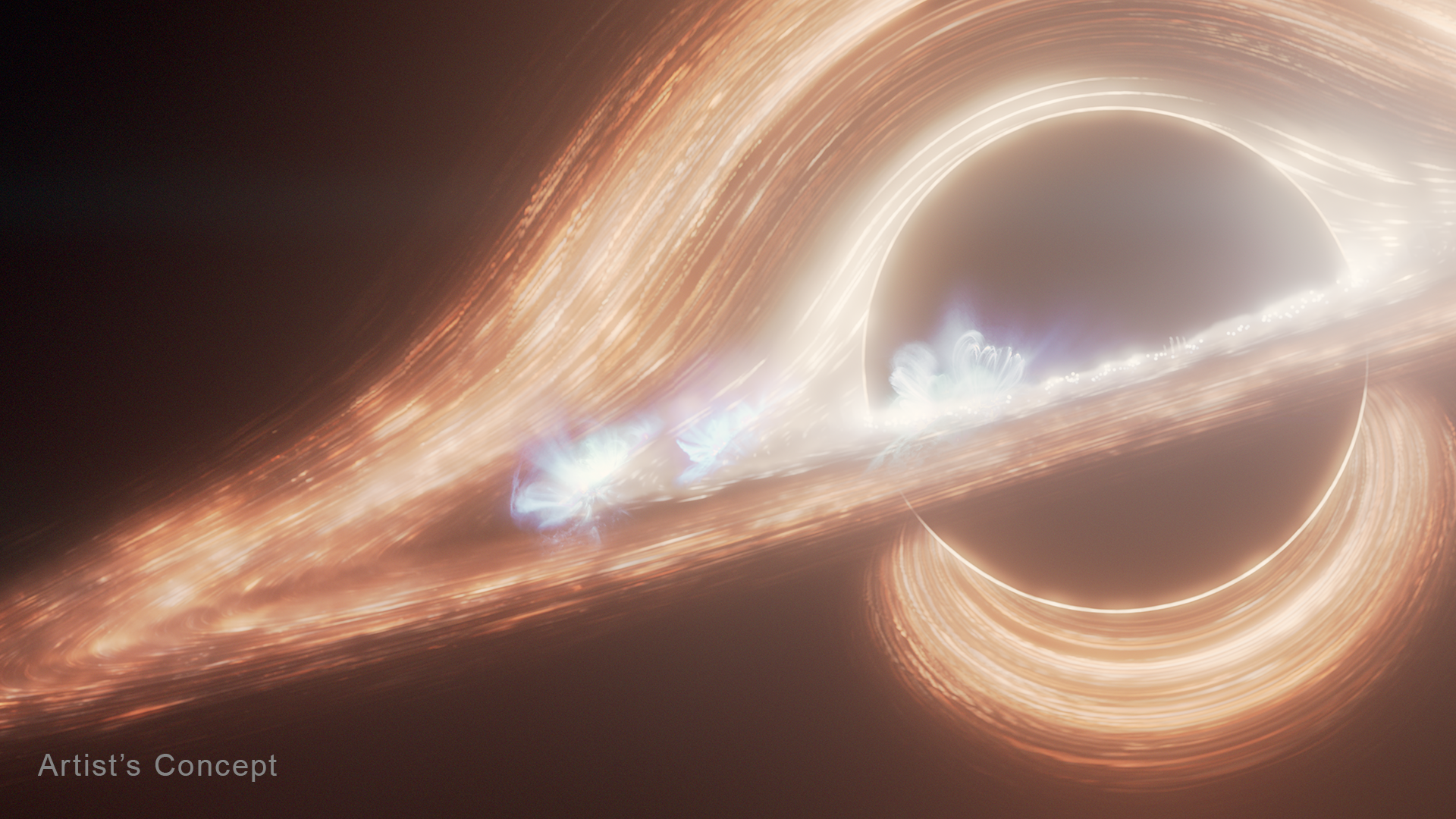
A region of spacetime bounded by an event horizon, formed when collapse exceeds all known pressure support. It is not a material surface or solid object; its mass curves spacetime so strongly that nothing inside the horizon can send signals out.
Event horizon
The causal boundary of a black hole: inside it, every future-directed path leads inward and no signal can escape to distant observers. It is a property of spacetime geometry, not a material surface. For a non-rotating black hole it sits at the Schwarzschild radius.
The Schwarzschild Radius: A Newtonian Preview
We can motivate the event-horizon scale with a Newtonian escape-speed argument. The escape speed from radius around mass is . Setting and solving gives , the
For a non-rotating, uncharged black hole, is the event-horizon radius.
Schwarzschild radius
The event-horizon radius of a non-rotating, uncharged black hole, . Compress a mass inside its Schwarzschild radius and it becomes a black hole; the ratio measures how relativistic an object’s gravity is.
Problem
Compute the Schwarzschild radius of the Sun. Use , , .
StepNumerator and denominator
StepDivide and convert
Dimensional check
✓ — the units reduce to a length.
Result
To make the Sun a black hole, you would compress one solar mass inside a radius of about .
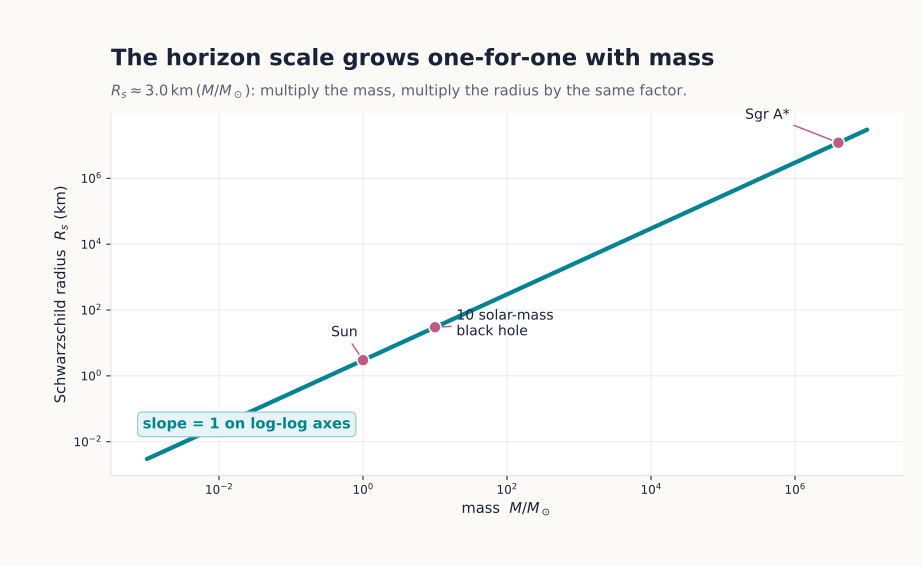
Useful scaling relation
Because , using the Sun as reference gives .
| Object | Mass | Schwarzschild radius |
|---|---|---|
| Sun | ||
| black hole | ||
| Sgr A* |
Problem
Use . (1) for a black hole? (2) For a black hole? (3) Why didn’t you need and again?
; . You did not need and again because the proportionality constant was already evaluated for one solar mass.
Compactness: When does gravity become relativistic?
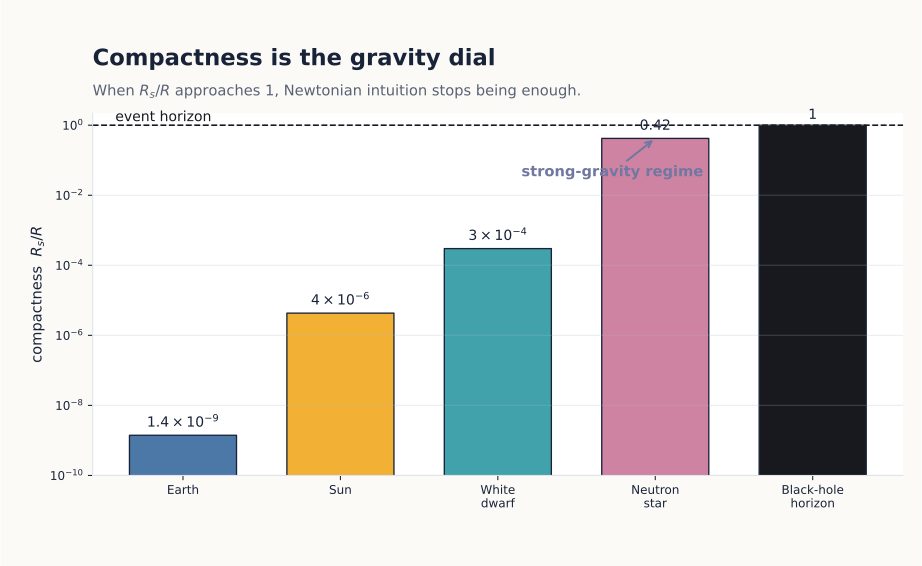
The Schwarzschild radius is useful even for objects that are not black holes. The
A compactness of is enormous: general relativity is not a tiny correction for neutron stars, it is essential. The Newtonian escape-speed estimate gives , so .
Compactness
The dimensionless ratio of an object’s Schwarzschild radius to its actual radius — a measure of how close it is to being a black hole. Tiny for Earth and the Sun, for neutron stars, and exactly at a black-hole event horizon. Large compactness means general relativity is essential.
Quick check
Rank Earth, Sun, white dwarf, neutron star, and black-hole event horizon by compactness , smallest to largest. Which require general relativity?
Earth, Sun, white dwarf, neutron star, black-hole event horizon. General relativity is essential for neutron stars and black holes because their compactness is a large fraction of unity; it is a tiny correction for Earth and the Sun in most contexts.
Quick check
A neutron star and a stellar-mass black hole of the same mass both bend light strongly and accrete gas.
- (a) State the key physical difference between the neutron star’s surface and the black hole’s event horizon.
- (b) Name one observation that would distinguish “has a material surface” from “has a horizon.”
(a) The neutron star’s surface is material — solid, nuclear-density matter you could in principle stand on, where infalling gas crashes and is stopped. The event horizon is not made of anything: it is a causal boundary in spacetime. Infalling matter passes through it without hitting a surface, and nothing inside can send a signal back out.
(b) Surface signatures distinguish them: thermonuclear X-ray bursts (accreted hydrogen/helium piling on a surface and igniting) and steady thermal surface emission are seen for neutron stars but are absent for black holes — matter reaching a horizon simply disappears, with no surface to pile up on or radiate from. Their absence (plus a mass above the TOV limit) favors a horizon.
Why General Relativity?
The Newtonian escape-speed argument gives the correct Schwarzschild radius, but it does not explain what an event horizon really is. Newtonian gravity has no universal speed limit; general relativity does. GR changes the picture three ways: nothing travels faster than light; mass and energy curve spacetime; and inside an event horizon, all future-directed paths lead inward. That last point is the key — the horizon is not a wall, it is where the geometry of spacetime prevents outward escape.
Gravitational redshift
The stretching of light to longer wavelengths as it climbs out of a gravitational field, for a static compact object. It comes from spacetime curvature, not from motion, and grows without bound as the emitter approaches the event horizon.
Observational Evidence
Part 5: Observational Evidence
How do we know neutron stars and black holes are real?
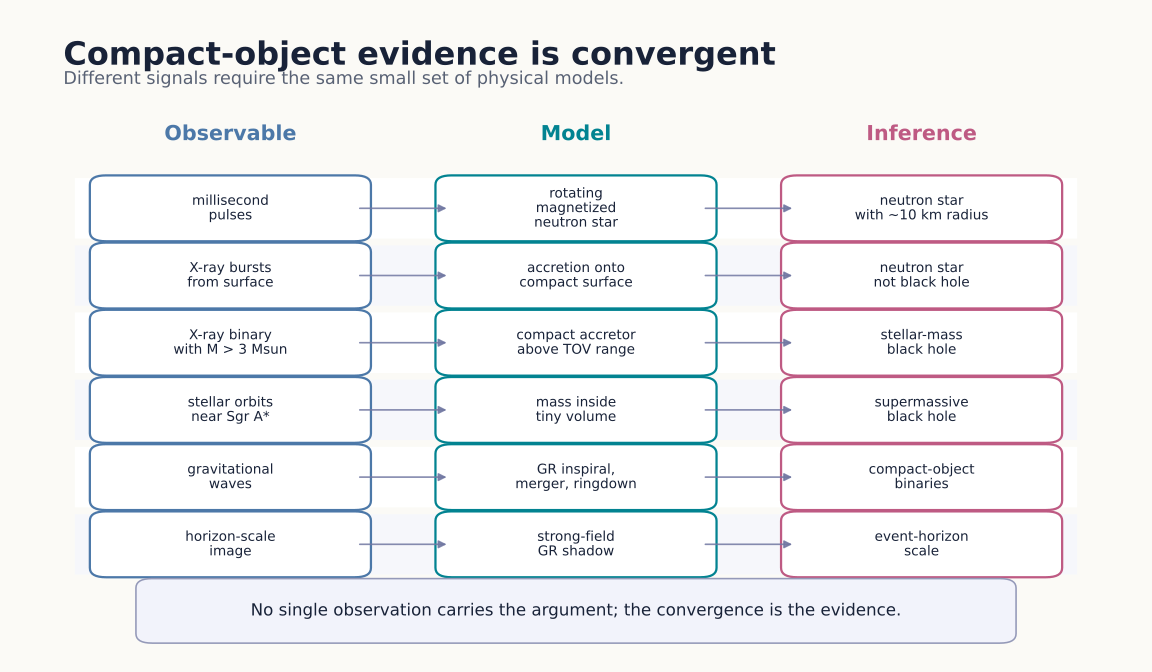
Neither object is easy to observe directly: neutron stars are tiny and often faint, and black holes emit no light from inside the event horizon. So the evidence is mostly indirect — but indirect does not mean weak. It is strong because many independent observations point to the same physical models.
Evidence for neutron stars
| Observable | Model | Inference |
|---|---|---|
| Regular radio or X-ray pulses | rotating magnetized neutron star | pulsars are compact, rapidly rotating remnants |
| Millisecond periods | radius must be tens of km or less | normal stars are ruled out |
| Pulsar glitches | solid crust coupled to fluid/superfluid interior | neutron stars have internal structure |
| X-ray bursts in binaries | accretion onto a compact surface | some compact objects have surfaces |
| Neutron-star mergers | gravitational waves from dense-object inspiral | neutron stars merge and constrain dense matter |
A radio source pulses every few milliseconds
Extremely regular pulses, fast enough to act as a clock.
A rotating lighthouse beam
A beam sweeps across Earth once per rotation of a magnetized neutron star.
The source must be compact enough to rotate that fast
A neutron star explains the period, compactness, magnetic field, and stability.
Evidence for black holes
| Observable | Model | Inference |
|---|---|---|
| X-ray binaries with compact objects above | accretion onto an object too massive to be a neutron star | stellar-mass black hole |
| No surface emission from the compact object | event horizon rather than material surface | black-hole model favored |
| Stellar orbits around Sgr A* | Keplerian orbits around an unseen compact mass | inside a tiny region |
| Gravitational waves from mergers | inspiral, merger, and ringdown predicted by GR | black-hole binaries exist |
| Event Horizon Telescope images | horizon-scale emission and shadow | strong-field GR near supermassive black holes |
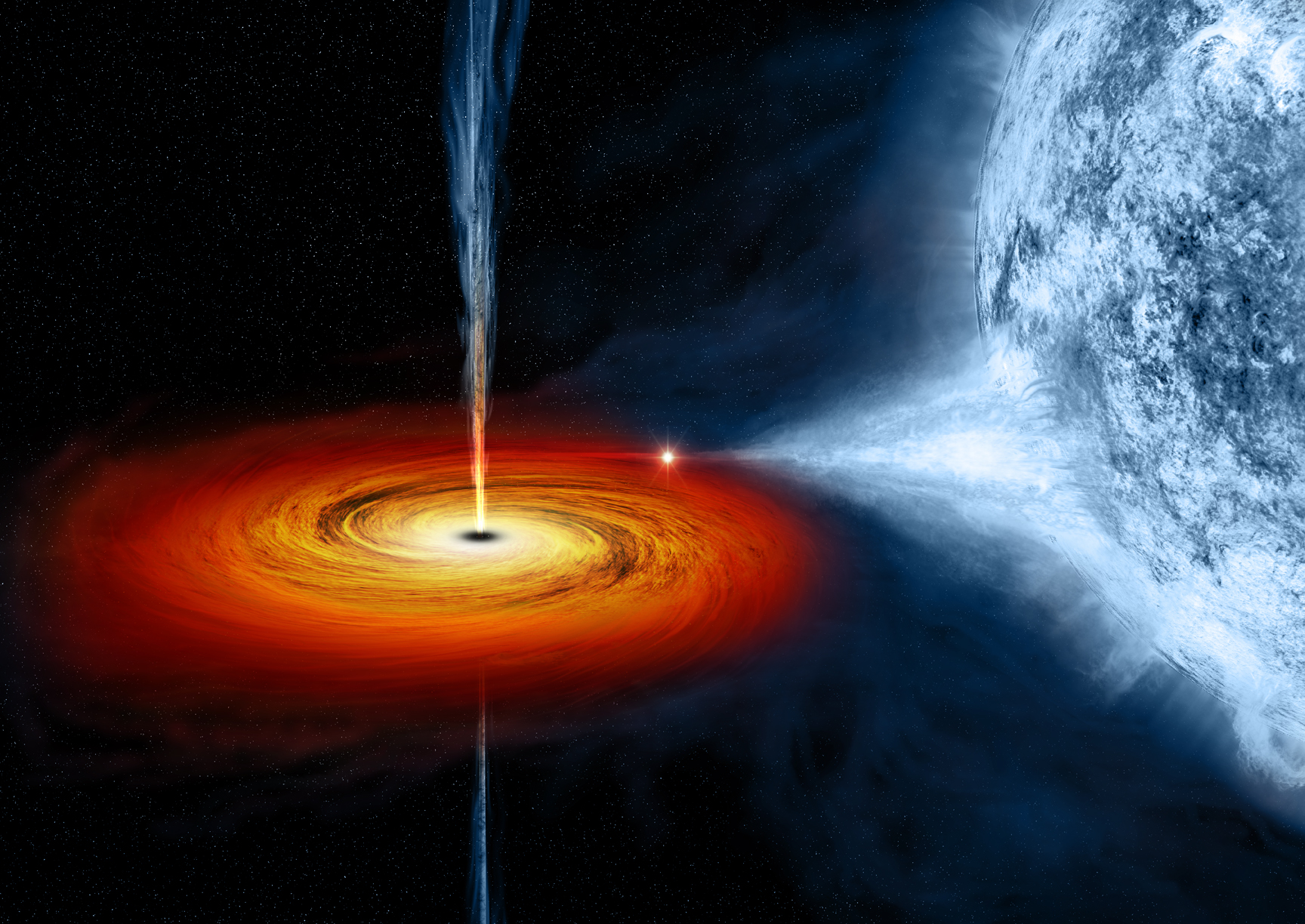
Cygnus X-1 is a classic black-hole candidate. We do not see the black hole directly; we infer it from the companion star’s orbit, the mass of the compact object, and the intense X-ray emission from
Accretion
The process in which gas falls onto a compact object. As the gas loses gravitational potential energy it heats up and can emit X-rays — the glow that lets us detect otherwise-invisible neutron stars and black holes in binaries.
A gravitational-wave signal that swept up in frequency and amplitude
LIGO detected a chirp whose frequency and amplitude changed rapidly with time.
Two black holes spiraling together (GR waveform)
General relativity predicts the inspiral-merger-ringdown waveform of a binary black hole.
A binary black-hole merger
The initial black holes had masses of tens of solar masses, and several solar masses of energy were radiated as gravitational waves.
Problem
The black hole at the Galactic center has . Find its Schwarzschild radius and compare it to the Sun’s radius and to 1 AU.
StepSchwarzschild radius by scaling
StepCompare to the Sun and to 1 AU
Dimensional check
Both comparisons are ratios of kilometers to kilometers, so they are dimensionless ✓.
Result
Even a four-million-solar-mass black hole has an event horizon smaller than Mercury’s orbit — about 17 solar radii.
Quick check
An unseen object has mass , strong X-ray emission from accretion, no evidence for a surface, and a rapidly orbiting companion. Why is the black-hole model favored over a neutron star?
An compact object is above the expected maximum mass of a stable neutron star. The X-rays show accretion onto a compact object, the absence of surface evidence favors an event horizon rather than a neutron-star surface, and the companion orbit fixes the mass — so the black-hole model is the best fit.
The Gravity Scoreboard
Part 6: The Gravity Scoreboard — Final Entry
The complete compact-remnant picture
The outcome of stellar evolution depends most directly on the final core mass, not just the initial mass. Initial mass still matters, but mass loss, metallicity, rotation, and binary interaction can shift the boundaries.
| Approximate initial mass | Typical final remnant | Physical support |
|---|---|---|
| brown dwarf | electron degeneracy, no sustained hydrogen fusion | |
| white dwarf | electron degeneracy pressure | |
| neutron star | dense nuclear matter and neutron degeneracy pressure | |
| black hole | no stable pressure support outside an event horizon |
Gravity’s opponents
| Opponent | What it does | When it fails |
|---|---|---|
| Thermal pressure | gas pressure pushes outward | fuel is exhausted and the star cools |
| Nuclear fusion | replaces lost thermal energy | fusion reaches iron-group nuclei |
| Radiation pressure | supports massive stars | contributes to instability and mass loss |
| Electron degeneracy pressure | supports white dwarfs | fails near |
| Dense nuclear matter | supports neutron stars | fails above roughly – |
| Nothing known | no stable support | black hole forms |
Compact Objects at a Glance
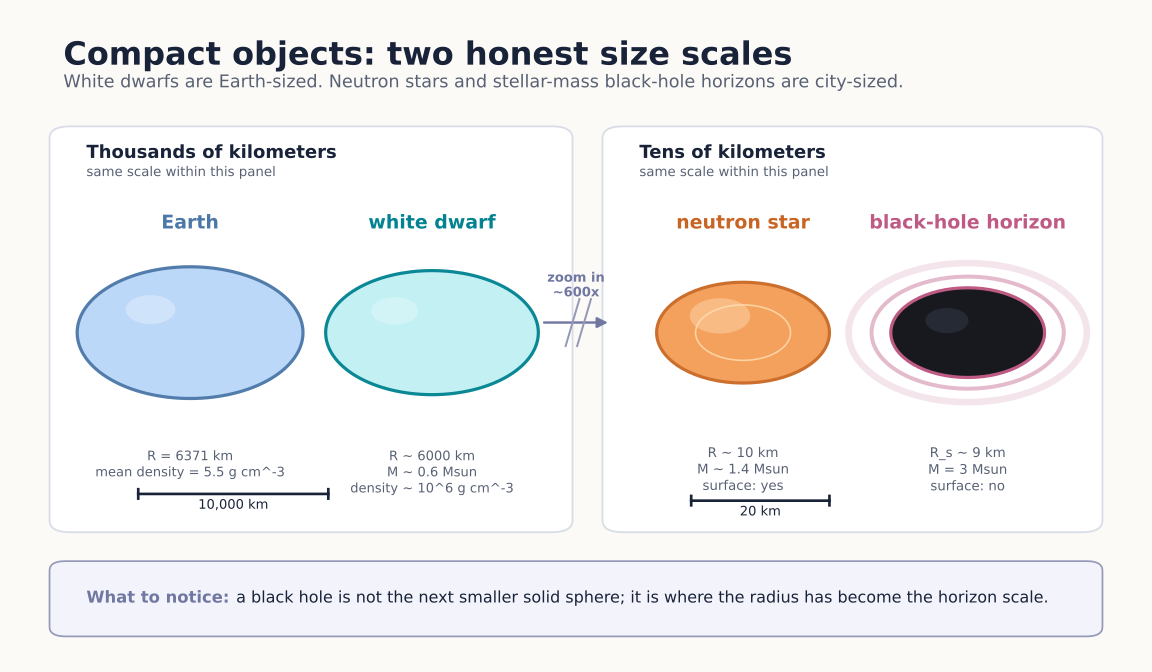
| Property | White dwarf | Neutron star | Black hole |
|---|---|---|---|
| Mass | – | for stellar remnants | |
| Radius | |||
| Density | – | no material density at a surface | |
| Compactness | at the event horizon | ||
| Support | electron degeneracy | no stable material surface | |
| Surface? | yes | yes | no; event horizon |
Dense nuclear matter
Matter compressed to densities comparable to or above an atomic nucleus, where
Neutron degeneracy pressure
Quantum pressure from densely packed neutrons, the neutron analog of electron degeneracy pressure. In a real neutron star it is only part of the support; nuclear interactions and relativistic effects also contribute.
Symbol Legend
| Symbol | Meaning | Typical units |
|---|---|---|
| Schwarzschild radius | or | |
| maximum stable neutron-star mass | ||
| pulsar period | ||
| magnetic flux | ||
| angular velocity | ||
| compactness | dimensionless |
Summary: Gravity Wins
The most important ideas from this reading:
- Neutron stars are nuclear-density remnants — roughly a solar mass in a radius of about , supported by dense nuclear matter.
- Pulsars are rotating neutron stars — short periods require compact objects, and the lighthouse model explains the pulses without the star turning on and off.
- The TOV limit is the neutron-star maximum mass — roughly –, but its exact value depends on the uncertain dense-matter equation of state and on general relativity.
- The Schwarzschild radius sets the black-hole scale — .
- Compactness tells us when gravity becomes relativistic — is tiny for Earth and the Sun, but large for neutron stars and equal to at an event horizon.
- Black holes are causal boundaries, not material surfaces — the event horizon is the boundary beyond which no signal escapes.
- The evidence is convergent — pulsars, X-ray binaries, gravitational waves, stellar orbits, and horizon-scale imaging all point to compact remnants governed by dense matter and general relativity.
A black hole emits no light from inside its horizon, yet astronomers are confident black holes exist. In two or three sentences, explain how indirect evidence makes that case — and why a compact accretor is read as a black hole rather than a neutron star.
Independent lines of evidence — companion-star orbits (mass), X-rays from accretion (a compact object), the absence of surface emission (an event horizon, not a surface), gravitational-wave chirps, and horizon-scale images — converge on the same model, and convergence of independent measurements is what makes an inference strong, not directness. A accretor is above both the Chandrasekhar limit (so not a white dwarf) and the – TOV limit (so not a stable neutron star), leaving a black hole as the only remaining compact-object model.
Glossary
- Accretion
The process in which gas falls onto a compact object. As the gas loses gravitational potential energy it heats up and can emit X-rays — the glow that lets us detect otherwise-invisible neutron stars and black holes in binaries.
- Black hole
A region of spacetime bounded by an event horizon, formed when collapse exceeds all known pressure support. It is not a material surface or solid object; its mass curves spacetime so strongly that nothing inside the horizon can send signals out.
- Compactness
The dimensionless ratio of an object’s Schwarzschild radius to its actual radius — a measure of how close it is to being a black hole. Tiny for Earth and the Sun, for neutron stars, and exactly at a black-hole event horizon. Large compactness means general relativity is essential.
- Dense nuclear matter
Matter compressed to densities comparable to or above an atomic nucleus, where
neutron degeneracy pressure, nuclear interactions, and general relativity all matter. It is the pressure source that supports a neutron star.- Equation of state
A relationship between pressure, density, temperature, and composition. For neutron stars the high-density equation of state is uncertain, which is the main reason the TOV limit is imprecise.
- Event horizon
The causal boundary of a black hole: inside it, every future-directed path leads inward and no signal can escape to distant observers. It is a property of spacetime geometry, not a material surface. For a non-rotating black hole it sits at the Schwarzschild radius.
- Gravitational redshift
The stretching of light to longer wavelengths as it climbs out of a gravitational field, for a static compact object. It comes from spacetime curvature, not from motion, and grows without bound as the emitter approaches the event horizon.
- Lighthouse model
The model in which a pulsar’s radiation beam sweeps across Earth because the neutron star’s magnetic axis is misaligned with its rotation axis. We see a pulse each time the beam points at us — the pulse period is the rotation period.
- Millisecond pulsar
A rapidly rotating neutron star with a period of a few milliseconds, typically an old neutron star spun back up by accreting matter from a binary companion.
- Neutron degeneracy pressure
Quantum pressure from densely packed neutrons, the neutron analog of electron degeneracy pressure. In a real neutron star it is only part of the support; nuclear interactions and relativistic effects also contribute.
- Neutron star
A compact remnant with roughly a solar mass compressed into a radius of order , supported by dense nuclear matter (neutron degeneracy pressure plus nuclear interactions). Densities reach –, comparable to an atomic nucleus.
- Pulsar
A rotating, magnetized neutron star observed through regular pulses of radiation as its beam crosses our line of sight. The pulse period is the star’s rotation period — not a blinking on and off.
- Schwarzschild radius
The event-horizon radius of a non-rotating, uncharged black hole, . Compress a mass inside its Schwarzschild radius and it becomes a black hole; the ratio measures how relativistic an object’s gravity is.
- TOV limit
The Tolman-Oppenheimer-Volkoff limit: the maximum mass of a stable neutron star, set by general relativity and the equation of state of dense nuclear matter. In this course treat it as roughly – — less precisely known than the Chandrasekhar limit.