The Final States
Section 5 of 6
Observational Evidence
Part 5: Observational Evidence
How do we know neutron stars and black holes are real?
Neither object is easy to observe directly: neutron stars are tiny and often faint, and black holes emit no light from inside the event horizon. So the evidence is mostly indirect — but indirect does not mean weak. It is strong because many independent observations point to the same physical models.
Evidence for neutron stars
| Observable | Model | Inference |
|---|---|---|
| Regular radio or X-ray pulses | rotating magnetized neutron star | pulsars are compact, rapidly rotating remnants |
| Millisecond periods | radius must be tens of km or less | normal stars are ruled out |
| Pulsar glitches | solid crust coupled to fluid/superfluid interior | neutron stars have internal structure |
| X-ray bursts in binaries | accretion onto a compact surface | some compact objects have surfaces |
| Neutron-star mergers | gravitational waves from dense-object inspiral | neutron stars merge and constrain dense matter |
A radio source pulses every few milliseconds
Extremely regular pulses, fast enough to act as a clock.
A rotating lighthouse beam
A beam sweeps across Earth once per rotation of a magnetized neutron star.
The source must be compact enough to rotate that fast
A neutron star explains the period, compactness, magnetic field, and stability.
Evidence for black holes
| Observable | Model | Inference |
|---|---|---|
| X-ray binaries with compact objects above | accretion onto an object too massive to be a neutron star | stellar-mass black hole |
| No surface emission from the compact object | event horizon rather than material surface | black-hole model favored |
| Stellar orbits around Sgr A* | Keplerian orbits around an unseen compact mass | inside a tiny region |
| Gravitational waves from mergers | inspiral, merger, and ringdown predicted by GR | black-hole binaries exist |
| Event Horizon Telescope images | horizon-scale emission and shadow | strong-field GR near supermassive black holes |
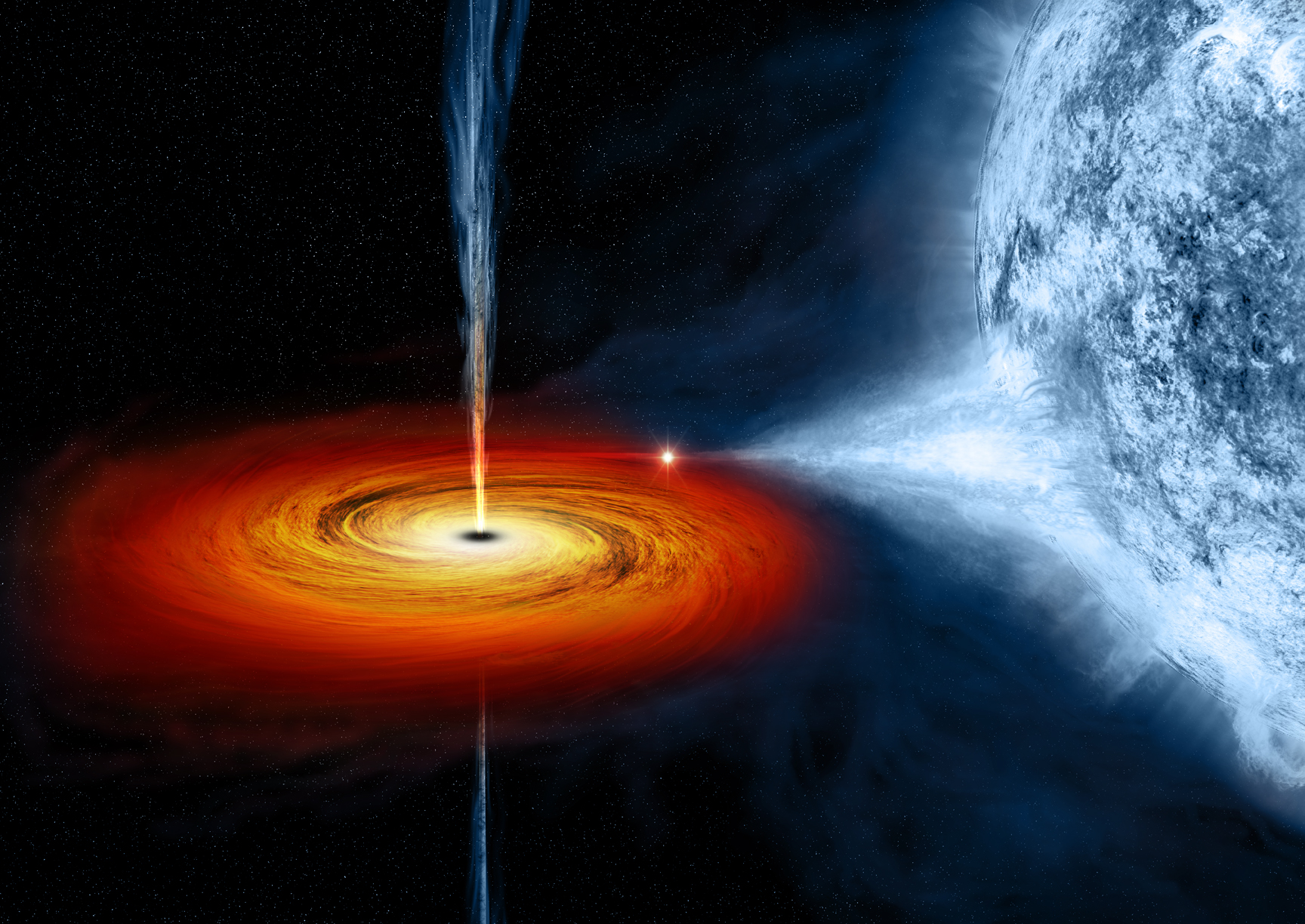
Cygnus X-1 is a classic black-hole candidate. We do not see the black hole directly; we infer it from the companion star’s orbit, the mass of the compact object, and the intense X-ray emission from
Accretion
The process in which gas falls onto a compact object. As the gas loses gravitational potential energy it heats up and can emit X-rays — the glow that lets us detect otherwise-invisible neutron stars and black holes in binaries.
A gravitational-wave signal that swept up in frequency and amplitude
LIGO detected a chirp whose frequency and amplitude changed rapidly with time.
Two black holes spiraling together (GR waveform)
General relativity predicts the inspiral-merger-ringdown waveform of a binary black hole.
A binary black-hole merger
The initial black holes had masses of tens of solar masses, and several solar masses of energy were radiated as gravitational waves.
Problem
The black hole at the Galactic center has . Find its Schwarzschild radius and compare it to the Sun’s radius and to 1 AU.
StepSchwarzschild radius by scaling
StepCompare to the Sun and to 1 AU
Dimensional check
Both comparisons are ratios of kilometers to kilometers, so they are dimensionless ✓.
Result
Even a four-million-solar-mass black hole has an event horizon smaller than Mercury’s orbit — about 17 solar radii.
Quick check
An unseen object has mass , strong X-ray emission from accretion, no evidence for a surface, and a rapidly orbiting companion. Why is the black-hole model favored over a neutron star?
An compact object is above the expected maximum mass of a stable neutron star. The X-rays show accretion onto a compact object, the absence of surface evidence favors an event horizon rather than a neutron-star surface, and the companion orbit fixes the mass — so the black-hole model is the best fit.