The Final States
Section 4 of 6
Black Holes
Part 4: Black Holes — Where Gravity Wins
Black hole
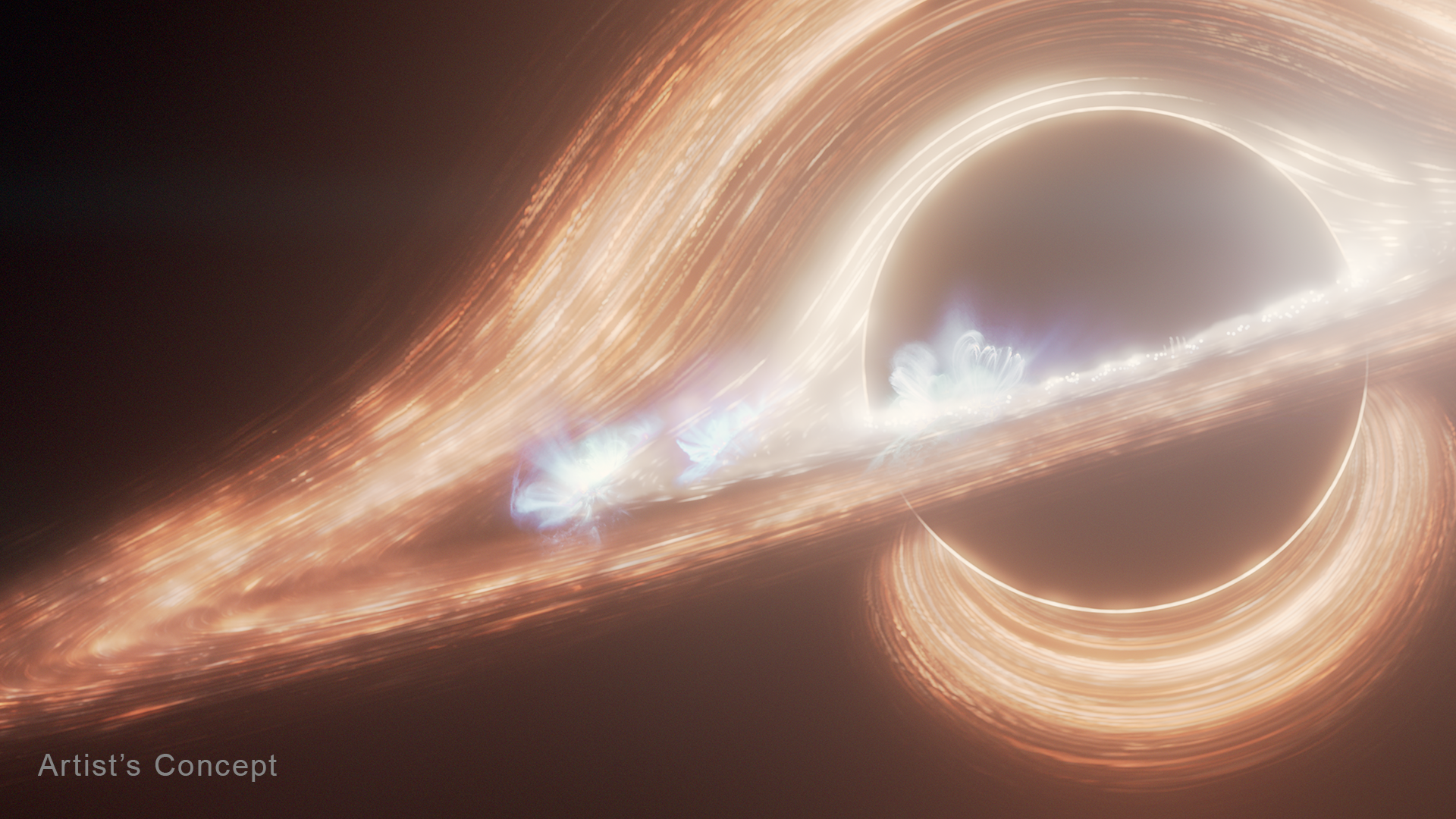
A region of spacetime bounded by an event horizon, formed when collapse exceeds all known pressure support. It is not a material surface or solid object; its mass curves spacetime so strongly that nothing inside the horizon can send signals out.
Event horizon
The causal boundary of a black hole: inside it, every future-directed path leads inward and no signal can escape to distant observers. It is a property of spacetime geometry, not a material surface. For a non-rotating black hole it sits at the Schwarzschild radius.
The Schwarzschild Radius: A Newtonian Preview
We can motivate the event-horizon scale with a Newtonian escape-speed argument. The escape speed from radius around mass is . Setting and solving gives , the
For a non-rotating, uncharged black hole, is the event-horizon radius.
Schwarzschild radius
The event-horizon radius of a non-rotating, uncharged black hole, . Compress a mass inside its Schwarzschild radius and it becomes a black hole; the ratio measures how relativistic an object’s gravity is.
Problem
Compute the Schwarzschild radius of the Sun. Use , , .
StepNumerator and denominator
StepDivide and convert
Dimensional check
✓ — the units reduce to a length.
Result
To make the Sun a black hole, you would compress one solar mass inside a radius of about .
Useful scaling relation
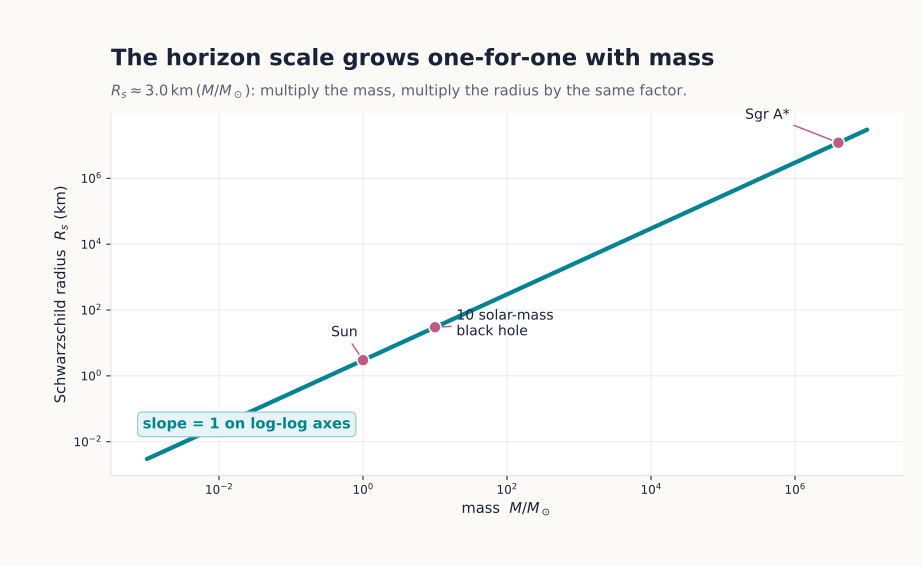
Because , using the Sun as reference gives .
| Object | Mass | Schwarzschild radius |
|---|---|---|
| Sun | ||
| black hole | ||
| Sgr A* |
Problem
Use . (1) for a black hole? (2) For a black hole? (3) Why didn’t you need and again?
; . You did not need and again because the proportionality constant was already evaluated for one solar mass.
Compactness: When does gravity become relativistic?
The Schwarzschild radius is useful even for objects that are not black holes. The
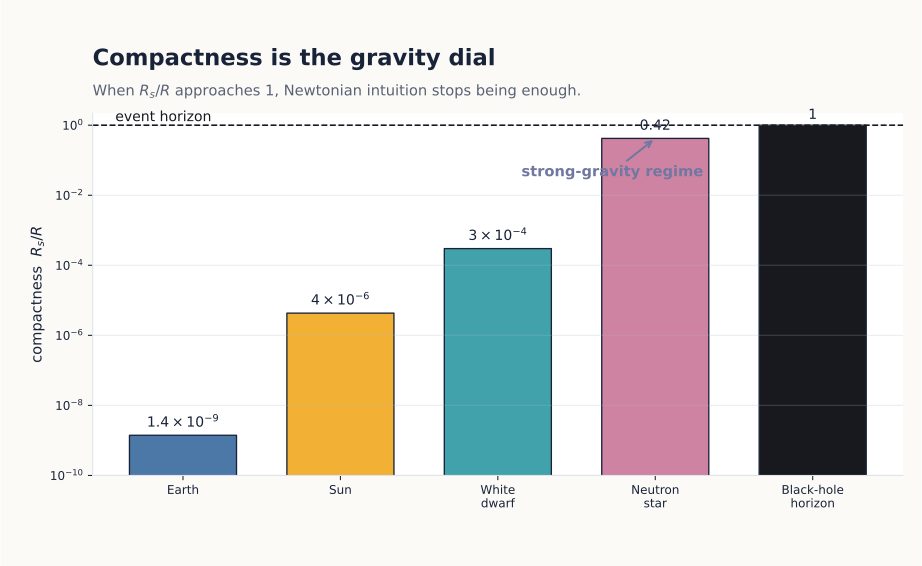
A compactness of is enormous: general relativity is not a tiny correction for neutron stars, it is essential. The Newtonian escape-speed estimate gives , so .
Compactness
The dimensionless ratio of an object’s Schwarzschild radius to its actual radius — a measure of how close it is to being a black hole. Tiny for Earth and the Sun, for neutron stars, and exactly at a black-hole event horizon. Large compactness means general relativity is essential.
Quick check
Rank Earth, Sun, white dwarf, neutron star, and black-hole event horizon by compactness , smallest to largest. Which require general relativity?
Earth, Sun, white dwarf, neutron star, black-hole event horizon. General relativity is essential for neutron stars and black holes because their compactness is a large fraction of unity; it is a tiny correction for Earth and the Sun in most contexts.
Quick check
A neutron star and a stellar-mass black hole of the same mass both bend light strongly and accrete gas.
- (a) State the key physical difference between the neutron star’s surface and the black hole’s event horizon.
- (b) Name one observation that would distinguish “has a material surface” from “has a horizon.”
(a) The neutron star’s surface is material — solid, nuclear-density matter you could in principle stand on, where infalling gas crashes and is stopped. The event horizon is not made of anything: it is a causal boundary in spacetime. Infalling matter passes through it without hitting a surface, and nothing inside can send a signal back out.
(b) Surface signatures distinguish them: thermonuclear X-ray bursts (accreted hydrogen/helium piling on a surface and igniting) and steady thermal surface emission are seen for neutron stars but are absent for black holes — matter reaching a horizon simply disappears, with no surface to pile up on or radiate from. Their absence (plus a mass above the TOV limit) favors a horizon.
Why General Relativity?
The Newtonian escape-speed argument gives the correct Schwarzschild radius, but it does not explain what an event horizon really is. Newtonian gravity has no universal speed limit; general relativity does. GR changes the picture three ways: nothing travels faster than light; mass and energy curve spacetime; and inside an event horizon, all future-directed paths lead inward. That last point is the key — the horizon is not a wall, it is where the geometry of spacetime prevents outward escape.
Gravitational redshift
The stretching of light to longer wavelengths as it climbs out of a gravitational field, for a static compact object. It comes from spacetime curvature, not from motion, and grows without bound as the emitter approaches the event horizon.