Gravity and Orbits
Section 2 of 6
The Physics of Motion
Part 2: The Physics of Motion
Vectors and Key Variables: The Language of Motion
Before diving into Newton’s laws, we need to establish notation. Physics uses symbols as shorthand — but those symbols must be defined before we use them.
The key variables we’ll use:
| Symbol | Name | What it measures | CGS units |
|---|---|---|---|
| position | where an object is (relative to a reference) | cm | |
| velocity | how fast and in what direction position changes | cm/s | |
| acceleration | how fast and in what direction velocity changes | cm/s² | |
| mass | how much matter (and resistance to acceleration) | g | |
| force | a push or pull that causes acceleration | dyne |
The arrow notation ( vs. ) distinguishes vectors from scalars. When we write without the arrow, we mean the speed — just the magnitude (always zero or positive). Velocity components like can be positive or negative: the sign tells you which way that part of the motion points.
Setting the Stage: Newton’s Laws of Motion
Before Newton could explain why planets move as they do, he needed the fundamental rules of motion itself.
First Law (Inertia):
An object remains at rest or in uniform motion unless acted upon by a net external force.
Mathematically: if , then . Motion doesn’t require continuous effort — only changes in motion require forces.
Second Law (Force and Acceleration):
The net force on an object equals its mass times its acceleration.
This is the heart of Newtonian mechanics: forces cause accelerations, mediated by mass.
Inertia
An object’s resistance to acceleration, set by its mass. For the same force, a more massive object accelerates less.
For the same force, a more massive object accelerates less — this resistance is
Third Law (Action-Reaction):
For every action there is an equal and opposite reaction: .
If the Sun pulls on Earth, Earth pulls back on the Sun with exactly the same force. This matters for center of mass and binary systems.
Kinematics: Describing Motion Quantitatively
To apply Newton’s laws, we need precise language for describing motion — position, velocity, and acceleration.
Velocity (): how position changes with time, both speed and direction.
Units: .
Acceleration (): how velocity changes with time.
Units: . Acceleration doesn’t just mean “speeding up” — it means any change in velocity, including slowing down or changing direction. A planet in a circular orbit at constant speed is still accelerating because its direction continuously changes. Your car’s speedometer can stay at 60 mph while you round a curve, but you still have to turn the wheel — that steering effort is the acceleration.
Pause & Predict #2
A car drives around a circular track at constant speedometer reading (constant speed).
Check below.
Quick check
For the car on the circular track above: (a) Is it accelerating? (b) Which direction does the acceleration point? (c) For a tighter circle at the same speed, does the required acceleration increase or decrease?
- Yes — direction is changing, so velocity is changing, so there’s acceleration.
- Toward the center of the circle.
- Increase — a tighter circle at the same speed means is larger.
Circular Motion and the Centripetal Force
Here’s the key insight connecting motion physics to orbits: an object moving in a circle is constantly accelerating, even at constant speed. Because velocity is a vector, and for circular motion its direction is always changing.
Faster motion means direction changes more rapidly; a tighter curve (smaller radius) means direction changes more sharply. These combine: for an object moving in a circle of radius with speed , the
Centripetal acceleration
The center-directed acceleration of an object in circular motion, . It changes the direction of velocity, not its magnitude.
Unit check: ✓. By Newton’s second law, this acceleration requires a force — the
Centripetal force
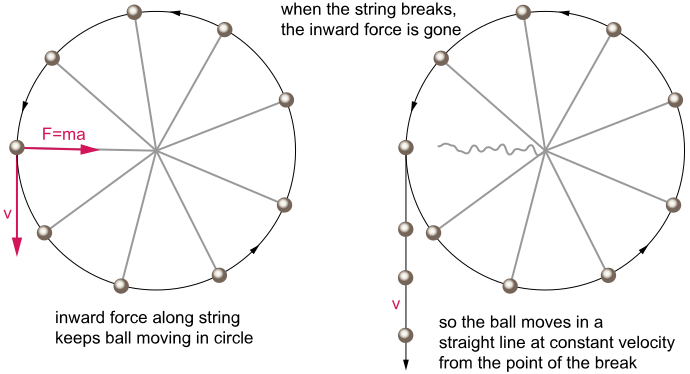
The net inward force required to keep an object on a circular path, . It is not a new kind of force — it’s a role played by whatever real force points to the center (gravity, tension, friction).
This isn’t a new type of force — it’s whatever force happens to be pulling the object toward the center. For planets, that force is gravity; for a ball on a string, tension; for a car turning, friction.