Gravity and Orbits
Complete lesson
From Empirical Laws to Mechanism
After completing this reading, you will be able to:
Part 1: The Scientific Revolution in Miniature
Why This Matters
Imagine you’ve spent twenty years meticulously recording the positions of planets. You’ve filled notebooks with data, tracking Mars against the background stars night after night. Eventually, patterns emerge. You discover three remarkable regularities — but you have no idea why they’re true. You can predict where Mars will be next year, but you can’t explain what makes it move.
This was Johannes Kepler’s situation in the early 1600s. His three laws of planetary motion were extraordinary achievements: precise, quantitative rules extracted directly from observational data. But they raised as many questions as they answered. Why ellipses and not circles? Why do planets speed up near the Sun? What physical mechanism connects a planet’s distance to its orbital period?
These questions would haunt astronomy for nearly a century — until Isaac Newton showed that all three of Kepler’s laws were consequences of a single, deeper truth: the law of universal gravitation.
Empirical law
A pattern extracted from data that describes what happens without explaining the underlying mechanism. Reliable within the range of the data, but silent on why.
Physical law
A statement of mechanism, derived from first principles, that explains why a pattern holds — and predicts new situations beyond the original data.
This story illustrates something profound about how science works. An
Kepler’s Empirical Laws: Patterns Without Explanation
Before we can appreciate what Newton accomplished, we need to understand what Kepler discovered. His three laws of planetary motion, distilled from decades of observation by Tycho Brahe, are:
Kepler’s First Law (Law of Orbits):
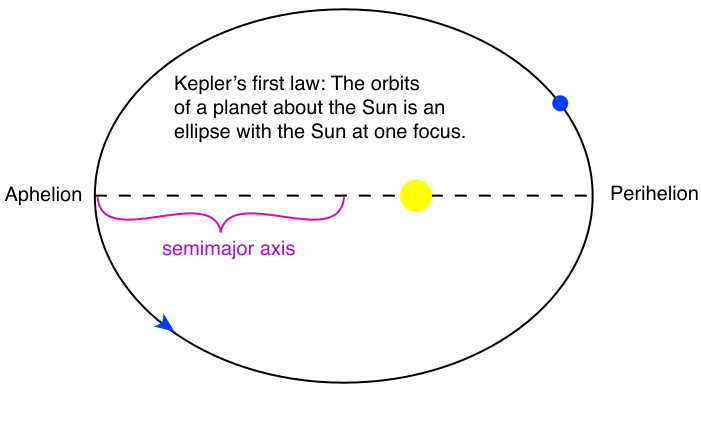
Planets move in ellipses, with the Sun at one focus.
This was revolutionary. The ancient Greeks — and nearly everyone since — had assumed celestial motion must be circular, because circles were “perfect.” Kepler showed that nature doesn’t care about geometric aesthetics. Real orbits are ellipses, which means a planet’s distance from the Sun changes continuously throughout its orbit.
Eccentricity
A number measuring how “squashed” an ellipse is. is a circle; as the ellipse becomes more elongated. Earth’s is about 0.017 — nearly circular.
The
Semi-major axis
Half the longest diameter of an ellipse — the average distance from the orbiting body to its host. We reserve the symbol for it throughout.
Key orbital terms:
Semi-major axis Perihelion Aphelion - Instantaneous separation (): the current distance between the two bodies, varying between and .
Perihelion
The point of closest approach to the Sun, at distance .
Aphelion
The farthest point from the Sun, at distance .
Kepler’s Second Law (Law of Areas):
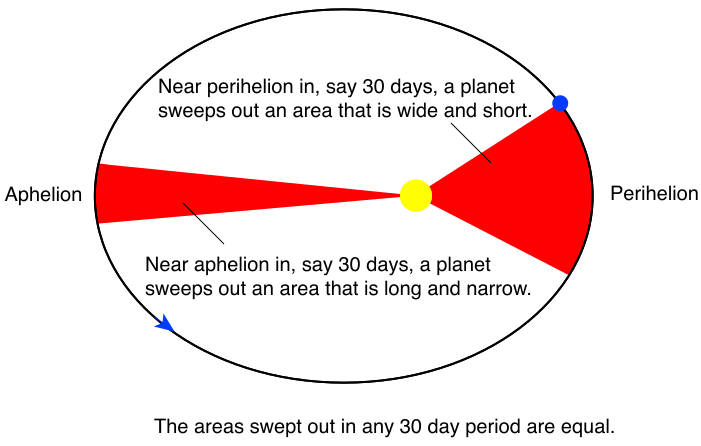
A line connecting a planet to the Sun sweeps out equal areas in equal times.
This law encodes a surprising fact: planets move faster when they’re closer to the Sun and slower when they’re farther away. The “equal areas” rule quantifies exactly how the speed changes — but it doesn’t explain why speed and distance are connected this way.
Central force
A force directed along the line connecting two bodies (toward a center). Gravity is central — and any central force conserves angular momentum, which is why Kepler’s Second Law holds.
Foreshadowing: the equal-area law hints at something deep — it suggests the force on the planet points directly toward the Sun (a
Kepler’s Third Law (Law of Periods):
For orbits around a given central mass, .
This is a scaling relation — it tells us how one quantity changes when we change another. If you move a planet farther from the Sun, its orbital period increases, but not linearly: doubling the distance increases the period by a factor of . Written as a proportionality:
where is the orbital period and is the semi-major axis. Notice this is a proportionality, not an equality — the constant of proportionality depends on the central mass, as Newton would later show.
Pause & Predict #1
Commit to an answer before reading on.
Check your reasoning against the answers below.
Problem
Check the two predictions above. (a) If you double a planet’s orbital distance, by what factor does its period change? (b) Does Kepler II’s “faster near the Sun” mean planets are accelerating?
- If distance doubles, increases by , so increases by .
- Yes — planets accelerate continuously (their velocity direction always changes). The “speeding up” near perihelion is the linear speed increasing; the acceleration always points toward the Sun.
The Limits of Empirical Laws
Kepler’s laws are powerful predictive tools. Given a planet’s orbital parameters, you can calculate where it will be at any future time. But notice what they don’t tell you: why orbits are ellipses, what causes the speed-up near the Sun, why the period depends on distance with exactly this power, or whether the same rules apply beyond our solar system. Empirical laws summarize observations but don’t explain the underlying physics. This is precisely where Newton’s contribution transformed astronomy into physics.
The Physics of Motion
Part 2: The Physics of Motion
Vectors and Key Variables: The Language of Motion
Before diving into Newton’s laws, we need to establish notation. Physics uses symbols as shorthand — but those symbols must be defined before we use them.
The key variables we’ll use:
| Symbol | Name | What it measures | CGS units |
|---|---|---|---|
| position | where an object is (relative to a reference) | cm | |
| velocity | how fast and in what direction position changes | cm/s | |
| acceleration | how fast and in what direction velocity changes | cm/s² | |
| mass | how much matter (and resistance to acceleration) | g | |
| force | a push or pull that causes acceleration | dyne |
The arrow notation ( vs. ) distinguishes vectors from scalars. When we write without the arrow, we mean the speed — just the magnitude (always zero or positive). Velocity components like can be positive or negative: the sign tells you which way that part of the motion points.
Setting the Stage: Newton’s Laws of Motion
Before Newton could explain why planets move as they do, he needed the fundamental rules of motion itself.
First Law (Inertia):
An object remains at rest or in uniform motion unless acted upon by a net external force.
Mathematically: if , then . Motion doesn’t require continuous effort — only changes in motion require forces.
Second Law (Force and Acceleration):
The net force on an object equals its mass times its acceleration.
This is the heart of Newtonian mechanics: forces cause accelerations, mediated by mass.
Inertia
An object’s resistance to acceleration, set by its mass. For the same force, a more massive object accelerates less.
For the same force, a more massive object accelerates less — this resistance is
Third Law (Action-Reaction):
For every action there is an equal and opposite reaction: .
If the Sun pulls on Earth, Earth pulls back on the Sun with exactly the same force. This matters for center of mass and binary systems.
Kinematics: Describing Motion Quantitatively
To apply Newton’s laws, we need precise language for describing motion — position, velocity, and acceleration.
Velocity (): how position changes with time, both speed and direction.
Units: .
Acceleration (): how velocity changes with time.
Units: . Acceleration doesn’t just mean “speeding up” — it means any change in velocity, including slowing down or changing direction. A planet in a circular orbit at constant speed is still accelerating because its direction continuously changes. Your car’s speedometer can stay at 60 mph while you round a curve, but you still have to turn the wheel — that steering effort is the acceleration.
Pause & Predict #2
A car drives around a circular track at constant speedometer reading (constant speed).
Check below.
Quick check
For the car on the circular track above: (a) Is it accelerating? (b) Which direction does the acceleration point? (c) For a tighter circle at the same speed, does the required acceleration increase or decrease?
- Yes — direction is changing, so velocity is changing, so there’s acceleration.
- Toward the center of the circle.
- Increase — a tighter circle at the same speed means is larger.
Circular Motion and the Centripetal Force
Here’s the key insight connecting motion physics to orbits: an object moving in a circle is constantly accelerating, even at constant speed. Because velocity is a vector, and for circular motion its direction is always changing.
Faster motion means direction changes more rapidly; a tighter curve (smaller radius) means direction changes more sharply. These combine: for an object moving in a circle of radius with speed , the
Centripetal acceleration
The center-directed acceleration of an object in circular motion, . It changes the direction of velocity, not its magnitude.
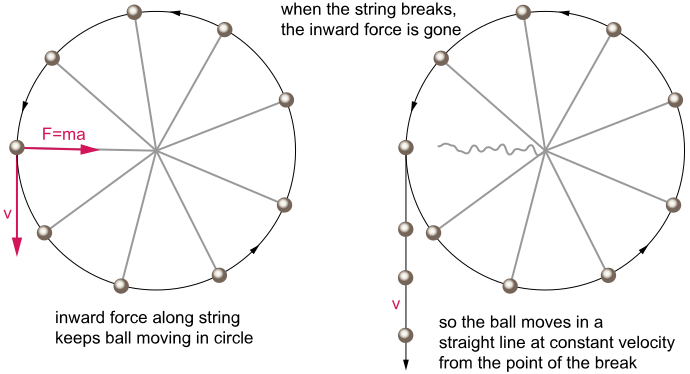
Unit check: ✓. By Newton’s second law, this acceleration requires a force — the
Centripetal force
The net inward force required to keep an object on a circular path, . It is not a new kind of force — it’s a role played by whatever real force points to the center (gravity, tension, friction).
This isn’t a new type of force — it’s whatever force happens to be pulling the object toward the center. For planets, that force is gravity; for a ball on a string, tension; for a car turning, friction.
Newtonian Gravitation
Part 3: Newton’s Law of Gravitation
From Patterns to Mechanism
Now we arrive at Newton’s great insight: gravity is a universal force between all masses, following a precise law.
Here is Newton’s gravitational constant, and are the two masses (in grams), is the distance between their centers, and the force is attractive, directed along the line connecting them.
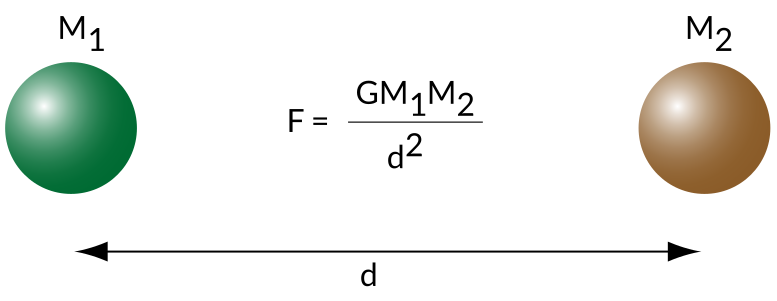
Each piece carries meaning. Gravity depends on the product of both masses (by the third law, each must feel the same force). The in the denominator is an inverse-square law: double the distance, and the force drops to one-quarter. And is a universal constant — the same everywhere in the universe. Solving for confirms its units must be (equivalently ). In the limits: as the force approaches zero but never quite vanishes; if either mass is zero, there is no force.
Note on light and gravity: Newtonian gravity acts on mass. Since photons are massless, it doesn’t correctly predict how light bends near massive objects — Einstein’s General Relativity does. More on that in Part 6.
Pause & Predict #3
Use Newton's law of gravitation.
Check below.
Problem
Check the three predictions above. (a) Double the distance: by what factor does the force change? (b) Double both masses: by what factor does the force change? (c) The Moon is 60 Earth radii away — what fraction of surface gravity does Earth’s pull provide there?
- Force drops by a factor of 4 (inverse-square).
- Force increases by a factor of 4 (proportional to the product of masses).
- of surface gravity.
How Did Newton Know This?
Newton didn’t propose the inverse-square law out of thin air — he derived it by requiring that gravity reproduce Kepler’s observations. The reasoning, as a scaling argument:
Assume orbits are nearly circular (), the force is a power-law central force for unknown , and the central mass dominates ().
Step 1 — Kepler III as a constraint: .
Step 2 — Postulate a general force: .
Step 3 — Apply circular-motion physics: gravity provides the centripetal force, so . The planet’s mass cancels:
Step 4 — Connect speed and period: for circular motion , so
Step 5 — Compare with Kepler III: requires , so . The inverse-square law is the only power law consistent with Kepler’s Third Law.
Step 6 — Identify the constant: when , is Newton’s gravitational constant , with units , giving . Newton didn’t just say “here’s a formula that works” — he showed the inverse-square law is required by the observed period-distance relation.
Newton’s Version of Kepler’s Third Law
Armed with the law of gravitation, Newton derived a complete version of Kepler III:
The registry card records the simplified form (valid when ). Newton’s full two-body form keeps both masses:
What’s different from Kepler’s empirical version? The constant of proportionality is now determined — it depends on and the total mass — and it applies to any two-body system, not just our solar system. A unit check confirms the right side has units of . When (Sun-planet systems), , recovering Kepler’s simpler form. And by measuring and we can solve for the total mass,
which is how we “weigh” stars in binaries, measure black-hole masses from orbiting stars, and estimate galaxy masses from rotation curves.
Two-Body Reality: The Center of Mass
Where does that factor come from? So far we’ve imagined the Sun sitting motionless. But Newton’s Third Law says if the Sun pulls on Earth, Earth pulls back equally — the Sun must move too. In reality, both bodies orbit their common
Barycenter
The center of mass of a two-body system — the “balance point” about which both bodies orbit. The more massive body orbits closer to it.
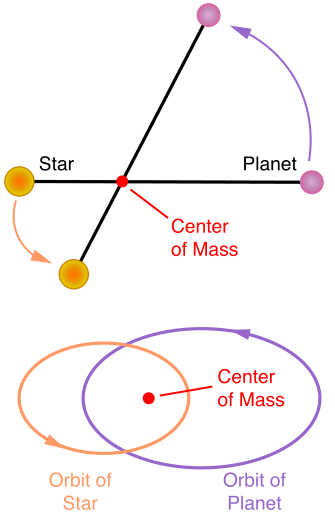
For two bodies separated by distance , the center of mass lies along the connecting line at distances
with . The more massive body orbits closer to the center of mass. When , the barycenter lies very close to — which is why Kepler’s “Sun at one focus” works so well. For the Sun-Jupiter system the Sun wobbles by about 750,000 km (roughly one solar radius); that wobble is exactly how we detect exoplanets via the radial-velocity method. When both bodies are properly accounted for, the orbital dynamics depend on the total mass, which is where the in Kepler III comes from.
Pause & Predict #3.5 — Is Kepler's Constant Really Constant?
Newton showed P^2/a^3 = 4*pi^2 / [G(M+m)], which depends on the total system mass.
Check below.
Problem
Check the three predictions above. (a) Is the same for a red dwarf system and a system? (b) Is a planet at 1 AU around the red dwarf longer- or shorter-period than Earth, and by what factor? (c) Why didn’t Kepler notice this mass dependence?
- No. The “constant” depends on total mass. The system’s constant is 4× smaller than the system’s.
- Longer. For the red dwarf the constant is twice as large, so is twice as large at the same , meaning is times longer — about 1.4 years at 1 AU.
- All Solar System bodies orbit the same central mass (), so they share one “Kepler constant.” Kepler had no other star system to compare with — exoplanet detection came 400 years later.
Orbital and Escape Velocity
Part 4: Orbital Velocity and Escape Velocity
How Fast Must a Planet Move?
For a stable circular orbit at radius around a mass , one specific speed satisfies force balance: gravity equals the centripetal requirement,
The orbiting mass appears on both sides and cancels — all objects orbit at the same speed at a given radius. (This puzzled physicists until Einstein explained that the mass which resists acceleration equals the mass gravity pulls on.) Multiplying by gives , so the
Orbital velocity
The speed required for a circular orbit at radius around mass , . It depends only on and — not on the orbiting object’s mass.
Larger means stronger gravity, so you must orbit faster to avoid falling in; larger means weaker gravity, so you can orbit more slowly. The orbiting object’s mass doesn’t matter.
Problem
Find Earth’s circular orbital speed, given g, AU cm, and .
StepSubstitute into the formula
StepCombine powers of ten
Dimensional check
✓ — the grams cancel and the result is a speed.
Result
km/s. Earth travels at about 30 km/s just to stay in orbit. Sanity check: that’s about 0.01% of the speed of light — fast, but not relativistic.
Pause & Predict #4
Use v_orb = sqrt(GM/r).
Check below.
Problem
Check the two predictions above. (a) Jupiter at 5 AU vs Earth: is its orbital velocity greater, less, or equal — and by what factor? (b) A low satellite at km vs a GPS satellite at km: which moves faster, and by roughly what factor?
- Jupiter is slower. Since , at 5 AU it moves by a factor of Earth’s speed.
- The low satellite is faster, by a factor .
Escape Velocity: Breaking Free of Gravity
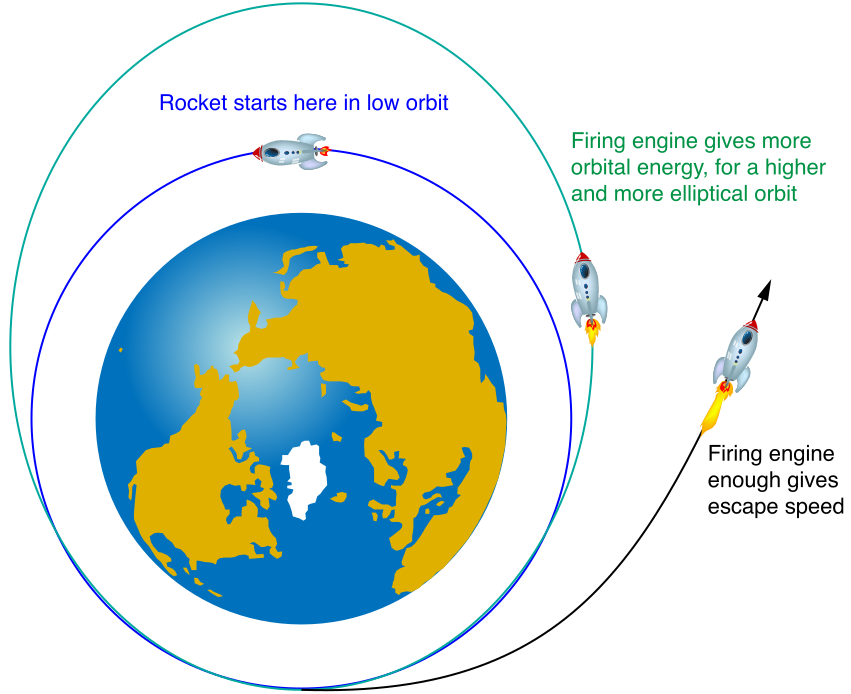
What if you want to leave a gravitational system entirely? You need enough kinetic energy to overcome the gravitational binding. The minimum speed is the
Escape velocity
The minimum launch speed needed to coast from radius to infinity, . The escaping object’s own mass cancels.
Escape velocity is exactly times the orbital velocity at the same radius, . Larger or smaller means a deeper gravitational well and a harder escape. The escaping object’s mass cancels — a rocket and a baseball need the same speed.
Problem
Find Earth’s escape velocity, given g, cm, and .
StepSubstitute into the formula
StepCombine powers of ten
Dimensional check
The factor of 2 is dimensionless, so the units are identical to : ✓.
Result
km/s. Sanity check: this is larger than the near-surface orbital velocity ( km/s) by ✓.
Comparison of key velocities:
| Location | (km/s) | (km/s) |
|---|---|---|
| Earth at (hypothetical near-surface orbit) | 7.9 | 11.2 |
| Moon surface | 1.7 | 2.4 |
| Sun surface | 434 | 618 |
A physical orbit at Earth’s surface is impossible due to atmospheric drag; the values are for the field strength at that radius. This is why Apollo astronauts needed a smaller rocket to leave the Moon: its escape velocity (2.4 km/s) is only about one-fifth of Earth’s, so less fuel is required.
Conservation Laws
Part 5: Conservation Laws in Orbital Mechanics
Energy Conservation: Predicting Orbital Fate
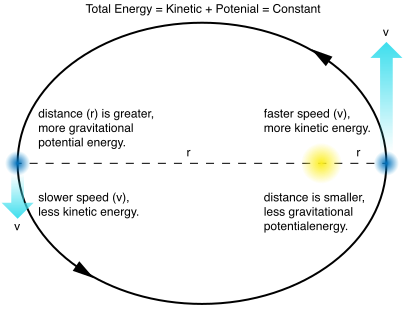
An orbiting object has two forms of mechanical energy: kinetic (from motion) and potential (from position in the gravitational field). A feature that surprises many students is that gravitational potential energy is negative. The total mechanical energy is
where is the kinetic energy (always positive) and is the
Gravitational potential energy
The energy stored in the gravitational field of two bodies, with zero defined at infinity. It is negative because a bound object sits below the zero level — in a “well” it would need energy to climb out of.
Both terms have units of erg: , and ✓. Total energy is conserved: as an object moves closer to the central mass it speeds up, converting potential to kinetic, but stays constant.
| Energy | Meaning | Orbit Type |
|---|---|---|
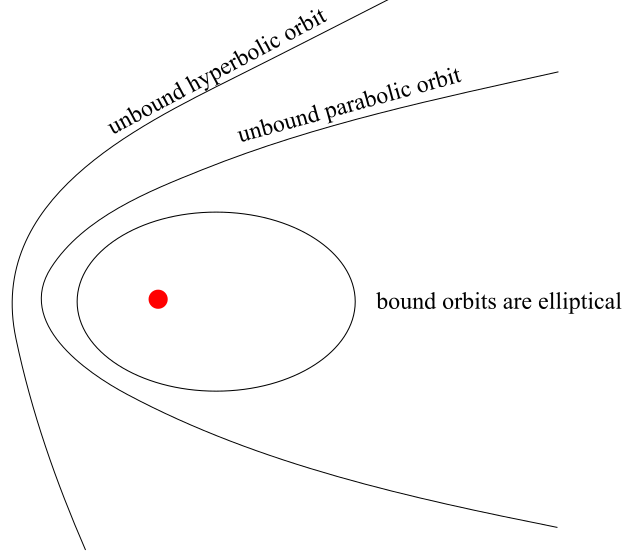
| Bound | Closed (ellipse or circle) | |
| Marginally bound | Parabolic (just escapes) | |
| Unbound | Hyperbolic (escapes with speed to spare) |
A spacecraft is in a stable circular orbit around Earth. Without calculating, what is the sign of its total mechanical energy?
Negative (). A stable orbit is a bound orbit — the spacecraft keeps coming back, and bound orbits always have negative total energy. If the energy were positive, it would escape to infinity.
For any bound orbit (circular or elliptical) with semi-major axis , the total energy is . For a circular orbit, .
Pause & Predict #5
Reason about total mechanical energy.
Check below.
Multiple choice
A comet approaches the Sun with total energy (and doesn’t hit the Sun). Will it return, or escape to infinity?
It escapes — positive energy means unbound (assuming no collision with the Sun).
Multiple choice
A spacecraft in a circular orbit fires its engines to speed up. Does it become more bound or less bound?
Total energy increases (less negative or positive), so the orbit becomes less bound (larger semi-major axis).
Angular Momentum Conservation: Why Kepler’s Second Law Works
Angular momentum
A conserved measure of orbiting/spinning motion, for circular motion. A central force exerts no torque, so stays constant — the deep reason behind Kepler’s Second Law.
Unit check: ✓. Why is angular momentum conserved? Because gravity is a
Torque
A twisting influence that changes angular momentum. A central force produces zero torque about the center, so it leaves unchanged.
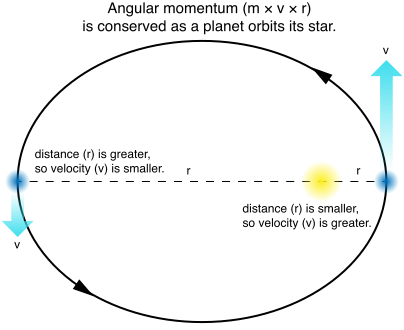
This immediately explains Kepler’s Second Law:
- Gravity is a central force — it points directly toward the Sun.
- A central force exerts no torque about the center.
- No torque means angular momentum stays constant.
- The area swept in time is a thin pie-slice, .
- Since is constant, the
areal velocity - Constant is exactly Kepler’s Second Law: equal areas in equal times.
Areal velocity
The rate at which the planet-Sun line sweeps out area, . Angular-momentum conservation makes it constant — which is Kepler’s Second Law.
When a planet is closer to the Sun (smaller ), it must move faster angularly to keep constant — like an ice skater spinning faster when pulling their arms in.
Pause & Predict #6
A planet's elliptical orbit has r_p = 1 AU at perihelion and r_a = 4 AU at aphelion.
Check below.
Problem
Check the three predictions above for the orbit with AU and AU. (a) Where is the planet faster, perihelion or aphelion? (b) Using , by what factor is the angular velocity larger at perihelion? (c) Is the linear-speed ratio the same as the angular-velocity ratio?
- Perihelion (closer = faster).
- From , the ratio is .
- No. Linear speed , so . The planet moves 4× faster (linear speed) at perihelion, not 16×.
The Virial Theorem: A Deep Connection
For gravitationally bound systems there’s a remarkable relationship between kinetic and potential energy — but it applies only to truly static systems (a star in hydrostatic equilibrium) or periodic systems averaged over a complete orbit. Writing for the time-averaged kinetic energy, the virial theorem states:
Equivalently, . The kinetic energy is exactly half the magnitude of the (negative) potential energy. (We meet the virial theorem in full when we build stellar structure in Module 3.)
Verify it for a circular orbit, where instantaneous equals average. The kinetic energy is , and the potential energy is . Then ✓. The total energy is , i.e. .
The same relationship that governs planetary orbits applies across the universe — when systems are in equilibrium. It sets stellar structure (thermal energy balances gravitational binding), reveals galaxy masses including dark matter (from stellar motions), and determines when gas clouds collapse.
Synthesis and Relativity
Part 6: Synthesis — The Unity of Celestial and Terrestrial Physics
What Newton Achieved
Before Newton, celestial and terrestrial physics were separate domains: the heavens were thought to obey different rules. Newton demolished this distinction. The same force that pulls an apple from a tree — gravity following an inverse-square law — keeps the Moon orbiting Earth and the planets orbiting the Sun. There is one physics, applying everywhere.
| Kepler’s Laws | Newton’s Explanation |
|---|---|
| Orbits are ellipses | Solution to the equations of motion under inverse-square gravity |
| Equal areas in equal times | Conservation of angular momentum (central force → no torque) |
| Requires the inverse-square law; constant set by and the masses |
This is the template for all of physics: observe patterns, propose mechanisms, derive the patterns as consequences, then use the mechanisms to predict new phenomena.
Forward Connections
| Topic | Connection |
|---|---|
| Binary Stars | Orbital measurements → stellar masses via Newton’s Kepler III |
| Exoplanets | Transit timing, radial velocity → masses and orbits |
| Stellar Structure | Virial theorem (at equilibrium) → pressure-temperature balance |
| Compact Objects | Escape velocity → black-hole event horizons |
| Galaxy Dynamics | Rotation curves → dark-matter inference |
Every time we infer mass from orbital motion, we’re using Newton’s framework.
Beyond Newton: A Glimpse of Einstein
Newton’s framework is extraordinarily powerful — it explains planetary motion, predicts eclipses, weighs distant stars, and guides spacecraft. For nearly all astrophysical situations in this course, it’s excellent. But it’s not the final word. In 1915, Einstein’s
General relativity
Einstein’s 1915 theory of gravity as the curvature of spacetime: “mass tells spacetime how to curve; spacetime tells mass how to move.” Newtonian gravity is its weak-field, low-speed limit.
| Newton’s View | Einstein’s View |
|---|---|
| Gravity is a force acting instantaneously across space | Gravity is the curvature of spacetime itself |
| Space and time are fixed, absolute backdrops | Space and time are dynamic, shaped by mass and energy |
| Objects feel a gravitational pull | Objects follow the straightest possible paths (geodesics) through curved spacetime |
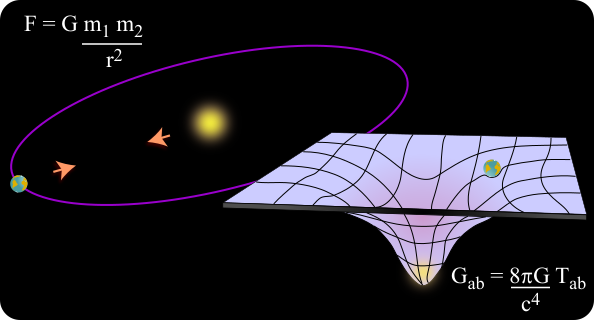
Newton’s framework needs corrections in three regimes: near extremely dense objects (neutron stars, black holes), at very high speeds (approaching ), and for precision measurements (GPS satellites need relativistic corrections or positioning drifts by ~10 km/day).
A teaser — black holes and the cosmic speed limit. Recall escape velocity, . What happens if you compress enough mass into a small enough region that escape velocity reaches the speed of light? Setting and solving for :
This is the Schwarzschild radius — the boundary of a black hole’s event horizon. Inside it, not even light can escape.
The same formula that describes rockets leaving Earth, pushed to its logical extreme, predicts the most exotic objects in the universe. Newton gave us the tools; Einstein showed us where they lead. (We’ll explore black holes in detail when we study compact objects later this semester.)
Quick Practice
Use these as a fast warm-up before the graded set.
Problem
Empirical vs. physical: Kepler observed . Newton derived that the power of in gravity must be 2 to reproduce it. If gravity instead followed , what relationship between and would we observe?
With (), the derivation gives , so — a steeper dependence. The inverse-square law is uniquely consistent with .
Problem
Orbital velocity scaling: Jupiter orbits at 5 AU, Earth at 1 AU. Without exact numbers, is Jupiter’s orbital velocity greater than, less than, or equal to Earth’s — and by what factor?
Jupiter is slower. Since , at 5 AU it moves by a factor of Earth’s speed.
Problem
Escape velocity intuition: a neutron star has roughly the Sun’s mass but a radius of only 10 km cm. Compared to the Sun’s escape velocity (618 km/s), is the neutron star’s larger or smaller? Estimate the ratio.
Much larger. Same but a vastly smaller , so is far bigger — the ratio is , giving km/s (about ).
Multiple choice
Energy and orbit type: a comet approaches the Sun with total energy erg (and doesn’t hit the Sun). Will it…
(b) Escape. Positive total energy means unbound; negative would be bound (elliptical), zero parabolic.
The 11 graded practice problems for this lecture live in the companion practice set.
Key Equations Summary
| Quantity | Equation | CGS Units |
|---|---|---|
| Gravitational Force | dyne | |
| Centripetal Force | dyne | |
| Orbital Velocity | cm/s | |
| Escape Velocity | cm/s | |
| Kepler III (Newton) | ||
| Gravitational PE | erg | |
| Total Energy | erg | |
| Bound Orbit Energy | erg | |
| Angular Momentum | ||
| Areal Velocity | ||
| Virial Theorem | (energy relation) |
CGS constants: ; g; cm; g; cm; 1 AU cm; 1 yr s.
This reading emphasizes the conceptual journey from empirical patterns to physical explanations — one of the most important transitions in the history of science. As you work through the mathematics, keep asking: what does this equation tell me? What happens if I change one variable? And always check your units.
Glossary
- Angular momentum
A conserved measure of orbiting/spinning motion, for circular motion. A central force exerts no torque, so stays constant — the deep reason behind Kepler’s Second Law.
- Aphelion
The farthest point from the Sun, at distance .
- Areal velocity
The rate at which the planet-Sun line sweeps out area, . Angular-momentum conservation makes it constant — which is Kepler’s Second Law.
- Barycenter
The center of mass of a two-body system — the “balance point” about which both bodies orbit. The more massive body orbits closer to it.
- Central force
A force directed along the line connecting two bodies (toward a center). Gravity is central — and any central force conserves angular momentum, which is why Kepler’s Second Law holds.
- Centripetal acceleration
The center-directed acceleration of an object in circular motion, . It changes the direction of velocity, not its magnitude.
- Centripetal force
The net inward force required to keep an object on a circular path, . It is not a new kind of force — it’s a role played by whatever real force points to the center (gravity, tension, friction).
- Eccentricity
A number measuring how “squashed” an ellipse is. is a circle; as the ellipse becomes more elongated. Earth’s is about 0.017 — nearly circular.
- Empirical law
A pattern extracted from data that describes what happens without explaining the underlying mechanism. Reliable within the range of the data, but silent on why.
- Escape velocity
The minimum launch speed needed to coast from radius to infinity, . The escaping object’s own mass cancels.
- General relativity
Einstein’s 1915 theory of gravity as the curvature of spacetime: “mass tells spacetime how to curve; spacetime tells mass how to move.” Newtonian gravity is its weak-field, low-speed limit.
- Gravitational potential energy
The energy stored in the gravitational field of two bodies, with zero defined at infinity. It is negative because a bound object sits below the zero level — in a “well” it would need energy to climb out of.
- Inertia
An object’s resistance to acceleration, set by its mass. For the same force, a more massive object accelerates less.
- Orbital velocity
The speed required for a circular orbit at radius around mass , . It depends only on and — not on the orbiting object’s mass.
- Perihelion
The point of closest approach to the Sun, at distance .
- Physical law
A statement of mechanism, derived from first principles, that explains why a pattern holds — and predicts new situations beyond the original data.
- Semi-major axis
Half the longest diameter of an ellipse — the average distance from the orbiting body to its host. We reserve the symbol for it throughout.
- Torque
A twisting influence that changes angular momentum. A central force produces zero torque about the center, so it leaves unchanged.