Gravity and Orbits
Section 5 of 6
Conservation Laws
Part 5: Conservation Laws in Orbital Mechanics
Energy Conservation: Predicting Orbital Fate
An orbiting object has two forms of mechanical energy: kinetic (from motion) and potential (from position in the gravitational field). A feature that surprises many students is that gravitational potential energy is negative. The total mechanical energy is
where is the kinetic energy (always positive) and is the
Gravitational potential energy
The energy stored in the gravitational field of two bodies, with zero defined at infinity. It is negative because a bound object sits below the zero level — in a “well” it would need energy to climb out of.
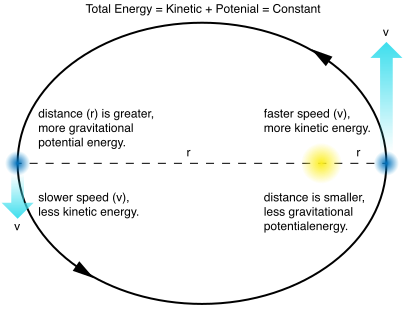
Both terms have units of erg: , and ✓. Total energy is conserved: as an object moves closer to the central mass it speeds up, converting potential to kinetic, but stays constant.
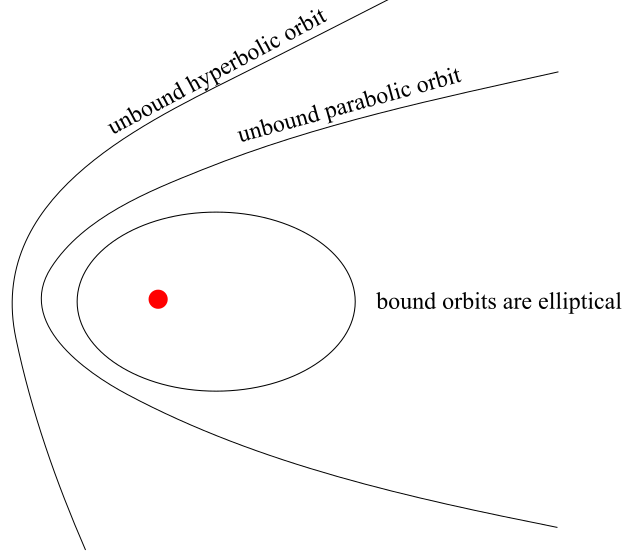
| Energy | Meaning | Orbit Type |
|---|---|---|
| Bound | Closed (ellipse or circle) | |
| Marginally bound | Parabolic (just escapes) | |
| Unbound | Hyperbolic (escapes with speed to spare) |
A spacecraft is in a stable circular orbit around Earth. Without calculating, what is the sign of its total mechanical energy?
Negative (). A stable orbit is a bound orbit — the spacecraft keeps coming back, and bound orbits always have negative total energy. If the energy were positive, it would escape to infinity.
For any bound orbit (circular or elliptical) with semi-major axis , the total energy is . For a circular orbit, .
Pause & Predict #5
Reason about total mechanical energy.
Check below.
Multiple choice
A comet approaches the Sun with total energy (and doesn’t hit the Sun). Will it return, or escape to infinity?
It escapes — positive energy means unbound (assuming no collision with the Sun).
Multiple choice
A spacecraft in a circular orbit fires its engines to speed up. Does it become more bound or less bound?
Total energy increases (less negative or positive), so the orbit becomes less bound (larger semi-major axis).
Angular Momentum Conservation: Why Kepler’s Second Law Works
Angular momentum
A conserved measure of orbiting/spinning motion, for circular motion. A central force exerts no torque, so stays constant — the deep reason behind Kepler’s Second Law.
Unit check: ✓. Why is angular momentum conserved? Because gravity is a
Torque
A twisting influence that changes angular momentum. A central force produces zero torque about the center, so it leaves unchanged.
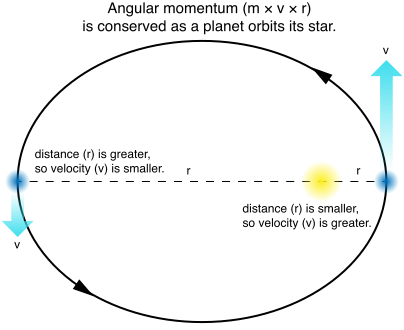
This immediately explains Kepler’s Second Law:
- Gravity is a central force — it points directly toward the Sun.
- A central force exerts no torque about the center.
- No torque means angular momentum stays constant.
- The area swept in time is a thin pie-slice, .
- Since is constant, the
areal velocity - Constant is exactly Kepler’s Second Law: equal areas in equal times.
Areal velocity
The rate at which the planet-Sun line sweeps out area, . Angular-momentum conservation makes it constant — which is Kepler’s Second Law.
When a planet is closer to the Sun (smaller ), it must move faster angularly to keep constant — like an ice skater spinning faster when pulling their arms in.
Pause & Predict #6
A planet's elliptical orbit has r_p = 1 AU at perihelion and r_a = 4 AU at aphelion.
Check below.
Problem
Check the three predictions above for the orbit with AU and AU. (a) Where is the planet faster, perihelion or aphelion? (b) Using , by what factor is the angular velocity larger at perihelion? (c) Is the linear-speed ratio the same as the angular-velocity ratio?
- Perihelion (closer = faster).
- From , the ratio is .
- No. Linear speed , so . The planet moves 4× faster (linear speed) at perihelion, not 16×.
The Virial Theorem: A Deep Connection
For gravitationally bound systems there’s a remarkable relationship between kinetic and potential energy — but it applies only to truly static systems (a star in hydrostatic equilibrium) or periodic systems averaged over a complete orbit. Writing for the time-averaged kinetic energy, the virial theorem states:
Equivalently, . The kinetic energy is exactly half the magnitude of the (negative) potential energy. (We meet the virial theorem in full when we build stellar structure in Module 3.)
Verify it for a circular orbit, where instantaneous equals average. The kinetic energy is , and the potential energy is . Then ✓. The total energy is , i.e. .
The same relationship that governs planetary orbits applies across the universe — when systems are in equilibrium. It sets stellar structure (thermal energy balances gravitational binding), reveals galaxy masses including dark matter (from stellar motions), and determines when gas clouds collapse.