Gravity and Orbits
Section 6 of 6
Synthesis and Relativity
Part 6: Synthesis — The Unity of Celestial and Terrestrial Physics
What Newton Achieved
Before Newton, celestial and terrestrial physics were separate domains: the heavens were thought to obey different rules. Newton demolished this distinction. The same force that pulls an apple from a tree — gravity following an inverse-square law — keeps the Moon orbiting Earth and the planets orbiting the Sun. There is one physics, applying everywhere.
| Kepler’s Laws | Newton’s Explanation |
|---|---|
| Orbits are ellipses | Solution to the equations of motion under inverse-square gravity |
| Equal areas in equal times | Conservation of angular momentum (central force → no torque) |
| Requires the inverse-square law; constant set by and the masses |
This is the template for all of physics: observe patterns, propose mechanisms, derive the patterns as consequences, then use the mechanisms to predict new phenomena.
Forward Connections
| Topic | Connection |
|---|---|
| Binary Stars | Orbital measurements → stellar masses via Newton’s Kepler III |
| Exoplanets | Transit timing, radial velocity → masses and orbits |
| Stellar Structure | Virial theorem (at equilibrium) → pressure-temperature balance |
| Compact Objects | Escape velocity → black-hole event horizons |
| Galaxy Dynamics | Rotation curves → dark-matter inference |
Every time we infer mass from orbital motion, we’re using Newton’s framework.
Beyond Newton: A Glimpse of Einstein
Newton’s framework is extraordinarily powerful — it explains planetary motion, predicts eclipses, weighs distant stars, and guides spacecraft. For nearly all astrophysical situations in this course, it’s excellent. But it’s not the final word. In 1915, Einstein’s
General relativity
Einstein’s 1915 theory of gravity as the curvature of spacetime: “mass tells spacetime how to curve; spacetime tells mass how to move.” Newtonian gravity is its weak-field, low-speed limit.
| Newton’s View | Einstein’s View |
|---|---|
| Gravity is a force acting instantaneously across space | Gravity is the curvature of spacetime itself |
| Space and time are fixed, absolute backdrops | Space and time are dynamic, shaped by mass and energy |
| Objects feel a gravitational pull | Objects follow the straightest possible paths (geodesics) through curved spacetime |
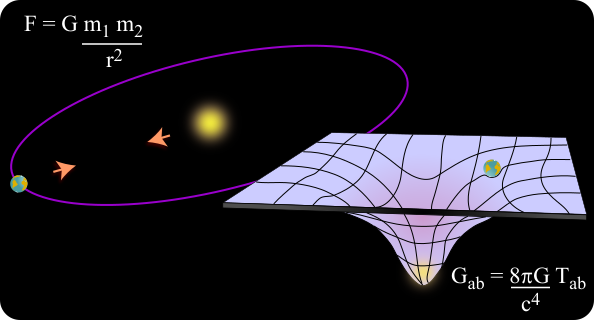
Newton’s framework needs corrections in three regimes: near extremely dense objects (neutron stars, black holes), at very high speeds (approaching ), and for precision measurements (GPS satellites need relativistic corrections or positioning drifts by ~10 km/day).
A teaser — black holes and the cosmic speed limit. Recall escape velocity, . What happens if you compress enough mass into a small enough region that escape velocity reaches the speed of light? Setting and solving for :
This is the Schwarzschild radius — the boundary of a black hole’s event horizon. Inside it, not even light can escape.
The same formula that describes rockets leaving Earth, pushed to its logical extreme, predicts the most exotic objects in the universe. Newton gave us the tools; Einstein showed us where they lead. (We’ll explore black holes in detail when we study compact objects later this semester.)
Quick Practice
Use these as a fast warm-up before the graded set.
Problem
Empirical vs. physical: Kepler observed . Newton derived that the power of in gravity must be 2 to reproduce it. If gravity instead followed , what relationship between and would we observe?
With (), the derivation gives , so — a steeper dependence. The inverse-square law is uniquely consistent with .
Problem
Orbital velocity scaling: Jupiter orbits at 5 AU, Earth at 1 AU. Without exact numbers, is Jupiter’s orbital velocity greater than, less than, or equal to Earth’s — and by what factor?
Jupiter is slower. Since , at 5 AU it moves by a factor of Earth’s speed.
Problem
Escape velocity intuition: a neutron star has roughly the Sun’s mass but a radius of only 10 km cm. Compared to the Sun’s escape velocity (618 km/s), is the neutron star’s larger or smaller? Estimate the ratio.
Much larger. Same but a vastly smaller , so is far bigger — the ratio is , giving km/s (about ).
Multiple choice
Energy and orbit type: a comet approaches the Sun with total energy erg (and doesn’t hit the Sun). Will it…
(b) Escape. Positive total energy means unbound; negative would be bound (elliptical), zero parabolic.
The 11 graded practice problems for this lecture live in the companion practice set.
Key Equations Summary
| Quantity | Equation | CGS Units |
|---|---|---|
| Gravitational Force | dyne | |
| Centripetal Force | dyne | |
| Orbital Velocity | cm/s | |
| Escape Velocity | cm/s | |
| Kepler III (Newton) | ||
| Gravitational PE | erg | |
| Total Energy | erg | |
| Bound Orbit Energy | erg | |
| Angular Momentum | ||
| Areal Velocity | ||
| Virial Theorem | (energy relation) |
CGS constants: ; g; cm; g; cm; 1 AU cm; 1 yr s.
This reading emphasizes the conceptual journey from empirical patterns to physical explanations — one of the most important transitions in the history of science. As you work through the mathematics, keep asking: what does this equation tell me? What happens if I change one variable? And always check your units.
Glossary
- Angular momentum
A conserved measure of orbiting/spinning motion, for circular motion. A central force exerts no torque, so stays constant — the deep reason behind Kepler’s Second Law.
- Aphelion
The farthest point from the Sun, at distance .
- Areal velocity
The rate at which the planet-Sun line sweeps out area, . Angular-momentum conservation makes it constant — which is Kepler’s Second Law.
- Barycenter
The center of mass of a two-body system — the “balance point” about which both bodies orbit. The more massive body orbits closer to it.
- Central force
A force directed along the line connecting two bodies (toward a center). Gravity is central — and any central force conserves angular momentum, which is why Kepler’s Second Law holds.
- Centripetal acceleration
The center-directed acceleration of an object in circular motion, . It changes the direction of velocity, not its magnitude.
- Centripetal force
The net inward force required to keep an object on a circular path, . It is not a new kind of force — it’s a role played by whatever real force points to the center (gravity, tension, friction).
- Eccentricity
A number measuring how “squashed” an ellipse is. is a circle; as the ellipse becomes more elongated. Earth’s is about 0.017 — nearly circular.
- Empirical law
A pattern extracted from data that describes what happens without explaining the underlying mechanism. Reliable within the range of the data, but silent on why.
- Escape velocity
The minimum launch speed needed to coast from radius to infinity, . The escaping object’s own mass cancels.
- General relativity
Einstein’s 1915 theory of gravity as the curvature of spacetime: “mass tells spacetime how to curve; spacetime tells mass how to move.” Newtonian gravity is its weak-field, low-speed limit.
- Gravitational potential energy
The energy stored in the gravitational field of two bodies, with zero defined at infinity. It is negative because a bound object sits below the zero level — in a “well” it would need energy to climb out of.
- Inertia
An object’s resistance to acceleration, set by its mass. For the same force, a more massive object accelerates less.
- Orbital velocity
The speed required for a circular orbit at radius around mass , . It depends only on and — not on the orbiting object’s mass.
- Perihelion
The point of closest approach to the Sun, at distance .
- Physical law
A statement of mechanism, derived from first principles, that explains why a pattern holds — and predicts new situations beyond the original data.
- Semi-major axis
Half the longest diameter of an ellipse — the average distance from the orbiting body to its host. We reserve the symbol for it throughout.
- Torque
A twisting influence that changes angular momentum. A central force produces zero torque about the center, so it leaves unchanged.