Gravity and Orbits
Section 3 of 6
Newtonian Gravitation
Part 3: Newton’s Law of Gravitation
From Patterns to Mechanism
Now we arrive at Newton’s great insight: gravity is a universal force between all masses, following a precise law.
Here is Newton’s gravitational constant, and are the two masses (in grams), is the distance between their centers, and the force is attractive, directed along the line connecting them.
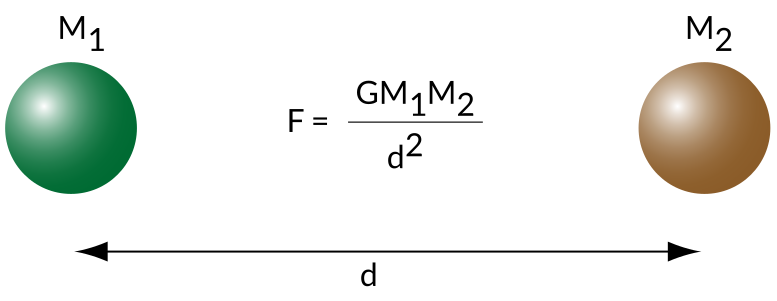
Each piece carries meaning. Gravity depends on the product of both masses (by the third law, each must feel the same force). The in the denominator is an inverse-square law: double the distance, and the force drops to one-quarter. And is a universal constant — the same everywhere in the universe. Solving for confirms its units must be (equivalently ). In the limits: as the force approaches zero but never quite vanishes; if either mass is zero, there is no force.
Note on light and gravity: Newtonian gravity acts on mass. Since photons are massless, it doesn’t correctly predict how light bends near massive objects — Einstein’s General Relativity does. More on that in Part 6.
Pause & Predict #3
Use Newton's law of gravitation.
Check below.
Problem
Check the three predictions above. (a) Double the distance: by what factor does the force change? (b) Double both masses: by what factor does the force change? (c) The Moon is 60 Earth radii away — what fraction of surface gravity does Earth’s pull provide there?
- Force drops by a factor of 4 (inverse-square).
- Force increases by a factor of 4 (proportional to the product of masses).
- of surface gravity.
How Did Newton Know This?
Newton didn’t propose the inverse-square law out of thin air — he derived it by requiring that gravity reproduce Kepler’s observations. The reasoning, as a scaling argument:
Assume orbits are nearly circular (), the force is a power-law central force for unknown , and the central mass dominates ().
Step 1 — Kepler III as a constraint: .
Step 2 — Postulate a general force: .
Step 3 — Apply circular-motion physics: gravity provides the centripetal force, so . The planet’s mass cancels:
Step 4 — Connect speed and period: for circular motion , so
Step 5 — Compare with Kepler III: requires , so . The inverse-square law is the only power law consistent with Kepler’s Third Law.
Step 6 — Identify the constant: when , is Newton’s gravitational constant , with units , giving . Newton didn’t just say “here’s a formula that works” — he showed the inverse-square law is required by the observed period-distance relation.
Newton’s Version of Kepler’s Third Law
Armed with the law of gravitation, Newton derived a complete version of Kepler III:
The registry card records the simplified form (valid when ). Newton’s full two-body form keeps both masses:
What’s different from Kepler’s empirical version? The constant of proportionality is now determined — it depends on and the total mass — and it applies to any two-body system, not just our solar system. A unit check confirms the right side has units of . When (Sun-planet systems), , recovering Kepler’s simpler form. And by measuring and we can solve for the total mass,
which is how we “weigh” stars in binaries, measure black-hole masses from orbiting stars, and estimate galaxy masses from rotation curves.
Two-Body Reality: The Center of Mass
Where does that factor come from? So far we’ve imagined the Sun sitting motionless. But Newton’s Third Law says if the Sun pulls on Earth, Earth pulls back equally — the Sun must move too. In reality, both bodies orbit their common
Barycenter
The center of mass of a two-body system — the “balance point” about which both bodies orbit. The more massive body orbits closer to it.
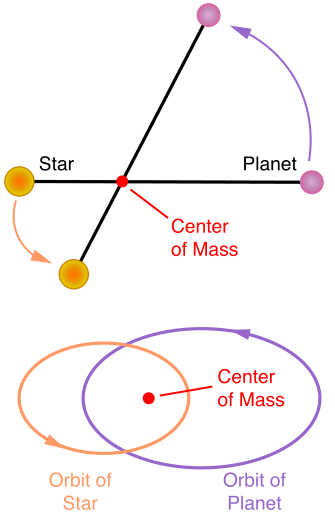
For two bodies separated by distance , the center of mass lies along the connecting line at distances
with . The more massive body orbits closer to the center of mass. When , the barycenter lies very close to — which is why Kepler’s “Sun at one focus” works so well. For the Sun-Jupiter system the Sun wobbles by about 750,000 km (roughly one solar radius); that wobble is exactly how we detect exoplanets via the radial-velocity method. When both bodies are properly accounted for, the orbital dynamics depend on the total mass, which is where the in Kepler III comes from.
Pause & Predict #3.5 — Is Kepler's Constant Really Constant?
Newton showed P^2/a^3 = 4*pi^2 / [G(M+m)], which depends on the total system mass.
Check below.
Problem
Check the three predictions above. (a) Is the same for a red dwarf system and a system? (b) Is a planet at 1 AU around the red dwarf longer- or shorter-period than Earth, and by what factor? (c) Why didn’t Kepler notice this mass dependence?
- No. The “constant” depends on total mass. The system’s constant is 4× smaller than the system’s.
- Longer. For the red dwarf the constant is twice as large, so is twice as large at the same , meaning is times longer — about 1.4 years at 1 AU.
- All Solar System bodies orbit the same central mass (), so they share one “Kepler constant.” Kepler had no other star system to compare with — exoplanet detection came 400 years later.