Gravity and Orbits
Section 4 of 6
Orbital and Escape Velocity
Part 4: Orbital Velocity and Escape Velocity
How Fast Must a Planet Move?
For a stable circular orbit at radius around a mass , one specific speed satisfies force balance: gravity equals the centripetal requirement,
The orbiting mass appears on both sides and cancels — all objects orbit at the same speed at a given radius. (This puzzled physicists until Einstein explained that the mass which resists acceleration equals the mass gravity pulls on.) Multiplying by gives , so the
Orbital velocity
The speed required for a circular orbit at radius around mass , . It depends only on and — not on the orbiting object’s mass.
Larger means stronger gravity, so you must orbit faster to avoid falling in; larger means weaker gravity, so you can orbit more slowly. The orbiting object’s mass doesn’t matter.
Problem
Find Earth’s circular orbital speed, given g, AU cm, and .
StepSubstitute into the formula
StepCombine powers of ten
Dimensional check
✓ — the grams cancel and the result is a speed.
Result
km/s. Earth travels at about 30 km/s just to stay in orbit. Sanity check: that’s about 0.01% of the speed of light — fast, but not relativistic.
Pause & Predict #4
Use v_orb = sqrt(GM/r).
Check below.
Problem
Check the two predictions above. (a) Jupiter at 5 AU vs Earth: is its orbital velocity greater, less, or equal — and by what factor? (b) A low satellite at km vs a GPS satellite at km: which moves faster, and by roughly what factor?
- Jupiter is slower. Since , at 5 AU it moves by a factor of Earth’s speed.
- The low satellite is faster, by a factor .
Escape Velocity: Breaking Free of Gravity
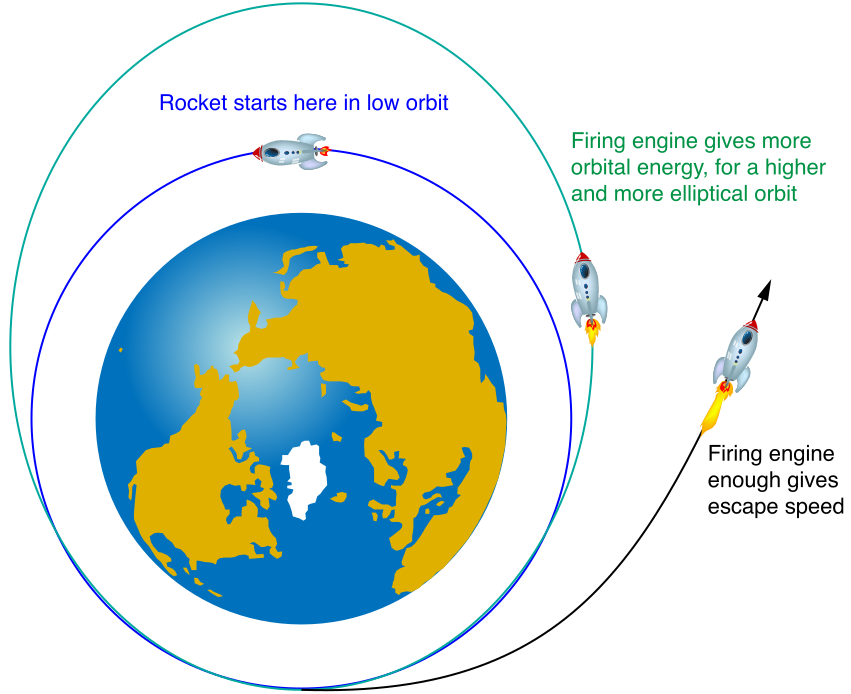
What if you want to leave a gravitational system entirely? You need enough kinetic energy to overcome the gravitational binding. The minimum speed is the
Escape velocity
The minimum launch speed needed to coast from radius to infinity, . The escaping object’s own mass cancels.
Escape velocity is exactly times the orbital velocity at the same radius, . Larger or smaller means a deeper gravitational well and a harder escape. The escaping object’s mass cancels — a rocket and a baseball need the same speed.
Problem
Find Earth’s escape velocity, given g, cm, and .
StepSubstitute into the formula
StepCombine powers of ten
Dimensional check
The factor of 2 is dimensionless, so the units are identical to : ✓.
Result
km/s. Sanity check: this is larger than the near-surface orbital velocity ( km/s) by ✓.
Comparison of key velocities:
| Location | (km/s) | (km/s) |
|---|---|---|
| Earth at (hypothetical near-surface orbit) | 7.9 | 11.2 |
| Moon surface | 1.7 | 2.4 |
| Sun surface | 434 | 618 |
A physical orbit at Earth’s surface is impossible due to atmospheric drag; the values are for the field strength at that radius. This is why Apollo astronauts needed a smaller rocket to leave the Moon: its escape velocity (2.4 km/s) is only about one-fifth of Earth’s, so less fuel is required.