Spoiler Alerts
Section 2 of 9
The Course Thesis
Think about this: every piece of information you’ve ever heard about the cosmos — the Sun’s temperature, the age of the universe, the composition of a distant star — none of it came from collecting samples. We can’t scoop up a piece of a star. We can’t fly to the edge of the universe with a tape measure. We’re stuck here on Earth (mostly), looking up at points of light.
And yet, somehow, we know that:
- The Sun’s surface temperature is about 5,800 K
- The nearest star is 4.2 light-years away
- Stars are mostly hydrogen and helium
- The universe is about 13.8 billion years old and expanding
How is any of that possible? The answer is the thesis of this course:
Pretty pictures are not the answer
Pretty pictures → measurements → models → inferences
Every gorgeous astronomical image you’ve ever seen is actually a dataset. The colors, the shapes, the bright spots and dark lanes — all of it encodes physical information. The job of an astronomer is to decode that information using physics and mathematics.
Inference
Drawing conclusions about quantities we cannot directly access (like a star’s temperature) from quantities we can measure (like its color). Inference requires a model — a physical relationship connecting observable to unobservable.
DigressionPretty pictures are data
Astronomical images are built from photon counts, not snapshots. Colors are often assigned to make invisible wavelengths visible to human eyes.
So astronomy is
The Four Things We Can Actually Measure
Here’s the humbling truth that makes astronomy both challenging and beautiful: from our cosmic vantage point, staring at points of light billions of kilometers away, we can directly measure only four types of things.
Reading tip: treat the tables in this reading as reference maps — don’t memorize them. You’ll revisit each one when it matters.
Four direct observables
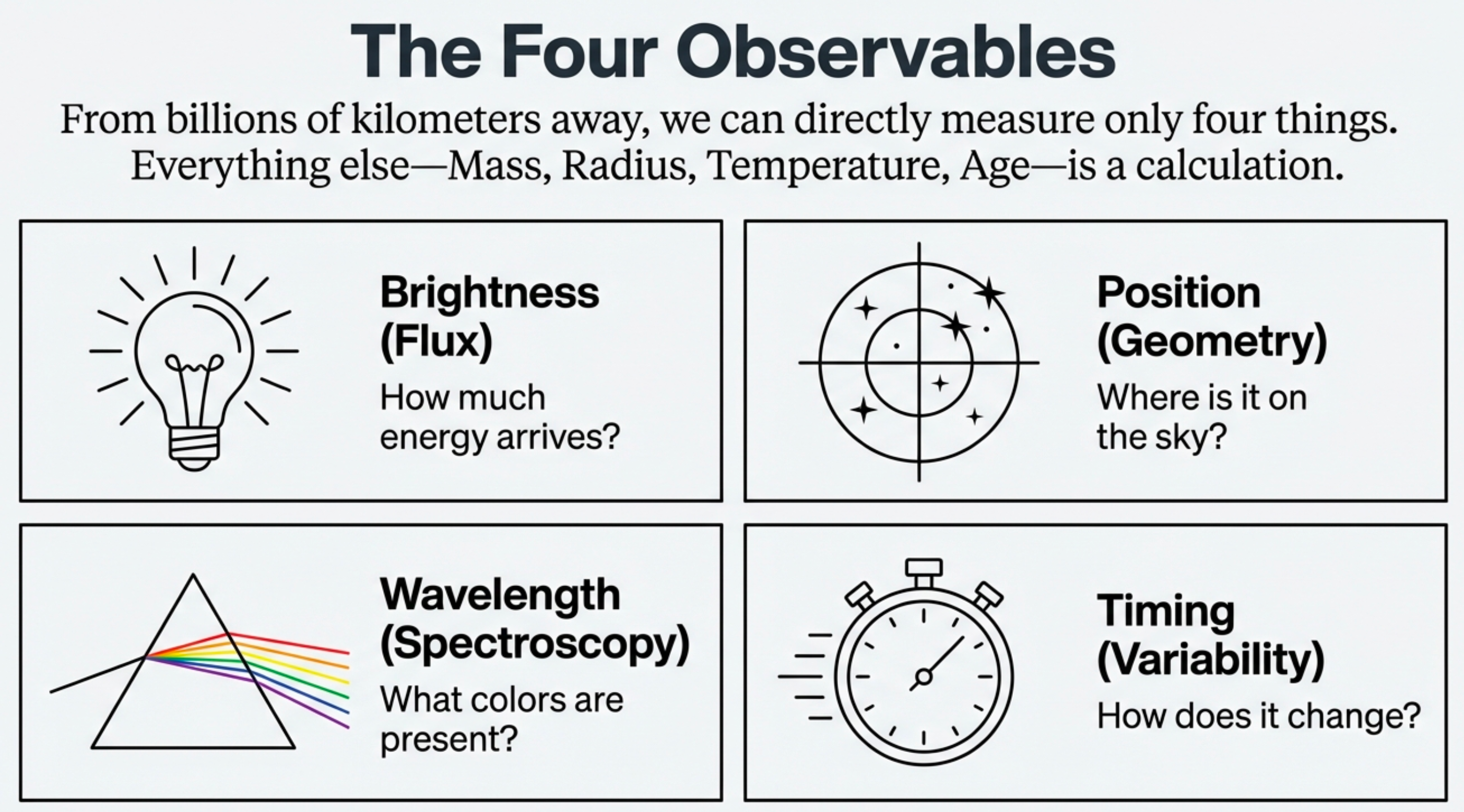
Let’s sharpen what each one means:
Brightness is the rate at which light energy arrives at your detector — photons per second per unit area. We literally count photons. This is the raw signal, and it depends on two things we can’t disentangle from brightness alone: how luminous the source truly is, and how far away it is. A dim nearby candle and a brilliant distant lighthouse can appear equally bright.
Position is where an object appears on the sky, measured in angles. This is purely geometric — we’re mapping locations on a celestial sphere. But position becomes powerful when we track changes: the annual wobble from Earth’s orbit (parallax), the slow drift across the sky (proper motion), or the periodic wobble caused by an unseen companion.
Wavelength is the key to spectroscopy. By spreading light into its component wavelengths, we transform a single brightness measurement into thousands of data points — brightness as a function of wavelength. This spectral information encodes temperature (through the overall color), composition (through absorption and emission lines), and motion (through Doppler shifts).
Timing is special: it’s both a measurement in its own right (when did this pulse arrive?) and a way to extract additional information from the other three. A star whose brightness varies periodically tells us something a constant star doesn’t. An object whose position shifts tells us about motion. Timing transforms static snapshots into dynamic movies.
DigressionKey insight
Timing unlocks physics that static measurements miss. Variability reveals masses (through orbits), sizes (through eclipses), and internal structure (through pulsations).
A star appears to wobble periodically in its position on the sky. Which of the four observables is this, and what might we infer from it?
This is Position (tracked over time via Timing). We might infer the star has an unseen companion — a planet or another star — whose gravitational pull causes the wobble.
What’s NOT on This List
Notice what you cannot directly measure:
| Property | How We Infer It |
|---|---|
| Temperature | From color/spectrum (hotter = bluer peak) |
| Composition | From spectral absorption/emission lines |
| Distance | From parallax, brightness + known luminosity, or other methods |
| Luminosity | From brightness + distance |
| Mass | From orbital motion (gravity reveals mass) |
| Size (radius) | From luminosity + temperature, or from eclipses |
| Age | From stellar evolution models |
Every single one of these fundamental properties must be inferred by combining measurements with physical models. The gap between “what we measure” and “what we want to know” is bridged by physics. That bridge takes the form of models — mathematical relationships that connect observables to physical quantities. We’ll formalize this in Section 1.3.
A student claims: “Astronomers measured the temperature of that star to be 5,800 K.” Is this technically accurate? If not, what did they actually measure, and how did they get to temperature?
The statement is imprecise. Astronomers measured the star’s spectrum or color (wavelength distribution). They inferred temperature using the physical relationship between temperature and peak emission wavelength — hotter objects emit bluer light. Temperature is never directly measured; it’s always inferred from wavelength observations via a model.
A Taste of What “Decoding” Means
Here’s a concrete example of the decoder ring in action.
Suppose you observe two stars of the same type (same intrinsic properties), but one appears 4× fainter than the other. Why might that be?
If they’re truly identical, the fainter one must be farther away. But how much farther? This is where physics enters. Light spreads out as it travels, and the amount of light you receive decreases with the square of the distance. So if Star B is 4× fainter than Star A, Star B must be 2× farther away (because ).
That’s one measurement (relative brightness), one physical law (the inverse-square law), one inference (relative distance). This is what “decoding” means.
Brightness is not distance
An otherwise identical star appears nine times fainter. How many times farther away is it?
Numeric answer
A third star of the same type appears 9× fainter than the reference star. How much farther away is it? (Give the distance ratio.)
3× farther, because .
Flux
Light energy per unit time per unit area reaching your detector — the precise, measurable version of “brightness.”
Luminosity
The total light energy a source emits per unit time — an intrinsic property of the object, independent of how far away it is.
Prediction Moment
Look at the first image in the spoiler reel below (the colorful nebulae). Before reading the explanation, commit to a guess. There's no wrong answer — this is about surfacing your intuitions.
Hold these guesses. We'll see how they compare to the physics as the spoiler reel unfolds.