UNDER REVIEW
Optional sections
Reading width
Color theme

Spoiler Alerts

Section 8 of 9

Looking Back in Time

Distance is a time dial

Light’s finite speed has a profound consequence for astronomy that deserves its own section.

When you look at the Sun, you see it as it was 8.3 minutes ago. The “Sun right now” is inaccessible — you can only see the “Sun 8.3 minutes ago.” For the Sun, this seems like a curiosity. For distant objects, it becomes transformative.

Lookback time

The time light takes to travel from an object to us. Because that’s also when the light was emitted, we see distant objects as they were in the past.

The universe is a time machine
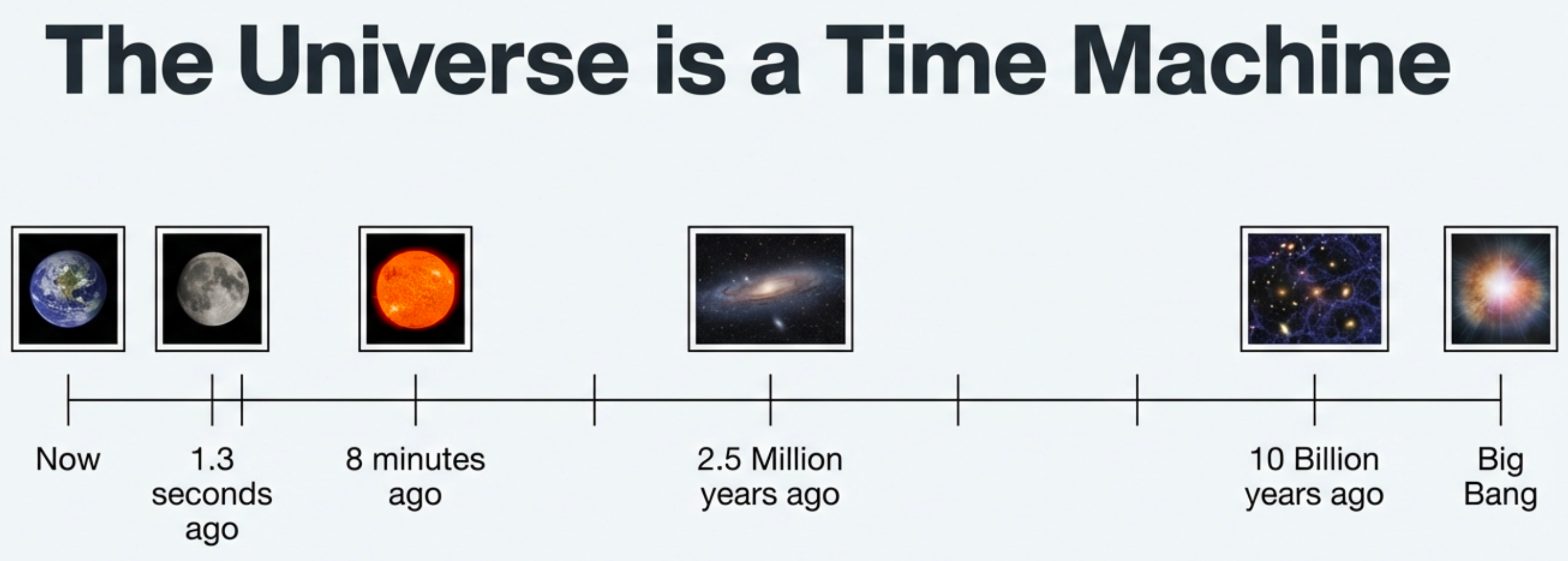
Timeline showing lookback time: Earth (Now), Moon (1.3 seconds ago), Sun (8 minutes ago), Andromeda galaxy (2.5 million years ago), distant galaxies (10 billion years ago), and cosmic microwave background (Big Bang). Each object shown as thumbnail image above the timeline.
Figure 19Distance is a time dial. Looking at the Moon = 1.3 seconds ago; the Sun = 8 minutes ago; Andromeda = 2.5 million years ago; distant galaxies = 10 billion years ago.Course illustration (A. Rosen)

This lookback time isn’t a limitation — it’s a feature. We can directly observe cosmic history by looking at objects at different distances. When we observe a galaxy 10 billion light-years away, we see it as it was 10 billion years ago — when the universe was young, when stars formed differently, when galaxies were still assembling. We’re not just measuring where things are; we’re witnessing when they were.

The cosmic microwave background (CMB) is the extreme case: light from 380,000 years after the Big Bang, traveling for 13.8 billion years. When we observe the CMB, we see the universe as a baby — the most ancient light in existence.