Spoiler Alerts
Section 6 of 9
The Decoder Ring
The decoder ring
The spoiler reel showed you what’s possible. Now let’s make the method explicit. Astronomy works because we follow a systematic process:
Signal → Measurement → Model → Inference → Prediction → Test
Claims must survive a reasoning chain
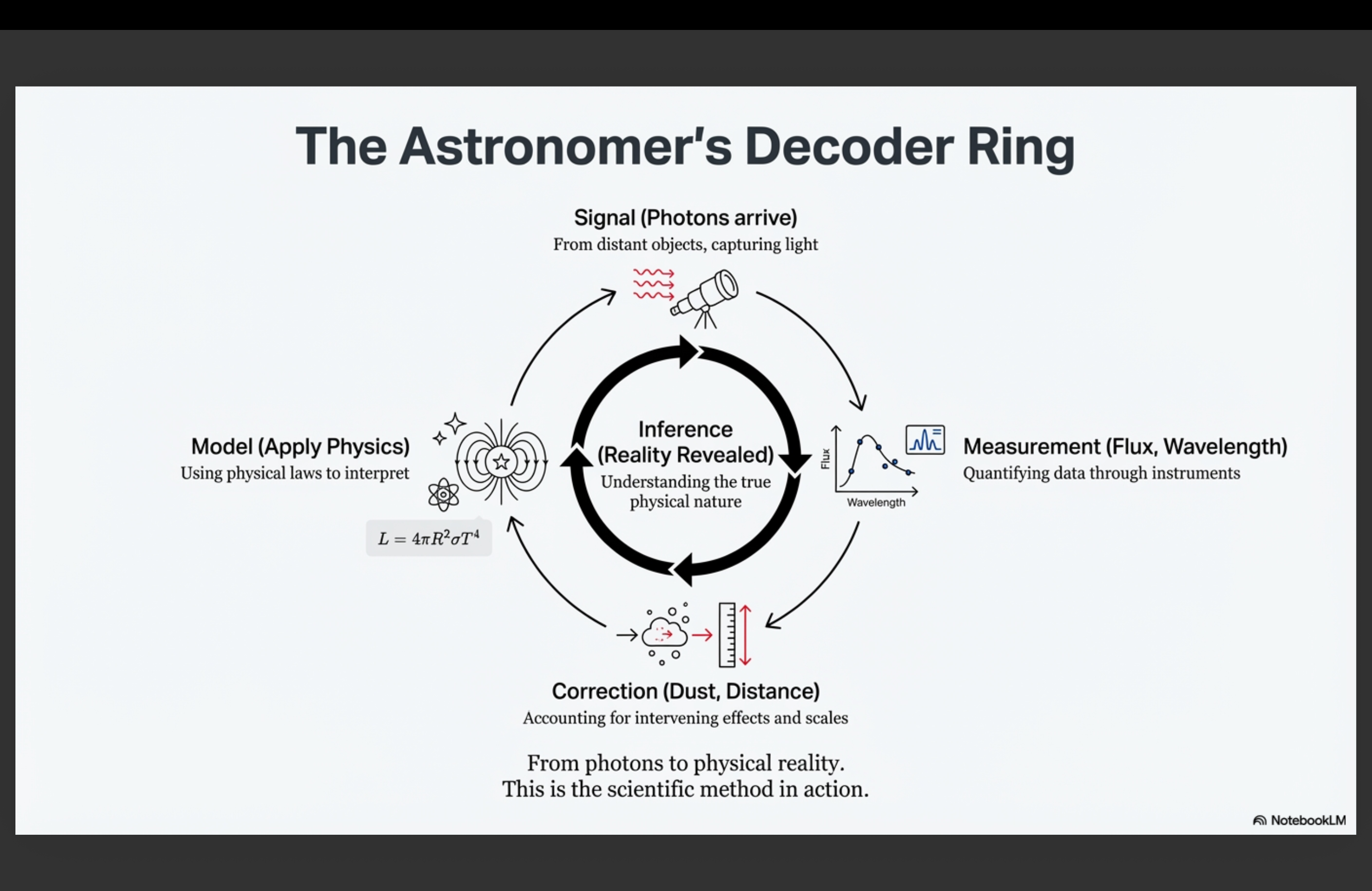
- Signal: the universe sends us electromagnetic radiation — photons.
- Measurement: we detect and quantify those signals.
- Model: we apply physical relationships that connect observables to physical quantities.
- Inference: model + measurement yields something we couldn’t directly measure.
- Prediction: the model tells us what else should be true.
- Test: we compare predictions to new observations.
When tests fail, we revise models. That cycle is how science progresses.
Model
A mathematical relationship encoding physical assumptions. Models connect what we measure to what we want to know — and, crucially, they can be tested.
A
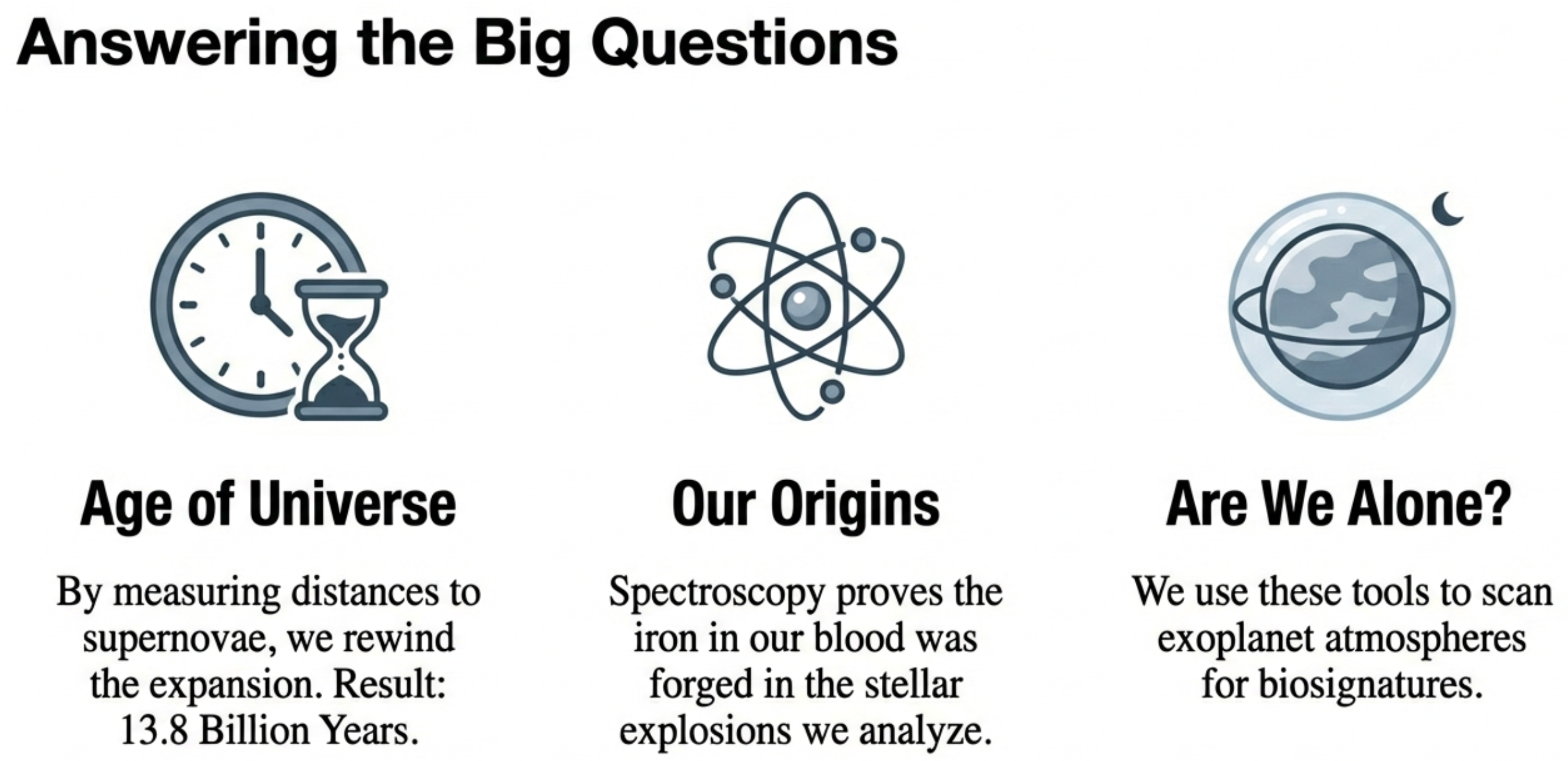
One method answers very different questions
The Physical Quantities We Care About
Measure four things. Infer the universe.
Here’s the distinction that makes astronomy both hard and fascinating:
- The Four Observables (Section 1.1): what we can directly measure — brightness, position, wavelength, timing.
- The Six Core Quantities (below): what we actually want to know about stars and galaxies.
Notice that none of the quantities below appear in the observables list. Every single one must be inferred by combining measurements with physical models. That gap — between what we measure and what we want to know — is where physics lives.
| Quantity | Symbol | What It Measures | How We Infer It | CGS Units |
|---|---|---|---|---|
| Distance | How far away | Parallax (position), standard candles (brightness) | cm (or pc, ly) | |
| Time | Duration or epoch | (context-dependent) | s (or yr) | |
| Speed | Rate of motion | Doppler shift (wavelength) | cm/s | |
| Mass | Amount of matter | Orbital motion (position + timing) | g (or ) | |
| Energy / Luminosity | , | Total energy; energy output per time | Flux (brightness) + distance | erg; erg/s (or ) |
| Temperature | Thermal energy scale | Spectrum/color (wavelength) | K |
Every value in the “How We Infer It” column connects back to one or more of the four observables via a physical model. That’s the course thesis in table form. These quantities are connected by physical laws: mass determines gravity, temperature determines spectrum, distance relates flux to luminosity. You’ll build the network of relationships throughout the semester.
DigressionEnergy vs. luminosity
You know energy from physics — the capacity to do work, measured in erg (or joules). In astronomy we often use luminosity: energy emitted per unit time (power), measured in erg/s or . The two are related: total energy output = luminosity × time. Solar units (, , ) are often more intuitive than CGS — “this star is 10 ” means “10 times the Sun’s mass.”