Spoiler Alerts
Section 5 of 9
The Dark and Evolving Universe
Spoiler 9: The Dark Universe — Most of Reality Is Invisible (and Not Static)
Most matter does not emit light
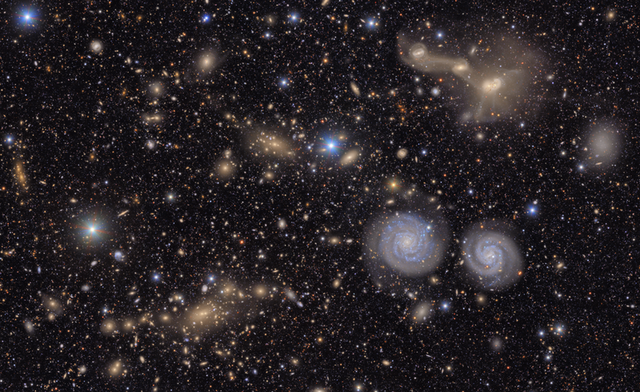
This spoiler chains together several observables, so it doesn’t fit the clean one-observable / one-model / one-inference pattern of the others. Watch the chain instead.
What do we measure? Velocities — and here’s how. When we spread starlight into a spectrum, we see absorption lines at specific wavelengths (the fingerprints from Spoiler 4). If those lines appear shifted from their laboratory (at-rest) wavelengths, the source is moving: lines shift → velocity. This is the Doppler effect in action. We measure how fast stars orbit within galaxies and how fast galaxies move within clusters — all by detecting tiny wavelength shifts in their spectra. We also measure how light bends as it passes near massive objects (gravitational lensing).
Why velocities matter: here’s the critical inference chain. Objects in orbit are constantly accelerating (changing direction). Acceleration requires a force. In space, the only force acting at these scales is gravity. And gravitational force depends on mass. So: Doppler shift → velocity → acceleration → gravitational force → mass.
What do we infer? Galaxies rotate too fast. Stars in the outer regions orbit at speeds that should fling them into intergalactic space — unless there’s far more mass than we can see. The same is true for galaxy clusters. When we calculate the mass required to explain the observed motions, it exceeds the visible mass by a factor of ~6. We infer the presence of dark matter — matter that doesn’t emit, absorb, or reflect light, but does exert gravitational pull.
What physics makes this legal? Newton’s law of gravity tells us that orbital speed depends on enclosed mass: . Measure and , solve for . The math is unambiguous. The extra mass is real — we detect it through the motions it causes.
Dark matter writes structure across the sky
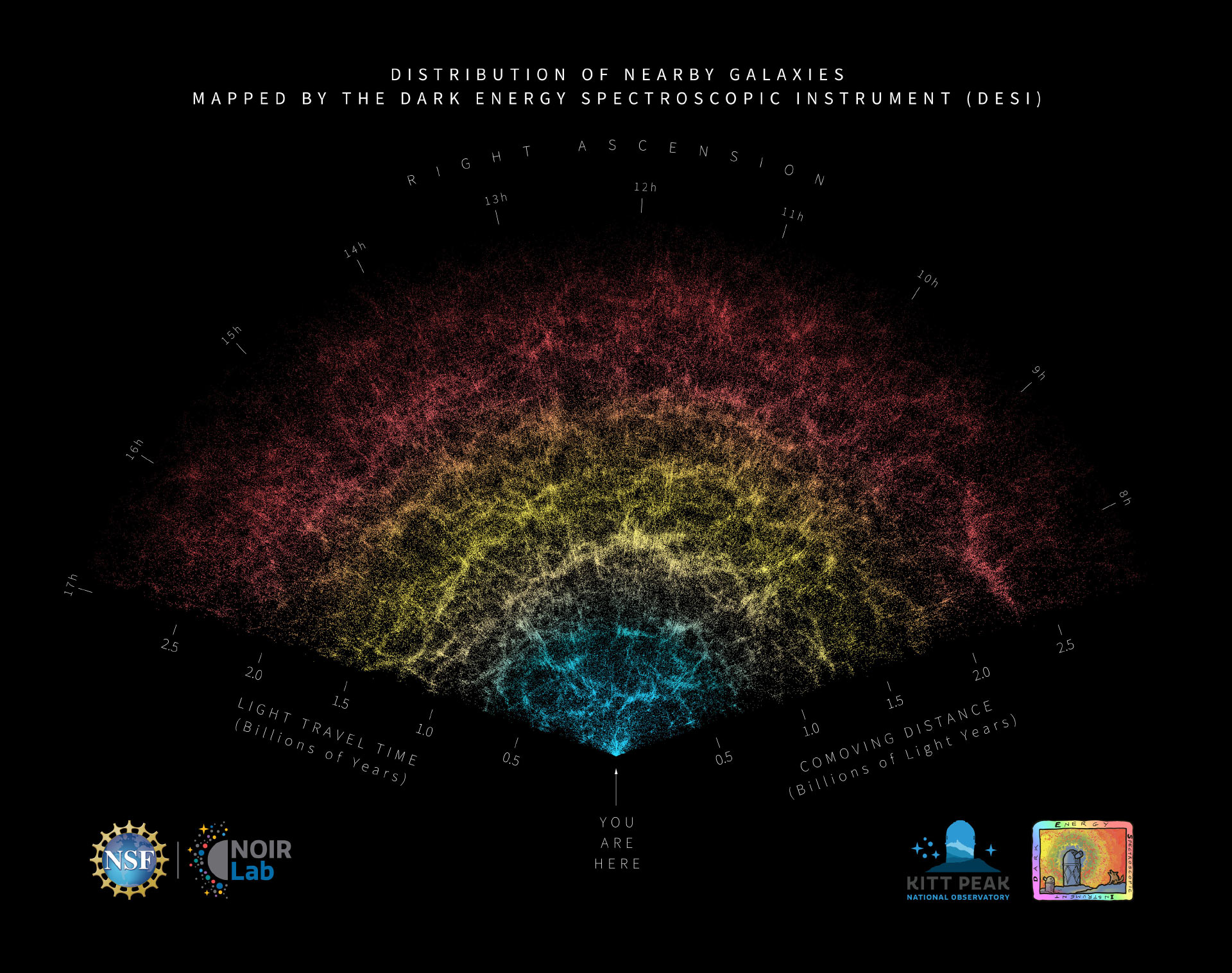
The cosmic web: when we map millions of galaxies in 3D (using redshifts for distances), we see that galaxies aren’t scattered randomly — they’re organized into a cosmic web of filaments, walls, and vast empty voids. This architecture is dark matter’s signature at the largest scales. And it’s still evolving: gravity pulls matter from voids into filaments, from filaments into clusters. The largest structures in the universe are still collapsing.
Key insight: motion reveals mass. Gravity causes acceleration; we measure velocities; the math tells us how much mass is required. Most of it is invisible — but the universe is not static, and gravity is still the architect, still building today.
Transition: dark matter tells us that most matter is invisible. But there’s something even stranger: most of the universe’s energy content isn’t matter at all…
Spoiler 10: Cosmic History — 13.8 Billion Years and Accelerating
Distance turns the universe into a history
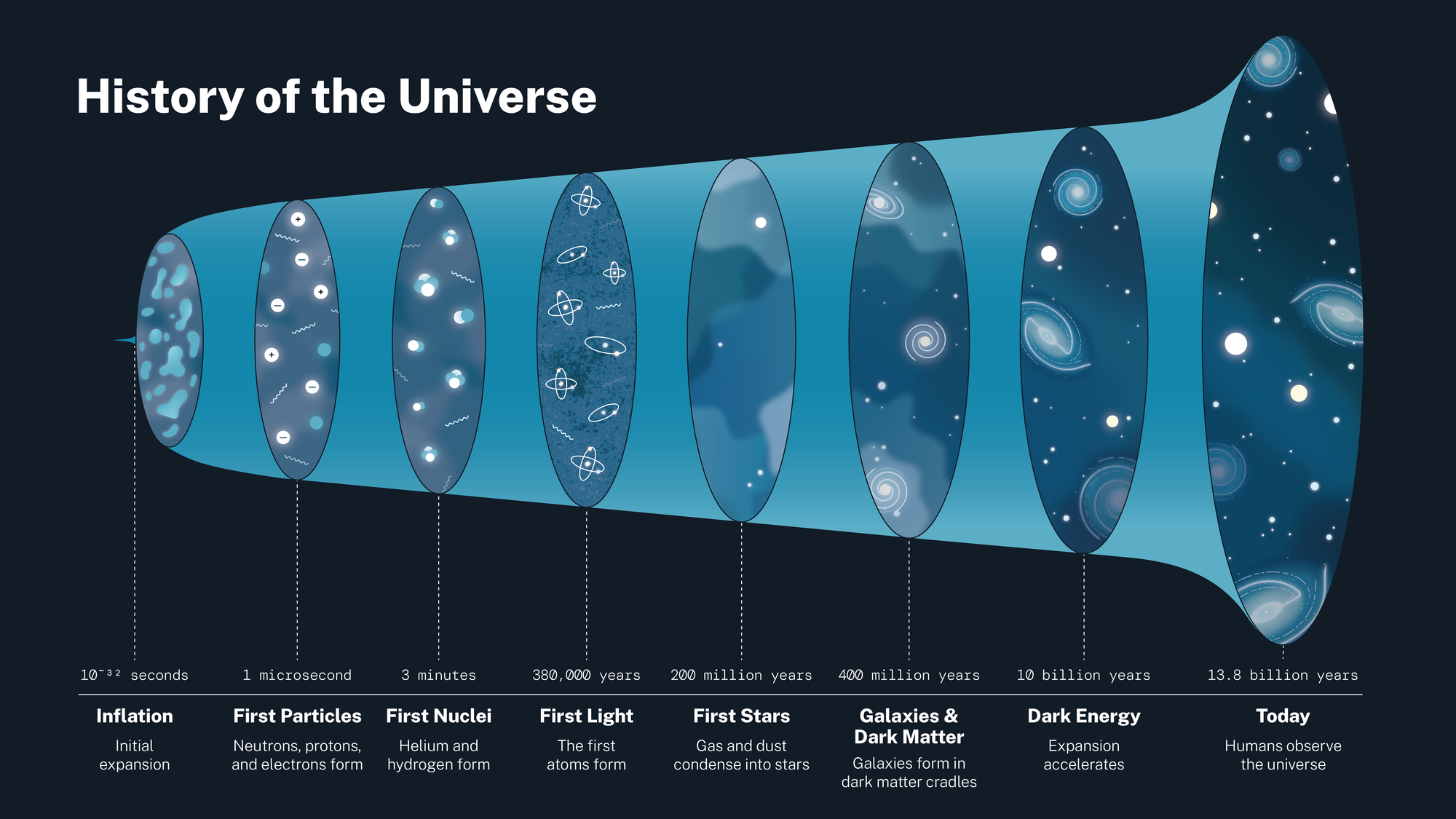
Like Spoiler 9, this one combines two measurements — distances and recession speeds — so we trace the chain rather than force it into a single flow.
What do we measure? Two things: distances to objects across cosmic history (using the distance ladder from Spoiler 2) and their recession speeds. How do we get recession speeds? Through redshift — the Doppler shift we introduced in Spoiler 4. When we spread a galaxy’s light into a spectrum, its spectral lines appear shifted toward longer (redder) wavelengths compared to laboratory values. The amount of shift tells us how fast the galaxy is moving away. By combining distances with redshifts for objects at different epochs, we reconstruct how the universe has expanded over time.
What do we infer?
- The universe is 13.8 billion years old — traced back from the observed expansion rate.
- The expansion was initially slowing down (gravity pulling matter together), but about 5 billion years ago it started speeding up.
- Something is pushing the universe apart faster and faster. We call it dark energy.
What physics makes this legal? If you know how fast galaxies are receding and how far away they are, you can “run the movie backward” to find when everything was in the same place — the Big Bang. Careful measurements give 13.8 billion years. The acceleration was discovered in 1998 by measuring Type Ia supernovae at large distances. These standard candles appeared fainter than expected — meaning they were farther away than a decelerating universe would predict. This was not predicted; it contradicted the expectation that gravity should be decelerating expansion. The universe broke the model, and cosmology had to revise. That’s how science works: when observations surprise us, we update.
Key insight: we can measure the age and fate of the universe — using the same tools we used to measure the distance to a nearby star. The method scales.
If this reading felt overwhelming in places, that’s not a warning sign — it’s evidence that your brain has been introduced to a new landscape. You are not expected to carry these details yet. You are expected to recognize them when we meet them again, with tools in hand.