Spoiler Alerts
Section 7 of 9
Light: The Cosmic Messenger
Light is the messenger
Everything we know about the universe beyond Earth comes from light — electromagnetic radiation traveling across the cosmos carrying information. Understanding light is foundational.
The Speed of Light: A Universal Constant
Light travels at a constant speed in vacuum:
This is fast — about 300,000 km/s, fast enough to circle Earth 7.5 times in one second. But it’s also finite, and that finiteness has profound consequences. To build intuition:
- Light crosses your room almost instantaneously.
- Light from the Sun takes 8.3 minutes to reach Earth.
- Light from the nearest star takes 4.2 years.
- Light from the Andromeda Galaxy takes 2.5 million years.
The light-year — the distance light travels in one year — is roughly cm, or about 63,000 AU.
DigressionWhy "c"?
From celeritas, Latin for “swiftness.” It’s one of the most fundamental constants in physics — the speed limit of the universe.
Light as a Wave: The Fundamental Relationship
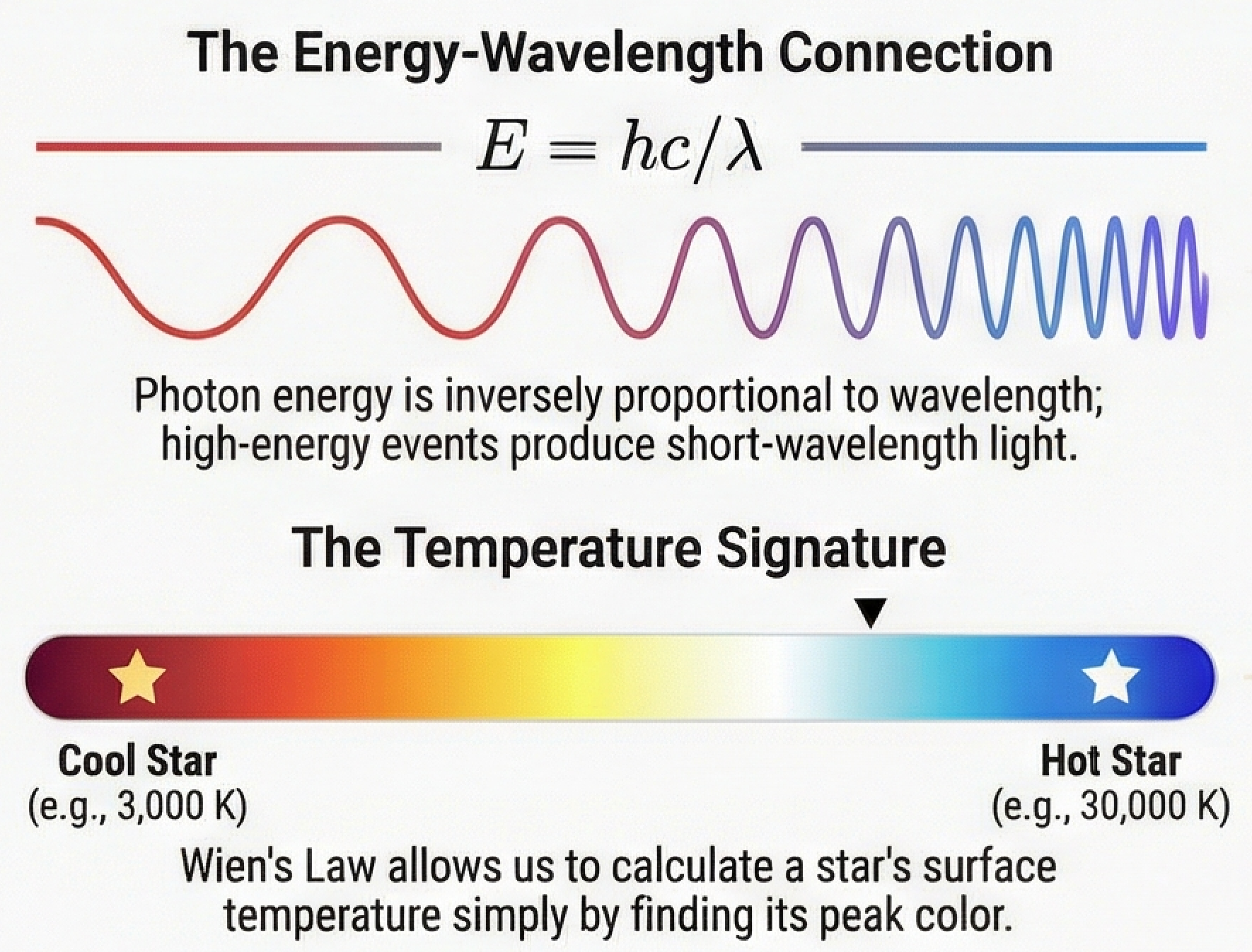
Light is an electromagnetic wave — oscillating electric and magnetic fields propagating through space. Like any wave, it has a wavelength (): the distance between successive crests. The relationship between wavelength, frequency, and speed is:
Wavelength and frequency trade places
Here is the (constant) speed of light, is the wavelength (cm), and is the frequency (Hz = cycles per second). Since is fixed, wavelength and frequency are inversely related: longer wavelength means lower frequency, and vice versa.
DigressionHertz (Hz)
The unit of frequency; 1 Hz = 1 cycle per second. Named after Heinrich Hertz, who first demonstrated electromagnetic waves. Units check: ✓.
Problem
Red light has wavelength nm cm. What’s its frequency?
StepCalculate
That’s 430 trillion oscillations per second!
Dimensional check
✓
StepLimiting case
Blue light ( nm) has shorter wavelength. Since , shorter means higher — roughly higher. Check: Hz, indeed about 1.7× larger ✓.
Result
Red light oscillates at Hz. Pattern: shorter wavelength → higher frequency. This inverse relationship appears throughout the course.
Problem
Radio waves have wavelengths of ~1 meter. Visible light has wavelengths of ~500 nm ( cm). Which has higher frequency, and by roughly how much?
Visible light has much higher frequency. Since , shorter wavelength means higher frequency. Visible light’s wavelength is about times smaller than radio, so its frequency is about times higher.
DigressionDoppler preview
If a light source moves toward you, the wavelengths you receive are compressed (shifted blue); if it moves away, they are stretched (shifted red). The speed of light stays constant — what changes is the wavelength. We’ll see this Doppler effect power major discoveries: dark matter, the expanding universe, and exoplanets.
Photon Energy: Where Quantum Mechanics Enters
Photon
A discrete packet (quantum) of light. Light is not only a wave; it also arrives in these indivisible bundles, each carrying a specific energy set by its frequency.
Light isn’t just a wave — it also comes in discrete packets called
Wavelength sets energy per photon
Here erg·s is Planck’s constant. Because , the two forms and are equivalent — a photon’s energy is fixed by its wavelength alone.
Problem
How much more energy does an X-ray photon ( nm cm) carry compared to a radio photon ( m cm)?
StepCalculate the ratio
Since , the ratio of energies is:
Dimensional check
The cancels, and cm/cm is dimensionless — the answer is a pure ratio ✓.
StepLimiting case
What if we used gamma rays instead ( cm)? The ratio becomes — a trillion times more energy than radio. The pattern holds: shorter → higher .
Result
X-ray photons carry a billion times more energy than radio photons. This explains why X-ray emission requires million-degree plasma, while radio emission can come from cold gas. Energy determines what processes can produce the light.
The Electromagnetic Spectrum: A Temperature Ladder
Combining and , we understand the EM spectrum as a map of physical conditions:
| Wavelength Range | λ (approximate) | Photon Energy | Typical Source |
|---|---|---|---|
| Radio | cm – m | ~ erg | Cold gas, magnetic fields |
| Infrared | 1 μm – 1 mm | ~ erg | Warm dust, cool stars |
| Visible | 400 – 700 nm | ~ erg | Stellar surfaces |
| Ultraviolet | 10 – 400 nm | ~ erg | Hot stars |
| X-ray | 0.01 – 10 nm | ~ erg | Hot plasma ( K) |
| Gamma-ray | <0.01 nm | > erg | Extreme events |
This hierarchy emerges from physics: hotter objects emit higher-energy (shorter-wavelength) photons. Different wavelengths probe different temperature regimes — cold things glow at long wavelengths, hot things at short wavelengths. Physics, not convention.
The spectrum is a ladder of physical conditions
Why do X-ray telescopes see different objects than optical telescopes?
X-ray photons have much higher energy than optical photons, requiring much hotter sources. X-ray telescopes detect million-degree plasma — gas in galaxy clusters, matter falling into black holes, stellar coronae — while optical telescopes see stellar surfaces at thousands of degrees. Different wavelengths = different temperature regimes = different objects visible.