UNDER REVIEW
Optional sections
Reading width
Color theme

Surface Flux & Colors of Stars

Section 3 of 8

The Stefan–Boltzmann Law

Part 3: The Stefan-Boltzmann Law

Every blackbody is described by its temperature. The Stefan-Boltzmann law quantifies how much power a blackbody radiates per unit area: , where . Multiplying by the spherical surface area gives the total luminosity.

conceptluminosity-temperature-radius
verbal

Temperature dominates and size amplifies. A blackbody’s output rises steeply with temperature — as T4T^4 per unit area — while total luminosity scales with surface area as R2R^2. So a hot star can be small and still bright, and a cool star must be huge to match it.

equation
seestefan-boltzmann(L)
figure
see Fig.blackbody-stellar-spectra(T)

The Stefan-Boltzmann law connects three quantities — , , — so knowing any two gives the third. Temperature enters as : a steep dependence that makes even small temperature differences produce large effects.

Stefan-Boltzmann law

— the total power a spherical blackbody of radius and effective temperature radiates. Surface flux times area .
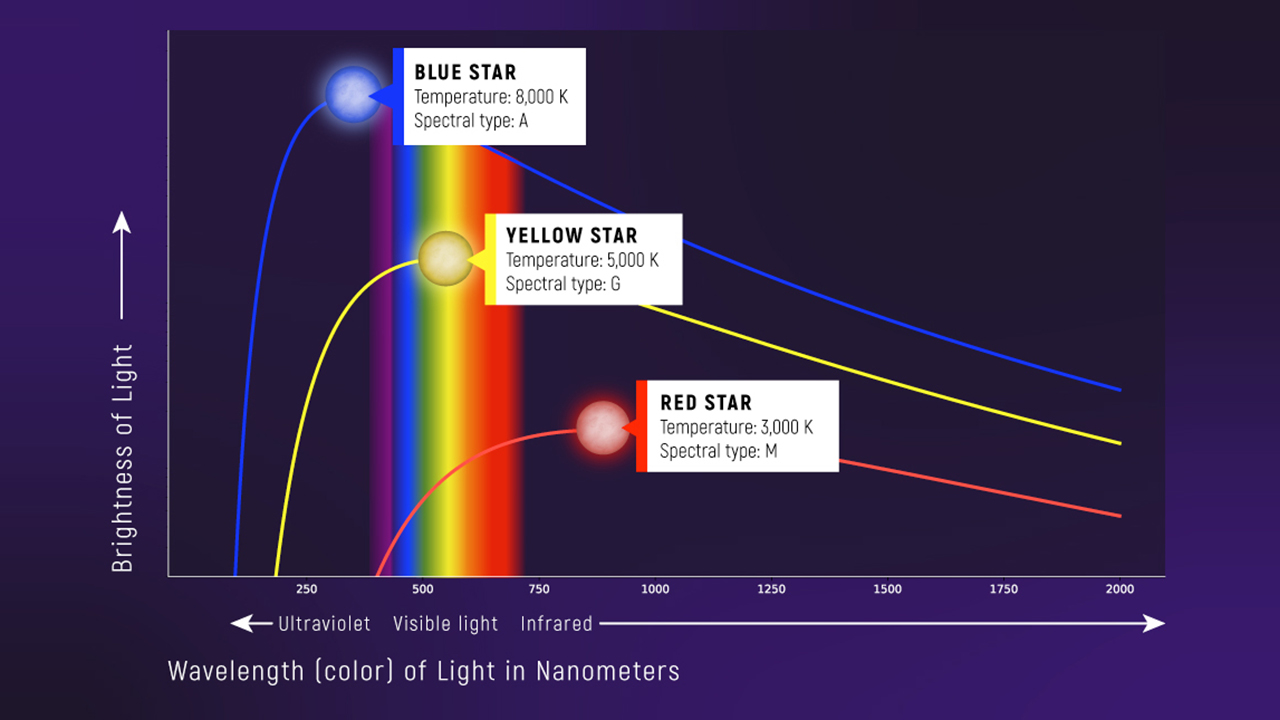
Graph showing three Planck curves for stars at 8000 K (blue, peaks in the near-UV around 360 nm), 5000 K (yellow, peaks near 580 nm), and 3000 K (red, peaks in the near-IR around 970 nm). The visible band (about 400-700 nm) is marked. Y-axis is brightness; X-axis is wavelength.
Figure 4Hotter stars peak at shorter (bluer) wavelengths and emit more total light: an 8000 K star peaks near 360 nm, a 3000 K star near 970 nm. Wien's law: lambda_peak = b/T with b = 0.2898 cm K.JWST/STScI