Surface Flux & Colors of Stars
Section 6 of 8
Inferring Stellar Radii
Part 6: Inferring Stellar Radii
We trust radii inferred from light because the chain is cross-validated: parallax distances match photometric luminosities, interferometry measures some angular diameters directly, and eclipsing binaries give independent sizes. The chain is model-based but repeatedly tested.
Solving the Stefan-Boltzmann law for radius: isolate , then raise to the power, . In solar units, .
Problem
Sirius A has and (from color), with , . Find its radius.
StepTemperature ratio, fourth power
, so .
StepSolve in solar units
, so .
Dimensional check
Solar-unit ratios are dimensionless; the result is a pure multiple of ✓. In CGS, .
Result
. Hot stars don’t need to be big to be bright: at , each cm² radiates the Sun’s surface power, so 25× the luminosity needs only ~70% more radius.
Predict first
Betelgeuse is 10^5 times more luminous than the Sun but only 60% as hot. Will its radius be closer to 10x, 100x, or 1000x the Sun's? Commit before checking the calculation.
Then work Example 4 below.
Problem
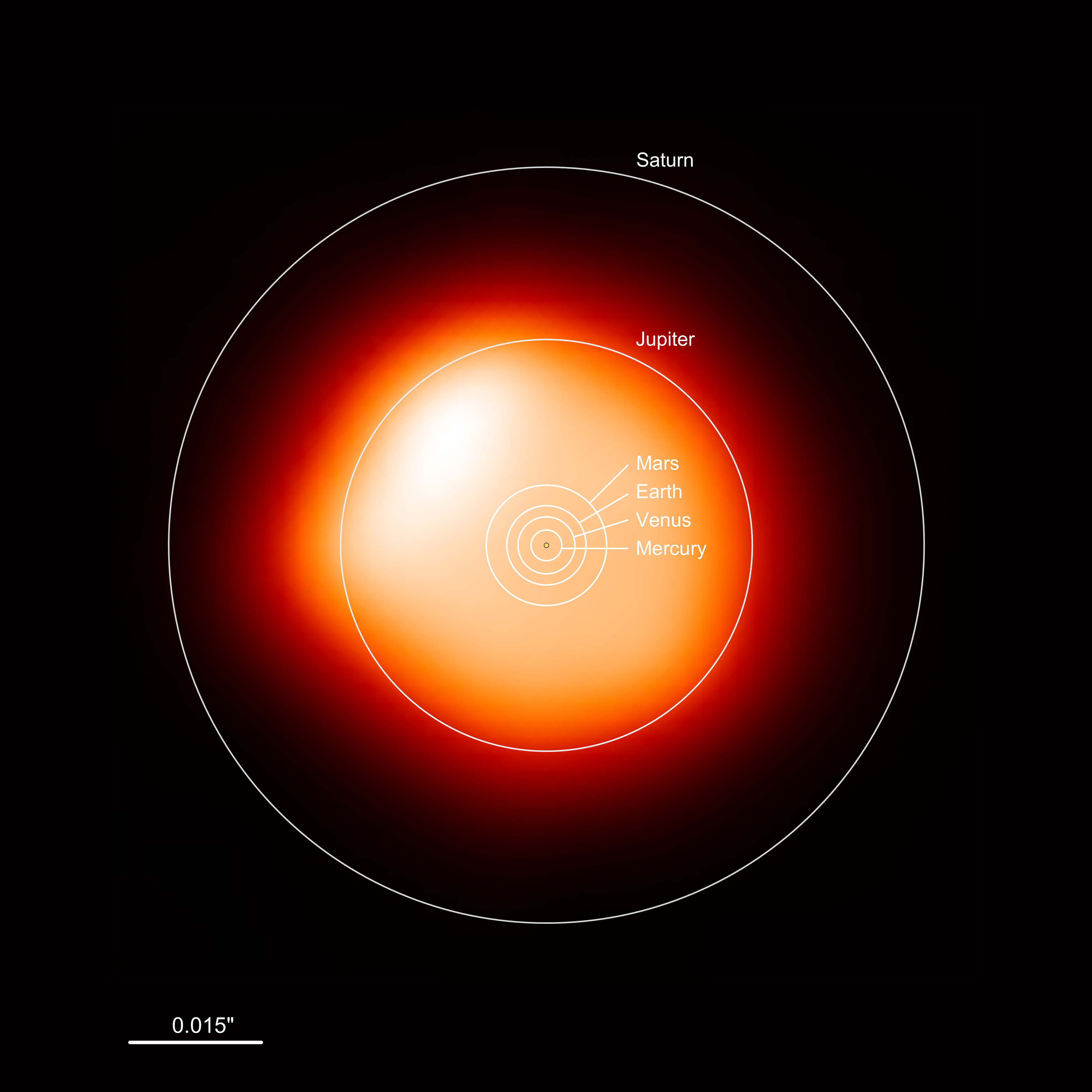
Betelgeuse has and . Find its radius and compare it to the Sun.
StepTemperature ratio, fourth power
, so .
StepSolve in solar units
, so .
Dimensional check
Dimensionless ratios ✓. In physical units, .
Result
— its surface would reach past Mars and approach Jupiter. It is enormous because it is cool: each cm² radiates only of the Sun’s surface power, so producing demands ~760,000× the Sun’s surface area.
Without looking back: two stars have the same luminosity but one is twice as hot. Which is larger, and by what factor? Which equation justifies it?
The cooler star is larger. At fixed , the Stefan-Boltzmann law gives , so doubling the temperature shrinks the radius by a factor of — the hotter star is one-quarter the radius.