Surface Flux & Colors of Stars
Section 5 of 8
Wien's Law: Color to Temperature
Part 5: Wien’s Law — Color to Temperature
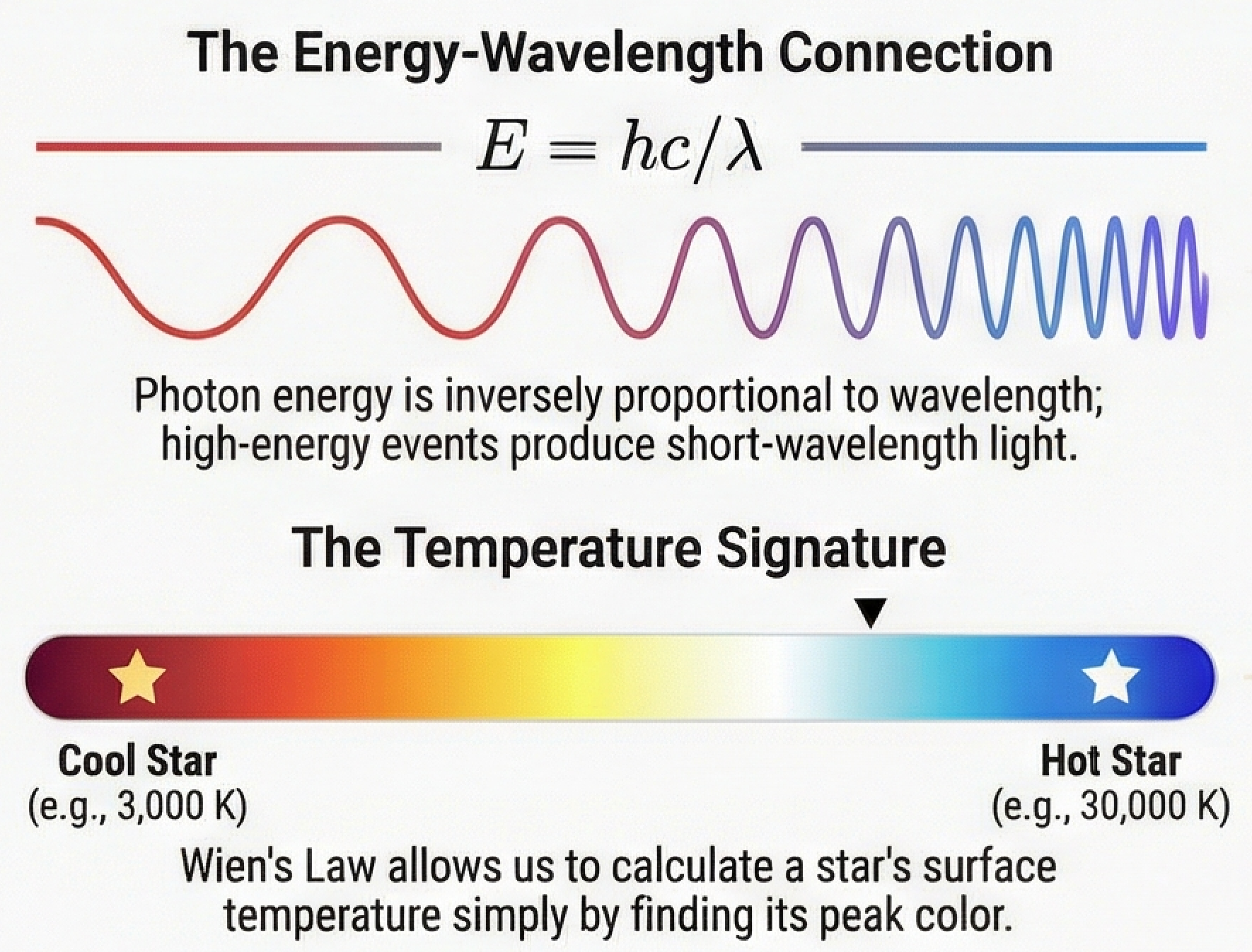
To use Stefan-Boltzmann we need an independent temperature. Wien’s displacement law supplies it: measure a star’s color (where its spectrum peaks) and read off temperature directly.
A star’s color is its temperature. Hotter stars peak at shorter (bluer) wavelengths; cooler stars peak at longer (redder) wavelengths. The relationship is inverse — double the temperature, halve the peak wavelength.
wien-displacement(T)energy-wavelength-connection(T)Each Planck curve has a single peak, and
Wien's law
with — the peak wavelength of a blackbody’s per-wavelength Planck curve is inversely proportional to temperature. Hotter is bluer.
Problem
From : (1) doubles → peak wavelength? (2) A star twice as hot as the Sun peaks where, relative to the Sun? (3) One star peaks red (700 nm), another blue (400 nm) — what’s the temperature ratio?
- Halves — peak wavelength is inversely proportional to temperature.
- Halves — at twice the Sun’s temperature, the peak is at half the wavelength (~250 nm, ultraviolet).
- Blue is hotter — since .
Problem
The Sun’s spectrum peaks at . Calculate its surface temperature using Wien’s law, , with .
StepApply Wien's law
.
Dimensional check
✓ — the nm cancels, leaving kelvin.
Result
, matching the directly measured solar surface temperature — a validation that the Sun radiates approximately as a blackbody.
Problem
Rigel (blue) peaks at ; Betelgeuse (red) at . Find both temperatures via Wien’s law.
StepRigel
.
StepBetelgeuse
.
Dimensional check
✓ for both.
Result
— Rigel is about 3.5 times hotter. Their visible colors directly reflect this: hot is blue, cool is red. This color–temperature relationship anchors the HR diagram’s horizontal axis.