Weighing the Invisible
Section 3 of 11
Motion Weighs What Light Cannot Show
Part 2: Motion Weighs What Light Cannot Show
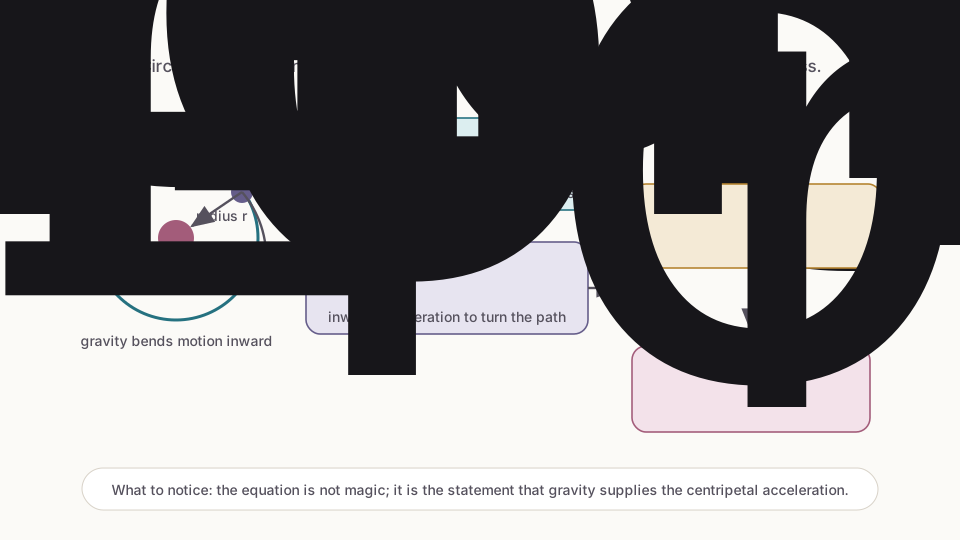
The central equation for this reading comes from circular motion. Imagine a small object orbiting at radius with speed . If gravity is the force bending that motion into a circle, then the inward gravitational acceleration must match the inward acceleration required for circular motion.
For a roughly spherical mass distribution, the gravitational acceleration at radius depends on the
Multiplying both sides by and dividing by gives the relation that organizes this whole reading:
Read it like a sentence: is the mass enclosed inside radius , the speed is the orbital speed at that radius, and is the gravitational constant. If you measure an orbital speed at some radius, you can infer how much mass must lie inside that orbit.
Enclosed mass
The amount of mass inside radius , written , inferred from orbital motion or other gravitational effects. It is the total gravitating mass interior to the orbit — not necessarily the mass that emits light.
The scaling is the important part. The equality sign in belongs to the idealized circular-orbit model; the approximately-equal sign, , is for real systems close to but not exactly ideal; and the proportionality sign, , is for scaling arguments. For this equation, . At fixed radius, increasing the speed increases the mass as . At fixed speed, increasing the radius increases the enclosed mass in proportion to . That one scaling statement is the key to galaxy rotation curves.
Now apply the same idea to the center of the Milky Way. Near the Galactic center, astronomers track individual stars orbiting an invisible compact object. These are the S-stars. Their orbits are small, fast, and curved around a common focus.
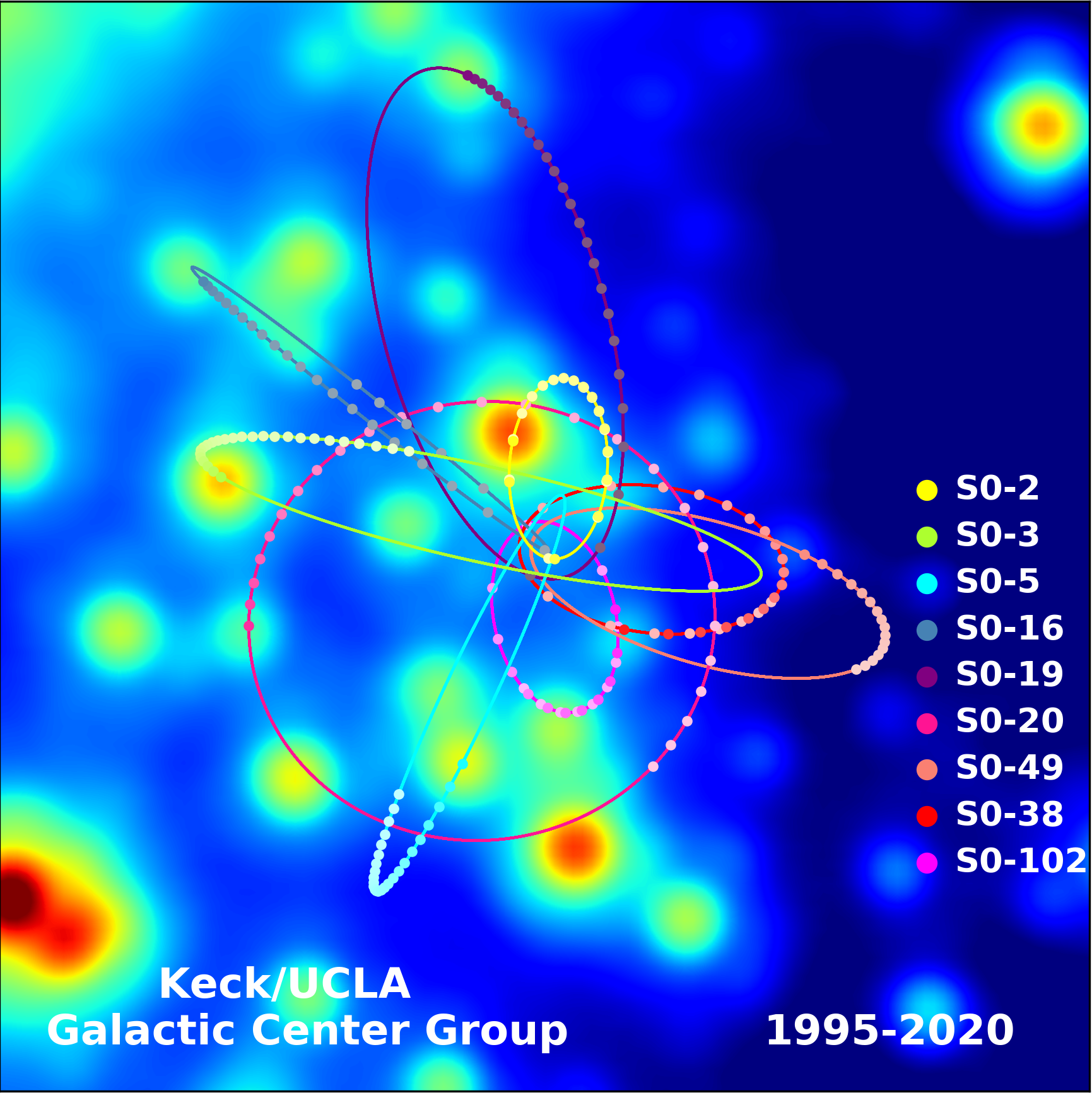
The observation is motion. The model is gravity. The inference is mass. The S-star orbits require about four million solar masses packed into a region far smaller than a normal star cluster could occupy stably. That compact mass is Sagittarius A*, the Milky Way’s central
Supermassive black hole
A black hole with millions to billions of solar masses, commonly found in galactic centers. The Milky Way’s is Sagittarius A*, about four million solar masses, inferred from the orbits of stars that pass close to it.
The simple circular-speed equation is not how the final S-star mass is measured. Real S-star orbits are elliptical, and the best fits use the full orbital shape, timing, and, for the closest stars, relativistic corrections. The transferable idea is the gravitational principle: faster motion close to a common focus requires a large compact enclosed mass.
The Event Horizon Telescope gives a different kind of evidence. It does not replace the orbital argument; it complements it by imaging plasma near the event-horizon scale.
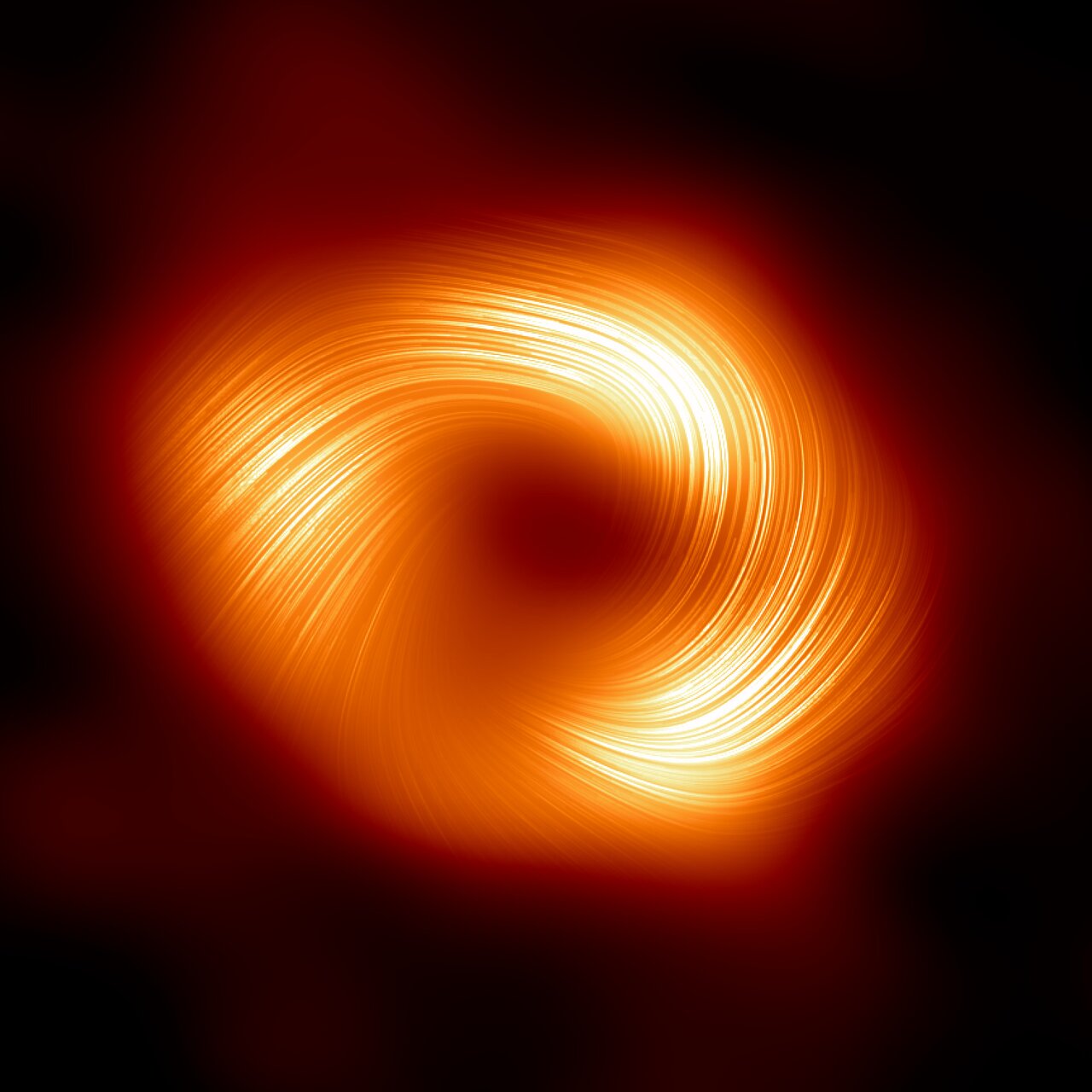
This is a good example of how astronomy builds confidence. One observation rarely carries the whole story. Stellar orbits, radio emission, infrared observations, and horizon-scale imaging all point toward the same physical model: a supermassive black hole at the center of the Milky Way.
Quick check
What is the observable in the S-star argument, and what is the inference?
The observable is the motion of stars orbiting near the Galactic center. The model is gravity, and the inference is that a very large mass must be packed into a very small region: Sagittarius A*, the Milky Way’s central supermassive black hole.