Weighing the Invisible
Section 4 of 11
The Rotation-Curve Surprise
Part 3: The Rotation-Curve Surprise
Now move from the central black hole to the entire disk of a galaxy. The Solar System gives us a useful expectation. Nearly all of the Solar System’s mass is in the Sun. As you move outward, the enclosed mass barely changes, so the orbital speed decreases with distance.
You can see that directly from the same equation. Solving for the speed gives . For the Solar System outside the Sun the enclosed mass is approximately constant, , so and therefore . In a central-mass system, larger-radius orbits move more slowly.

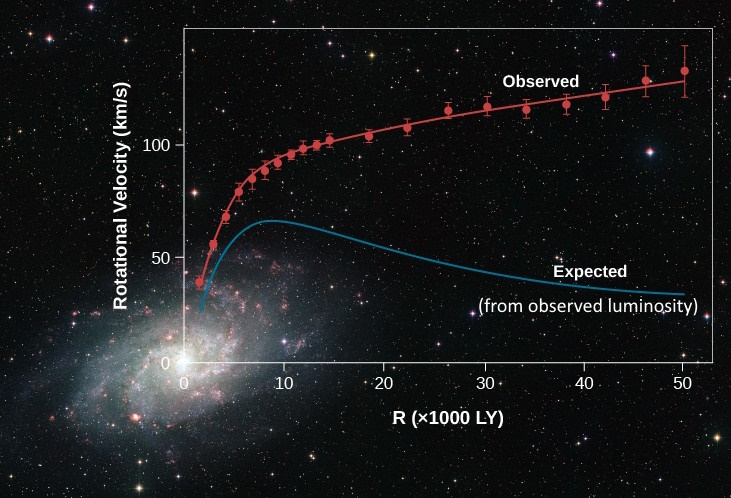
That falling curve is what we would expect if most of a galaxy’s mass were concentrated where most of its light is. Spiral galaxies have bright stellar disks. If the visible disk contained most of the mass, then stars and gas far from the center should orbit more slowly, much like outer planets orbit the Sun more slowly than inner planets.
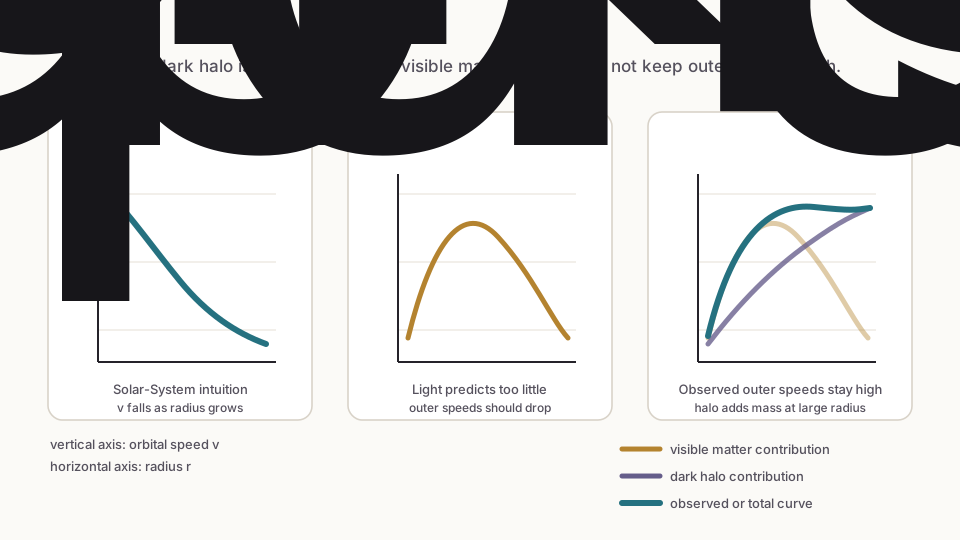
But that is not what we observe.
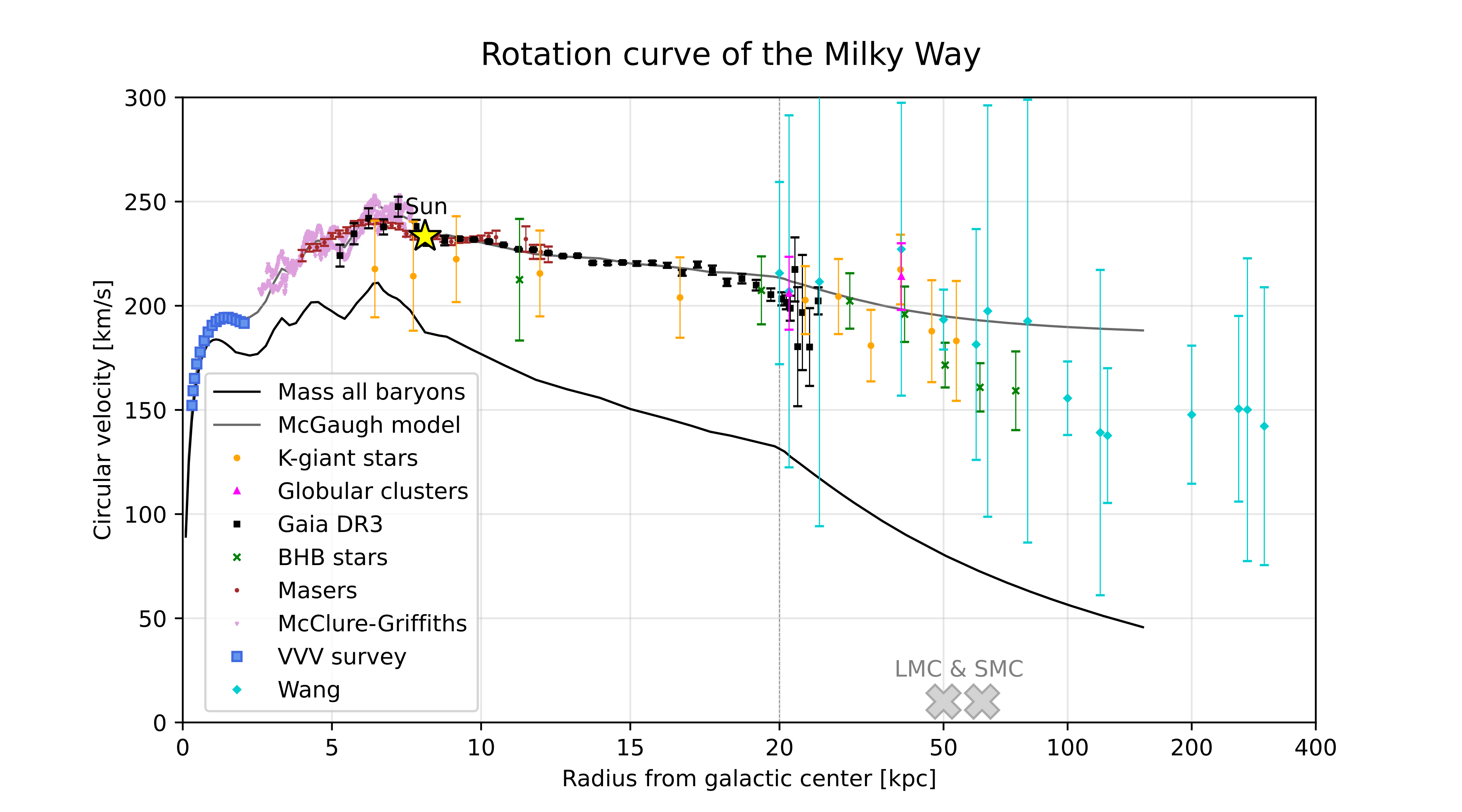
The Milky Way’s
Rotation curve
A plot of orbital speed versus distance from the center of a galaxy. Its shape encodes how mass is distributed: a falling curve means a central mass concentration; a flat curve means mass that keeps growing outward.
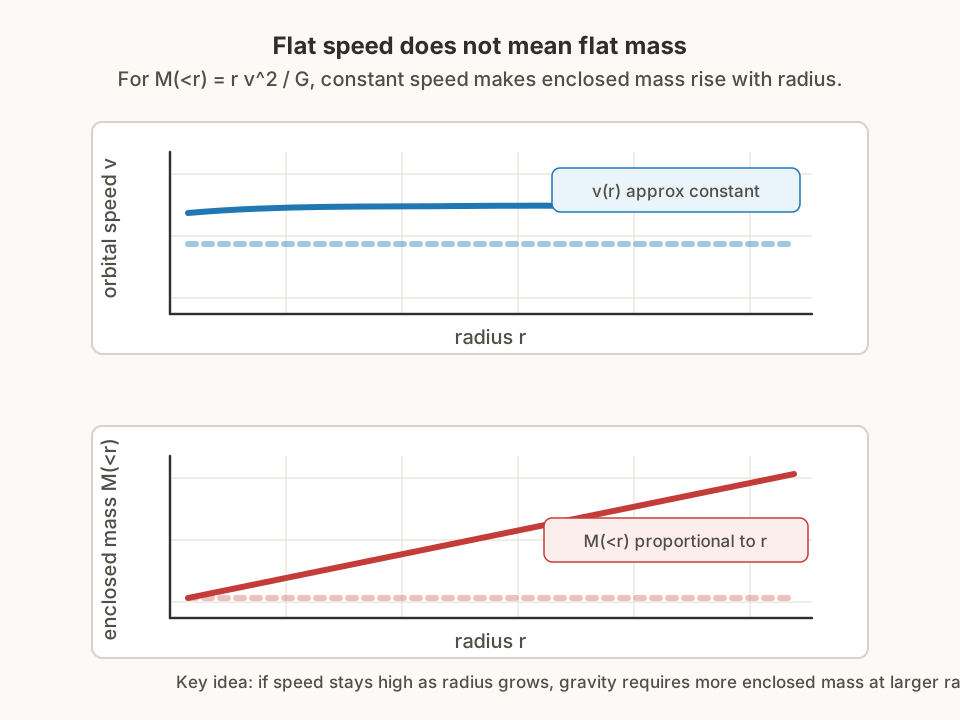
Here the word “flat” needs careful math grammar. A
Flat rotation curve
A galaxy rotation curve in which orbital speed stays roughly constant with radius. Through , a flat speed implies an enclosed mass that rises in proportion to radius — the signature of an extended dark-matter halo.
External galaxies show the same pattern.
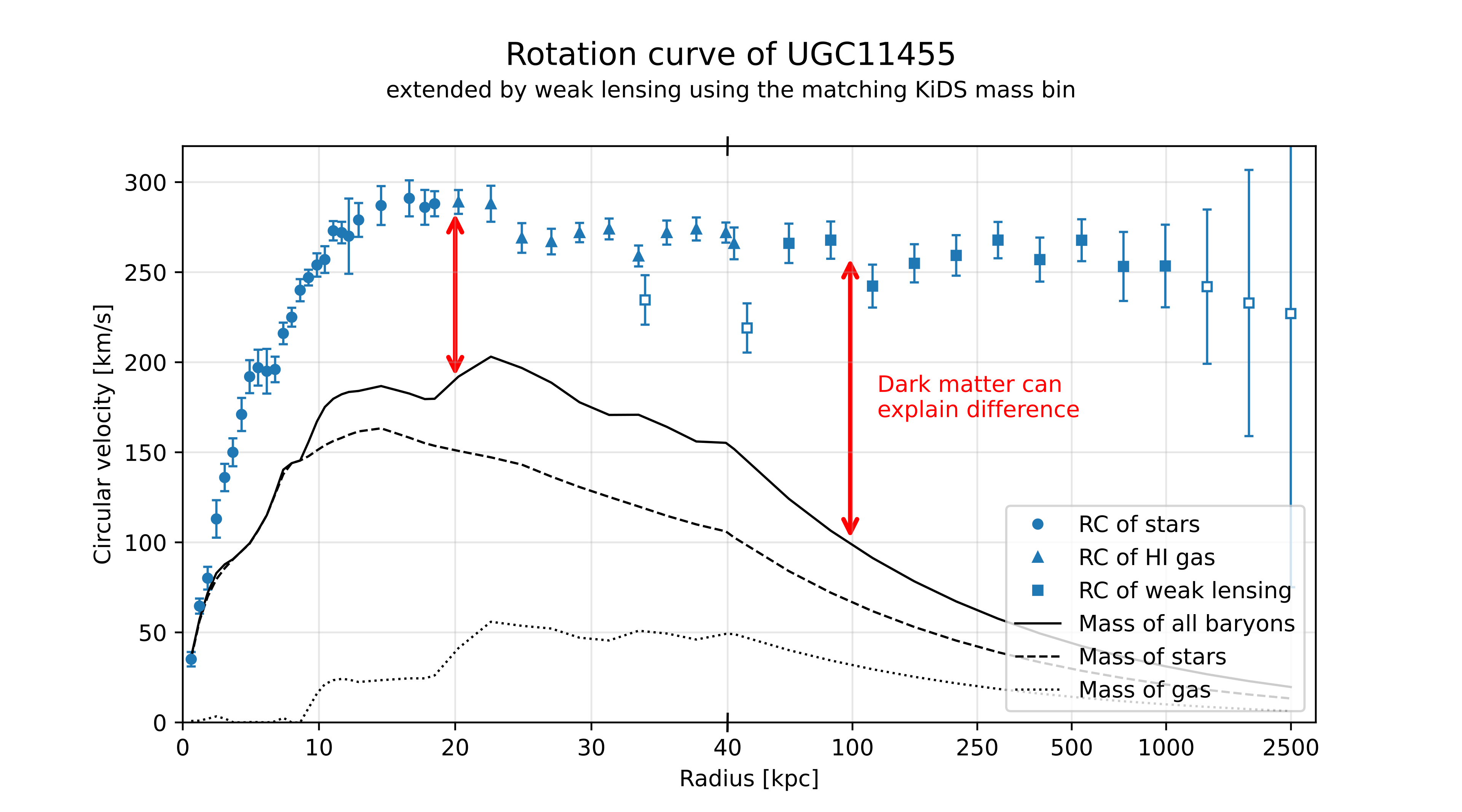
This matters because it turns dark matter from a one-galaxy oddity into a population-level inference. If many spiral galaxies show flat rotation curves, then the problem is not that we made one bad map of the Milky Way. The pattern is telling us something general about galaxy mass distributions.
The term
Dark matter
A gravitating component inferred from motion, lensing, and structure formation that does not emit, absorb, or scatter enough light to be seen directly. “Dark” means electromagnetically dark — visible through gravity, not through ordinary light. This reading, built on rotation curves and the Bullet Cluster, is its canonical home in the course.
Multiple choice
If a spiral galaxy has a flat rotation curve far beyond its bright stellar disk, what is the most direct inference from ?
The enclosed mass keeps increasing at large radius. With roughly constant, grows in proportion to — so substantial gravitating mass lies well beyond the bright disk. The outer gas is very much affected by gravity (that is what keeps it orbiting fast), and “almost no mass outside the disk” is exactly the Solar-System-like expectation the data rule out.
Quick check
Suppose a galaxy’s rotation speed stays about constant as radius doubles. According to , what happens to the enclosed mass?
If stays constant and doubles, then roughly doubles. A flat rotation curve means the enclosed mass keeps growing with radius.