Weighing the Invisible
Complete lesson
Concept Throughline
By the end of this reading, you will be able to:
Concept Throughline
Gravity is the universe’s scale. If something moves in an orbit, its motion tells us what mass is pulling on it. When the motion does not match the light, the universe is telling us that light is not the whole mass budget.
This reading is about dynamics: how motion reveals mass. You already know the core idea from binaries and orbits. In Module 2, binary stars let us measure stellar masses. In Module 3, gravity battled pressure inside stars. Now the same gravitational reasoning moves outward to galaxies, clusters, and the cosmic web.
The method is still observe → model → infer. We observe positions, velocities, redshifts, or lensing patterns. We model them with gravity. Then we infer masses, dark matter, compact objects, and the architecture of large-scale structure.
Motion and lensing
Orbital speeds at a given radius — S-stars whipping around the Galactic center, gas and stars circling a galaxy’s disk — and the bending of background light around clusters.
Gravity sets the motion
A circular orbit obeys : the speed at radius fixes the total mass enclosed inside it. Lensing weighs all the mass along the line of sight, luminous or not.
The total gravitating mass — including what emits no light
The mass the motion demands exceeds the mass we can see. The excess is dark matter: gravitating material that emits, absorbs, and scatters no light. We weigh it precisely because we cannot see it.
The Milky Way Is Not Alone
Part 1: The Milky Way Is Not Alone
Before we weigh a galaxy, we should place it in context. The Milky Way is one member of the
Local Group
The gravitationally bound galaxy group containing the Milky Way, Andromeda, Triangulum, and many dwarf galaxies. Because it is bound, its members’ motions are governed by local gravity rather than by cosmic expansion.
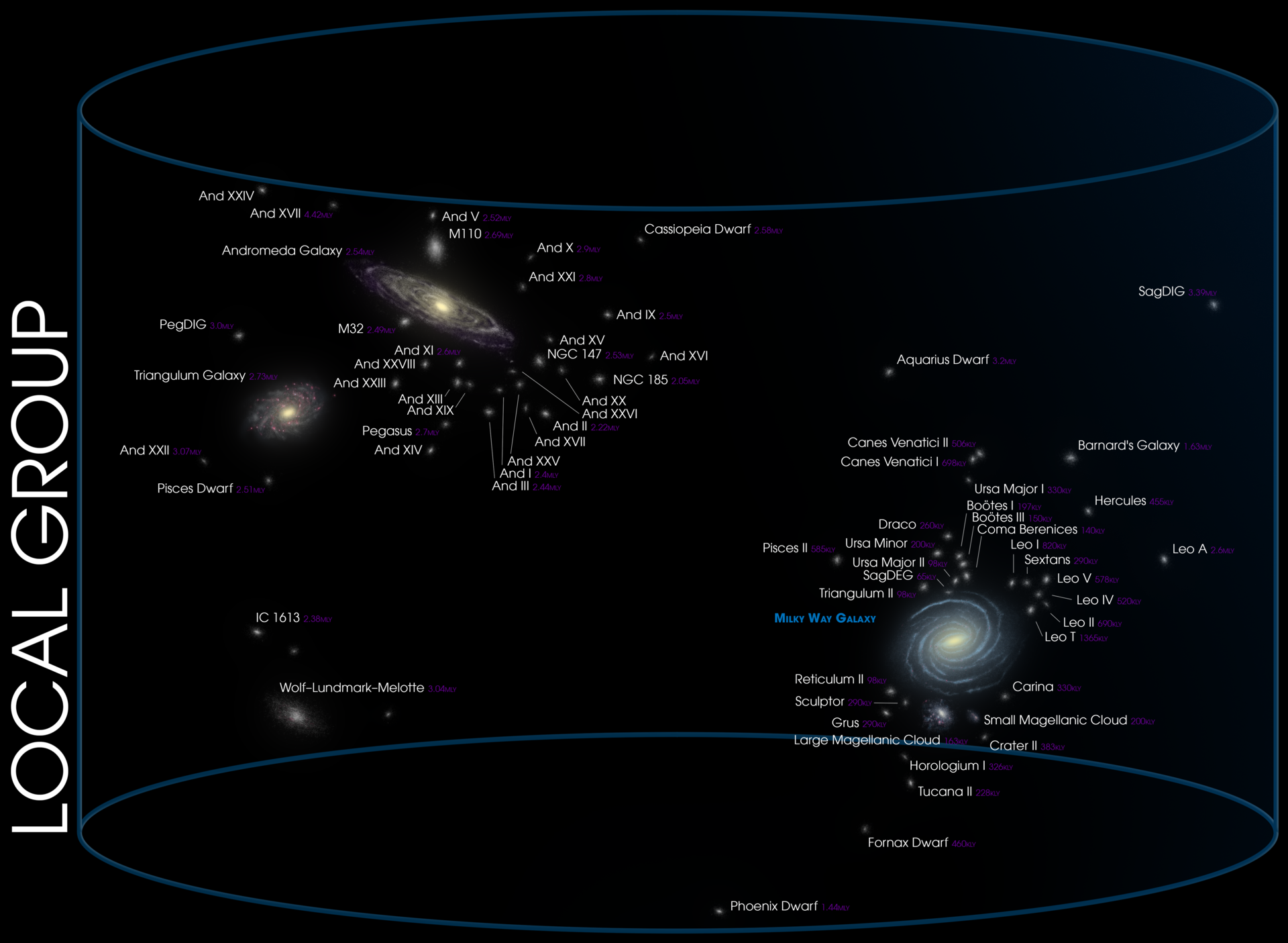
The Local Group is already a lesson in scale and hierarchy. The Milky Way and Andromeda dominate the visible stellar mass, but the group contains many smaller galaxies. Dwarf galaxies are easy to miss because they are faint, diffuse, and often low in surface brightness. Yet they are important: they trace the gravitational environment and help reveal how galaxies assemble over time.
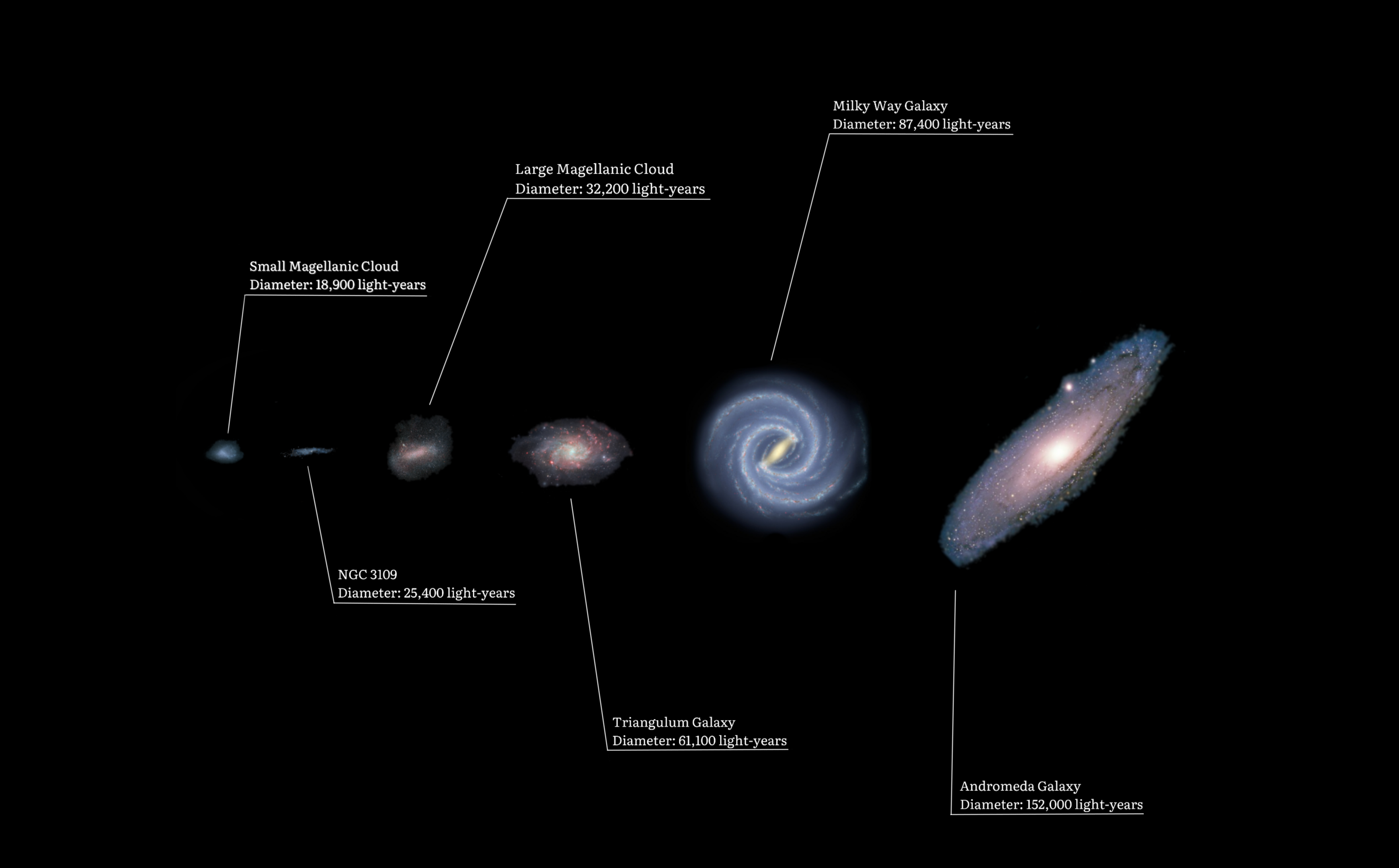
The word “group” should remind you of something from earlier in the course: when objects are gravitationally bound, their motions carry information about mass. The Local Group is not expanding with the Hubble flow in the simple way distant galaxies do. Local gravity matters more than cosmic expansion here. That distinction will become important in the cosmology reading.
Quick check
Why should we be careful about applying Hubble’s law to the Milky Way and Andromeda?
Because the Milky Way and Andromeda are in a gravitationally bound local system. Hubble expansion describes the large-scale average expansion of the universe, but nearby bound systems can have motions dominated by local gravity.
Motion Weighs What Light Cannot Show
Part 2: Motion Weighs What Light Cannot Show
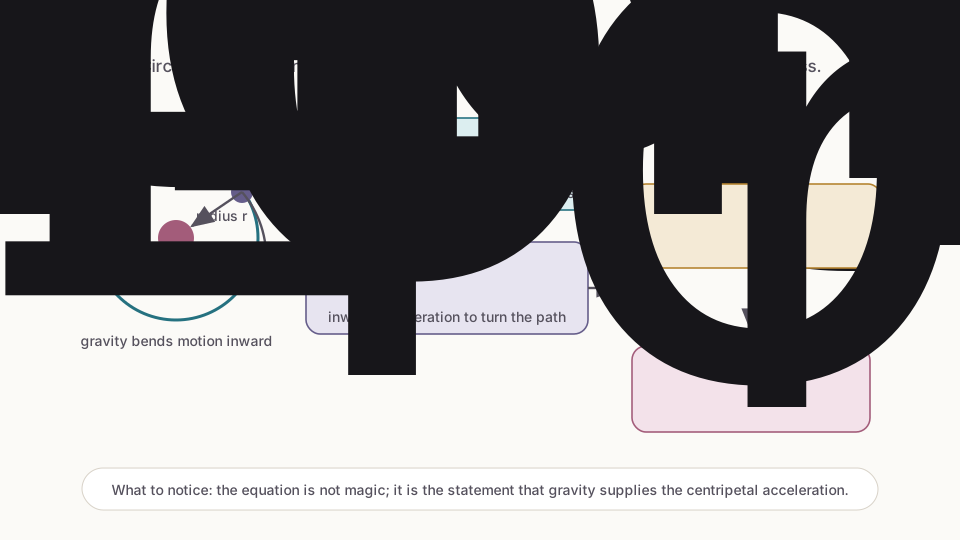
The central equation for this reading comes from circular motion. Imagine a small object orbiting at radius with speed . If gravity is the force bending that motion into a circle, then the inward gravitational acceleration must match the inward acceleration required for circular motion.
For a roughly spherical mass distribution, the gravitational acceleration at radius depends on the
Multiplying both sides by and dividing by gives the relation that organizes this whole reading:
Read it like a sentence: is the mass enclosed inside radius , the speed is the orbital speed at that radius, and is the gravitational constant. If you measure an orbital speed at some radius, you can infer how much mass must lie inside that orbit.
Enclosed mass
The amount of mass inside radius , written , inferred from orbital motion or other gravitational effects. It is the total gravitating mass interior to the orbit — not necessarily the mass that emits light.
The scaling is the important part. The equality sign in belongs to the idealized circular-orbit model; the approximately-equal sign, , is for real systems close to but not exactly ideal; and the proportionality sign, , is for scaling arguments. For this equation, . At fixed radius, increasing the speed increases the mass as . At fixed speed, increasing the radius increases the enclosed mass in proportion to . That one scaling statement is the key to galaxy rotation curves.
Now apply the same idea to the center of the Milky Way. Near the Galactic center, astronomers track individual stars orbiting an invisible compact object. These are the S-stars. Their orbits are small, fast, and curved around a common focus.
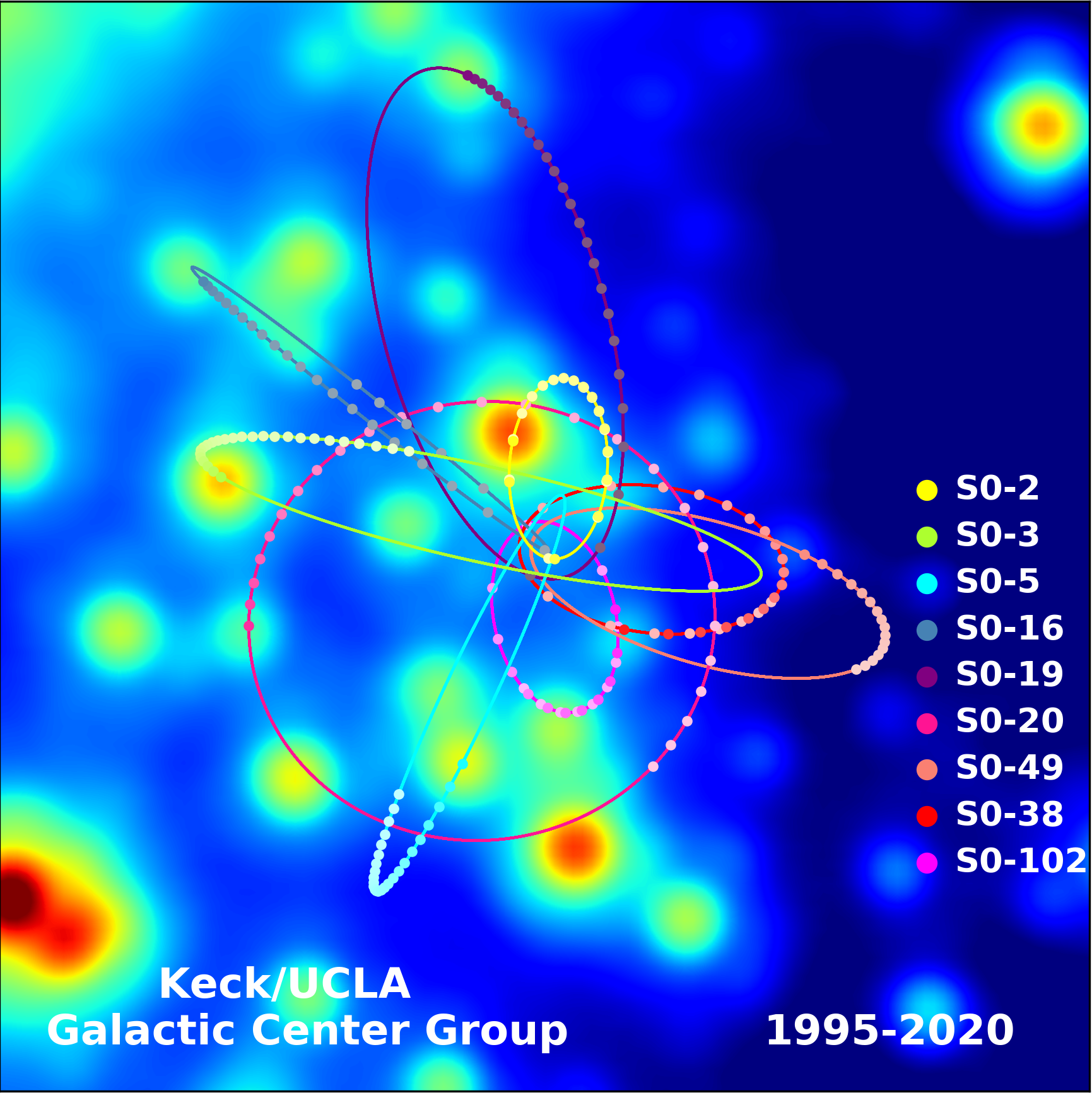
The observation is motion. The model is gravity. The inference is mass. The S-star orbits require about four million solar masses packed into a region far smaller than a normal star cluster could occupy stably. That compact mass is Sagittarius A*, the Milky Way’s central
Supermassive black hole
A black hole with millions to billions of solar masses, commonly found in galactic centers. The Milky Way’s is Sagittarius A*, about four million solar masses, inferred from the orbits of stars that pass close to it.
The simple circular-speed equation is not how the final S-star mass is measured. Real S-star orbits are elliptical, and the best fits use the full orbital shape, timing, and, for the closest stars, relativistic corrections. The transferable idea is the gravitational principle: faster motion close to a common focus requires a large compact enclosed mass.
The Event Horizon Telescope gives a different kind of evidence. It does not replace the orbital argument; it complements it by imaging plasma near the event-horizon scale.
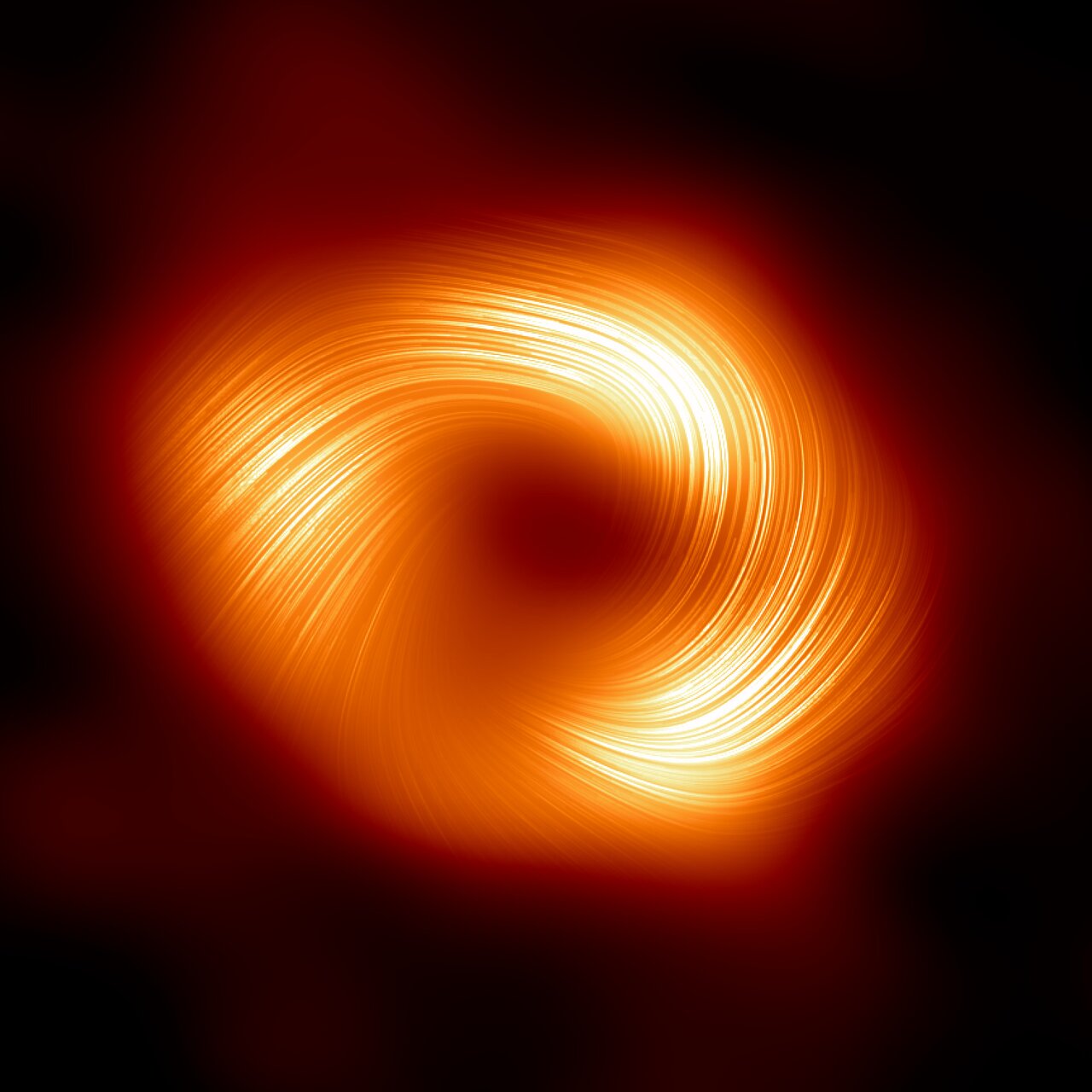
This is a good example of how astronomy builds confidence. One observation rarely carries the whole story. Stellar orbits, radio emission, infrared observations, and horizon-scale imaging all point toward the same physical model: a supermassive black hole at the center of the Milky Way.
Quick check
What is the observable in the S-star argument, and what is the inference?
The observable is the motion of stars orbiting near the Galactic center. The model is gravity, and the inference is that a very large mass must be packed into a very small region: Sagittarius A*, the Milky Way’s central supermassive black hole.
The Rotation-Curve Surprise
Part 3: The Rotation-Curve Surprise
Now move from the central black hole to the entire disk of a galaxy. The Solar System gives us a useful expectation. Nearly all of the Solar System’s mass is in the Sun. As you move outward, the enclosed mass barely changes, so the orbital speed decreases with distance.
You can see that directly from the same equation. Solving for the speed gives . For the Solar System outside the Sun the enclosed mass is approximately constant, , so and therefore . In a central-mass system, larger-radius orbits move more slowly.

That falling curve is what we would expect if most of a galaxy’s mass were concentrated where most of its light is. Spiral galaxies have bright stellar disks. If the visible disk contained most of the mass, then stars and gas far from the center should orbit more slowly, much like outer planets orbit the Sun more slowly than inner planets.
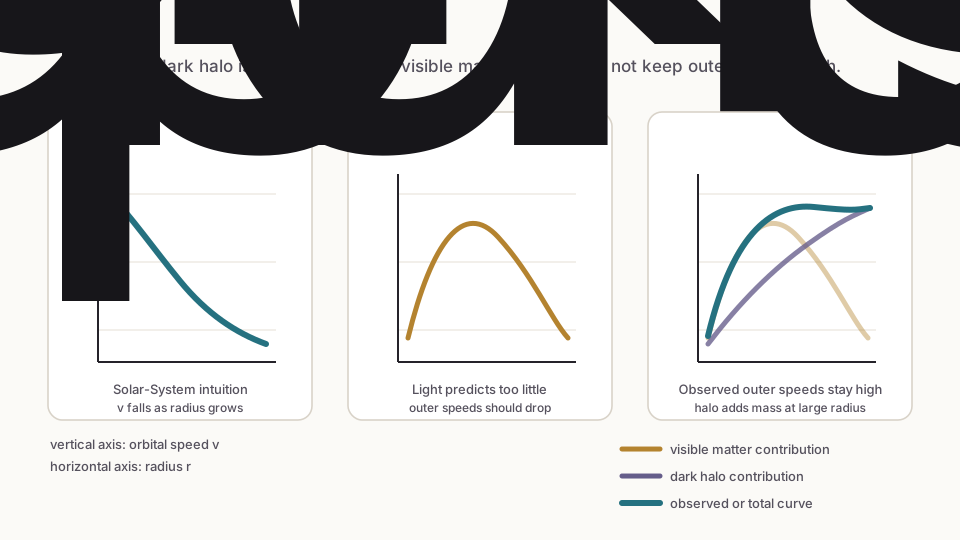
But that is not what we observe.
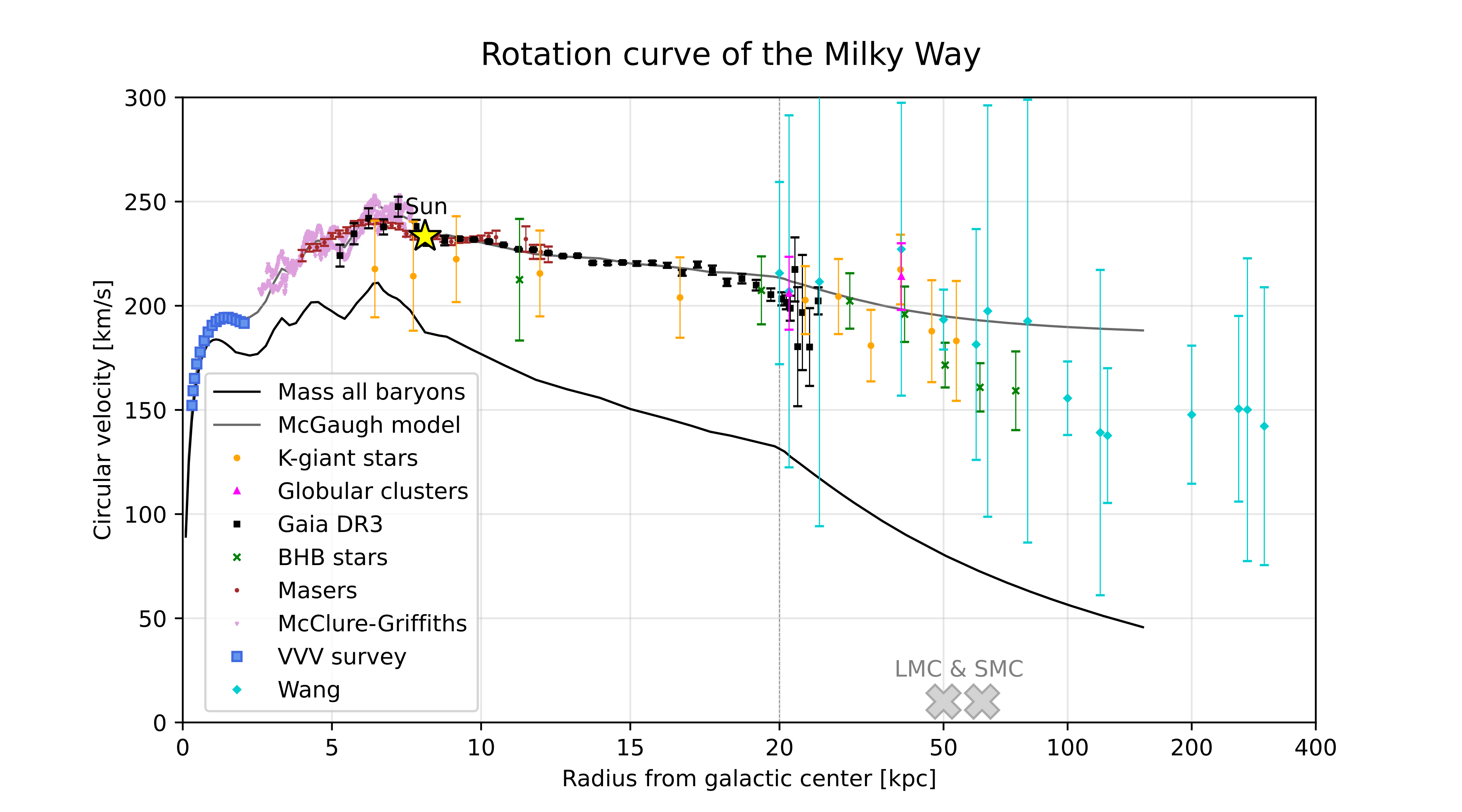
The Milky Way’s
Rotation curve
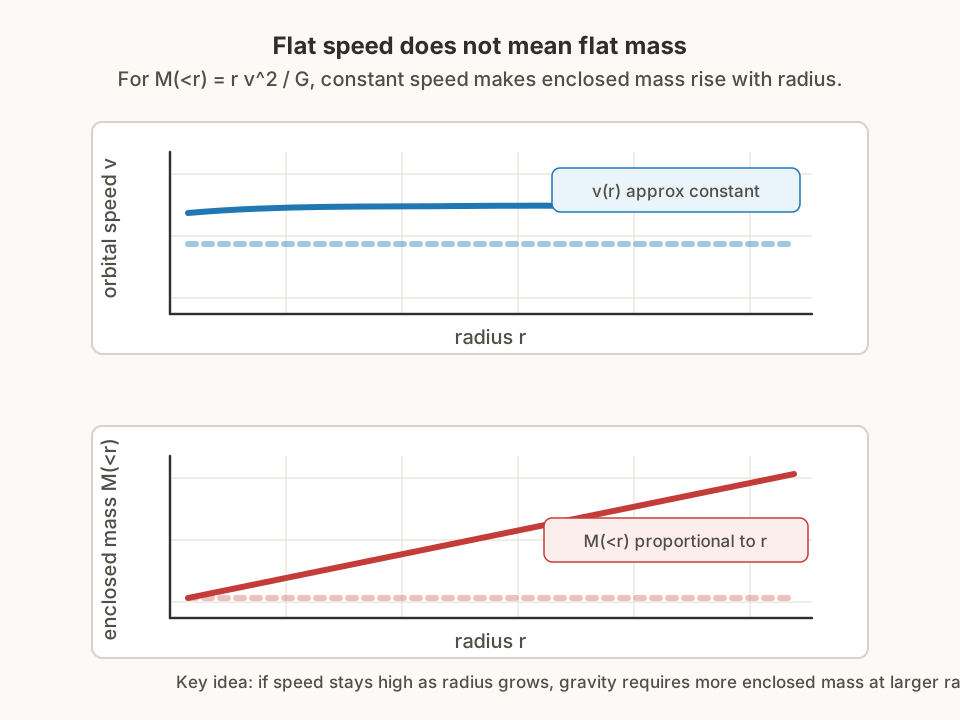
A plot of orbital speed versus distance from the center of a galaxy. Its shape encodes how mass is distributed: a falling curve means a central mass concentration; a flat curve means mass that keeps growing outward.
Here the word “flat” needs careful math grammar. A
Flat rotation curve
A galaxy rotation curve in which orbital speed stays roughly constant with radius. Through , a flat speed implies an enclosed mass that rises in proportion to radius — the signature of an extended dark-matter halo.
External galaxies show the same pattern.
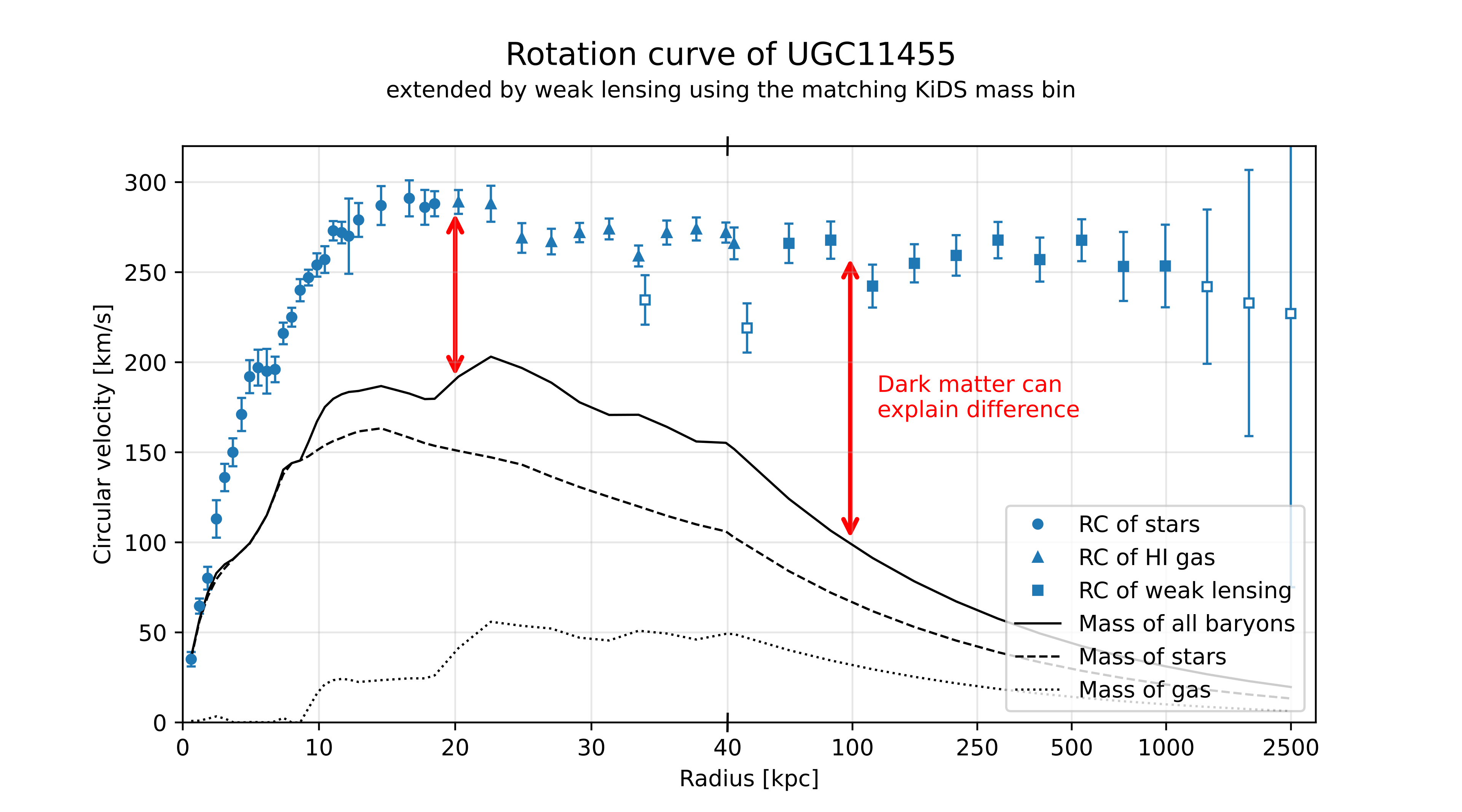
This matters because it turns dark matter from a one-galaxy oddity into a population-level inference. If many spiral galaxies show flat rotation curves, then the problem is not that we made one bad map of the Milky Way. The pattern is telling us something general about galaxy mass distributions.
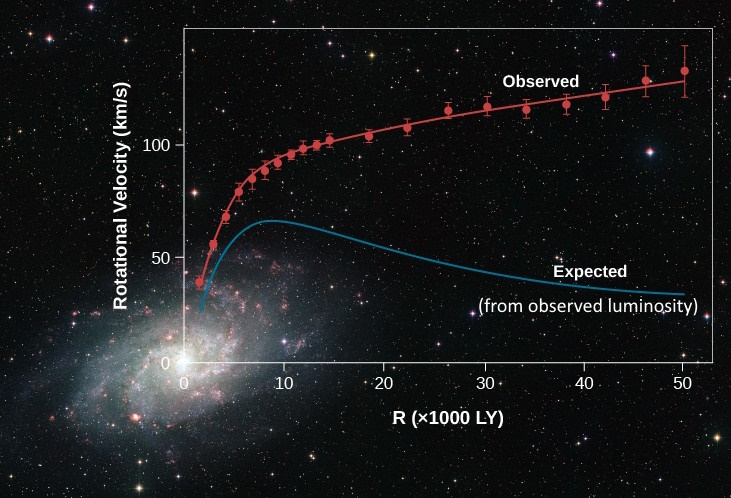
The term
Dark matter
A gravitating component inferred from motion, lensing, and structure formation that does not emit, absorb, or scatter enough light to be seen directly. “Dark” means electromagnetically dark — visible through gravity, not through ordinary light. This reading, built on rotation curves and the Bullet Cluster, is its canonical home in the course.
Multiple choice
If a spiral galaxy has a flat rotation curve far beyond its bright stellar disk, what is the most direct inference from ?
The enclosed mass keeps increasing at large radius. With roughly constant, grows in proportion to — so substantial gravitating mass lies well beyond the bright disk. The outer gas is very much affected by gravity (that is what keeps it orbiting fast), and “almost no mass outside the disk” is exactly the Solar-System-like expectation the data rule out.
Quick check
Suppose a galaxy’s rotation speed stays about constant as radius doubles. According to , what happens to the enclosed mass?
If stays constant and doubles, then roughly doubles. A flat rotation curve means the enclosed mass keeps growing with radius.
Compact Engines Inside Galaxies
Part 4: Compact Engines Inside Galaxies
Supermassive black holes are not dark matter, but they are part of the dynamical story of galaxies. The Milky Way’s central black hole is relatively quiet today. In other galaxies, gas falling onto a supermassive black hole can release enormous energy before crossing the event horizon. Such a system is called an
Active galactic nucleus
A luminous galactic center powered by accretion onto a supermassive black hole. The black hole itself emits no light; the brightness comes from infalling gas releasing gravitational energy outside the event horizon.
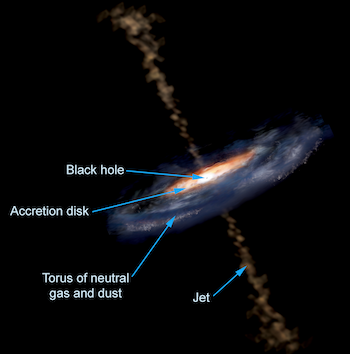
The engine is accretion. Gas loses gravitational potential energy as it spirals inward. Much of that energy becomes heat, radiation, and sometimes jets. The black hole itself is dark, but the material falling toward it can be among the brightest sources in the universe.
The geometry matters. A disk, dusty torus, broad-line region, and jets can look very different depending on viewing angle. That is why AGN classification can be complicated: the same underlying engine may present different observational faces.
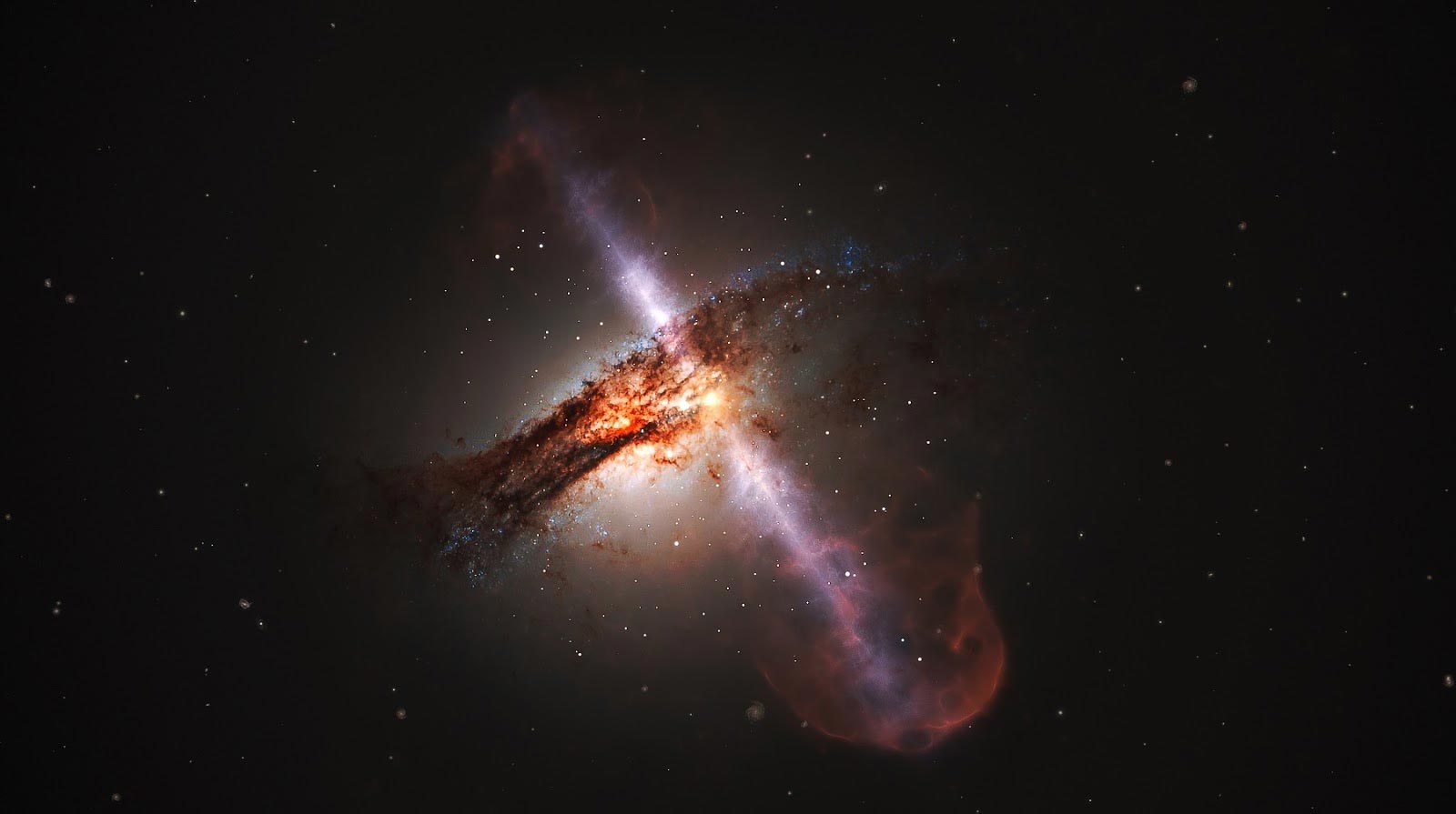
AGN matter for galaxy evolution because they can inject energy into surrounding gas. A jet or outflow can heat gas, stir it, or push it out of the galaxy. This connects back to the ecosystem model from the previous reading. Stars provide feedback; supermassive black holes can provide feedback too. Both change the gas supply that future star formation depends on.
Quick check
Why is an AGN not simply “a bright black hole”?
The black hole itself emits no light from inside the event horizon. The brightness comes from matter outside the horizon — especially gas in the accretion disk and sometimes jets — releasing gravitational energy as it falls inward.
Dark Matter Beyond Spiral Galaxies
Part 5: Dark Matter Beyond Spiral Galaxies
Rotation curves are powerful, but they are not the only evidence for dark matter. A different kind of test comes from
A galaxy cluster is a large gravitationally bound system containing many galaxies, a huge reservoir of hot diffuse gas, and dark matter. The galaxies are the easiest component to see in optical light, but they are not most of the cluster’s ordinary matter. Much of the ordinary matter is hot intracluster gas, which emits X-rays. The total gravitating mass can be mapped through
Galaxy cluster
A gravitationally bound system of many galaxies, hot X-ray-emitting intracluster gas, and dark matter. The galaxies are the easiest part to see, but they are not most of the cluster’s ordinary matter — and ordinary matter is not most of its total mass.
Gravitational lensing
Bending of light by mass, used to map total gravitating matter whether or not it emits light. Because lensing responds to all mass, it weighs dark matter directly — independent of any rotation-curve argument.
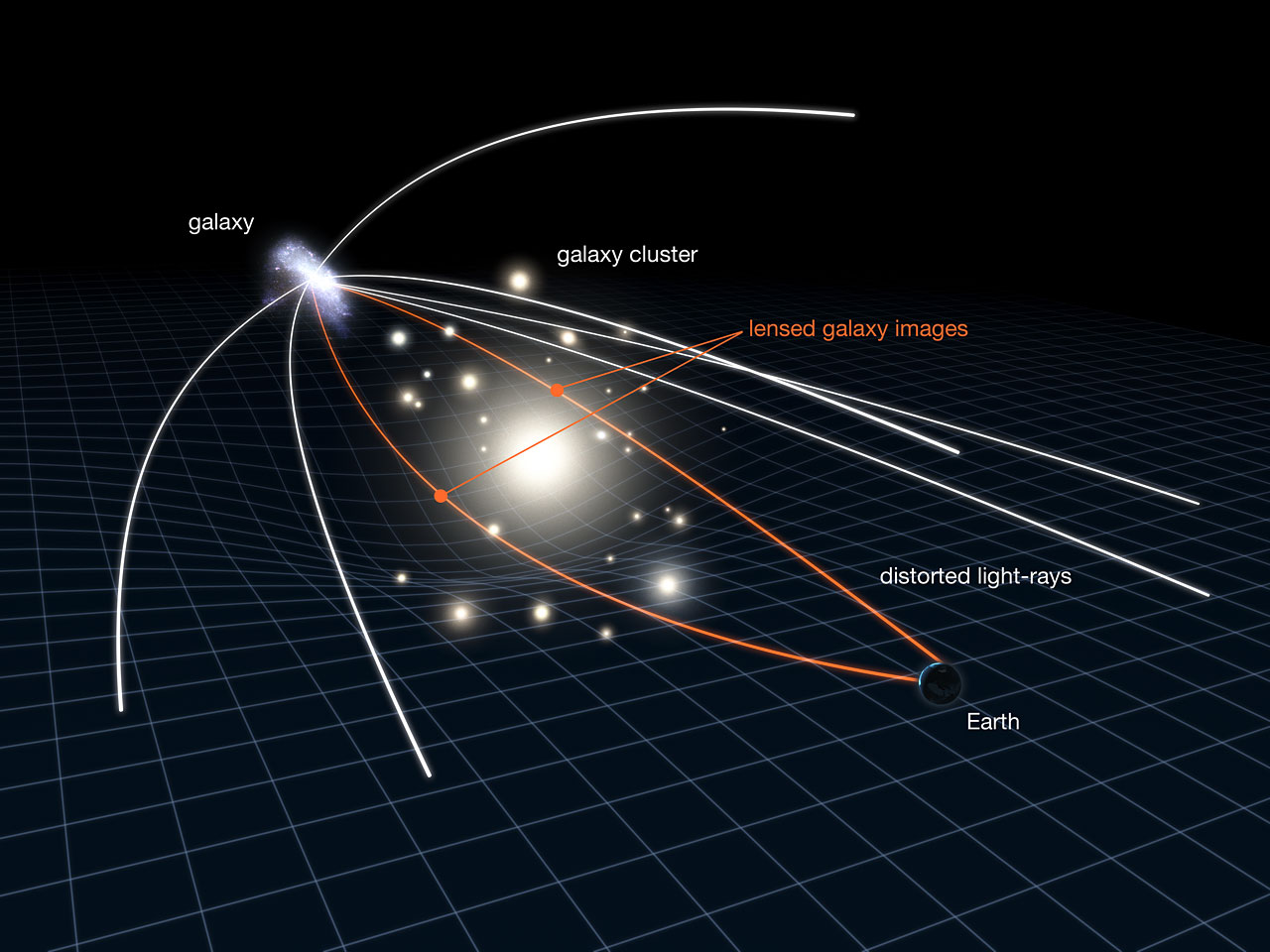
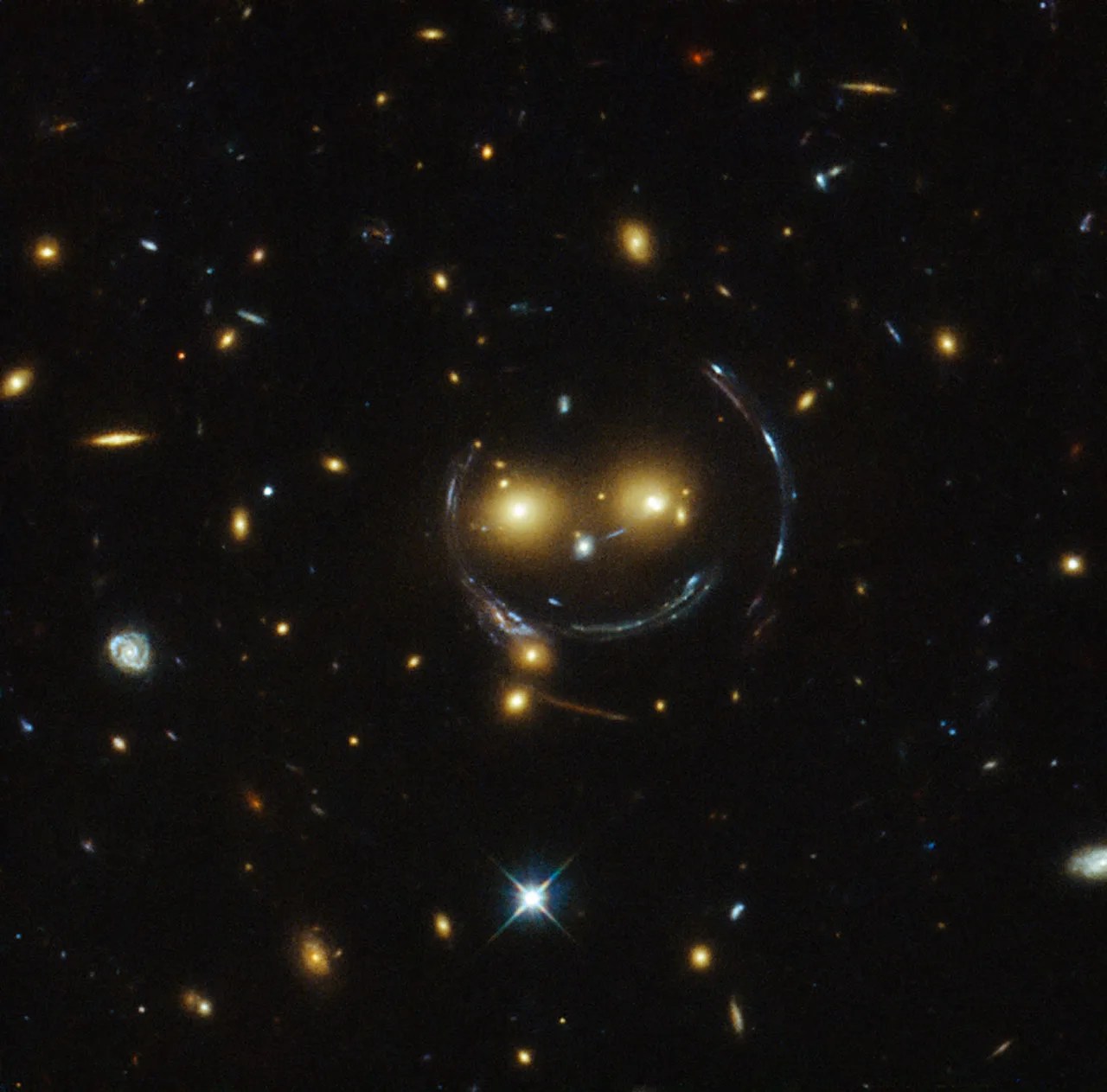
Real cluster images show the same idea in a less schematic way. The cluster galaxies act together as a lens, distorting more distant background galaxies into arcs and streaks.
The
Bullet Cluster
A colliding galaxy-cluster system where the hot X-ray-emitting gas and the gravitational-lensing mass are spatially separated. The offset is strong evidence that most of the gravitating mass is collisionless and not the ordinary hot gas.
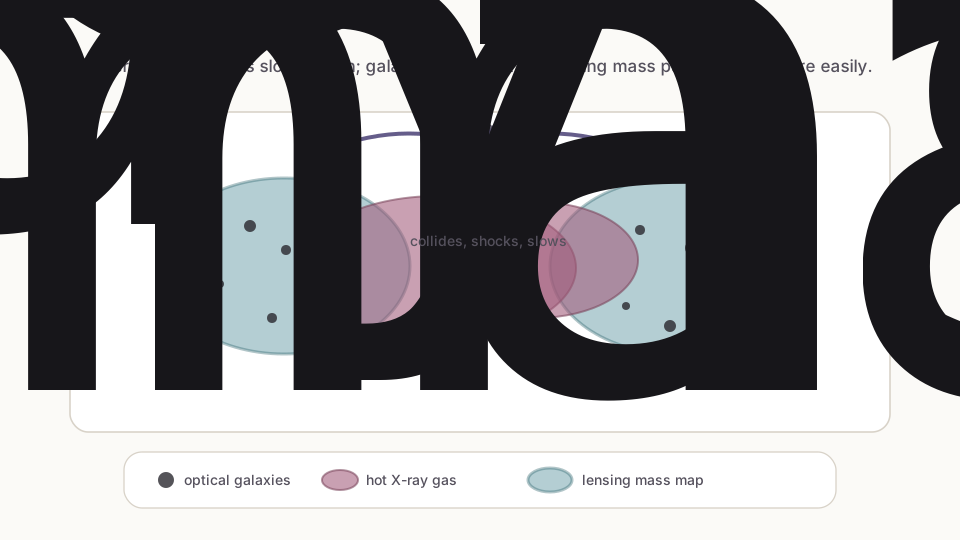
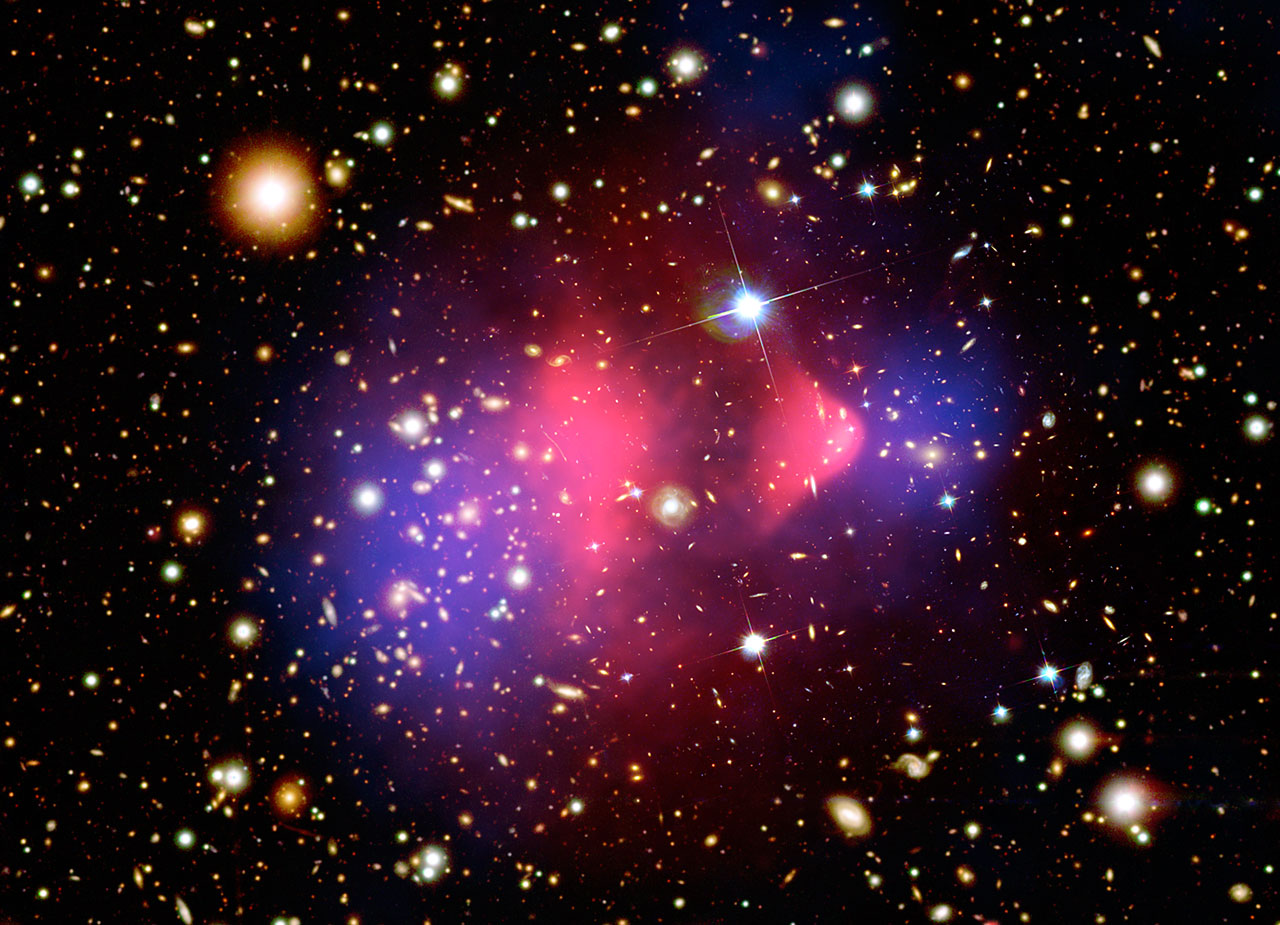
In a cluster collision, the galaxies mostly pass through one another because they are separated by enormous distances. The hot gas behaves differently: it collides, shocks, heats, and slows down. If most of the mass were ordinary gas, the gravitational mass map would line up with the hot gas. Instead, the lensing mass is offset from the gas and more closely associated with the collisionless components.
This does not make every detail of dark matter simple. It does make one thing hard to avoid: gravity is responding to a mass component that is not the hot X-ray gas and not the visible stars alone. The dark matter inference survives a very different kind of observation than a rotation curve.
Quick check
Why does the Bullet Cluster provide a different kind of evidence than a spiral-galaxy rotation curve?
A rotation curve uses orbital speeds to infer mass inside a galaxy. The Bullet Cluster uses a collision plus gravitational lensing to compare where hot gas is located with where the total gravitating mass is located. It tests dark matter with a different observable and a different physical setup.
Gravity Builds the Large-Scale Universe
Part 6: Gravity Builds the Large-Scale Universe
The final scale in this reading is larger than a galaxy or a cluster. Redshift surveys map the positions of huge numbers of galaxies in three dimensions. When we do this, galaxies do not appear randomly sprinkled through space. They form the
Cosmic web
The large-scale network of filaments, walls, clusters, and voids traced by galaxies and shaped by gravity. It is evidence that gravity has amplified small early density differences into the structure we observe today.
The phrase
Large-scale structure
The distribution of matter on scales larger than individual galaxies, including galaxy groups, clusters, filaments, walls, and voids. Its pattern records the gravitational growth of small early density differences over cosmic time.
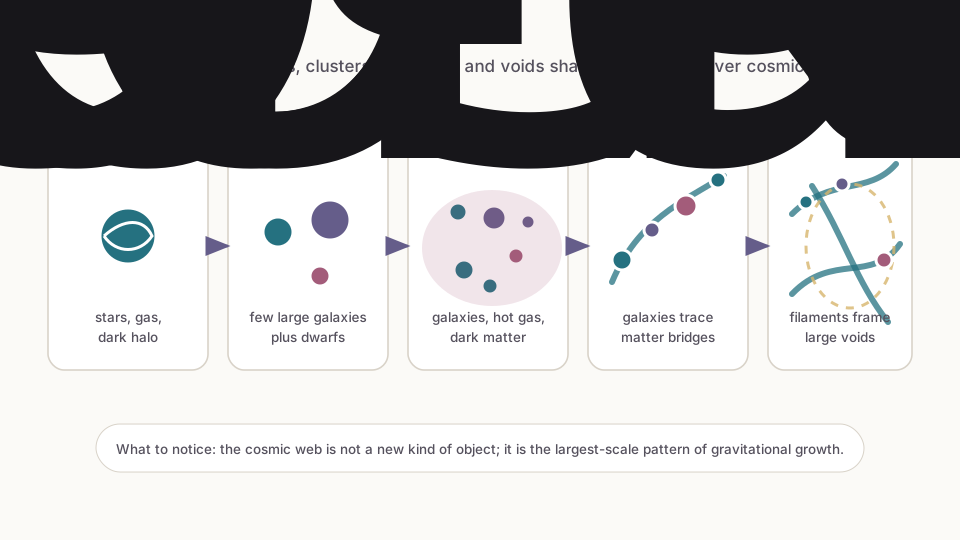
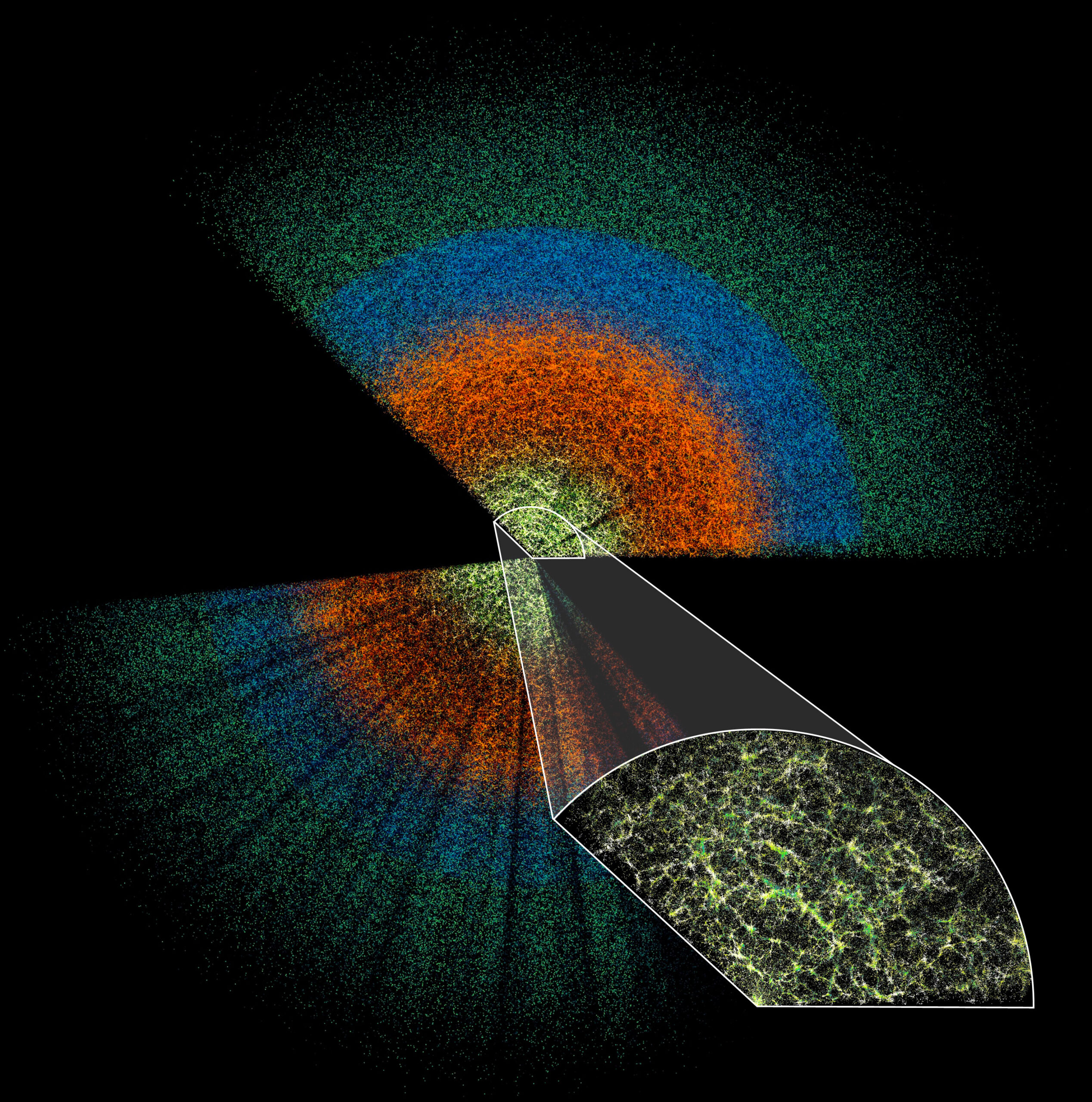
This is gravity at work on the largest observable scales. Slightly denser regions pull in matter. Under gravity, structure grows. Dark matter matters here because it begins forming gravitational scaffolding before ordinary gas can cool and form luminous galaxies. Galaxies trace the web, but they are not the whole web.
This prepares us for the next reading. Cosmology is not only the story of expansion. It is the story of expansion plus gravity. Expansion stretches distances on large scales. Gravity pulls matter together into structure. The universe we observe is the result of both.
Quick check
Why is the cosmic web evidence for gravity acting over cosmic time, rather than just a map of where galaxies happen to be today?
The web is a large-scale pattern of clusters, filaments, walls, and voids. Such structure is modeled as growth from small density differences under gravity. Galaxies trace that structure today, but the pattern records the history of gravitational growth.
Worked Example: Weighing a Galaxy
Worked Example: Weighing a Galaxy
Problem
Gas orbits in a galaxy at radius with orbital speed . Estimate the enclosed mass using . Use , , , and .
StepConvert the radius and speed to CGS
, and .
StepSquare the speed and substitute
, so the numerator is , and dividing by gives .
Dimensional check
— the result has units of mass, as a mass estimate must.
Result
Converting, . This is a dynamical mass: the gravitating matter required to produce the measured motion under the model assumptions. It is not automatically the mass in stars — to separate stars, gas, black holes, and dark matter, astronomers compare this dynamical mass to the mass traced by light and gas emission.
The Luminous and Dynamical Mass Ledger
The Ledger: Luminous versus Dynamical Mass
The worked example gives a dynamical mass — the gravitating matter the motion demands. Now weigh it against the light. Within the Milky Way’s stars sum to about , and its cold gas adds roughly — call it of
about 2.7 times the baryons — and because keeps rising while the light falls away, the dark fraction only grows outward.
The same ledger reads sharper at cluster scale. In a galaxy cluster most of the ordinary matter is not the galaxies but the hot X-ray gas between them — yet gravitational lensing weighs a total mass several times larger than that gas. At every scale we can weigh — a galaxy, a cluster, the cosmic web — the gravitating mass outweighs the baryons several-fold.
That is the stage-setting result for the rest of the module: the matter budget of the universe is mostly dark. Here we have only shown it as a ratio, galaxy by galaxy. Two readings from now we will put a single number on the cosmic matter budget — once we have a critical density to measure it against.
One Pattern, Many Scales
Synthesis: One Pattern, Many Scales
The dark-matter argument is strong because it is not balanced on one observation. Galaxy rotation curves infer extended mass from orbital speeds. Cluster collisions compare X-ray gas to gravitational lensing maps. The cosmic web tests whether gravity can grow the observed pattern of filaments, clusters, and voids over cosmic time.
Those are different observables and different models, but they point toward the same broad conclusion: visible matter is not the whole gravitating matter budget.
Summary
Summary
Motion is a mass measurement. S-star orbits reveal the compact mass at the Milky Way’s center. Galaxy rotation curves reveal mass extending far beyond the bright stellar disk. Cluster collisions separate hot gas from gravitational mass. Redshift surveys show a cosmic web shaped by gravity over billions of years. Across all these scales, the method is the same: observe motion or lensing, model with gravity, infer the mass distribution.
A galaxy’s rotation curve stays flat far beyond its bright disk. Using , explain what that implies about the enclosed mass — and then name one independent line of evidence that the missing mass is real, not a flaw in the rotation-curve method.
A flat curve means is roughly constant, so keeps rising in proportion to : gravitating mass extends well beyond the light. An independent line of evidence is the Bullet Cluster, where gravitational lensing locates most of the mass offset from the collisional hot X-ray gas — a completely different observable and physical setup that still requires dark matter (gravitational lensing of clusters and the gravitationally grown cosmic web are equally valid alternatives).
Glossary
- Active galactic nucleus
A luminous galactic center powered by accretion onto a supermassive black hole. The black hole itself emits no light; the brightness comes from infalling gas releasing gravitational energy outside the event horizon.
- Bullet Cluster
A colliding galaxy-cluster system where the hot X-ray-emitting gas and the gravitational-lensing mass are spatially separated. The offset is strong evidence that most of the gravitating mass is collisionless and not the ordinary hot gas.
- Cosmic web
The large-scale network of filaments, walls, clusters, and voids traced by galaxies and shaped by gravity. It is evidence that gravity has amplified small early density differences into the structure we observe today.
- Dark matter
A gravitating component inferred from motion, lensing, and structure formation that does not emit, absorb, or scatter enough light to be seen directly. “Dark” means electromagnetically dark — visible through gravity, not through ordinary light. This reading, built on rotation curves and the Bullet Cluster, is its canonical home in the course.
- Enclosed mass
The amount of mass inside radius , written , inferred from orbital motion or other gravitational effects. It is the total gravitating mass interior to the orbit — not necessarily the mass that emits light.
- Flat rotation curve
A galaxy rotation curve in which orbital speed stays roughly constant with radius. Through , a flat speed implies an enclosed mass that rises in proportion to radius — the signature of an extended dark-matter halo.
- Galaxy cluster
A gravitationally bound system of many galaxies, hot X-ray-emitting intracluster gas, and dark matter. The galaxies are the easiest part to see, but they are not most of the cluster’s ordinary matter — and ordinary matter is not most of its total mass.
- Gravitational lensing
Bending of light by mass, used to map total gravitating matter whether or not it emits light. Because lensing responds to all mass, it weighs dark matter directly — independent of any rotation-curve argument.
- Large-scale structure
The distribution of matter on scales larger than individual galaxies, including galaxy groups, clusters, filaments, walls, and voids. Its pattern records the gravitational growth of small early density differences over cosmic time.
- Local Group
The gravitationally bound galaxy group containing the Milky Way, Andromeda, Triangulum, and many dwarf galaxies. Because it is bound, its members’ motions are governed by local gravity rather than by cosmic expansion.
- Rotation curve
A plot of orbital speed versus distance from the center of a galaxy. Its shape encodes how mass is distributed: a falling curve means a central mass concentration; a flat curve means mass that keeps growing outward.
- Supermassive black hole
A black hole with millions to billions of solar masses, commonly found in galactic centers. The Milky Way’s is Sagittarius A*, about four million solar masses, inferred from the orbits of stars that pass close to it.