Weighing the Invisible
Section 6 of 11
Dark Matter Beyond Spiral Galaxies
Part 5: Dark Matter Beyond Spiral Galaxies
Rotation curves are powerful, but they are not the only evidence for dark matter. A different kind of test comes from
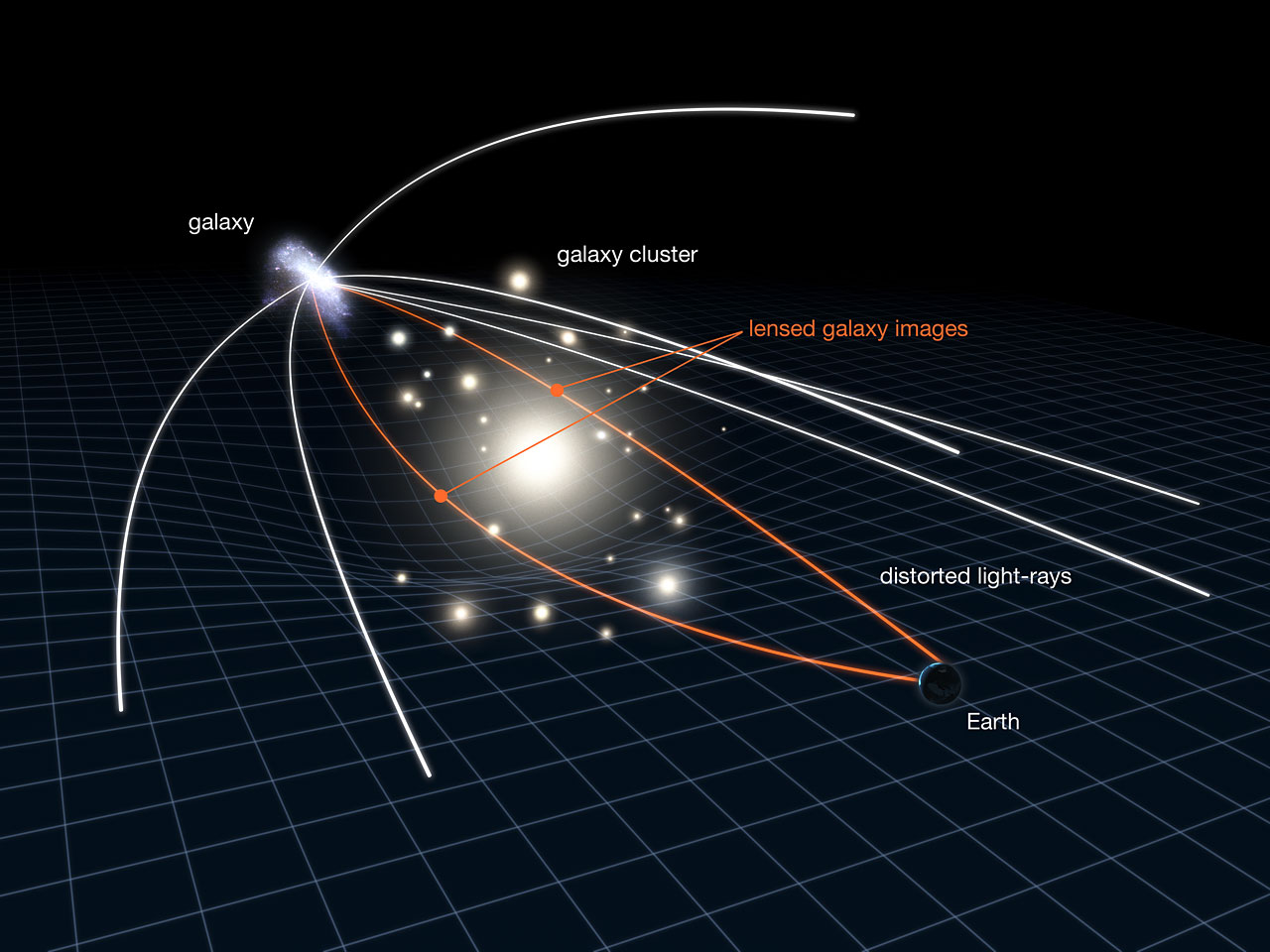
A galaxy cluster is a large gravitationally bound system containing many galaxies, a huge reservoir of hot diffuse gas, and dark matter. The galaxies are the easiest component to see in optical light, but they are not most of the cluster’s ordinary matter. Much of the ordinary matter is hot intracluster gas, which emits X-rays. The total gravitating mass can be mapped through
Galaxy cluster
A gravitationally bound system of many galaxies, hot X-ray-emitting intracluster gas, and dark matter. The galaxies are the easiest part to see, but they are not most of the cluster’s ordinary matter — and ordinary matter is not most of its total mass.
Gravitational lensing
Bending of light by mass, used to map total gravitating matter whether or not it emits light. Because lensing responds to all mass, it weighs dark matter directly — independent of any rotation-curve argument.
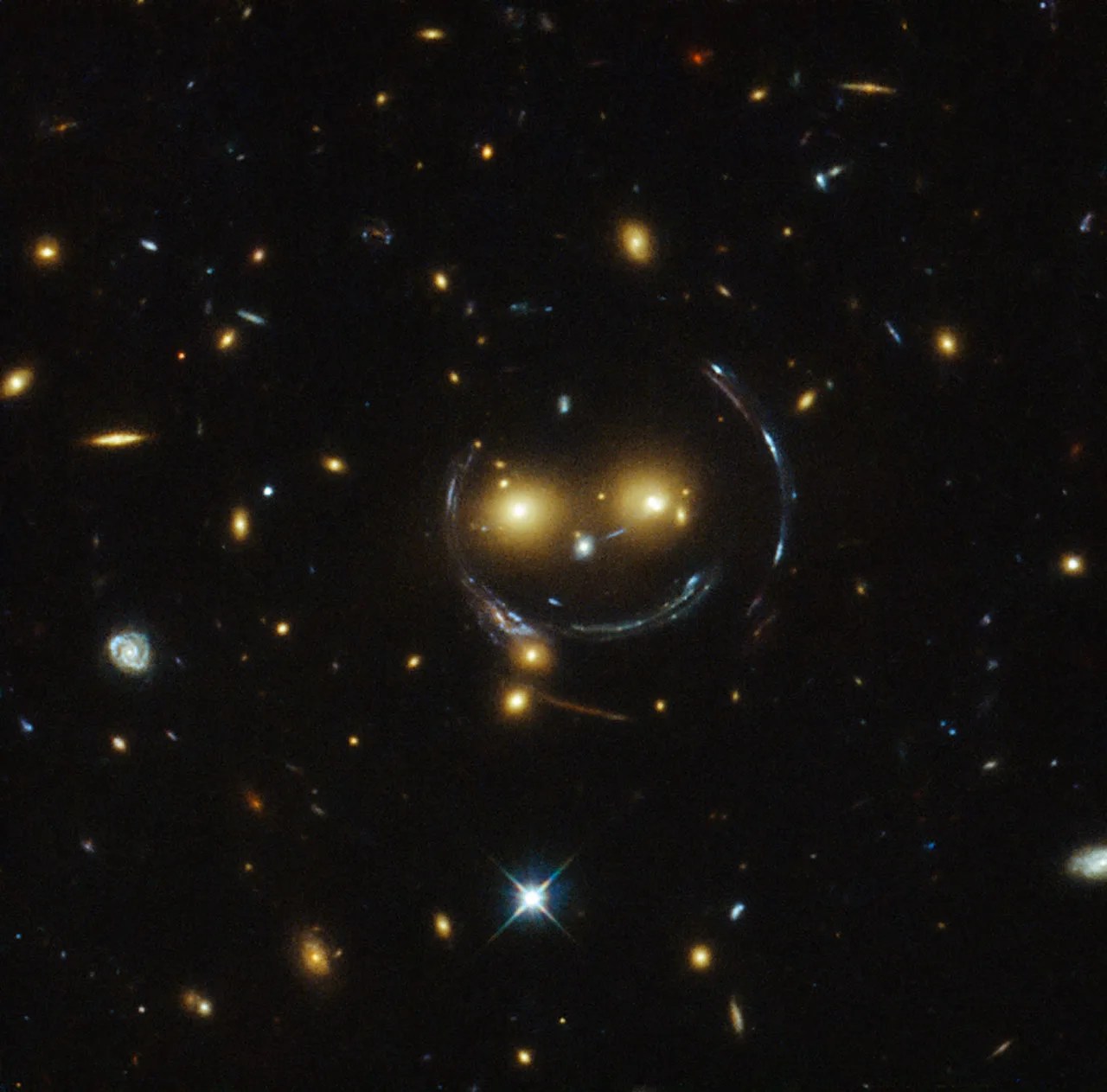
Real cluster images show the same idea in a less schematic way. The cluster galaxies act together as a lens, distorting more distant background galaxies into arcs and streaks.
The
Bullet Cluster
A colliding galaxy-cluster system where the hot X-ray-emitting gas and the gravitational-lensing mass are spatially separated. The offset is strong evidence that most of the gravitating mass is collisionless and not the ordinary hot gas.
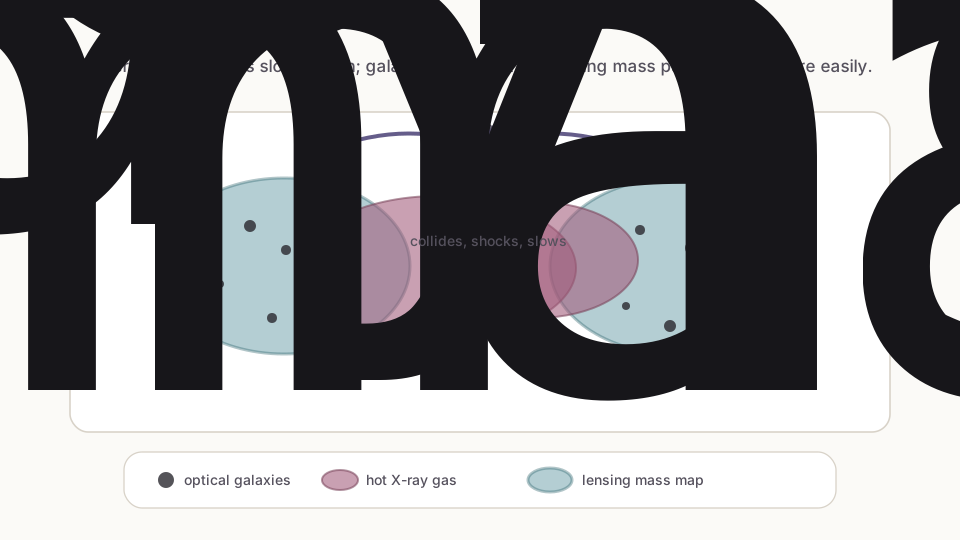
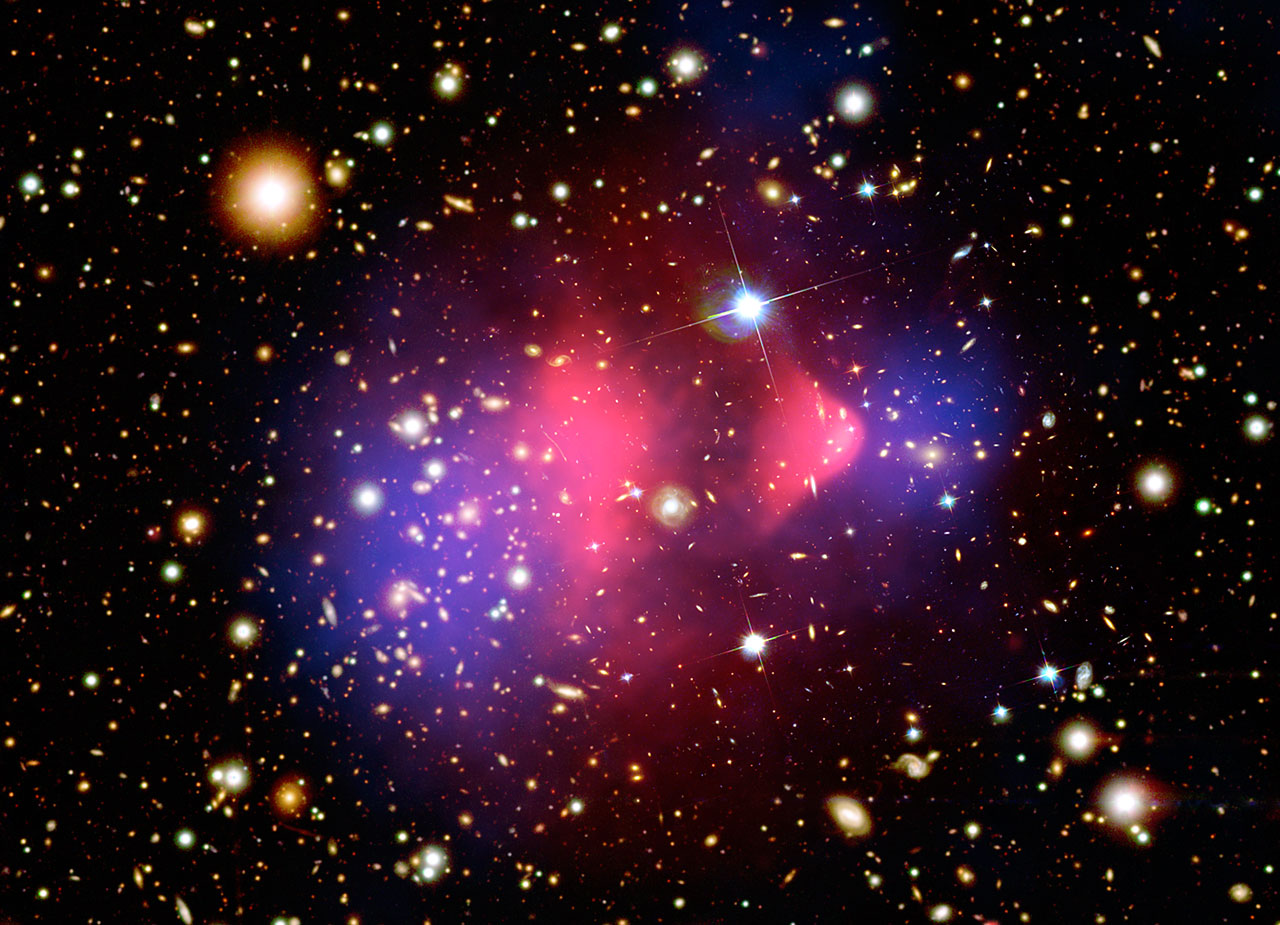
In a cluster collision, the galaxies mostly pass through one another because they are separated by enormous distances. The hot gas behaves differently: it collides, shocks, heats, and slows down. If most of the mass were ordinary gas, the gravitational mass map would line up with the hot gas. Instead, the lensing mass is offset from the gas and more closely associated with the collisionless components.
This does not make every detail of dark matter simple. It does make one thing hard to avoid: gravity is responding to a mass component that is not the hot X-ray gas and not the visible stars alone. The dark matter inference survives a very different kind of observation than a rotation curve.
Quick check
Why does the Bullet Cluster provide a different kind of evidence than a spiral-galaxy rotation curve?
A rotation curve uses orbital speeds to infer mass inside a galaxy. The Bullet Cluster uses a collision plus gravitational lensing to compare where hot gas is located with where the total gravitating mass is located. It tests dark matter with a different observable and a different physical setup.