Weighing the Invisible
Section 7 of 11
Gravity Builds the Large-Scale Universe
Part 6: Gravity Builds the Large-Scale Universe
The final scale in this reading is larger than a galaxy or a cluster. Redshift surveys map the positions of huge numbers of galaxies in three dimensions. When we do this, galaxies do not appear randomly sprinkled through space. They form the
Cosmic web
The large-scale network of filaments, walls, clusters, and voids traced by galaxies and shaped by gravity. It is evidence that gravity has amplified small early density differences into the structure we observe today.
The phrase
Large-scale structure
The distribution of matter on scales larger than individual galaxies, including galaxy groups, clusters, filaments, walls, and voids. Its pattern records the gravitational growth of small early density differences over cosmic time.
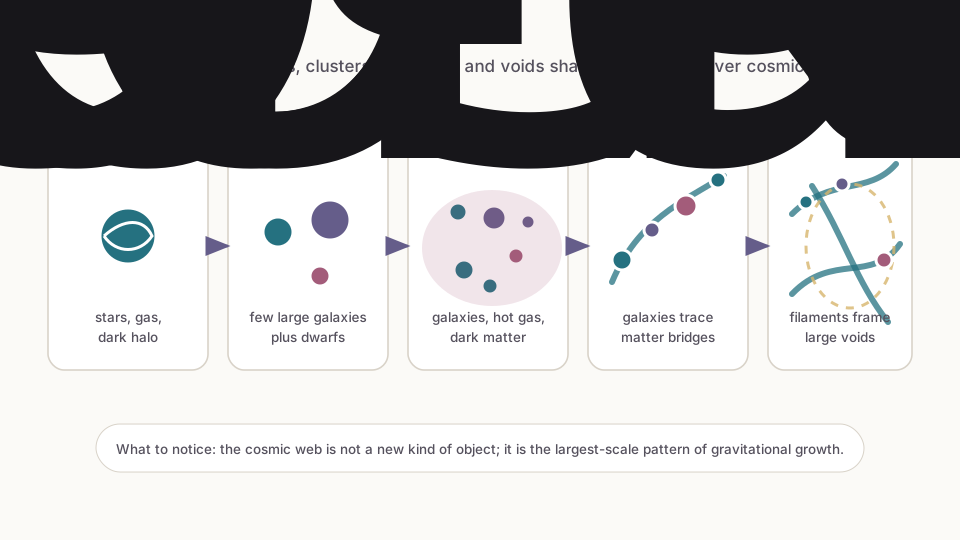
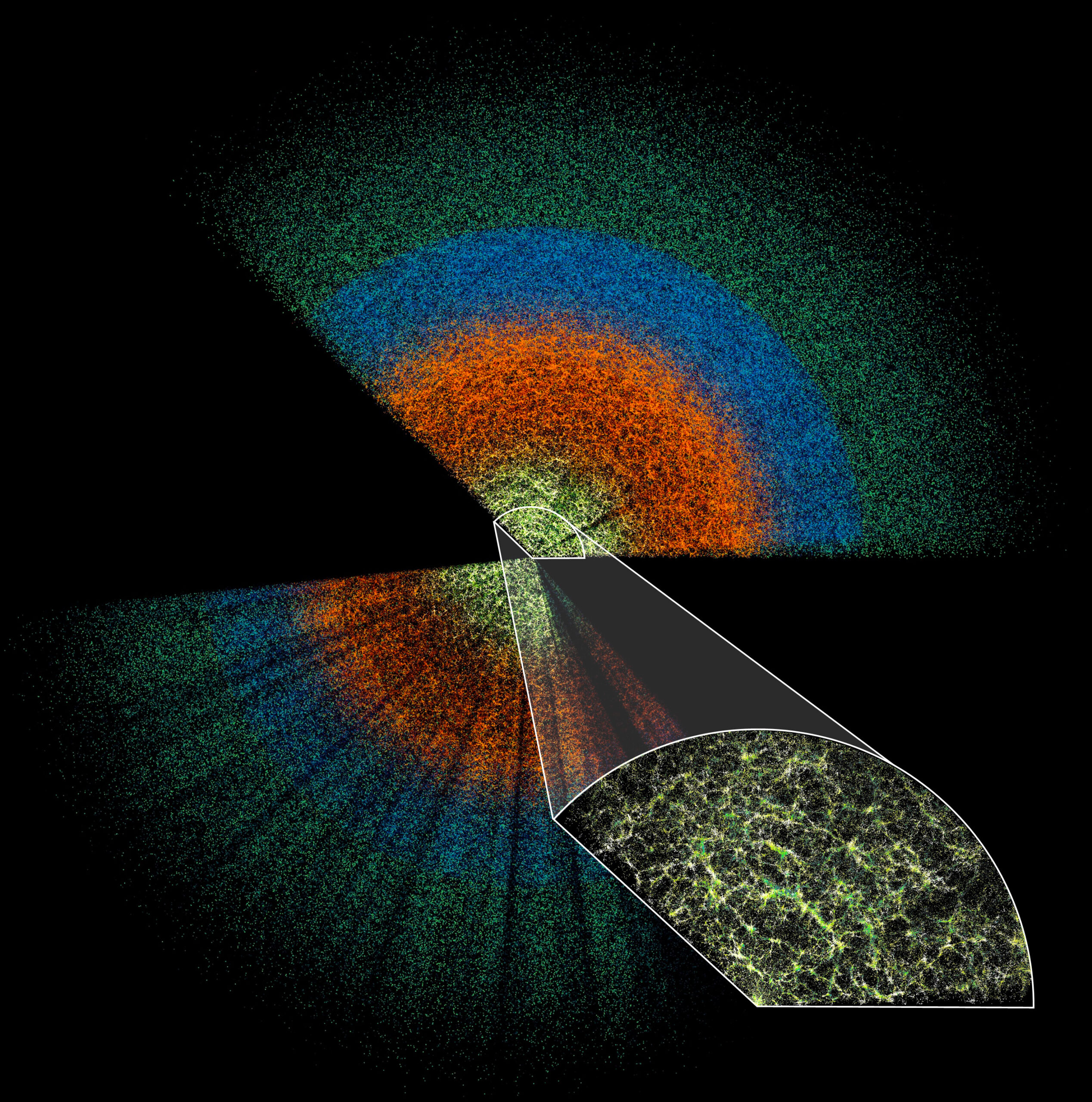
This is gravity at work on the largest observable scales. Slightly denser regions pull in matter. Under gravity, structure grows. Dark matter matters here because it begins forming gravitational scaffolding before ordinary gas can cool and form luminous galaxies. Galaxies trace the web, but they are not the whole web.
This prepares us for the next reading. Cosmology is not only the story of expansion. It is the story of expansion plus gravity. Expansion stretches distances on large scales. Gravity pulls matter together into structure. The universe we observe is the result of both.
Quick check
Why is the cosmic web evidence for gravity acting over cosmic time, rather than just a map of where galaxies happen to be today?
The web is a large-scale pattern of clusters, filaments, walls, and voids. Such structure is modeled as growth from small density differences under gravity. Galaxies trace that structure today, but the pattern records the history of gravitational growth.