Weighing the Invisible
Section 5 of 11
Compact Engines Inside Galaxies
Part 4: Compact Engines Inside Galaxies
Supermassive black holes are not dark matter, but they are part of the dynamical story of galaxies. The Milky Way’s central black hole is relatively quiet today. In other galaxies, gas falling onto a supermassive black hole can release enormous energy before crossing the event horizon. Such a system is called an
Active galactic nucleus
A luminous galactic center powered by accretion onto a supermassive black hole. The black hole itself emits no light; the brightness comes from infalling gas releasing gravitational energy outside the event horizon.
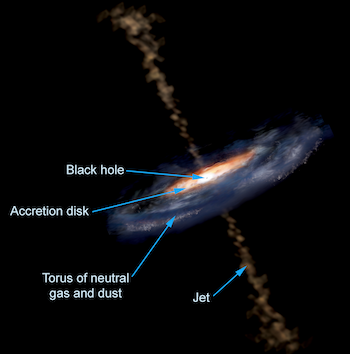
The engine is accretion. Gas loses gravitational potential energy as it spirals inward. Much of that energy becomes heat, radiation, and sometimes jets. The black hole itself is dark, but the material falling toward it can be among the brightest sources in the universe.
The geometry matters. A disk, dusty torus, broad-line region, and jets can look very different depending on viewing angle. That is why AGN classification can be complicated: the same underlying engine may present different observational faces.
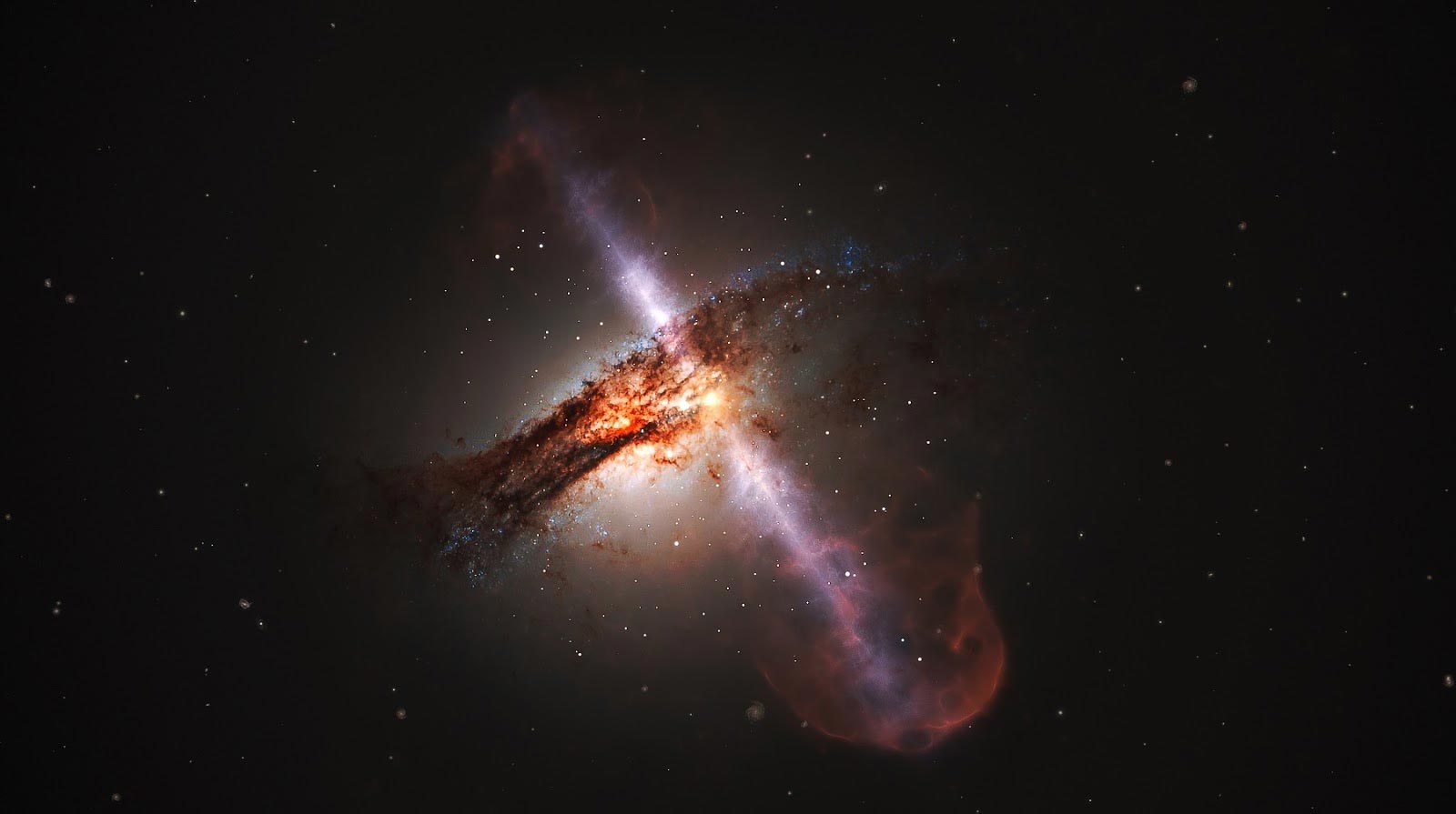
AGN matter for galaxy evolution because they can inject energy into surrounding gas. A jet or outflow can heat gas, stir it, or push it out of the galaxy. This connects back to the ecosystem model from the previous reading. Stars provide feedback; supermassive black holes can provide feedback too. Both change the gas supply that future star formation depends on.
Quick check
Why is an AGN not simply “a bright black hole”?
The black hole itself emits no light from inside the event horizon. The brightness comes from matter outside the horizon — especially gas in the accretion disk and sometimes jets — releasing gravitational energy as it falls inward.