Nuclear Fusion and the Four Forces
Section 3 of 7
Why Classical Fusion Should Fail
Part 2: Why Classical Fusion Should Fail
Reading 2 gave a solar-core temperature of roughly . That sounds hot — but the real question is not “Is it hot?” It is “Is it hot enough to force two positively charged protons to nuclear distance?” Classically, the answer is no. We settle it with one more Reading the Math pass — estimate the barrier, estimate the thermal scale, take the ratio — and then, as always, name the assumption. This time naming the assumption is the physics: the estimate will be arithmetically airtight and still reach the wrong conclusion.
Think first
Before any arithmetic, commit to a prediction: relative to the solar-core thermal energy, is the Coulomb barrier (1) slightly larger, (2) about 10x larger, or (3) about 1000x larger?
Hold your guess — the calculation is below.
The Coulomb barrier (order-of-magnitude head-on estimate)
For fusion, two protons must approach to about , where the strong interaction matters. In Gaussian CGS units the electrostatic potential energy of two protons separated by is the
Coulomb barrier
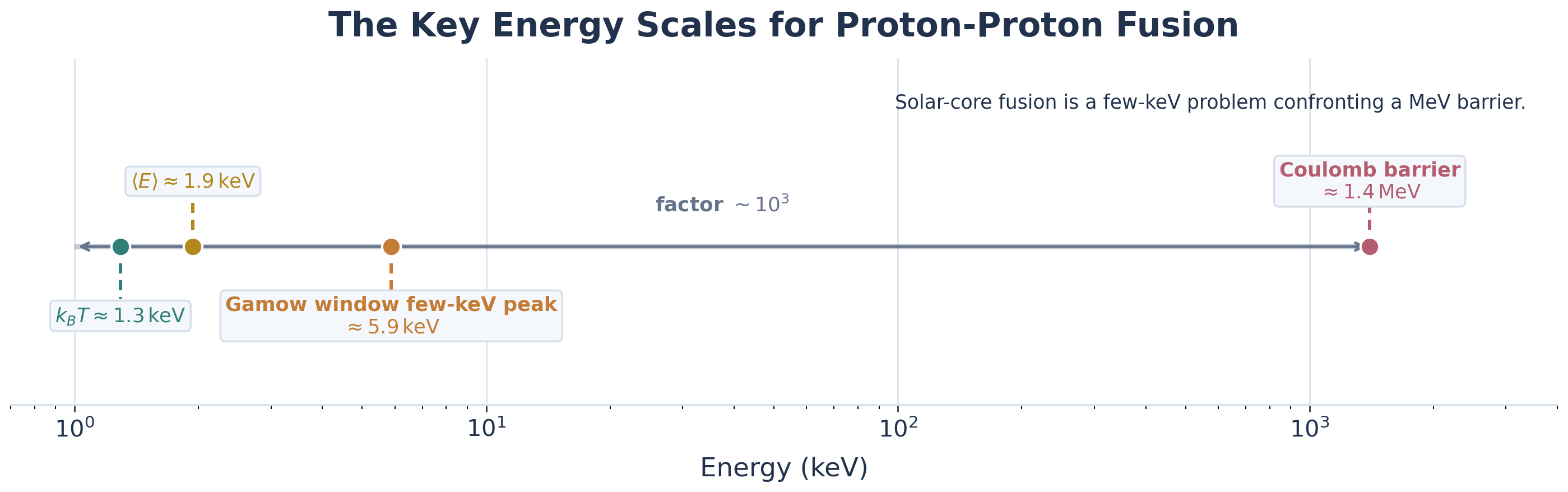
The electrostatic potential-energy barrier two like-charged nuclei must overcome (or tunnel through) to reach nuclear distance, . For two protons at it is of order — about a thousand times the solar-core thermal energy.
A unit check: in Gaussian CGS, carries units of , so has units — an energy, directly comparable to the thermal energy of the gas. Evaluating at nuclear distance:
Converting with gives . This is an order-of-magnitude estimate, not a sharp universal threshold — the important point is the scale: the barrier is of order .
The solar-core thermal scale
The Boltzmann constant is , so at the solar-core temperature . The mean kinetic energy of a monatomic gas is . Either way, the thermal scale is of order .
The mismatch
The Coulomb barrier is about a thousand times larger than the thermal scale. That is not a near miss — it is a complete classical failure.
Name the assumption. That ratio is arithmetically airtight — and still reaches the wrong answer, because one hidden assumption is load-bearing. Audit the estimate:
| We assumed | by treating | What it costs |
|---|---|---|
| a sharp barrier at | as a single threshold | a scale, not an exact height — fine |
| a head-on approach | zero impact parameter | the real barrier is a distribution — fine |
| classical point particles | protons as localized balls on one trajectory | fatal — the row Reading 3 overturns |
The first two rows cost only factors of order unity. The third is different in kind: it is not an approximation we can sharpen, it is a wrong model. A proton in the core is not a tiny ball with a definite position — it is a wave. This is Kelvin’s lesson from Reading 1 in a new guise: the arithmetic is right; the model is incomplete. The rest of this reading repairs that single row — and once it is fixed, fusion becomes possible.
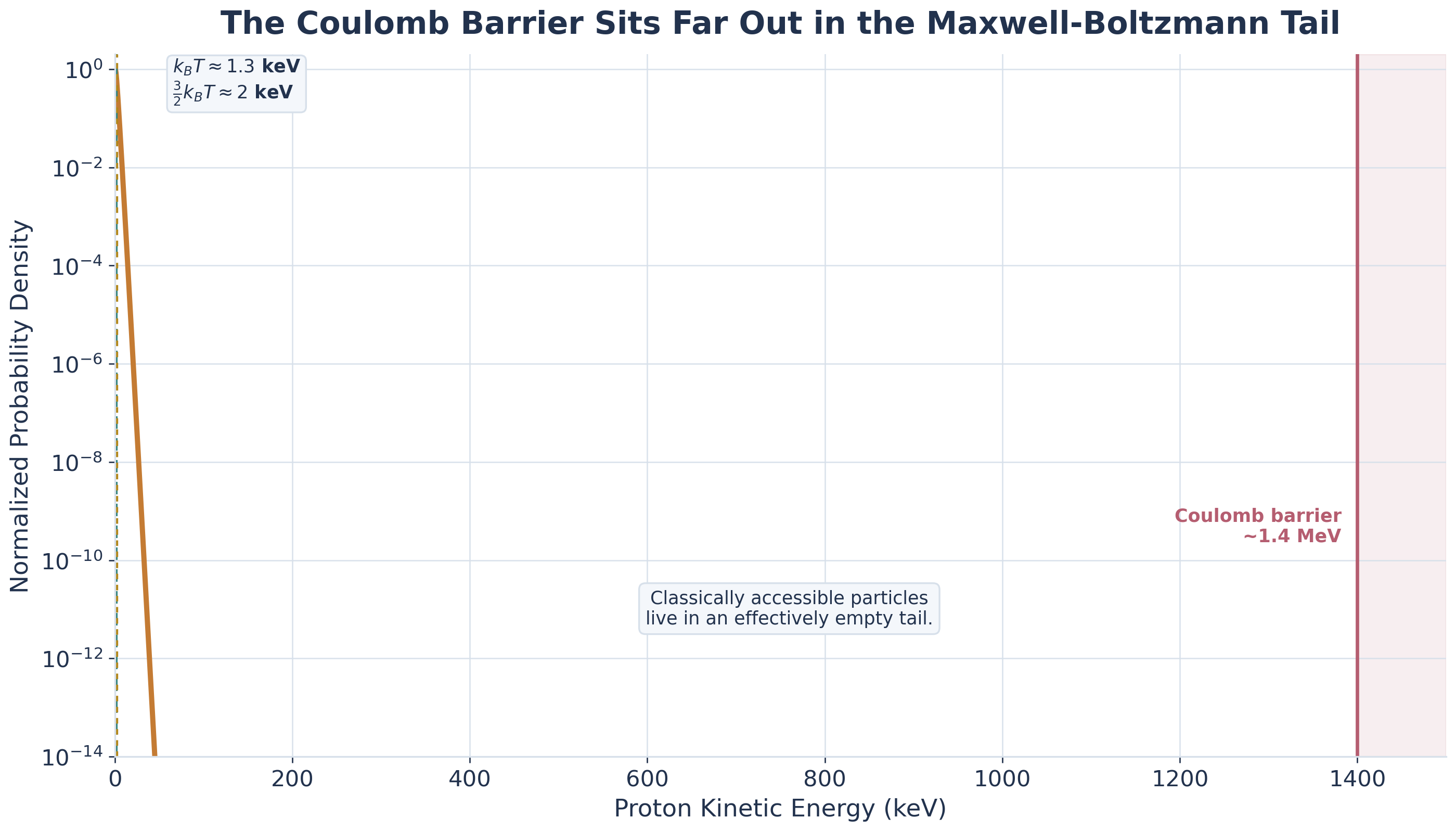
If the gas were purely classical, the fraction of particles at or above the barrier would be roughly — effectively zero for any astrophysical purpose. The classical tail gives essentially no fusion at all, which is why the next step must be a genuinely new physical mechanism.
| Effect | Expression | Physical meaning |
|---|---|---|
| Thermal rarity | high-energy particles are rare in the thermal distribution | |
| Tunneling suppression | low-energy particles penetrate the barrier poorly |
Numeric answer
Set and estimate the temperature required for classical fusion. Is that plausible for an ordinary main-sequence star?
Solving with gives — not . Ordinary main-sequence stars never reach that regime; classical fusion fails by orders of magnitude.