Nuclear Fusion and the Four Forces
Complete lesson
Concept Throughline
Guiding question: the Sun’s core is “only” about relative to the MeV-scale barrier problem — so why does fusion happen at all?
After completing this reading, you should be able to:
Concept Throughline
Gravity can make stars hot, but not classically hot enough. Reading 2 showed that hydrostatic equilibrium naturally gives a solar-core temperature of order . This reading asks why that still fails for classical proton-proton fusion, how quantum mechanics changes the answer, why the first reaction is slow, where the released energy comes from, and why the process eventually runs out of exothermic fuel near the iron/nickel region.
Which Force Matters Where
Part 1: Which Force Matters Where?
Students often memorize the names of the four forces without a clear picture of where each one matters. For stellar fusion, the cleanest map is scale-based: gravity dominates the whole star, electromagnetism dominates the approach of charged nuclei, the strong force matters only when nuclei are extremely close, and the weak force matters when one particle type must change into another.
| Physical scale or stage | Main actor | Job in this reading |
|---|---|---|
| Whole star | gravity | compresses the gas; sets the core temperature and density scale |
| Charged-particle encounter | electromagnetism | creates Coulomb repulsion between nuclei |
| Nuclear distance, | strong interaction | binds nucleons once they are close enough |
| Proton-to-neutron conversion in Step 1 | weak interaction | enables deuterium formation in the pp-chain |
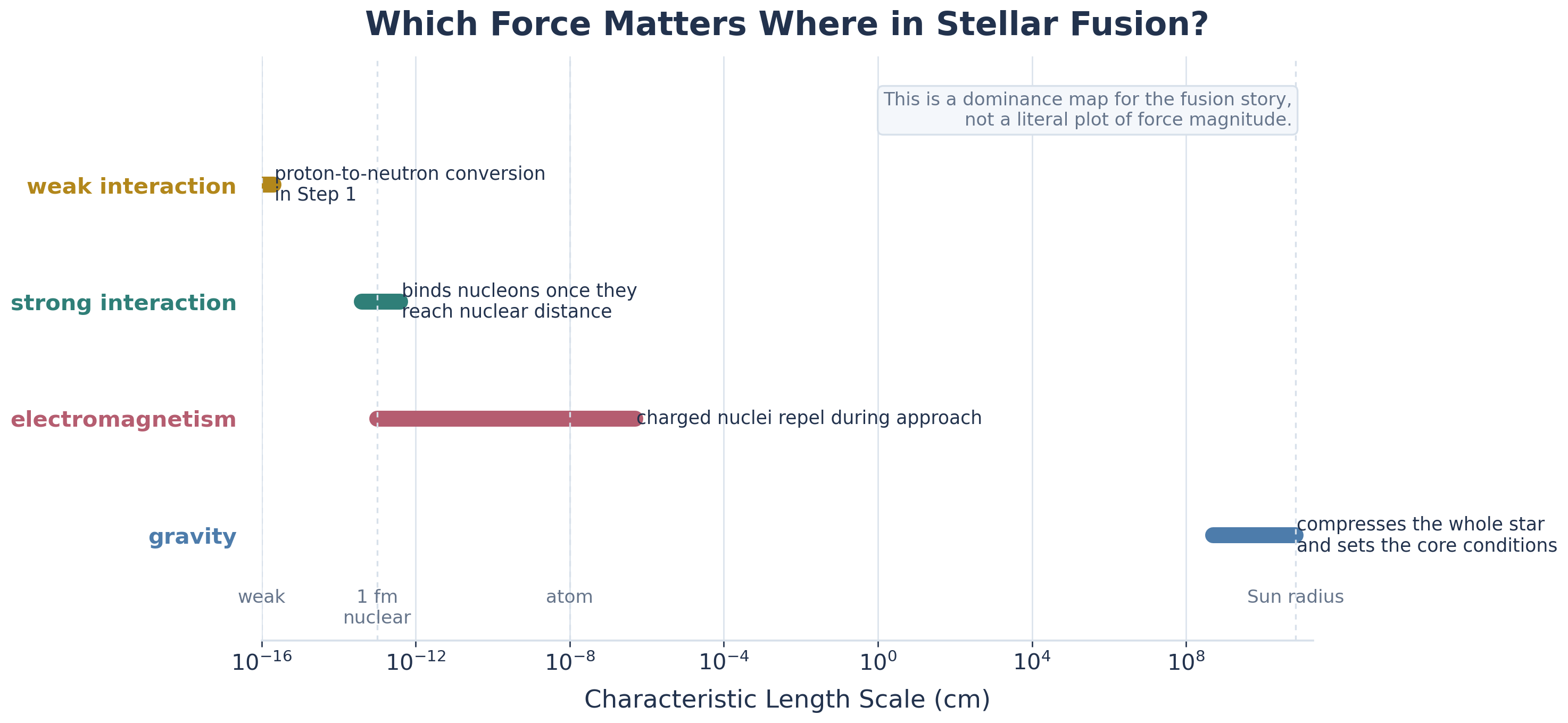
This is why gravity can be the global winner even though it is the weakest microscopic force. The
Strong interaction
The strongest fundamental force, but effective only at nuclear distances (). It binds quarks into protons and neutrons and binds nucleons into nuclei once they are close enough to overcome Coulomb repulsion.
Weak interaction
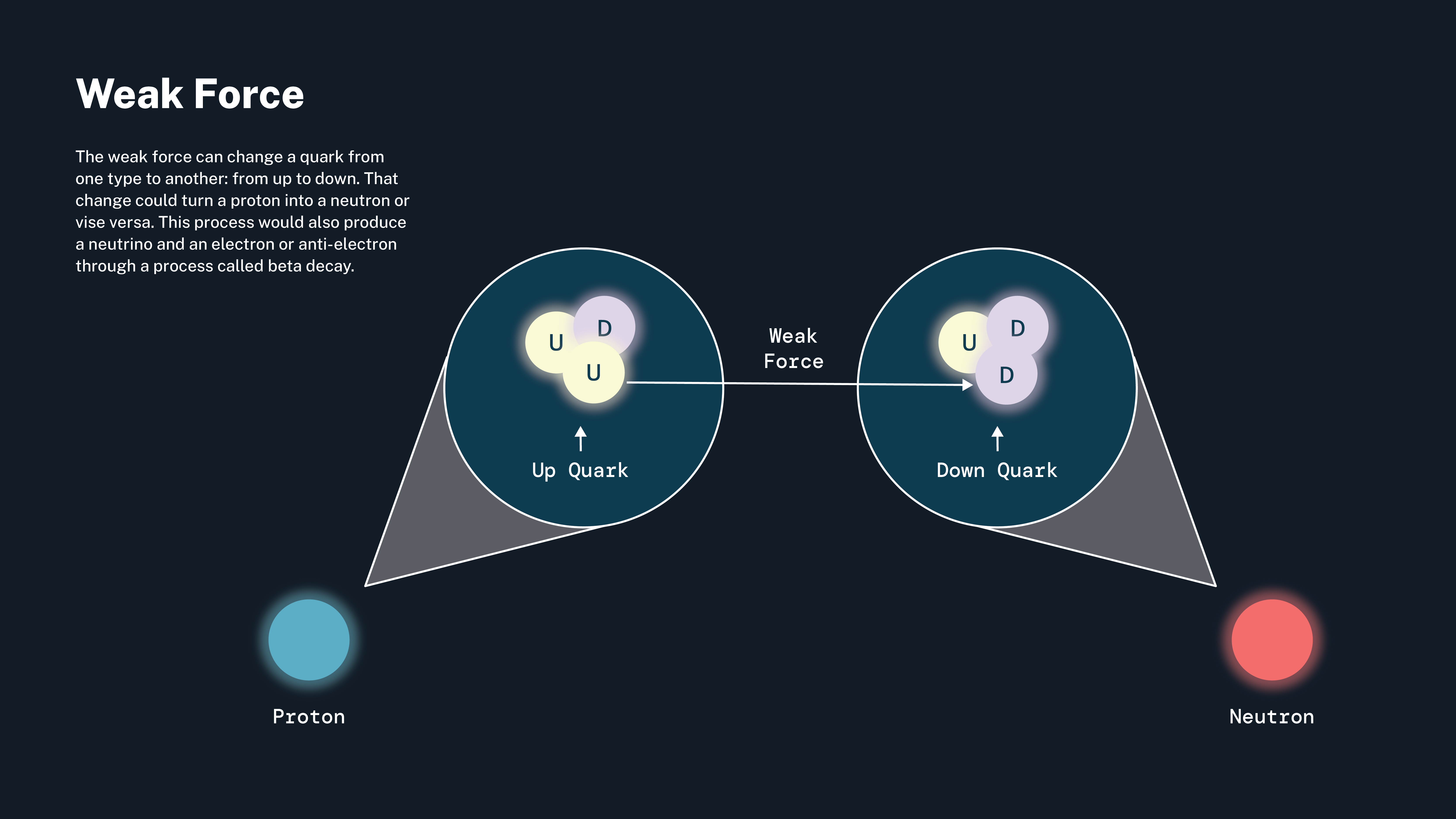
The fundamental force that converts one particle type into another — e.g. a proton into a neutron. In the pp-chain it enables the first reaction (); because weak conversions are rare, it sets the slow pace of solar hydrogen burning.
A visual tour of the four forces
The scale map above is the core reasoning tool. The four figures below give each force a visual identity — and each plays a distinct role in the one story of how a star shines.
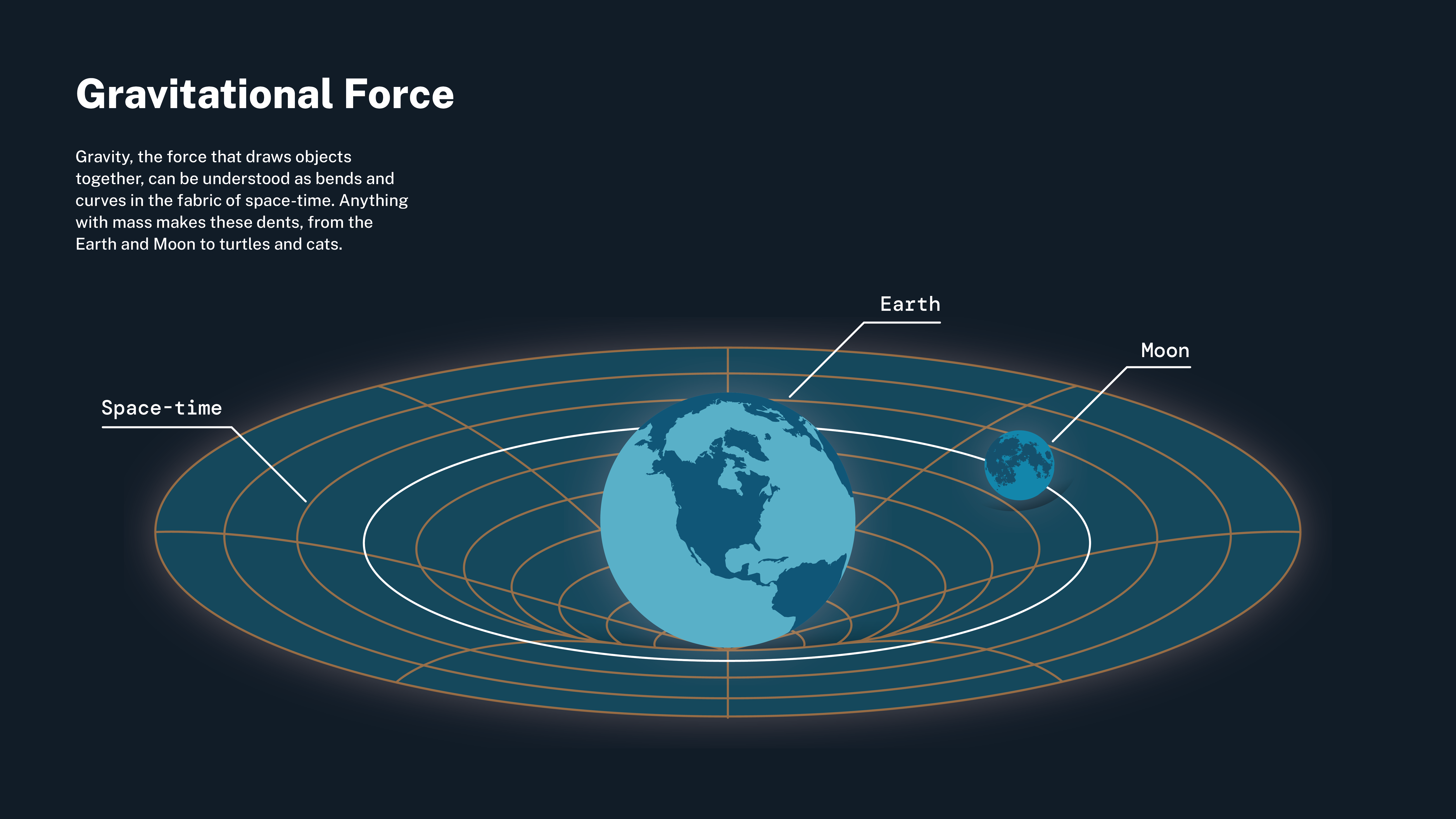
Gravity does the compressing: it squeezes the core to the temperature that makes everything downstream possible.
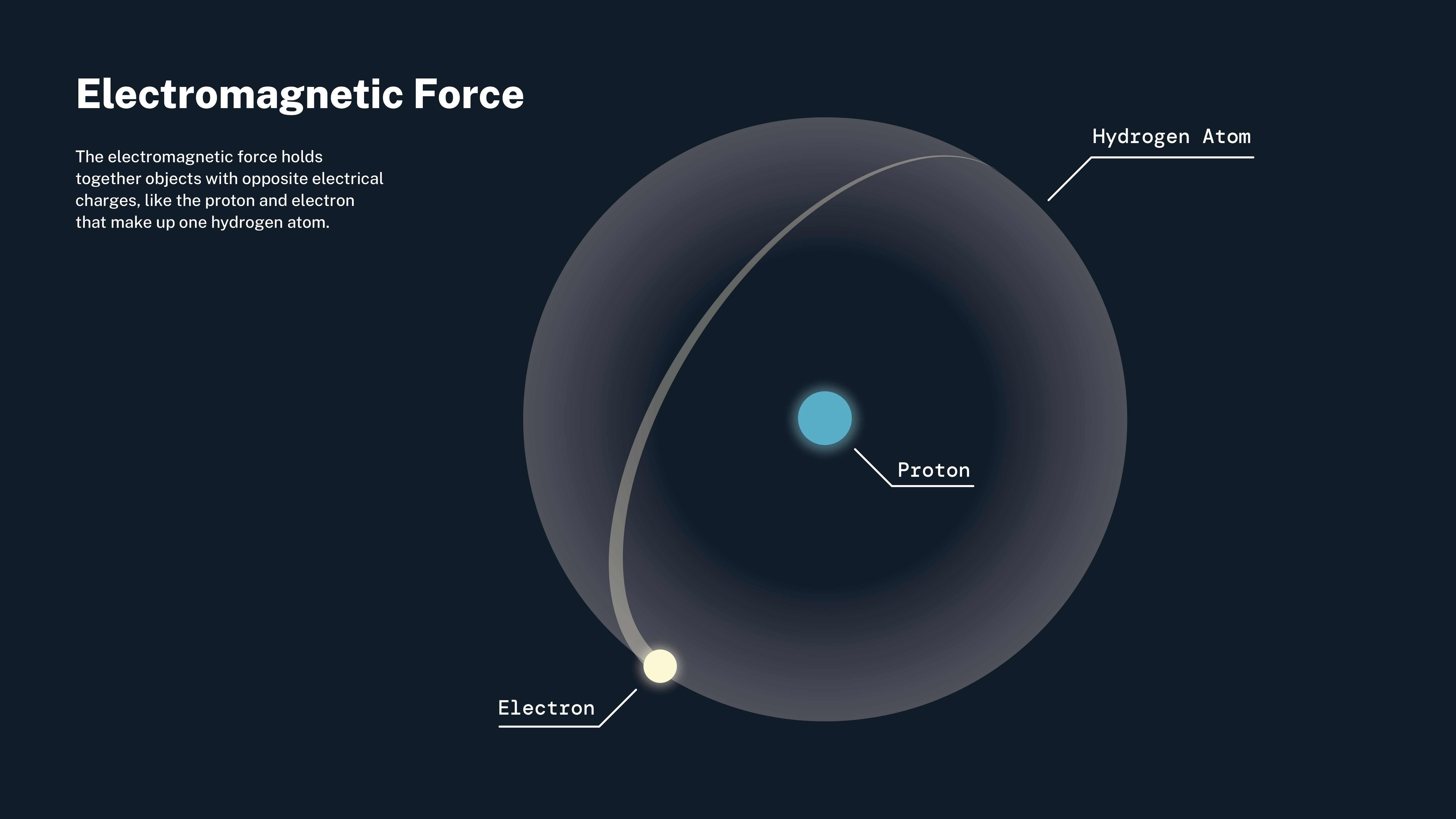
Electromagnetism is the obstacle: like charges repel, raising the Coulomb barrier two protons must get past.
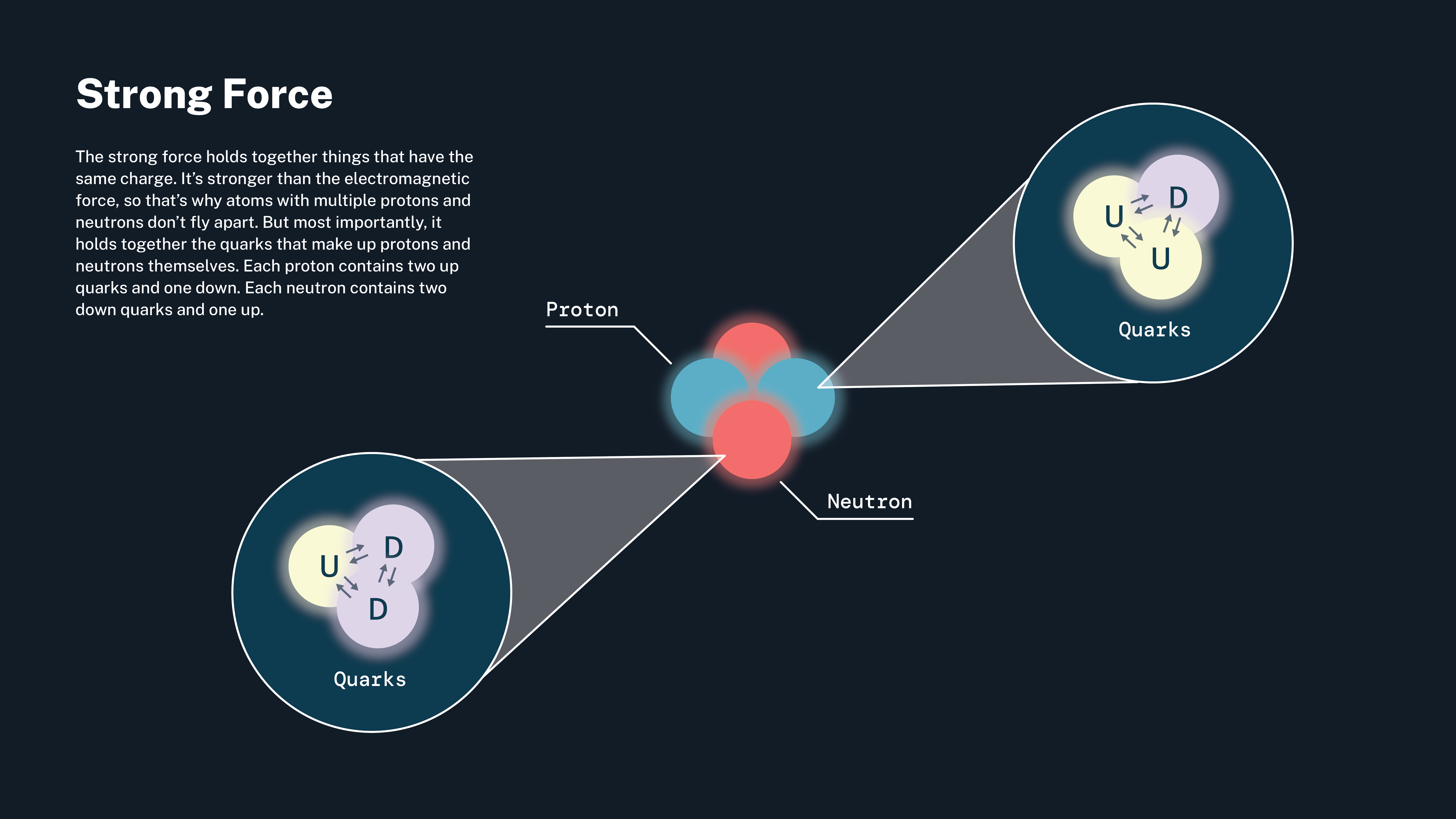
The strong force is the payoff: once nucleons finally touch, it binds them and releases the energy.
The weak force is the bottleneck: it must convert a proton into a neutron in the very first reaction, and it does so rarely — which is exactly why the Sun burns slowly enough to last billions of years.
Quick check
Why does gravity dominate the structure of stars even though it is vastly weaker than the strong and electromagnetic forces in a proton-proton encounter?
Gravity acts between every pair of masses, has infinite range, and never cancels. The strong force is much stronger, but matters only when particles are essentially touching. Electromagnetism also has infinite range, but opposite charges largely cancel on macroscopic scales. So gravity wins globally even though it loses microscopically.
Why Classical Fusion Should Fail
Part 2: Why Classical Fusion Should Fail
Reading 2 gave a solar-core temperature of roughly . That sounds hot — but the real question is not “Is it hot?” It is “Is it hot enough to force two positively charged protons to nuclear distance?” Classically, the answer is no. We settle it with one more Reading the Math pass — estimate the barrier, estimate the thermal scale, take the ratio — and then, as always, name the assumption. This time naming the assumption is the physics: the estimate will be arithmetically airtight and still reach the wrong conclusion.
Think first
Before any arithmetic, commit to a prediction: relative to the solar-core thermal energy, is the Coulomb barrier (1) slightly larger, (2) about 10x larger, or (3) about 1000x larger?
Hold your guess — the calculation is below.
The Coulomb barrier (order-of-magnitude head-on estimate)
For fusion, two protons must approach to about , where the strong interaction matters. In Gaussian CGS units the electrostatic potential energy of two protons separated by is the
Coulomb barrier
The electrostatic potential-energy barrier two like-charged nuclei must overcome (or tunnel through) to reach nuclear distance, . For two protons at it is of order — about a thousand times the solar-core thermal energy.
A unit check: in Gaussian CGS, carries units of , so has units — an energy, directly comparable to the thermal energy of the gas. Evaluating at nuclear distance:
Converting with gives . This is an order-of-magnitude estimate, not a sharp universal threshold — the important point is the scale: the barrier is of order .
The solar-core thermal scale
The Boltzmann constant is , so at the solar-core temperature . The mean kinetic energy of a monatomic gas is . Either way, the thermal scale is of order .
The mismatch
The Coulomb barrier is about a thousand times larger than the thermal scale. That is not a near miss — it is a complete classical failure.
Name the assumption. That ratio is arithmetically airtight — and still reaches the wrong answer, because one hidden assumption is load-bearing. Audit the estimate:
| We assumed | by treating | What it costs |
|---|---|---|
| a sharp barrier at | as a single threshold | a scale, not an exact height — fine |
| a head-on approach | zero impact parameter | the real barrier is a distribution — fine |
| classical point particles | protons as localized balls on one trajectory | fatal — the row Reading 3 overturns |
The first two rows cost only factors of order unity. The third is different in kind: it is not an approximation we can sharpen, it is a wrong model. A proton in the core is not a tiny ball with a definite position — it is a wave. This is Kelvin’s lesson from Reading 1 in a new guise: the arithmetic is right; the model is incomplete. The rest of this reading repairs that single row — and once it is fixed, fusion becomes possible.
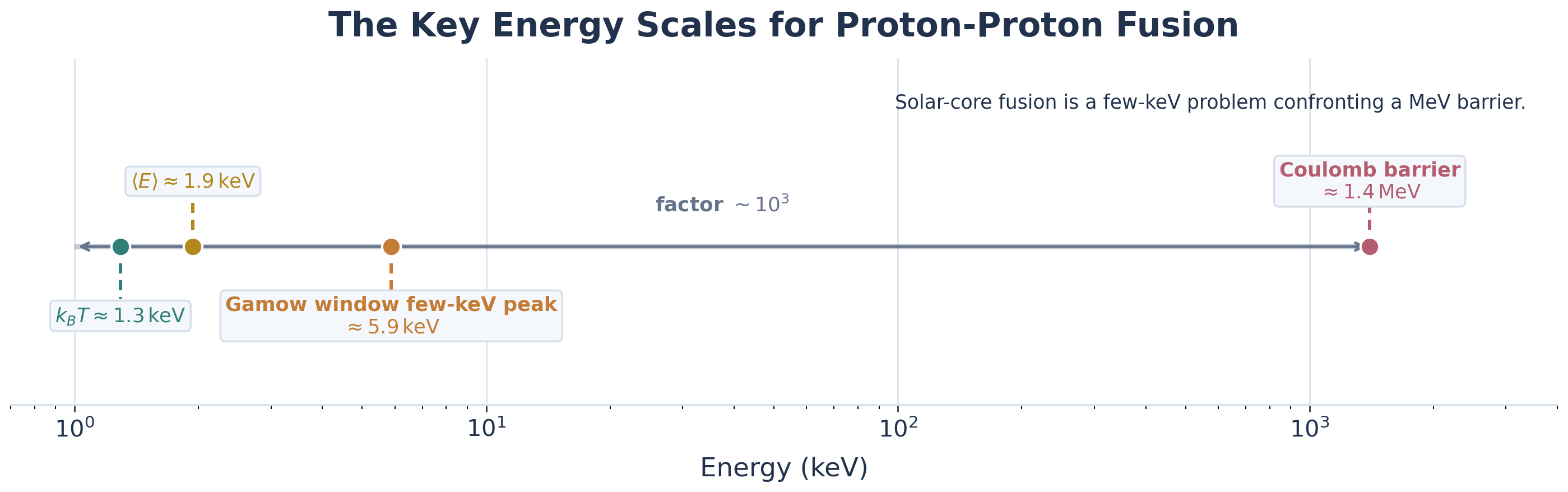
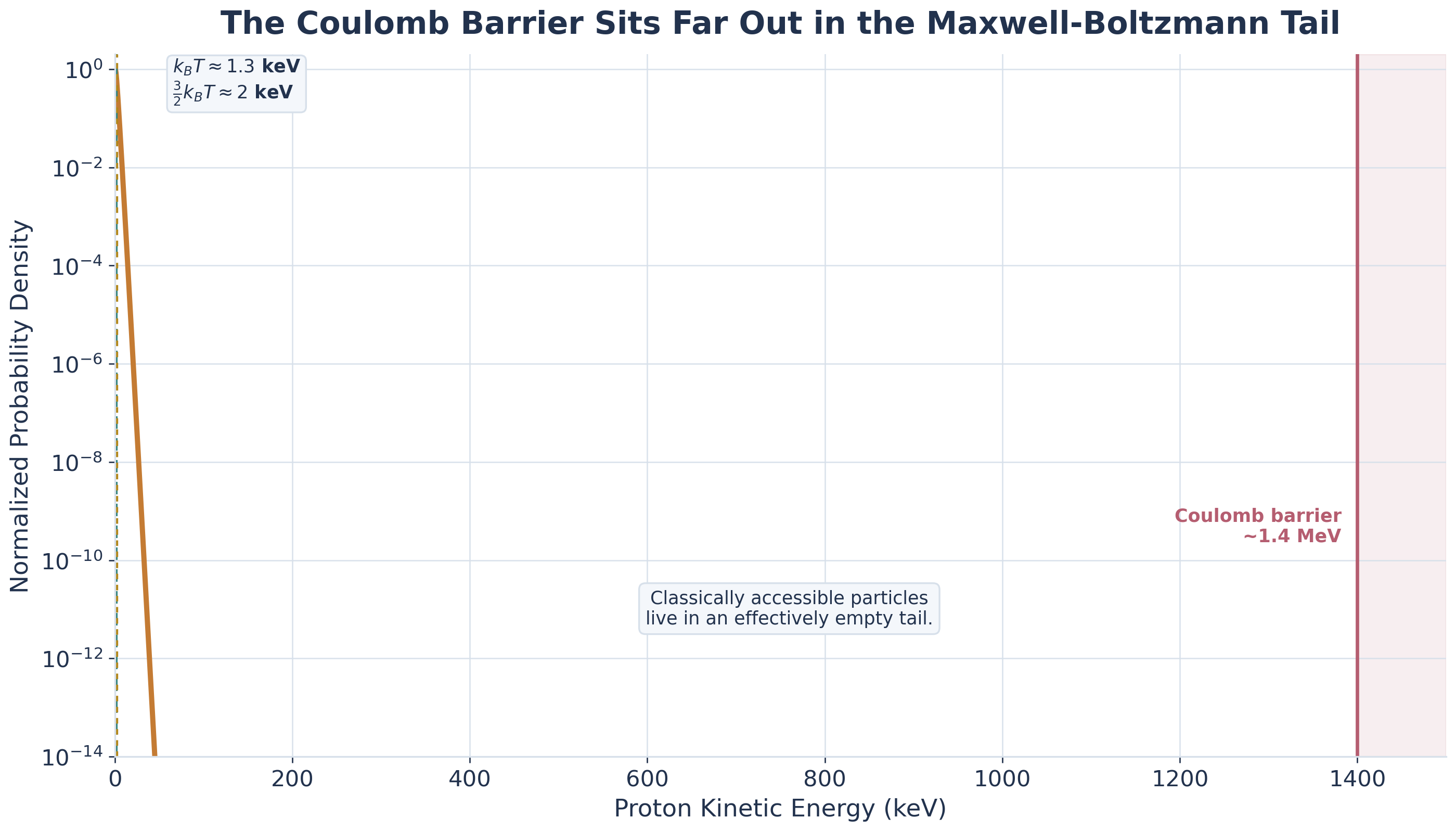
If the gas were purely classical, the fraction of particles at or above the barrier would be roughly — effectively zero for any astrophysical purpose. The classical tail gives essentially no fusion at all, which is why the next step must be a genuinely new physical mechanism.
| Effect | Expression | Physical meaning |
|---|---|---|
| Thermal rarity | high-energy particles are rare in the thermal distribution | |
| Tunneling suppression | low-energy particles penetrate the barrier poorly |
Numeric answer
Set and estimate the temperature required for classical fusion. Is that plausible for an ordinary main-sequence star?
Solving with gives — not . Ordinary main-sequence stars never reach that regime; classical fusion fails by orders of magnitude.
What Quantum Mechanics Changes
Part 3: What Quantum Mechanics Changes
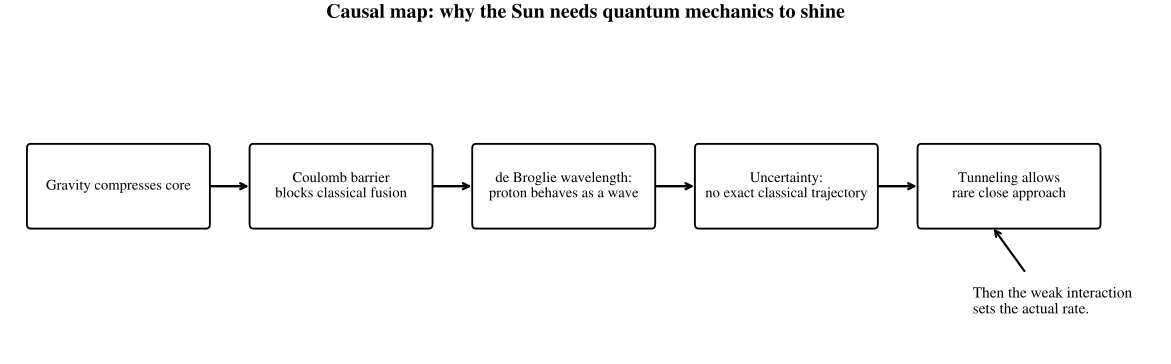
The Sun does not solve the fusion problem by getting classically hot enough. It solves it by leaving classical physics behind — repairing the audit’s fatal row by recognizing that the proton is a wave, not a ball.
Particles are also waves
A proton in the solar core cannot be treated as a tiny hard sphere on one exact path. The
de Broglie wavelength
The wavelength associated with a particle of momentum . When it is large compared with the relevant distance scale, wave behavior (interference, tunneling) dominates and the classical point-particle picture fails.
Problem
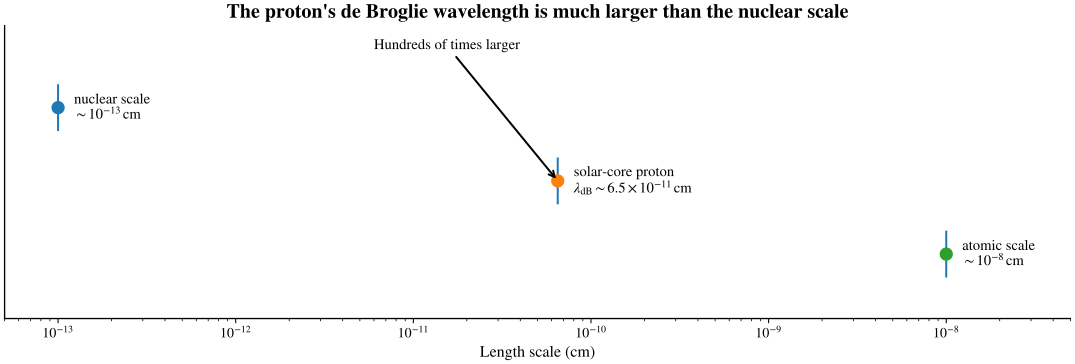
Take a characteristic proton energy equal to the mean thermal energy, , and find its de Broglie wavelength. Compare with the nuclear scale . Use , .
StepConvert energy to CGS
.
StepSpeed from kinetic energy
.
StepWavelength from momentum
.
Dimensional check
✓ — a length.
Result
. The proton’s wavelength is hundreds of times larger than the nuclear scale — classical barrier crossing is no longer the right language for the problem.
The uncertainty principle and why localization fails
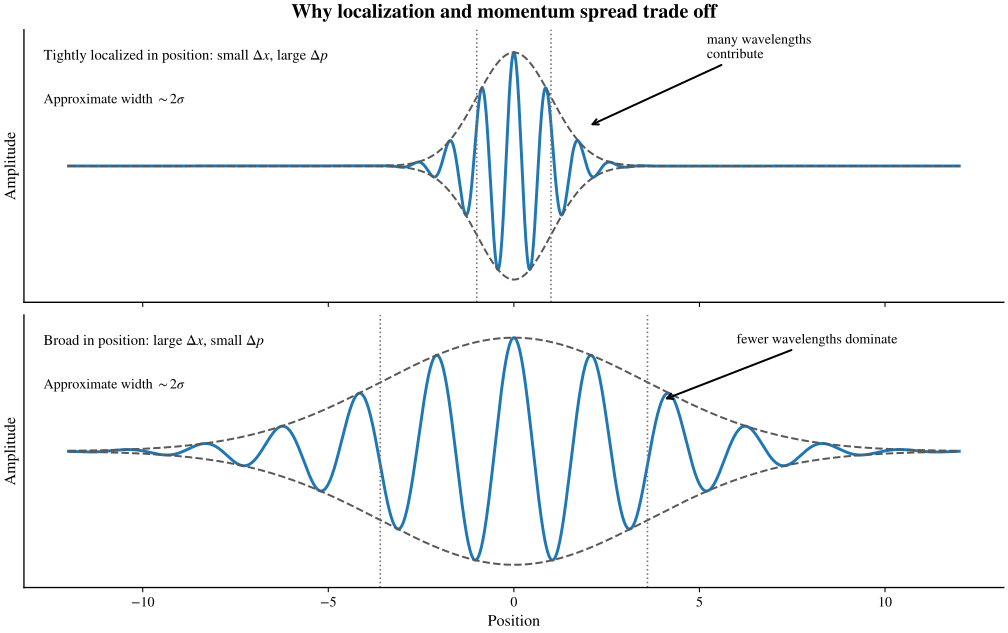
Because a wave cannot be both perfectly localized and have a single wavelength, position and momentum cannot both be sharply defined: the
Uncertainty principle
— a position spread and a momentum spread cannot both be made arbitrarily small. It is a structural consequence of describing particles as waves, not a measurement limitation.
Quick check
Suppose you try to confine a proton to . What happens to ? What does that imply about the range of velocities, and why does it make a single classical trajectory impossible?
From , shrinking forces to grow. The proton then cannot have one well-defined momentum — it contains a wide range of velocities, so its motion cannot be described by a single path. The classical trajectory picture breaks down completely.
Tunneling
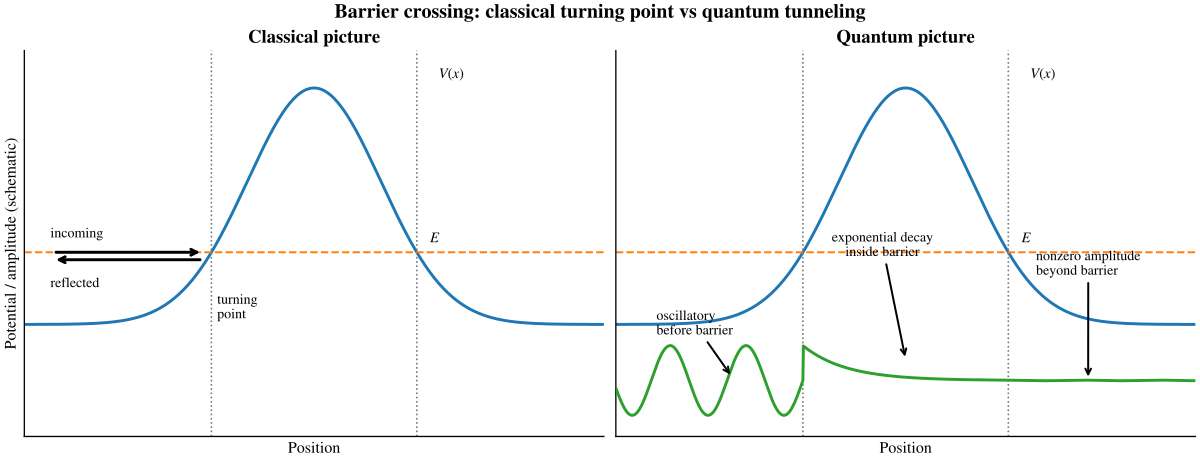
In classical mechanics, a particle with energy below the barrier reflects — but that assumes a perfectly localized particle on a single trajectory. Quantum mechanics has already removed that assumption. The proton’s wavefunction is spread over a finite region; it extends into the classically forbidden region, decays exponentially there, and can remain nonzero beyond the barrier. That is
Quantum tunneling
The penetration of a wavefunction into and beyond a classically forbidden barrier, giving a small but nonzero probability of finding the particle on the far side even when its energy is below the barrier. It is what makes stellar fusion possible at .
The Gamow window
Think first
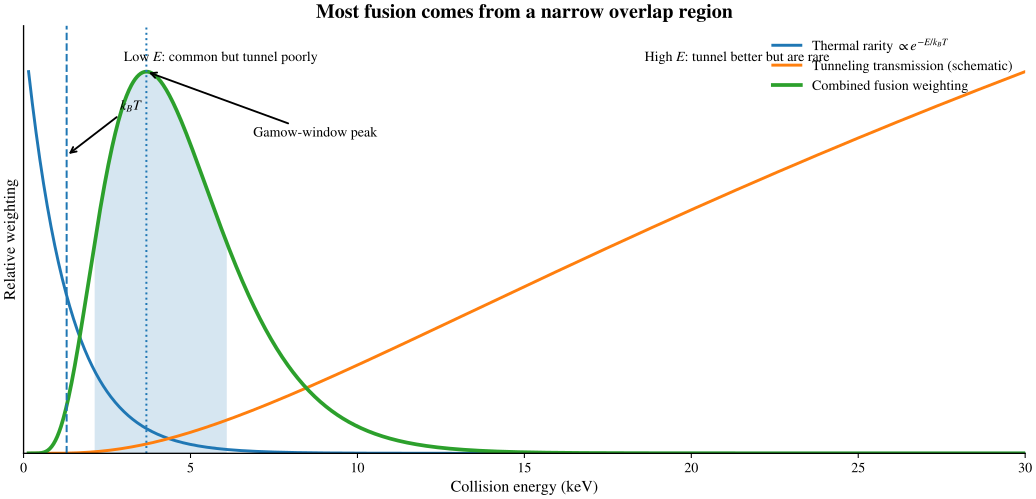
Low-energy particles are common but tunnel poorly; high-energy particles tunnel well but are rare. Where should most fusion events come from: (1) near the average thermal energy, (2) only the highest-energy tail, or (3) a narrow middle overlap?
Then read on.
Fusion does not happen at the average thermal energy. It happens in a narrow range where two competing effects overlap — higher-energy particles are rarer (Maxwell-Boltzmann) but tunnel more easily. Schematically the rate contribution at energy behaves like
where is the Gamow energy (it packages how hard a given pair of nuclei is to tunnel through, growing with the Coulomb barrier). The product peaks at an intermediate energy: the
Gamow window
The narrow band of collision energies — above the mean thermal energy but below the barrier — where the product of thermal abundance and tunneling probability peaks. Most fusion reactions occur here, not at the average thermal energy.
Multiple choice
True or false: most fusion reactions occur at the average thermal energy . Explain before calculating.
False. Low-energy collisions are common but tunnel poorly; high-energy collisions tunnel better but are rare. Fusion happens mostly in the narrow Gamow window where the two effects overlap, so the relevant energy is not the mean thermal energy alone.
Why the Sun still burns slowly
Tunneling makes fusion possible, but not easy. The first step of the pp-chain is — which requires more than a close encounter: one proton must convert into a neutron, controlled by the
The Proton-Proton Chain
Part 4: The Proton-Proton Chain
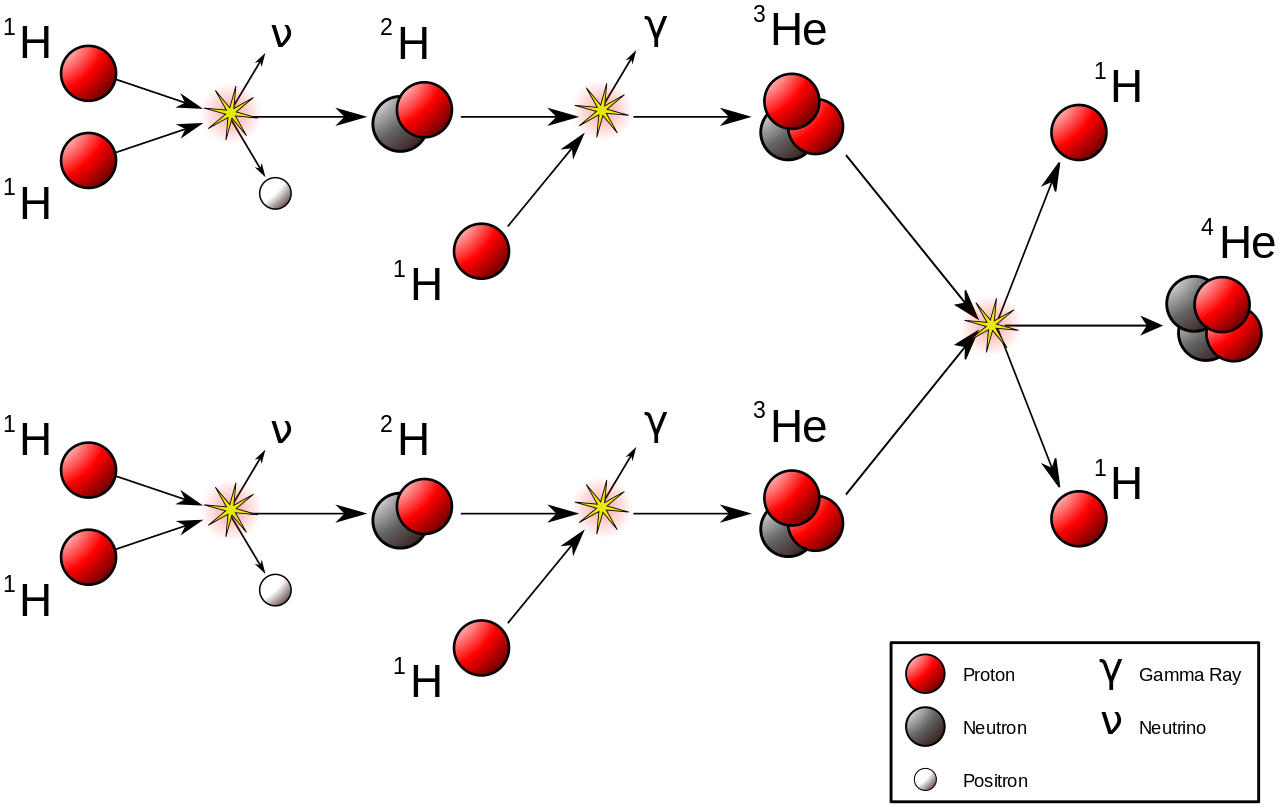
Now that close approach is possible, what actually happens? In the Sun, the dominant hydrogen-burning pathway is the proton-proton chain.
The positrons quickly annihilate with electrons in the plasma, and the neutrinos escape; the rest of the released energy thermalizes in the stellar interior.
Step by step
Step 1 — make deuterium: . The slow bottleneck — electromagnetism creates the barrier, tunneling makes close approach possible, the weak interaction converts one proton into a neutron, and the strong interaction binds the proton-neutron pair into
Step 2 — capture a proton: . Fast once deuterium exists; no weak conversion required.
Step 3 — build helium-4: . The nuclei tunnel through Coulomb repulsion, and the strong interaction binds the final helium-4 nucleus.
Deuterium
The hydrogen isotope with one proton and one neutron ( or ). Its formation in the first pp reaction is the rate-limiting, weak-interaction-controlled step of solar hydrogen burning.
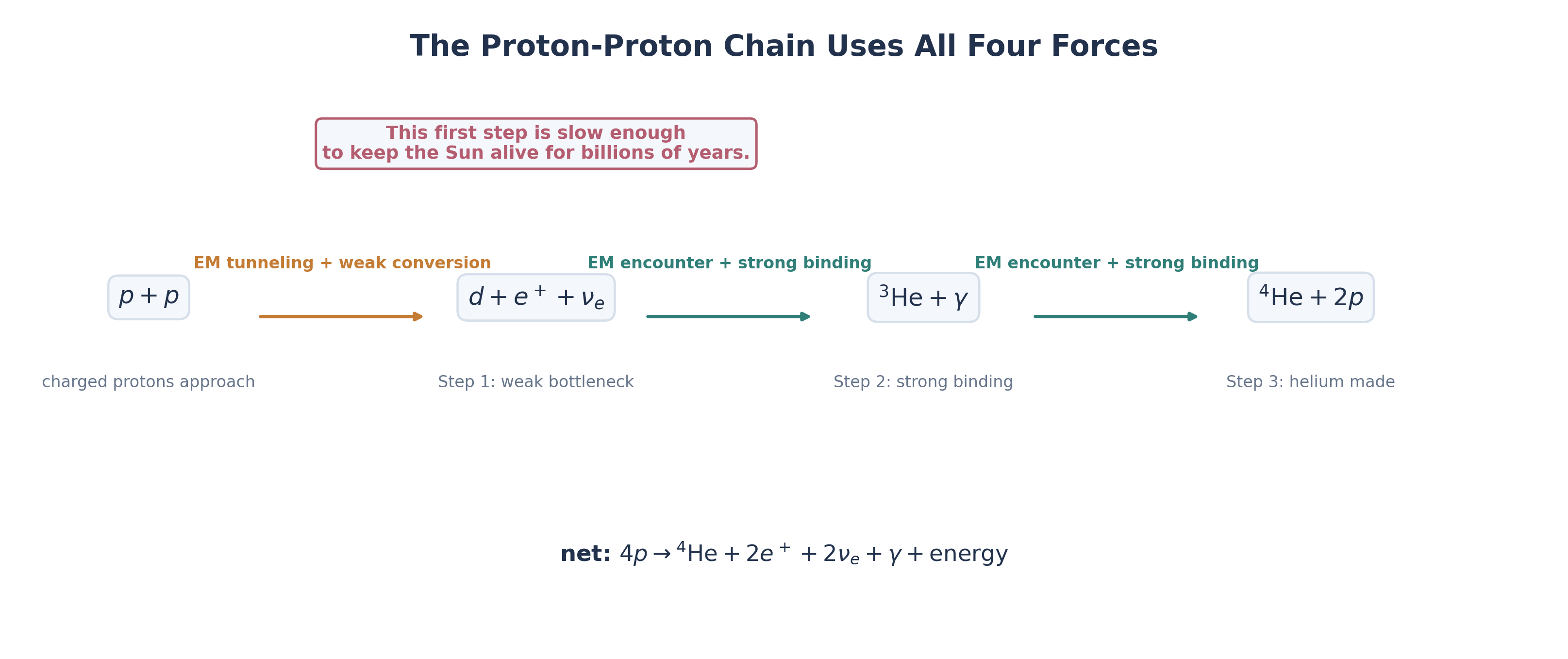
The force-labeled schematic above answers “which physics matters where?” The reaction-network view below answers “where do the particles go?” — making the duplicated deuterium-forming branches, the emitted neutrinos and gamma rays, and the returned protons easier to track.
Composition bookkeeping: X, Y, and Z
| Symbol | Meaning | Typical solar value |
|---|---|---|
| hydrogen mass fraction | ||
| helium mass fraction | ||
| everything heavier than helium |
Because these are mass fractions, . On the main sequence the dominant core change is as hydrogen becomes helium; matters indirectly through opacity, structure, and which burning pathway dominates.
Multiple choice
Which is rarer in the step that sets the Sun’s lifetime: a tunneling-enabled close approach, or a successful weak conversion that actually makes deuterium?
Tunneling-enabled close approaches are already rare, but a successful weak conversion is rarer still. That is why the first pp reaction is the bottleneck and why the weak interaction largely determines the main-sequence lifetime.
Solar neutrinos are detected on Earth
Detectors register neutrinos arriving from the Sun at the predicted flux and characteristic energies.
The pp-chain predicts those neutrinos
The first pp reaction, , emits a neutrino; the chain predicts both their existence and energies.
The Sun is powered by core fusion
The Sun’s energy source is nuclear fusion in its core — one of astronomy’s cleanest cases of inferring an invisible interior from particles that reach us directly.
Where Fusion Energy Comes From
Part 5: Where the Fusion Energy Comes From
Fusion does not release energy because nuclei “want” to glow. It releases energy because the products have less rest mass than the reactants.
The mass deficit
Using atomic masses keeps the electron bookkeeping clean:
| Quantity | Mass |
|---|---|
So the
Mass deficit
The difference between the total rest mass of the separate reactants and the bound product, . By it sets the energy released in fusion; for hydrogen-to-helium it is 0.71% of the mass, or about per net reaction.
Converting the deficit to grams, , then
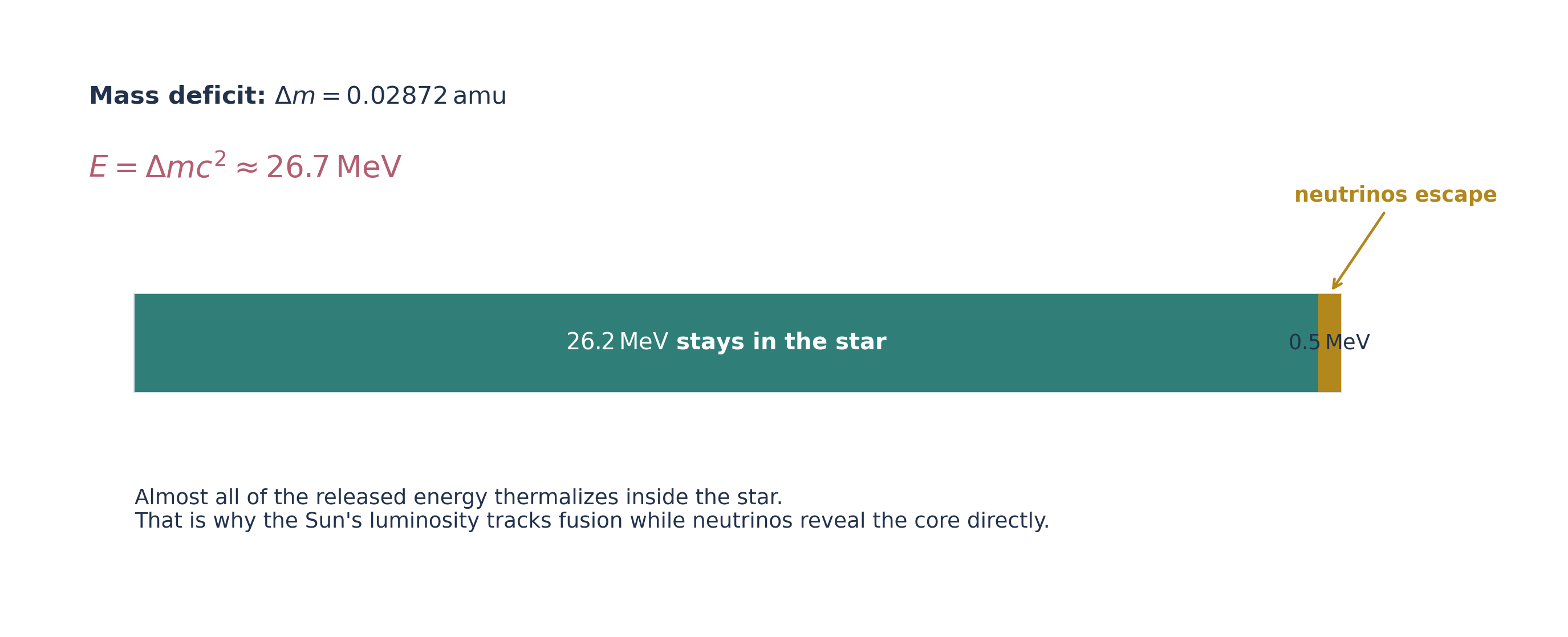
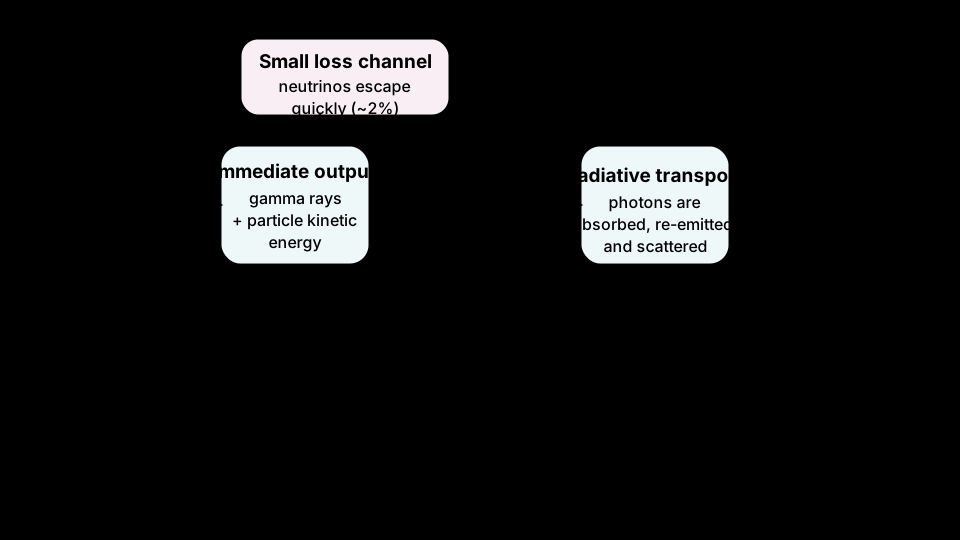
Not all of that energy heats the Sun: the neutrinos escape almost immediately, carrying away per net reaction, so about is retained. That retained energy thermalizes in the dense plasma and diffuses outward before emerging as luminosity.
Fusion Limits and Synthesis
Part 6: Why Fusion Stops Releasing Energy
Fusion releases energy only when it moves nuclei toward higher binding energy per nucleon — which means lower total mass-energy. For a nucleus with protons and neutrons, the binding energy is , and the
Binding energy per nucleon
The total nuclear binding energy divided by the number of nucleons, . It measures how tightly bound each nucleon is on average; it rises from light nuclei to a broad maximum at the iron/nickel peak, which is why exothermic fusion ends there.
Think first
If fusion means combining smaller nuclei into larger ones, should it always release energy? Commit before looking at the curve.
Then read on.
Light nuclei have relatively low binding energy per nucleon; it rises toward intermediate-mass nuclei and reaches a broad maximum in the iron/nickel peak.
| Nucleus | Binding energy per nucleon |
|---|---|
| iron/nickel region | – |
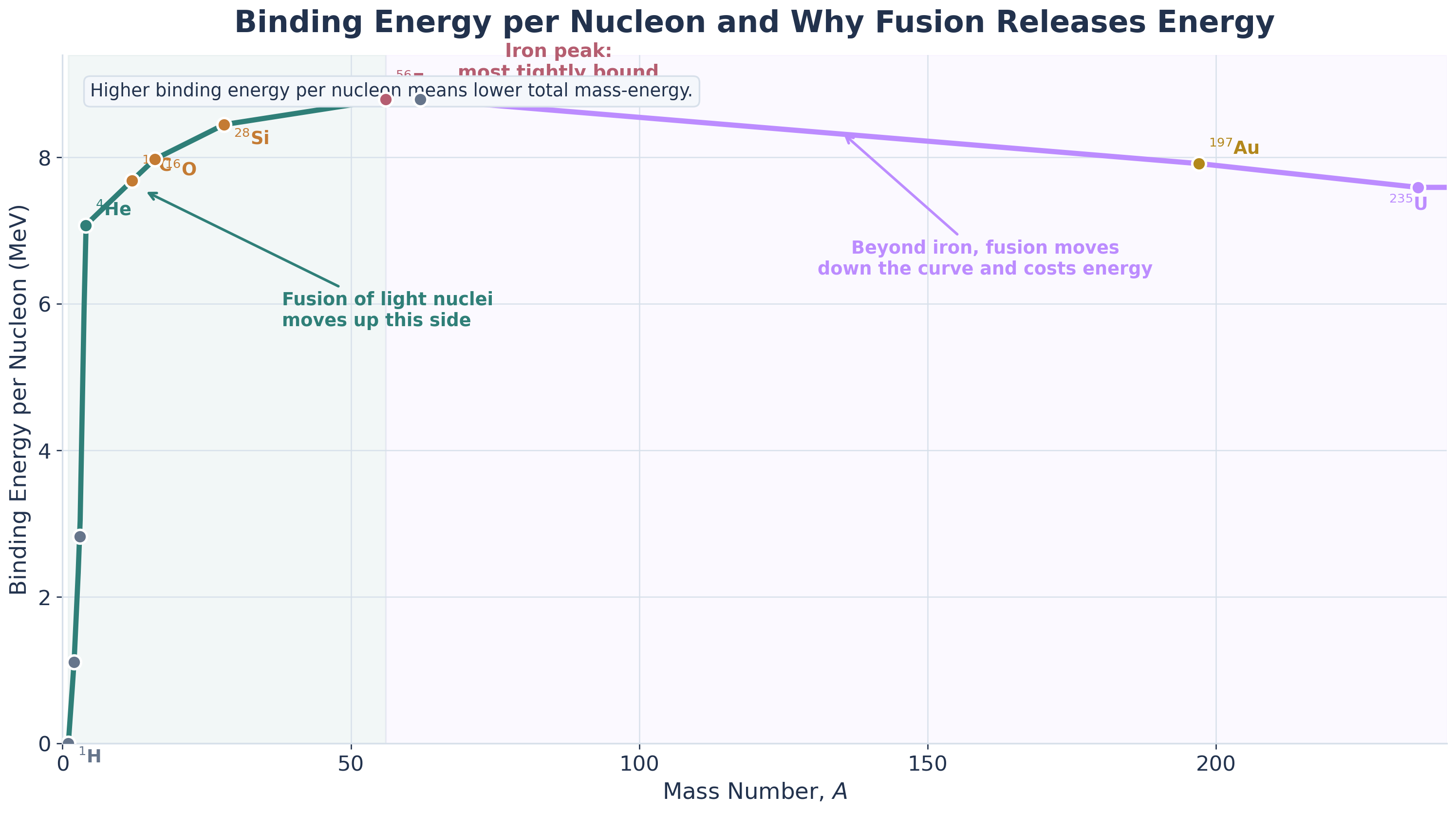
For nuclei lighter than the iron/nickel region, fusion moves matter upward on this curve, releasing energy. Beyond it, further fusion would move nuclei downward in binding energy per nucleon, so energy must be supplied — which is why ordinary exothermic stellar fusion stops near iron.
Quick check
A massive star has burned hydrogen to helium and helium to carbon and oxygen. If it starts fusing carbon, is energy still released? What about iron?
Carbon fusion can still release energy because carbon lies well below the iron/nickel region. Iron is different: nuclei near the iron/nickel peak are already among the most tightly bound, so further fusion is generally endothermic. That is why an iron core cannot support a star by ordinary exothermic fusion.
Enrichment: The CNO Cycle and Temperature Sensitivity
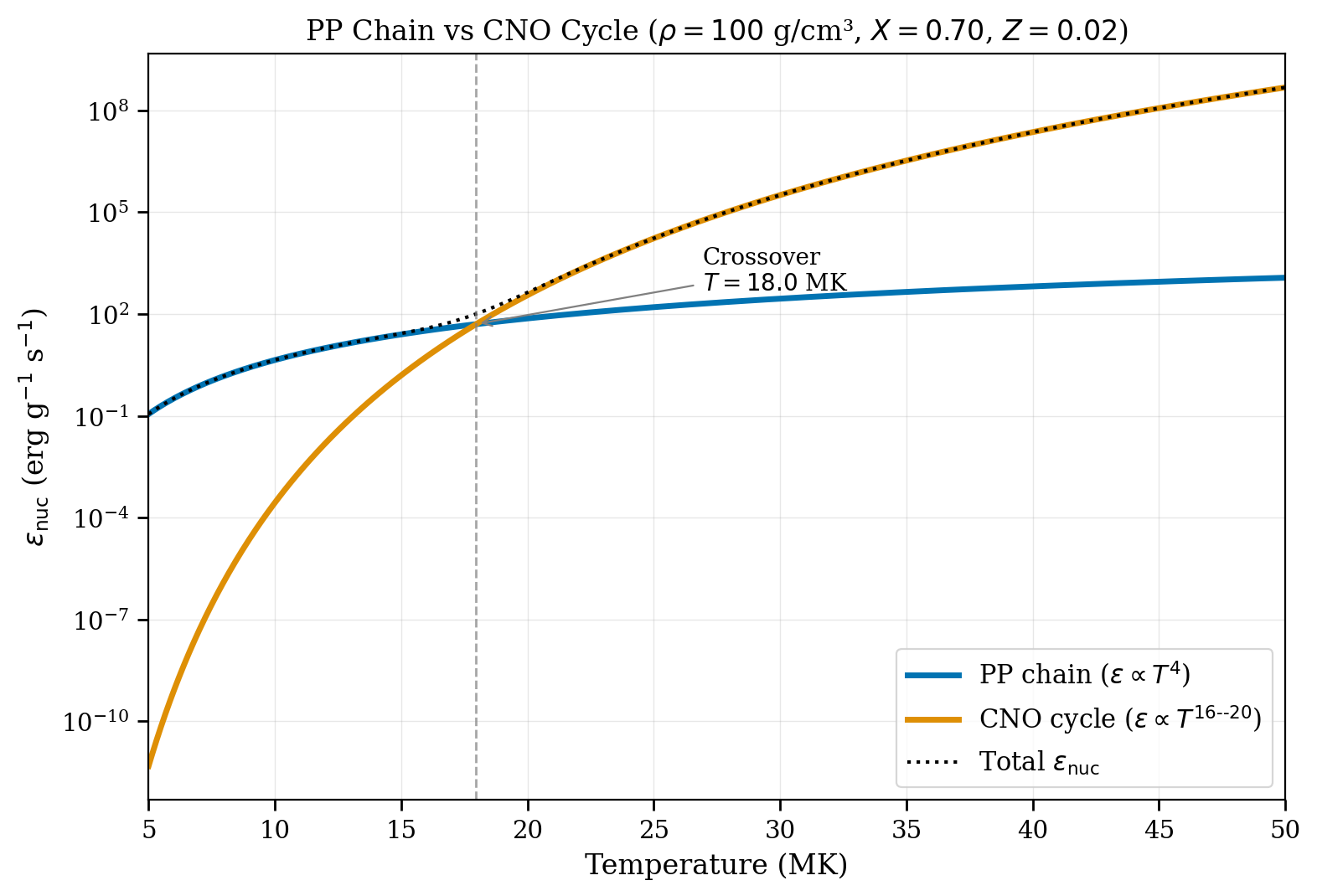
In Sun-like stars the pp-chain dominates hydrogen burning; in hotter, more massive stars the
CNO cycle
A hydrogen-burning pathway in which carbon, nitrogen, and oxygen act as catalysts (returned at the end) while four protons become one helium-4. Its rate is far more temperature-sensitive than the pp-chain ( vs ), so it dominates in hot, massive cores.
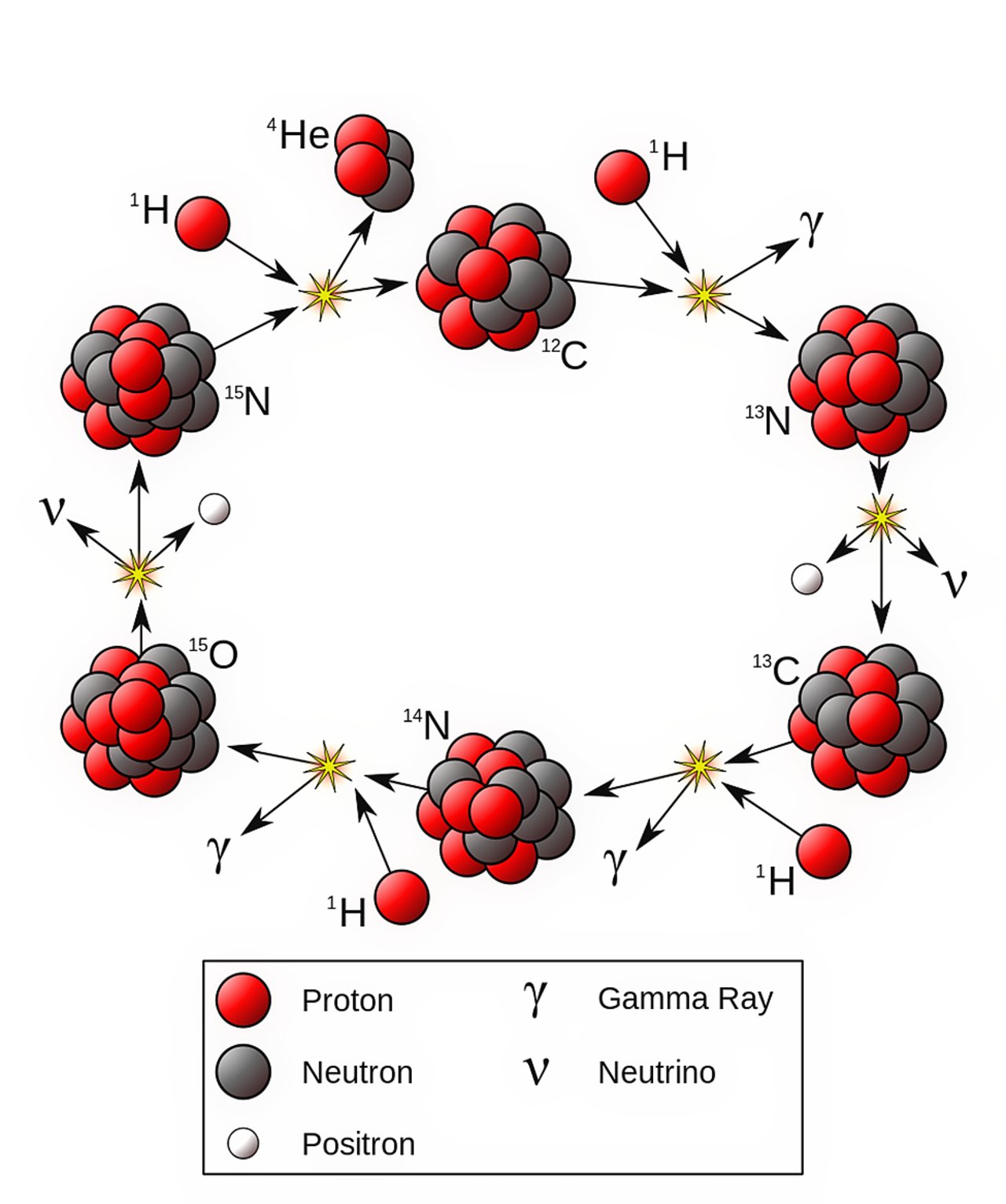
Near solar-core conditions a standard pedagogical approximation is , while for CNO burning a common rule of thumb is . That difference matters: once the core becomes hot enough, the CNO curve rises past the pp curve and the dominant pathway changes.
Problem
If the core temperature rises by 10%, estimate the change in rate for (1) pp burning with and (2) CNO burning with . Which responds more dramatically?
pp: — up about 46%. CNO: — up about a factor of 5–6. CNO burning responds far more dramatically, one reason massive-star cores have a different structure from the Sun’s.
Quick check
The first stars formed from nearly pure hydrogen and helium with essentially no carbon, nitrogen, or oxygen. Could they still fuse hydrogen? If so, which pathway had to start the burning?
Yes — the pp-chain does not require C, N, or O catalysts, so primordial stars had to begin hydrogen burning through the pp-chain. Without initial CNO material the CNO cycle cannot start the burning; once a trace of carbon formed, very massive stars could later switch to CNO because of its steep temperature sensitivity.
Synthesis
- Gravity compresses the core and sets a temperature of order .
- Electromagnetism creates a Coulomb barrier of order .
- A classical thermal gas at solar-core temperatures should fail to cross it.
- Quantum tunneling allows rare close approaches anyway.
- The weak interaction throttles the first pp reaction.
- The strong interaction binds nucleons once they are close enough.
- The mass deficit becomes released energy through .
- Fusion remains exothermic only up to the iron/nickel region.
| Step | Reaction | Dominant physics | Role in the timescale |
|---|---|---|---|
| 1 | tunneling + weak + strong | slow bottleneck | |
| 2 | EM approach + strong | fast once deuterium exists | |
| 3 | EM approach + strong | completes the chain | |
| net | all four forces | set mainly by Step 1 |
Quick check
Four symptoms, one per fundamental force. For each, name the force that is the key actor — and say which step would stall if that force were slightly weaker:
- A more massive star reaches a hotter core and fuses faster.
- Doubling a nucleus’s charge makes it far harder to fuse.
- Two nuclei merge into and release energy.
- The Sun’s hydrogen lasts ten billion years rather than minutes.
- Gravity — it sets the compression and core temperature; weaken it and the core never reaches fusion conditions. 2. Electromagnetism — the Coulomb barrier scales as ; weaken it and every barrier drops. 3. The strong force — it binds the final nucleus and supplies the mass-deficit energy; weaken it and fusion releases less (or nothing). 4. The weak force — it throttles the first conversion; weaken it and the bottleneck step stalls, lengthening or preventing the burn. The move is reading each symptom back to its force, not reciting the list.
Without looking back: the solar core is ~1000x too cool for classical proton-proton fusion. What two pieces of physics make fusion happen anyway, and which one makes it slow?
Quantum tunneling lets protons penetrate the Coulomb barrier despite sub-barrier energies, so fusion is possible. The first reaction also requires a weak-interaction proton-to-neutron conversion (making deuterium), which is rare — so the weak interaction makes fusion slow, setting the Sun’s multi-billion-year main-sequence lifetime.
Summary: All Four Forces, One Star
- Gravity alone can make stars hot, but not hot enough for classical proton-proton fusion.
- The Coulomb barrier is of order ; the solar-core thermal scale is only of order .
- The Boltzmann tail explains why classical high-energy particles are rare — it is not the tunneling law.
- Quantum tunneling makes close approach possible, but the first pp reaction is slow because it requires a weak-interaction proton-to-neutron conversion.
- A complete net pp-chain reaction releases about , most of which stays in the star.
- Fusion releases energy only while moving nuclei upward in binding energy per nucleon, which is why exothermic stellar fusion ends near the iron/nickel region.
Glossary
- Binding energy per nucleon
The total nuclear binding energy divided by the number of nucleons, . It measures how tightly bound each nucleon is on average; it rises from light nuclei to a broad maximum at the iron/nickel peak, which is why exothermic fusion ends there.
- CNO cycle
A hydrogen-burning pathway in which carbon, nitrogen, and oxygen act as catalysts (returned at the end) while four protons become one helium-4. Its rate is far more temperature-sensitive than the pp-chain ( vs ), so it dominates in hot, massive cores.
- Coulomb barrier
The electrostatic potential-energy barrier two like-charged nuclei must overcome (or tunnel through) to reach nuclear distance, . For two protons at it is of order — about a thousand times the solar-core thermal energy.
- de Broglie wavelength
The wavelength associated with a particle of momentum . When it is large compared with the relevant distance scale, wave behavior (interference, tunneling) dominates and the classical point-particle picture fails.
- Deuterium
The hydrogen isotope with one proton and one neutron ( or ). Its formation in the first pp reaction is the rate-limiting, weak-interaction-controlled step of solar hydrogen burning.
- Gamow window
The narrow band of collision energies — above the mean thermal energy but below the barrier — where the product of thermal abundance and tunneling probability peaks. Most fusion reactions occur here, not at the average thermal energy.
- Mass deficit
The difference between the total rest mass of the separate reactants and the bound product, . By it sets the energy released in fusion; for hydrogen-to-helium it is 0.71% of the mass, or about per net reaction.
- Quantum tunneling
The penetration of a wavefunction into and beyond a classically forbidden barrier, giving a small but nonzero probability of finding the particle on the far side even when its energy is below the barrier. It is what makes stellar fusion possible at .
- Strong interaction
The strongest fundamental force, but effective only at nuclear distances (). It binds quarks into protons and neutrons and binds nucleons into nuclei once they are close enough to overcome Coulomb repulsion.
- Uncertainty principle
— a position spread and a momentum spread cannot both be made arbitrarily small. It is a structural consequence of describing particles as waves, not a measurement limitation.
- Weak interaction
The fundamental force that converts one particle type into another — e.g. a proton into a neutron. In the pp-chain it enables the first reaction (); because weak conversions are rare, it sets the slow pace of solar hydrogen burning.