Nuclear Fusion and the Four Forces
Section 5 of 7
The Proton-Proton Chain
Part 4: The Proton-Proton Chain
Now that close approach is possible, what actually happens? In the Sun, the dominant hydrogen-burning pathway is the proton-proton chain.
The positrons quickly annihilate with electrons in the plasma, and the neutrinos escape; the rest of the released energy thermalizes in the stellar interior.
Step by step
Step 1 — make deuterium: . The slow bottleneck — electromagnetism creates the barrier, tunneling makes close approach possible, the weak interaction converts one proton into a neutron, and the strong interaction binds the proton-neutron pair into
Step 2 — capture a proton: . Fast once deuterium exists; no weak conversion required.
Step 3 — build helium-4: . The nuclei tunnel through Coulomb repulsion, and the strong interaction binds the final helium-4 nucleus.
Deuterium
The hydrogen isotope with one proton and one neutron ( or ). Its formation in the first pp reaction is the rate-limiting, weak-interaction-controlled step of solar hydrogen burning.
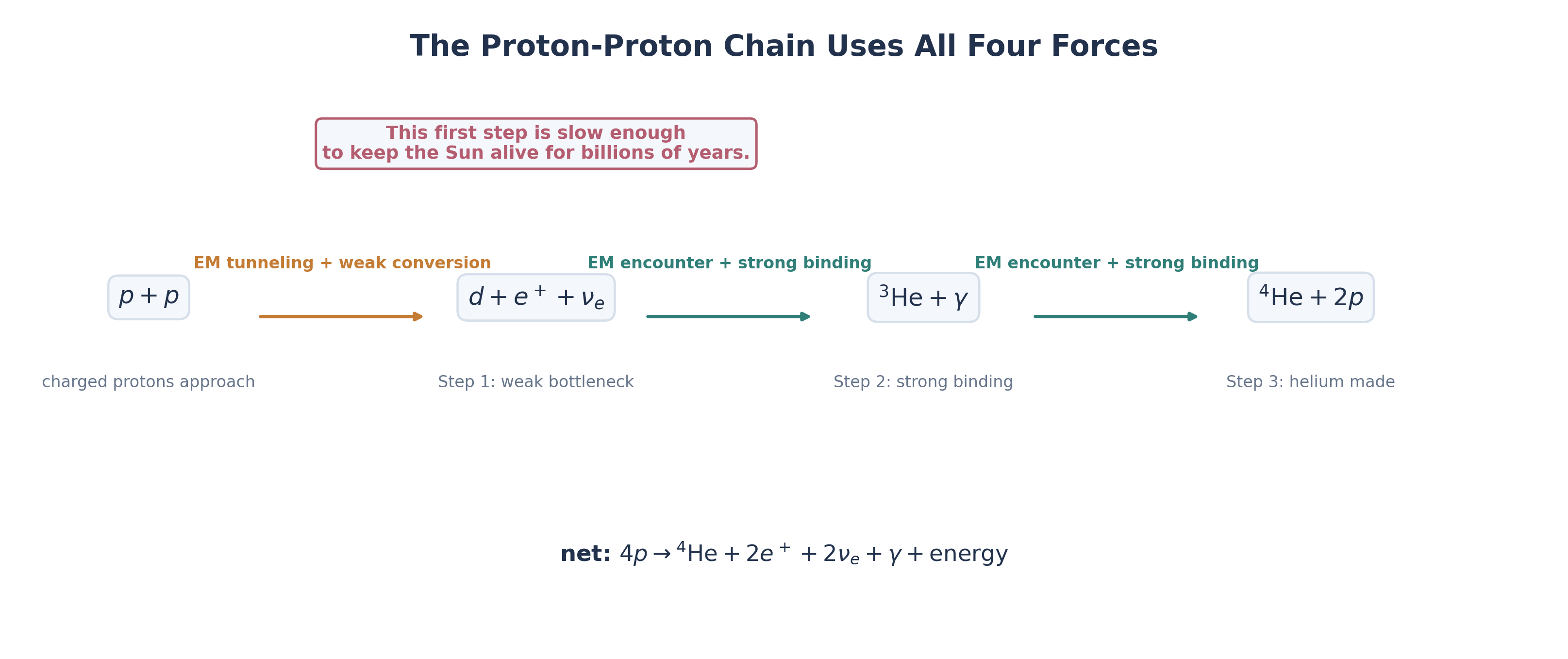
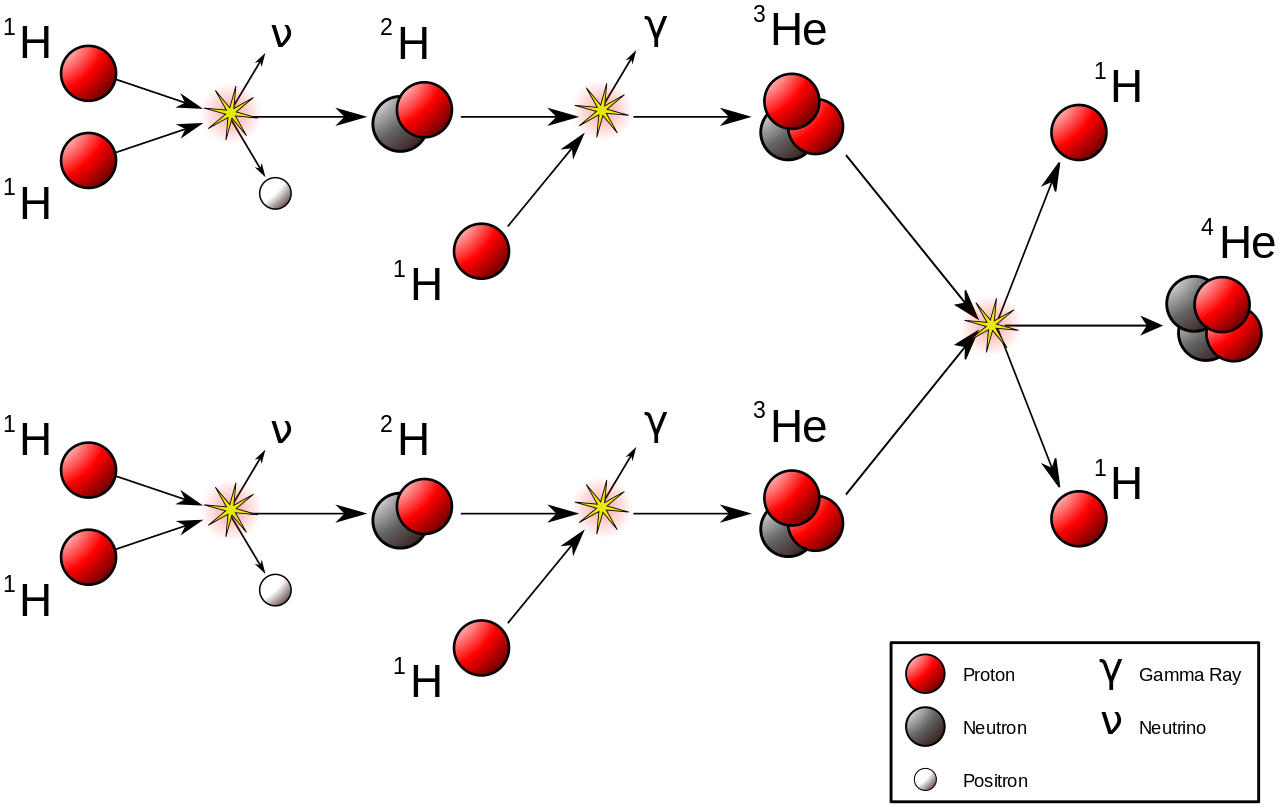
The force-labeled schematic above answers “which physics matters where?” The reaction-network view below answers “where do the particles go?” — making the duplicated deuterium-forming branches, the emitted neutrinos and gamma rays, and the returned protons easier to track.
Composition bookkeeping: X, Y, and Z
| Symbol | Meaning | Typical solar value |
|---|---|---|
| hydrogen mass fraction | ||
| helium mass fraction | ||
| everything heavier than helium |
Because these are mass fractions, . On the main sequence the dominant core change is as hydrogen becomes helium; matters indirectly through opacity, structure, and which burning pathway dominates.
Multiple choice
Which is rarer in the step that sets the Sun’s lifetime: a tunneling-enabled close approach, or a successful weak conversion that actually makes deuterium?
Tunneling-enabled close approaches are already rare, but a successful weak conversion is rarer still. That is why the first pp reaction is the bottleneck and why the weak interaction largely determines the main-sequence lifetime.
Solar neutrinos are detected on Earth
Detectors register neutrinos arriving from the Sun at the predicted flux and characteristic energies.
The pp-chain predicts those neutrinos
The first pp reaction, , emits a neutrino; the chain predicts both their existence and energies.
The Sun is powered by core fusion
The Sun’s energy source is nuclear fusion in its core — one of astronomy’s cleanest cases of inferring an invisible interior from particles that reach us directly.