Nuclear Fusion and the Four Forces
Section 4 of 7
What Quantum Mechanics Changes
Part 3: What Quantum Mechanics Changes
The Sun does not solve the fusion problem by getting classically hot enough. It solves it by leaving classical physics behind — repairing the audit’s fatal row by recognizing that the proton is a wave, not a ball.
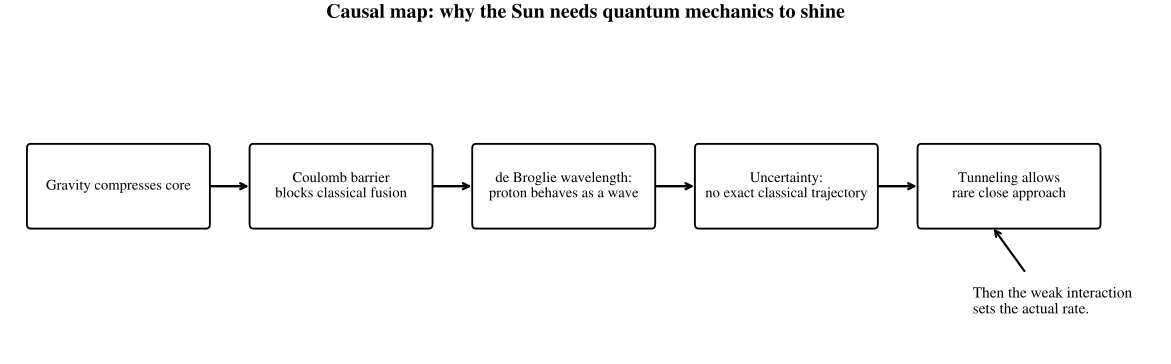
Particles are also waves
A proton in the solar core cannot be treated as a tiny hard sphere on one exact path. The
de Broglie wavelength
The wavelength associated with a particle of momentum . When it is large compared with the relevant distance scale, wave behavior (interference, tunneling) dominates and the classical point-particle picture fails.
Problem
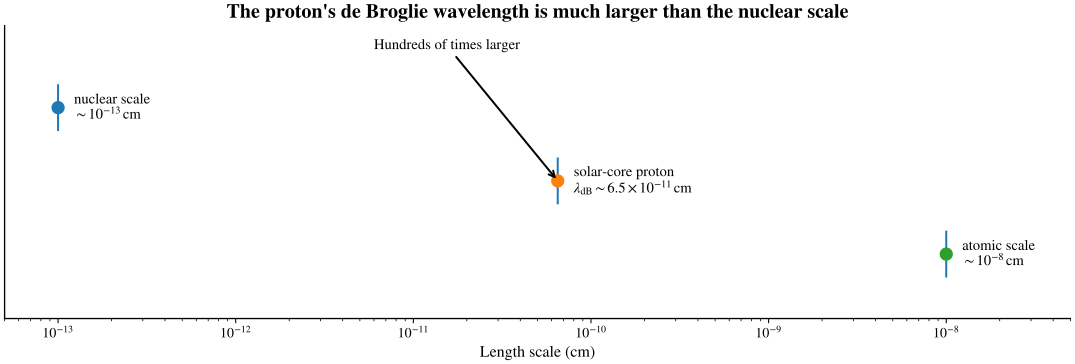
Take a characteristic proton energy equal to the mean thermal energy, , and find its de Broglie wavelength. Compare with the nuclear scale . Use , .
StepConvert energy to CGS
.
StepSpeed from kinetic energy
.
StepWavelength from momentum
.
Dimensional check
✓ — a length.
Result
. The proton’s wavelength is hundreds of times larger than the nuclear scale — classical barrier crossing is no longer the right language for the problem.
The uncertainty principle and why localization fails
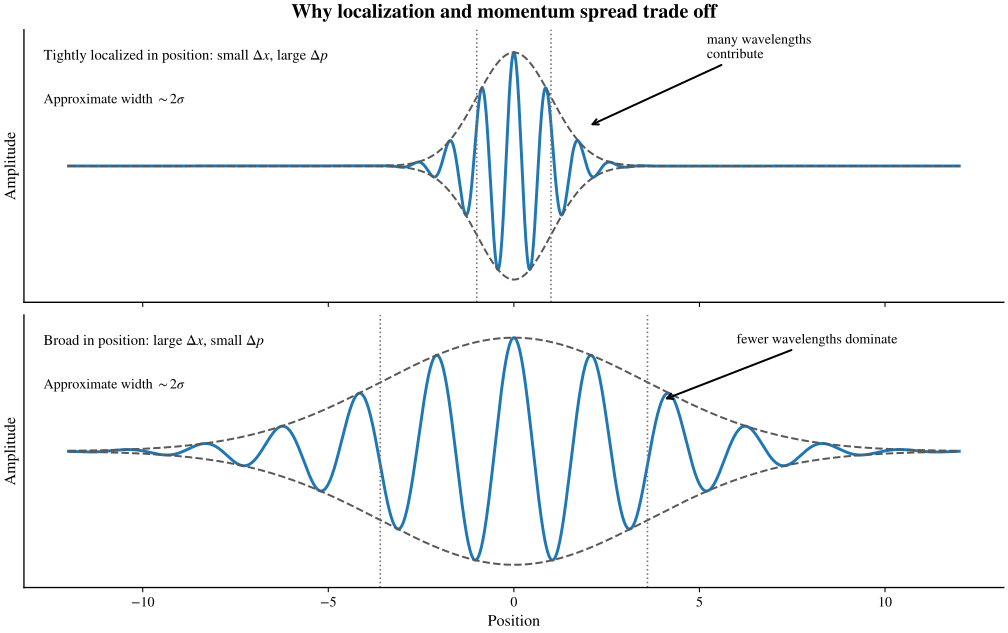
Because a wave cannot be both perfectly localized and have a single wavelength, position and momentum cannot both be sharply defined: the
Uncertainty principle
— a position spread and a momentum spread cannot both be made arbitrarily small. It is a structural consequence of describing particles as waves, not a measurement limitation.
Quick check
Suppose you try to confine a proton to . What happens to ? What does that imply about the range of velocities, and why does it make a single classical trajectory impossible?
From , shrinking forces to grow. The proton then cannot have one well-defined momentum — it contains a wide range of velocities, so its motion cannot be described by a single path. The classical trajectory picture breaks down completely.
Tunneling
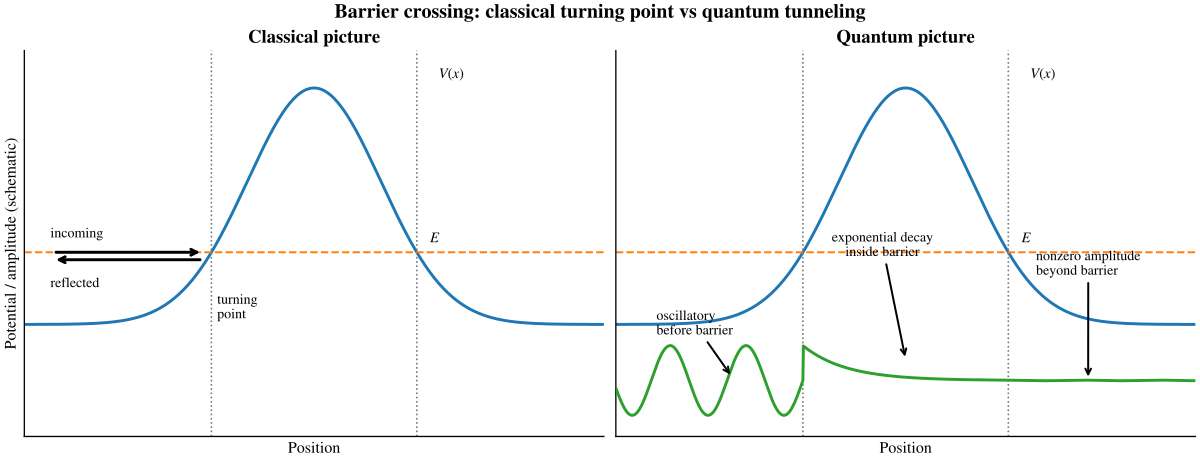
In classical mechanics, a particle with energy below the barrier reflects — but that assumes a perfectly localized particle on a single trajectory. Quantum mechanics has already removed that assumption. The proton’s wavefunction is spread over a finite region; it extends into the classically forbidden region, decays exponentially there, and can remain nonzero beyond the barrier. That is
Quantum tunneling
The penetration of a wavefunction into and beyond a classically forbidden barrier, giving a small but nonzero probability of finding the particle on the far side even when its energy is below the barrier. It is what makes stellar fusion possible at .
The Gamow window
Think first
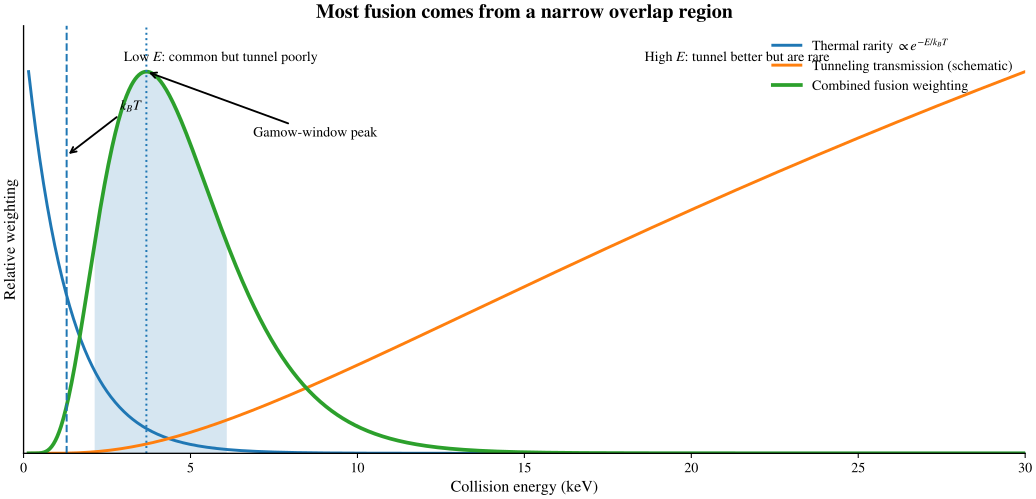
Low-energy particles are common but tunnel poorly; high-energy particles tunnel well but are rare. Where should most fusion events come from: (1) near the average thermal energy, (2) only the highest-energy tail, or (3) a narrow middle overlap?
Then read on.
Fusion does not happen at the average thermal energy. It happens in a narrow range where two competing effects overlap — higher-energy particles are rarer (Maxwell-Boltzmann) but tunnel more easily. Schematically the rate contribution at energy behaves like
where is the Gamow energy (it packages how hard a given pair of nuclei is to tunnel through, growing with the Coulomb barrier). The product peaks at an intermediate energy: the
Gamow window
The narrow band of collision energies — above the mean thermal energy but below the barrier — where the product of thermal abundance and tunneling probability peaks. Most fusion reactions occur here, not at the average thermal energy.
Multiple choice
True or false: most fusion reactions occur at the average thermal energy . Explain before calculating.
False. Low-energy collisions are common but tunnel poorly; high-energy collisions tunnel better but are rare. Fusion happens mostly in the narrow Gamow window where the two effects overlap, so the relevant energy is not the mean thermal energy alone.
Why the Sun still burns slowly
Tunneling makes fusion possible, but not easy. The first step of the pp-chain is — which requires more than a close encounter: one proton must convert into a neutron, controlled by the