UNDER REVIEW
Optional sections
Reading width
Color theme

Nuclear Fusion and the Four Forces

Section 6 of 7

Where Fusion Energy Comes From

Part 5: Where the Fusion Energy Comes From

Fusion does not release energy because nuclei “want” to glow. It releases energy because the products have less rest mass than the reactants.

The mass deficit

Using atomic masses keeps the electron bookkeeping clean:

QuantityMass

So the mass deficit is , a fractional loss of . That missing mass becomes released energy.

Mass deficit

The difference between the total rest mass of the separate reactants and the bound product, . By it sets the energy released in fusion; for hydrogen-to-helium it is 0.71% of the mass, or about per net reaction.

Converting the deficit to grams, , then
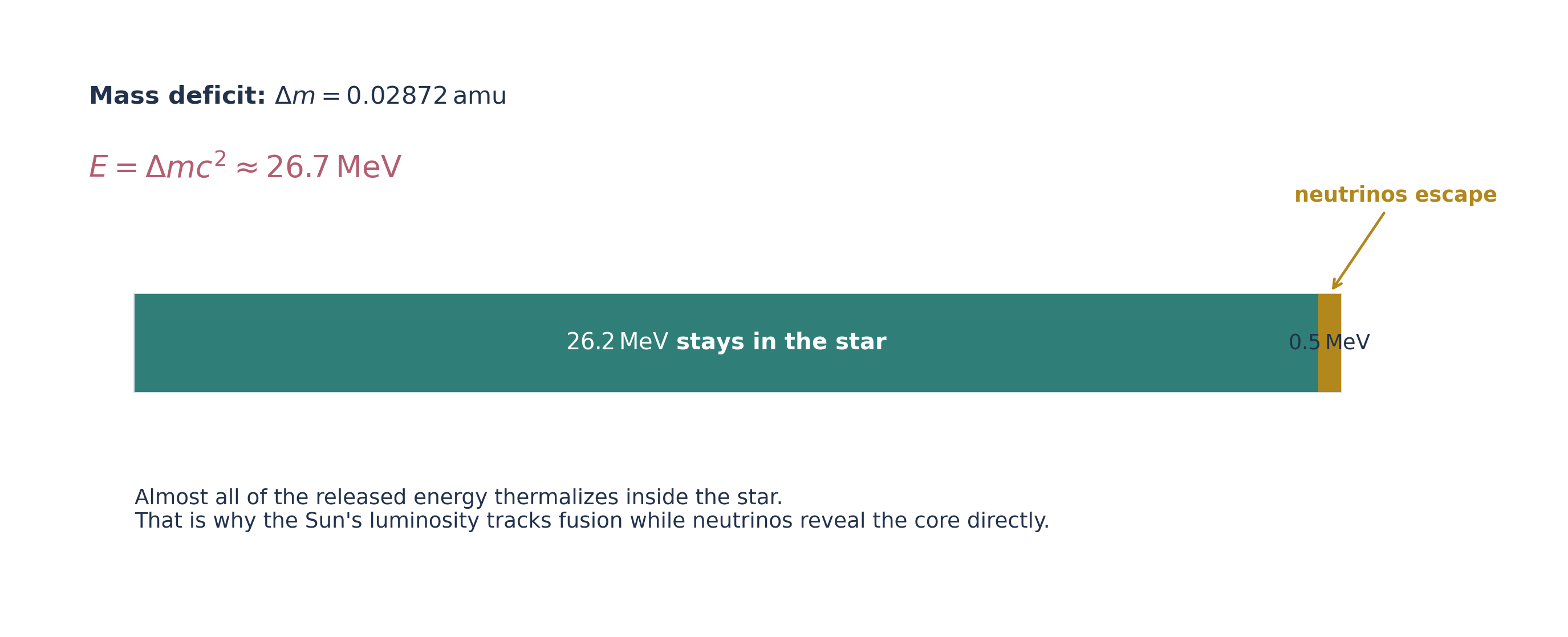
Generated energy-budget figure for one net proton-proton-chain reaction, showing the mass deficit in amu, the total energy release in MeV, and a horizontal bar splitting the energy into a large retained component and a small neutrino-loss component.
Figure 16The pp-chain releases about 26.7 MeV per net reaction, but only about 0.5 MeV escapes in neutrinos. Almost all of the energy stays in the star and powers the luminosity.ASTR 201 (generated)

Not all of that energy heats the Sun: the neutrinos escape almost immediately, carrying away per net reaction, so about is retained. That retained energy thermalizes in the dense plasma and diffuses outward before emerging as luminosity.
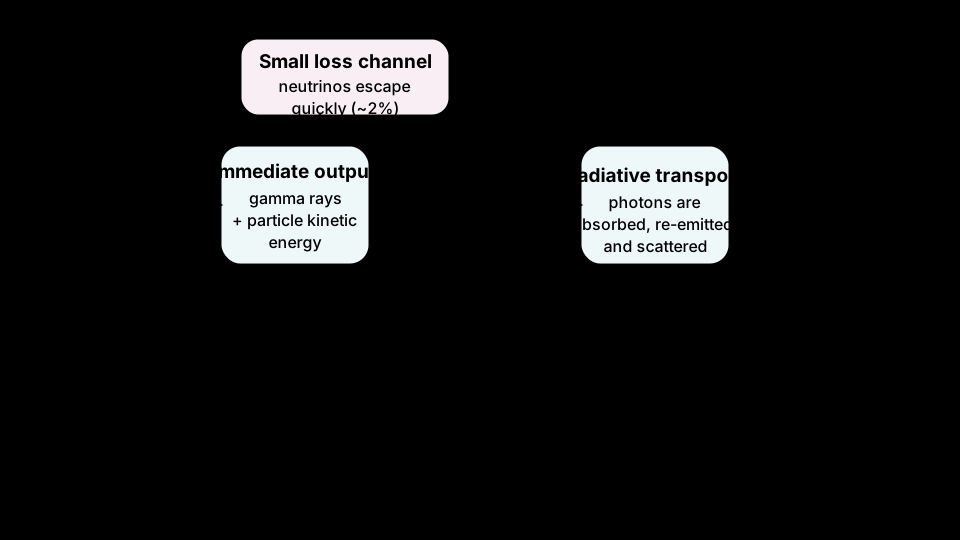
Horizontal flow diagram showing core mass deficit producing gamma rays and particle kinetic energy, a small branch for escaping neutrinos, then thermalization in dense plasma, photon diffusion through the star, and final surface luminosity.
Figure 17Fusion energy is born in the core, mostly stays in the star, and only later escapes as luminosity. Neutrinos leave quickly; photon energy must thermalize and diffuse outward through the interior.ASTR 201 (generated)