Light as Information
Section 2 of 9
The Electromagnetic Spectrum
Part 2: The Electromagnetic Spectrum
Unit convention: we use CGS units throughout (cm, s, erg, K). For convenience, optical/UV wavelengths are often written in nm, where .
Light as a Wave
Light is an electromagnetic wave — oscillating electric and magnetic fields that propagate through space at a constant speed.
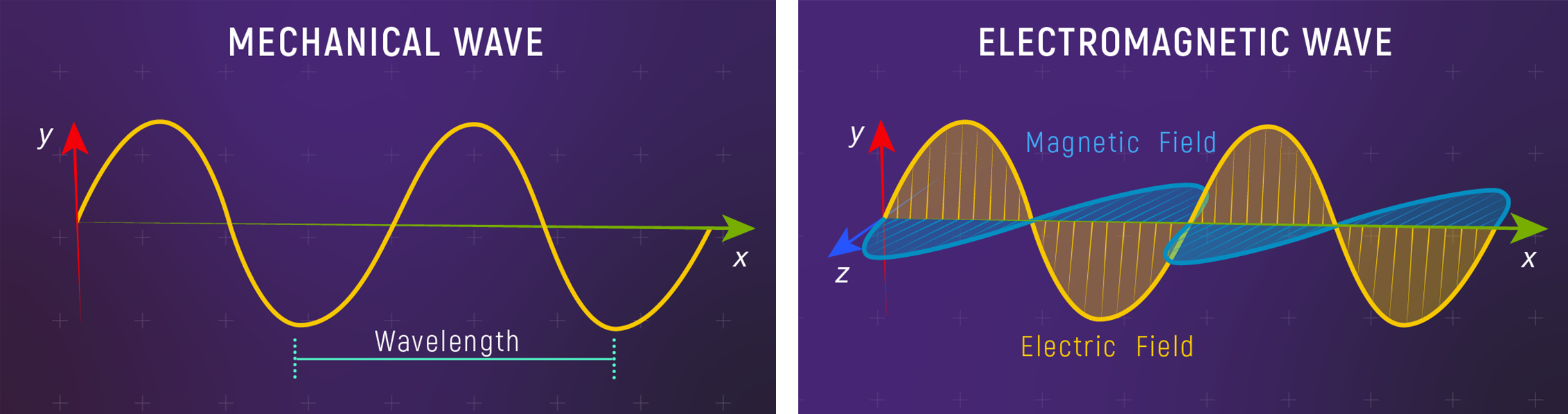
Unlike mechanical waves (water ripples, sound, a vibrating string), electromagnetic waves don’t need a medium. A water wave is the water moving up and down; a sound wave is air molecules compressing and expanding. But light travels perfectly well through the vacuum of space — what’s oscillating are the electric and magnetic fields themselves.
Both wave types share the same vocabulary:
- Wavelength (): the distance between successive crests. For light, wavelengths range from kilometers (radio) down to sub-atomic scales (gamma rays).
- Frequency (): the number of oscillations per second, in s (Hertz, Hz).
- Speed (): in vacuum, all electromagnetic waves travel at .
Nanometer
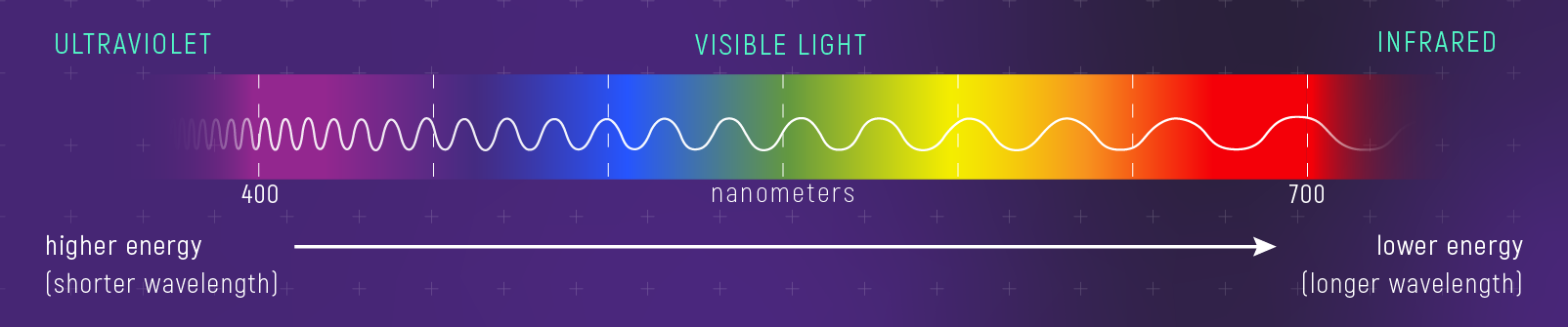
A unit of length, — roughly ten hydrogen-atom diameters, and the natural unit for optical and UV light. Visible light spans about 400-700 nm.
Optical and UV wavelengths are often written in
All EM waves travel at the same speed in vacuum; they differ only in how they trade off wavelength against frequency. Since is constant, the two are inversely related, : long wavelength means low frequency, short wavelength means high frequency.
Problem
Using : (1) if wavelength doubles, frequency does what? (2) If frequency triples, wavelength does what? (3) Radio waves have cm; visible light cm. How do their frequencies compare?
- Halves — frequency is inversely proportional to wavelength.
- Drops to one-third — same inverse relationship.
- Visible light has higher frequency, because its wavelength is shorter.
The Spectrum: From Radio to Gamma
The electromagnetic spectrum spans an enormous range of wavelengths, divided into named bands:
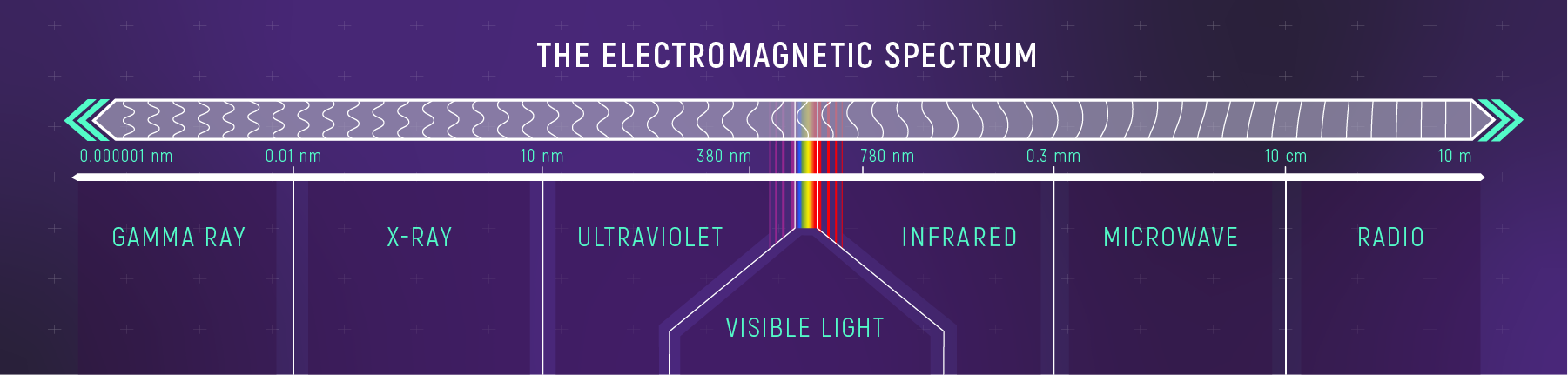
| Band | Wavelength Range | What It Reveals |
|---|---|---|
| Radio | cm | Cold gas, magnetic fields, pulsars |
| Microwave | – cm | CMB, molecular clouds |
| Infrared | nm– cm | Warm dust, cool stars, exoplanets |
| Visible | – nm | Stellar surfaces, nebulae |
| Ultraviolet | – nm | Hot stars, active galactic nuclei |
| X-ray | – nm | Million-degree plasma, accretion disks |
| Gamma | shorter than nm | Extreme events: supernovae, GRBs |
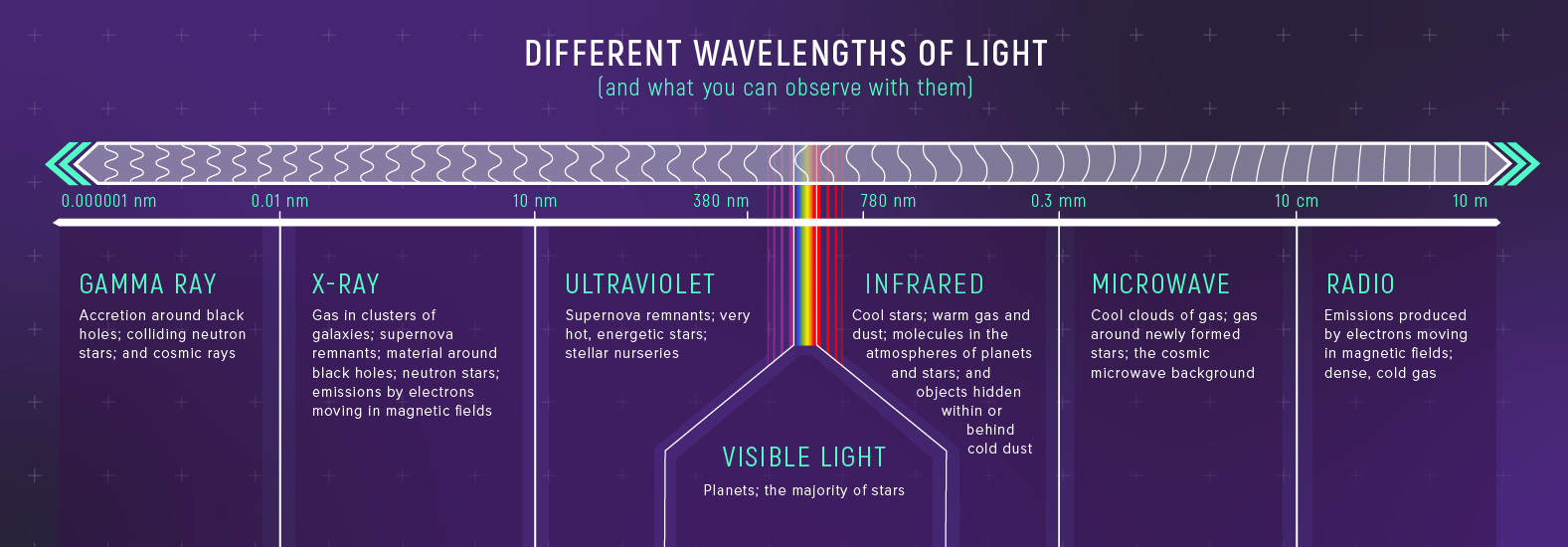
Key insight: different wavelengths reveal different physics. A galaxy looks completely different in radio versus X-rays because you’re seeing different physical components — cold gas versus hot plasma. This is why astronomers build telescopes for every part of the spectrum.
Light as Particles: Photon Energy
Light also behaves as particles called photons. Each photon carries a discrete amount of energy:
Here erg·s is Planck’s constant. The energy depends on either frequency or wavelength (they’re linked by ). The story: — shorter wavelength means higher energy, which is why gamma rays can damage DNA while radio waves pass harmlessly through your body.
Problem
Using : (1) if wavelength doubles, photon energy does what? (2) If wavelength is halved? (3) A 200 nm photon versus an 800 nm photon — how do their energies compare?
- Halves — energy is inversely proportional to wavelength.
- Doubles — halving doubles .
- The 200 nm photon has more energy (). This is why UV causes sunburns but red light doesn’t.
Pause & Predict
Same atmosphere, same sunlight - what's different? Commit to a guess before Part 3.
Part 3 answers this with Rayleigh scattering.