Light as Information
Section 8 of 9
Telescopes as Light Buckets
Part 8: Telescopes as Light Buckets
Telescopes extend our reach two ways: they collect more photons and resolve finer detail.
Collecting Area: Why Bigger Is Better
For a circular aperture, the
Collecting area
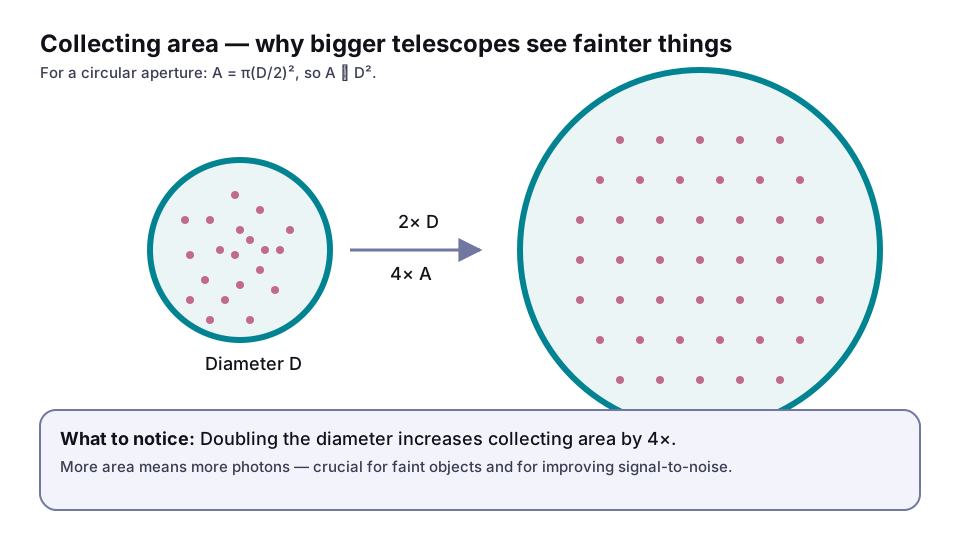
The light-gathering area of a telescope’s aperture, . The photon rate from a source scales with , so aperture — not magnification — sets how faint an object a telescope can detect.
The photon rate scales with area, so the faintest detectable source scales as : a mirror twice as wide gathers four times the light.
Problem
Using : (1) if diameter doubles, area does what? (2) Triples? (3) JWST ( m) versus Hubble ( m)?
- Quadruples ().
- — same scaling.
- JWST has Hubble’s collecting area — much fainter objects in the same exposure.
Angular Resolution: Why Bigger Is Sharper
Even with lots of light, you can’t see detail finer than your
Angular resolution
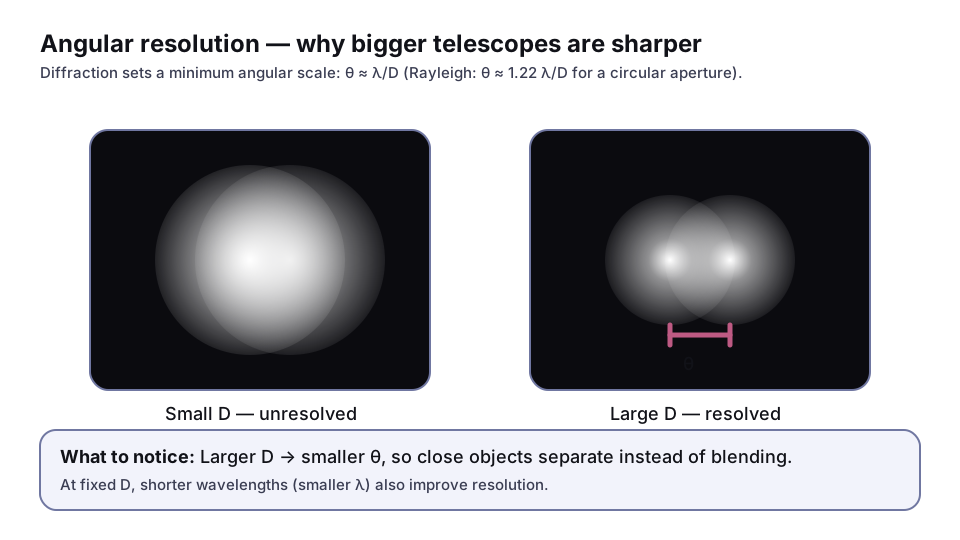
The smallest angular separation a telescope can distinguish, set by diffraction: (the circular-aperture form is ). Larger apertures and shorter wavelengths give finer resolution.
For a circular aperture the precise form is ; for scaling arguments we use . Bigger and shorter both sharpen the image.
Problem
Using : (1) if diameter doubles (fixed ), resolution does what? (2) If wavelength doubles (fixed )? (3) Observing at m instead of m with the same telescope?
- Improves by (the angle halves) — bigger mirrors resolve finer detail.
- Worsens by — longer wavelengths give blurrier images.
- Worsens by — you resolve less detail in the infrared, which is why IR astronomy often needs larger mirrors.
Ground-based optical telescopes often miss the diffraction limit because atmospheric turbulence blurs images —
Seeing
The blurring of astronomical images by turbulence in Earth’s atmosphere, which makes ground-based resolution (typically arcsec) far worse than the diffraction limit. Adaptive optics or space telescopes overcome it.