Light as Information
Section 4 of 9
Blackbody Radiation
Part 4: Blackbody Radiation
What Is a Blackbody?
A
Blackbody
An idealized perfect absorber and emitter: it absorbs all incident radiation and, when heated, emits a spectrum (the Planck curve) that depends only on its temperature . Stars are approximate blackbodies.
Stars are approximate blackbodies — their spectra deviate due to absorption lines, but the overall shape follows the blackbody curve. Other astronomical blackbodies: planets (Earth emits as a K blackbody in the infrared), the Cosmic Microwave Background (the most perfect blackbody ever measured, at 2.725 K), and accretion disks around black holes.
The Planck Spectrum: Qualitative Picture
When you heat an object it glows, and the color depends on temperature: a stovetop burner dull red (700 K), an incandescent filament yellow-white (2700 K), the Sun yellow (5800 K), a welding arc blue-white (6000+ K).
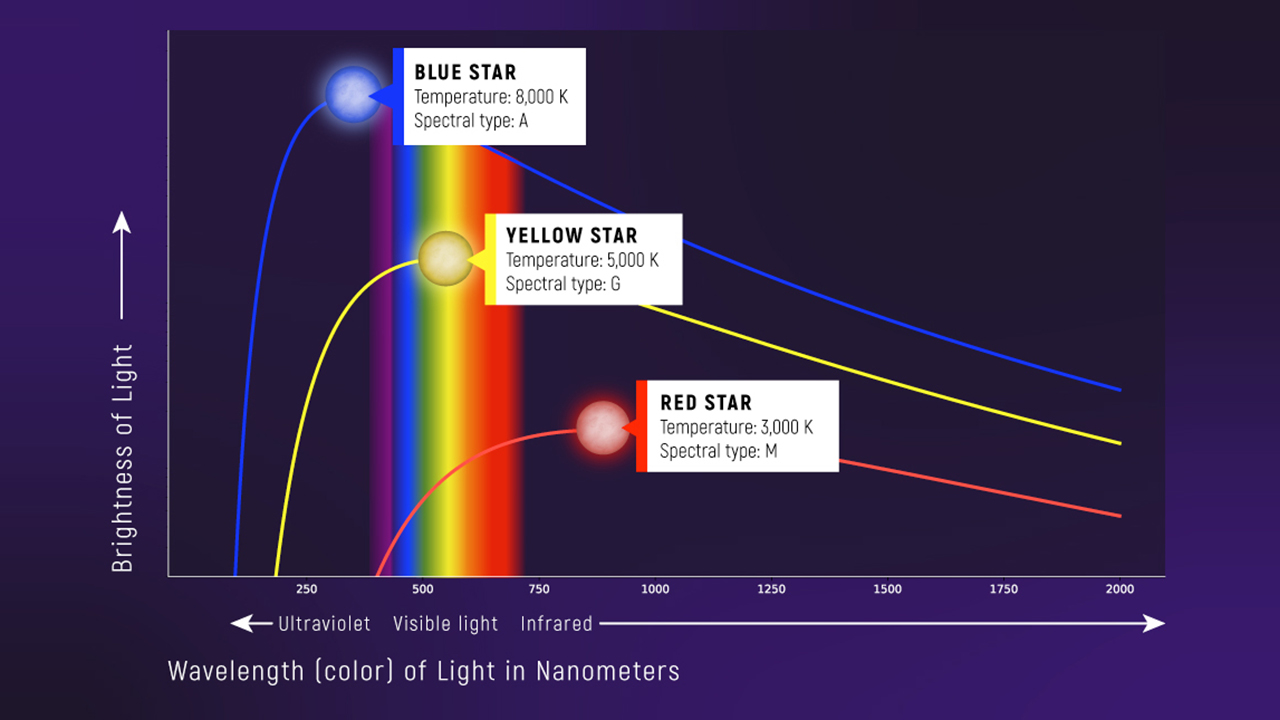
The blackbody spectra (Planck curves) show two patterns: (1) the peak shifts to shorter wavelengths as temperature increases — hot objects peak in the blue/UV, cool objects in the red/IR; (2) the total energy emitted increases dramatically with temperature — the area under the curve grows as (the Stefan-Boltzmann law, quantified in Module 2).
Pause & Predict #1
Think about the shape of the Planck curve, not just the peak location.
Check your reasoning against the answers below.
Multiple choice
An 8000 K star peaks in the ultraviolet, yet it still looks blue to your eyes (not invisible). Why?
Blue star: the Planck curve is broad, not a spike. Even with its peak in the UV, the star emits plenty of visible light — and more blue than red (blue is closer to the UV peak). Our eyes integrate this imbalance and perceive blue.
Red star: the same in reverse. It emits across a broad range including visible light, but more red than blue. The key insight: blackbodies emit at all wavelengths; the peak only tells you where emission is strongest. Color perception depends on the ratio of blue to red light.
The Ultraviolet Catastrophe
Before 1900, classical physics gave the Rayleigh-Jeans law, . It works at long wavelengths, but as the intensity diverges — classical physics predicted any warm object should emit infinite energy in the ultraviolet. This ultraviolet catastrophe was a fundamental failure: ovens don’t emit infinite UV.
Planck’s Quantum Solution
In 1900 Max Planck found the fix — “an act of desperation.” He proposed that energy is emitted in discrete packets (quanta) with energy . To emit a short-wavelength (high-frequency) photon, an oscillator needs energy ; if the available thermal energy () is less than , emission is suppressed — you can’t emit a fraction of a photon. This quantum suppression cuts off the catastrophe. It took Einstein (1905) to take quanta seriously, showing light itself comes in photons.
The Planck Function: Meeting a Real Equation
The complete blackbody spectrum is the Planck function. It looks intimidating — don’t panic; we read it piece by piece.
is the spectral radiance — power emitted per unit area, per unit solid angle, per unit wavelength. The factor would drive short wavelengths up, but the exponential term in the denominator suppresses them; the competition between the two creates the peak. You don’t need to compute it from scratch — you need to recognize its shape and know which term controls which regime.
Spectral radiance
The power a surface emits per unit area, per unit solid angle (“per direction”), per unit wavelength interval — what the Planck function gives. CGS units: .
The
Limiting Cases: Taming Complex Equations
The way to not be intimidated by a scary equation is to take its limiting cases — what happens when one term dominates.
Case 1 — long wavelengths (Rayleigh-Jeans). When , expand , so
Classical physics works here because quantum effects are negligible when .
Case 2 — short wavelengths (Wien tail). When , the is negligible and
The exponential cuts off short-wavelength emission — the quantum suppression that prevents the catastrophe. You can’t emit photons whose energy exceeds the available thermal energy.
| Regime | Condition | Behavior | Physical reason |
|---|---|---|---|
| Long | Classical limit; photons are “cheap” | ||
| Short | exponentially | Quantum suppression; photons are “expensive” |
Problem
Using : (1) if doubles (fixed ), intensity does what? (2) If doubles (fixed )? (3) Two blackbodies at the same , one at cm and one at cm — how do their Rayleigh-Jeans intensities compare?
- Doubles — intensity is linear in .
- Drops by — the dependence is steep.
- The shorter wavelength is brighter — exactly the runaway that gave the “ultraviolet catastrophe.”