Light as Information
Section 5 of 9
Wien's Displacement Law
Part 5: Wien’s Displacement Law
The Peak Wavelength
The Planck function peaks at a wavelength that depends only on temperature:
Here is Wien’s displacement constant, and “peak wavelength” means the maximum of (per unit wavelength). The story: — hotter objects peak bluer, cooler objects redder. This is why color encodes temperature.
Problem
Using : (1) if doubles, does what? (2) If halves? (3) Star A at 6000 K versus Star B at 3000 K — how do their peaks compare?
- Halves — peak wavelength is inversely proportional to temperature.
- Doubles — cooler means a longer peak wavelength.
- Star B peaks at the wavelength of Star A. If A peaks at 500 nm (green), B peaks at 1000 nm (infrared) — why hot stars are blue and cool stars red.
Problem
The Sun’s spectrum peaks at approximately 500 nm (green-yellow). What is its surface temperature?
StepInvert Wien's law
Dimensional check
✓ (using nm·K / nm consistently).
Result
About 5800 K — determined from the color of sunlight alone, no thermometer and no spacecraft. This is astronomical inference in action.
Problem
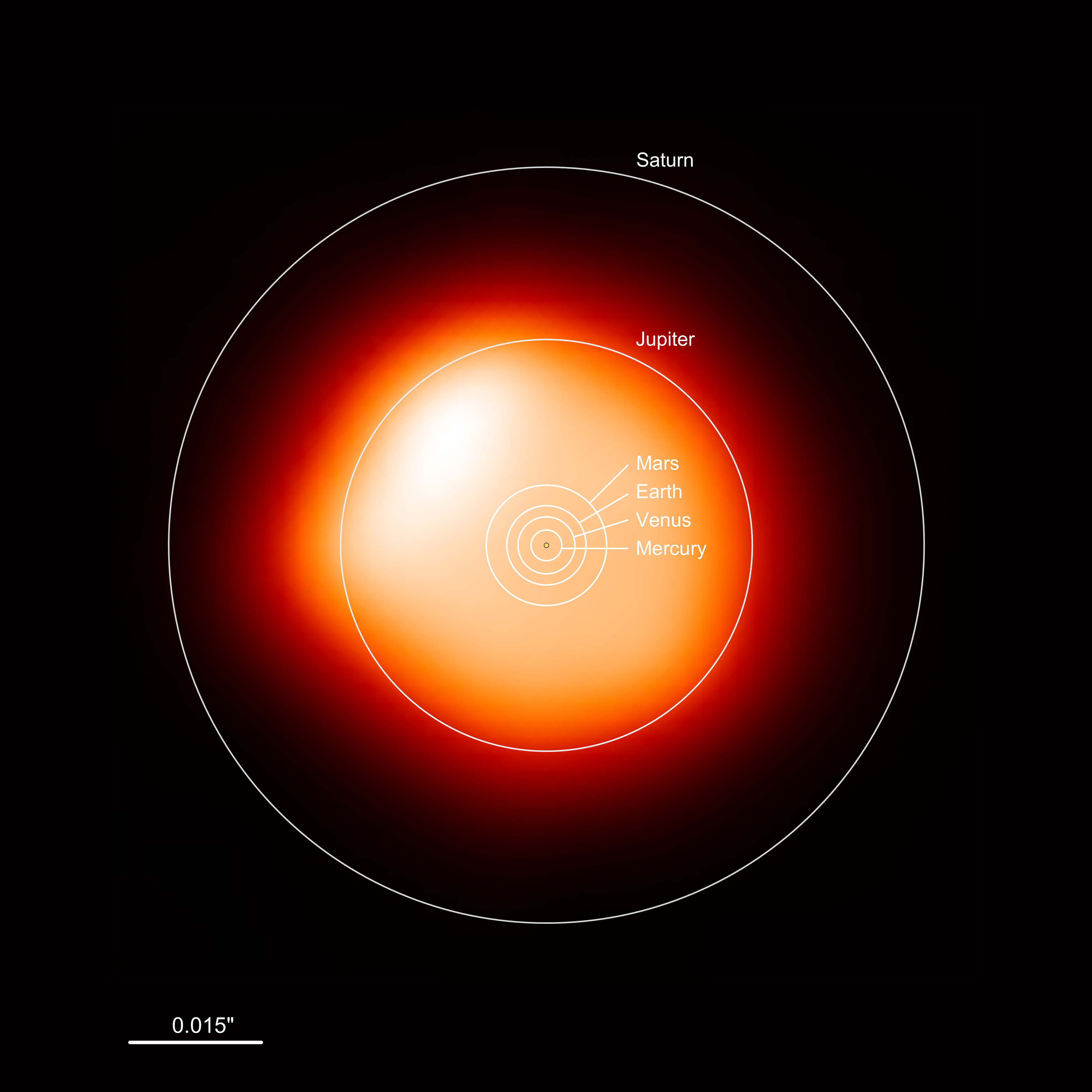
Betelgeuse (a red supergiant) peaks near 830 nm; Rigel (a blue supergiant) peaks near 240 nm. Find their surface temperatures.
StepApply Wien's law to each
Dimensional check
nm·K divided by nm leaves K ✓ — a temperature, as required.
Result
Rigel is about hotter than Betelgeuse. In Orion you’re literally seeing temperature as color: the red shoulder (Betelgeuse) is cool, the blue foot (Rigel) is hot.
Problem
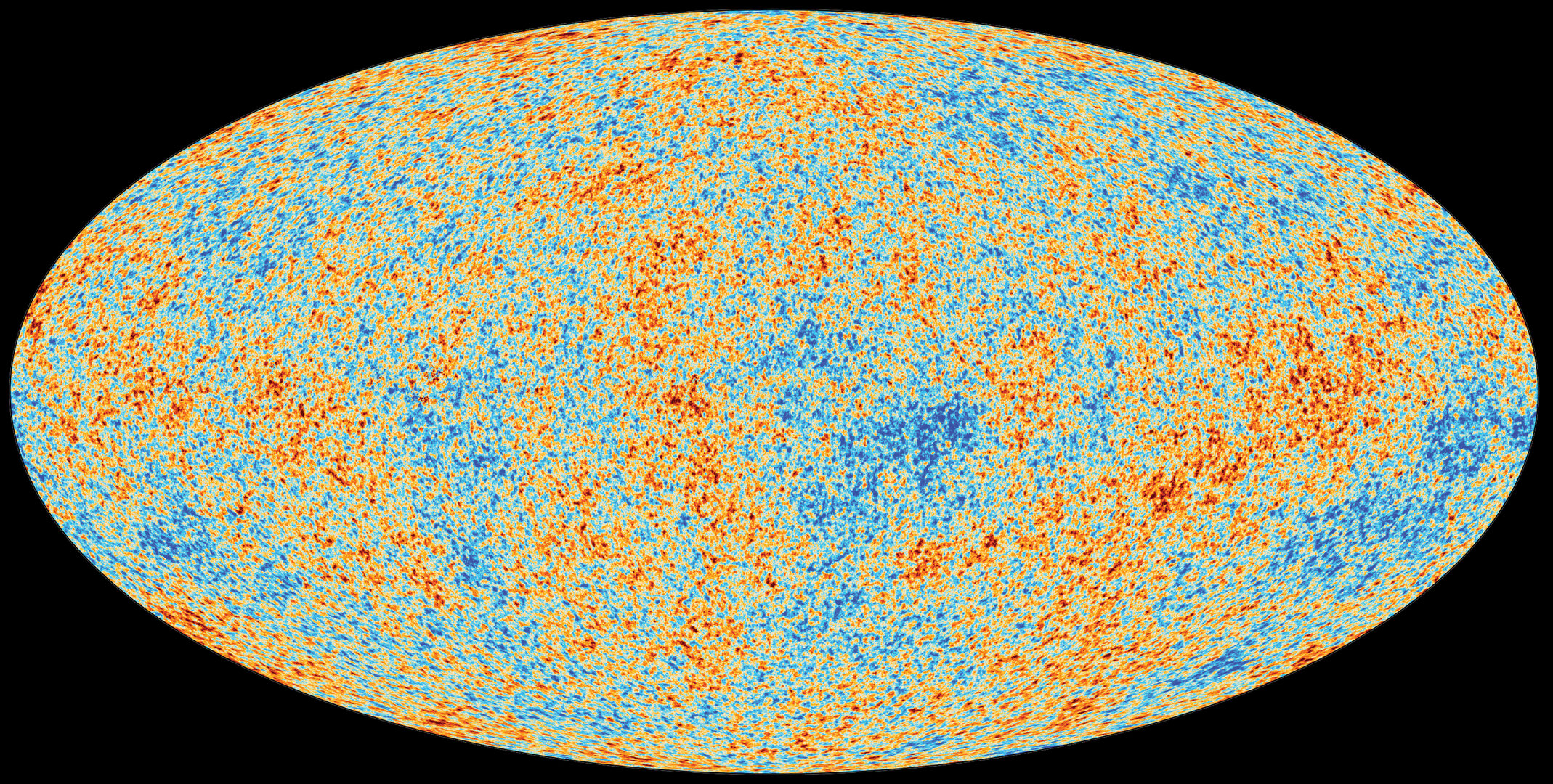
The CMB — the afterglow of the Big Bang — peaks at about cm. What is its temperature?
StepInvert Wien's law (CGS)
Dimensional check
cm·K divided by cm leaves K ✓.
Result
About 2.7 K — the temperature of the universe itself, cooling for 13.8 billion years as space expands. The CMB is the most perfect blackbody ever measured (COBE confirmed deviations ppm); Planck mapped its K fluctuations, the seeds of all cosmic structure.
Pause & Predict
A nebula glows bright red at one specific wavelength (656.3 nm); a nearby star shows a smooth rainbow with dark lines. Think about what's needed to produce each spectrum type.
Part 6 develops Kirchhoff's laws to answer this.