Light as Information
Section 3 of 9
Light-Matter Interactions
Part 3: How Light Interacts with Matter
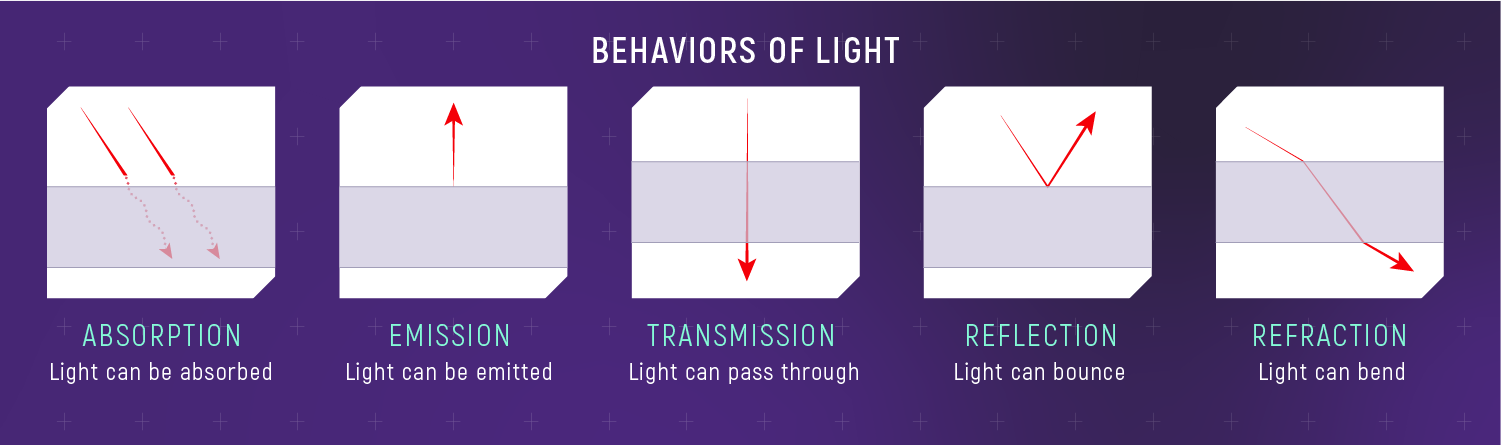
Light carries information because it doesn’t just travel — it interacts. The fundamental interactions are absorption, emission, and scattering; at a boundary we also describe transmission (it gets through), reflection (it bounces), and refraction (it bends). Every spectrum you will ever interpret is some combination of these.
- Absorption: a photon is destroyed and its energy goes into the material (heat, or exciting an electron). Absorption is selective — that selectivity turns a smooth spectrum into one with informative “missing” wavelengths.
- Emission: matter loses energy by creating a photon. What sets the photon’s wavelength is the energy the material loses — which is why atoms produce lines at specific wavelengths.
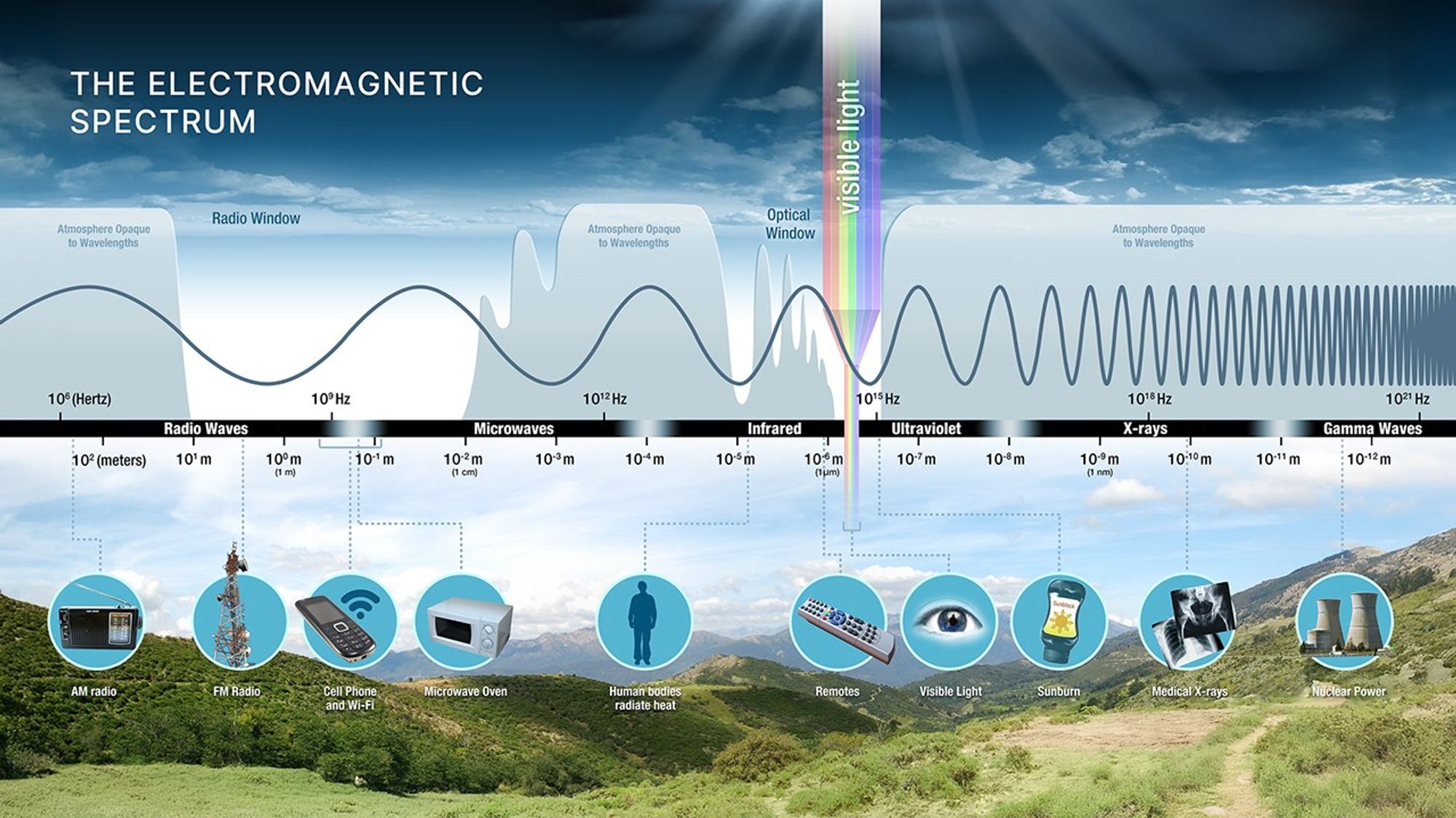
- Transmission: light passes through without being absorbed. Glass transmits visible but absorbs UV; Earth’s atmosphere transmits visible and radio but absorbs most X-rays.
- Reflection: light bouncing off a surface. The fraction reflected (the
albedo - Refraction: bending as light crosses between media. Lenses focus by refraction; atmospheric refraction makes stars twinkle. It is wavelength-dependent — blue bends more than red, which is why prisms spread white light.
Albedo
The fraction of incident light a surface reflects. A bright icy moon has high albedo; dark rock has low albedo. It encodes information about surface composition and texture.
Scattering: Blue Skies and Red Sunsets
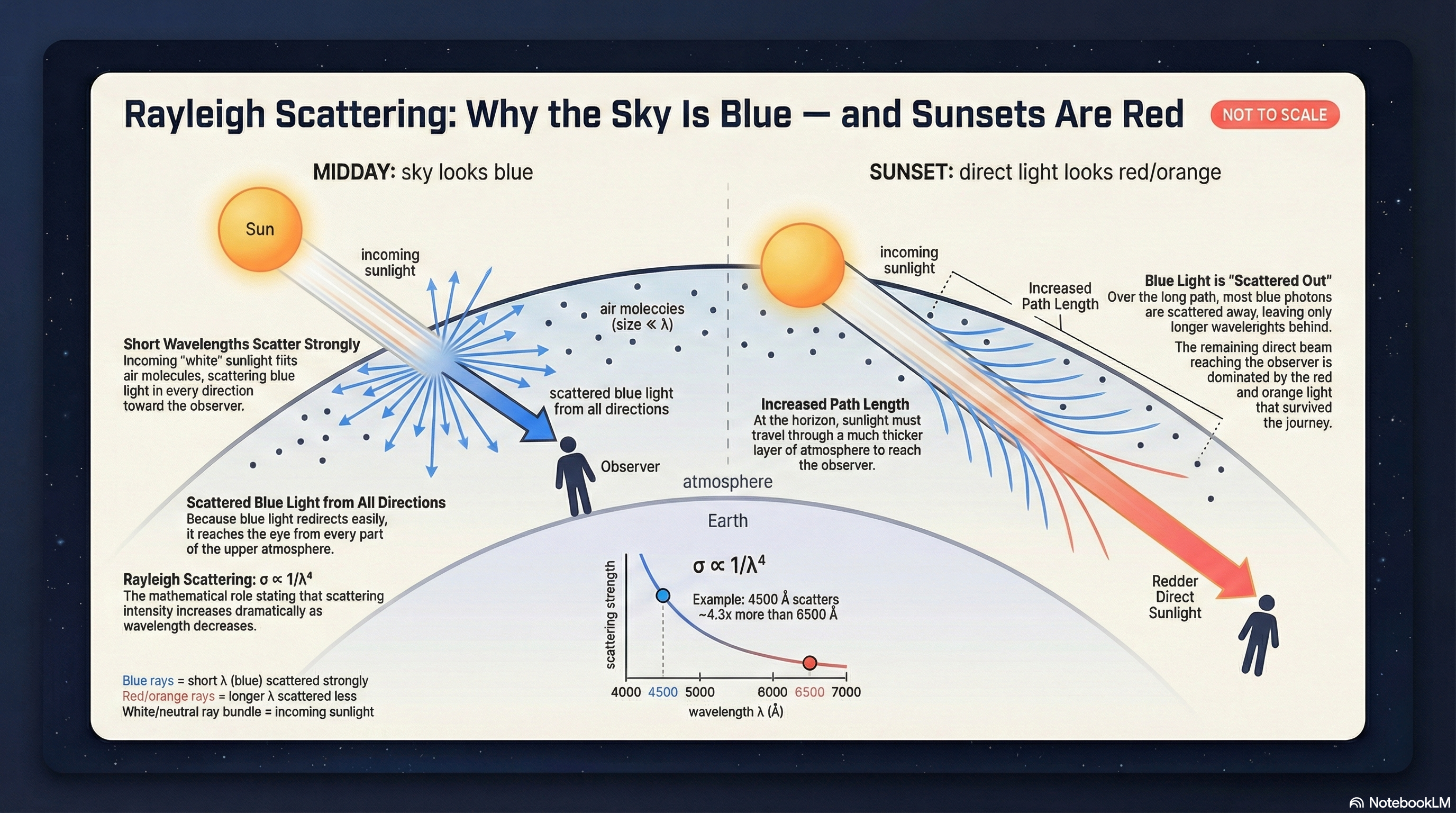
Scattering redirects light into new directions. When the scattering particles are much smaller than the wavelength (like air molecules), we get
Rayleigh scattering
Scattering of light by particles much smaller than its wavelength, with a steep dependence. It makes the daytime sky blue, sunsets red, and reddens starlight passing through interstellar dust.
The dependence is steep: blue light ( nm) scatters about times more than red ( nm), so .
Why the sky is blue: sunlight enters the atmosphere and meets countless N and O molecules. Short wavelengths scatter strongly in all directions, so when you look away from the Sun, much of what you see is scattered blue light arriving from all over the sky. Why sunsets are red: at sunset, light travels through much more atmosphere; along that long path the blue is preferentially scattered out of the direct beam, so the light that continues forward is redder. Same physics, different geometry.
Opacity and How Far Light Gets
Often we care less about “what is this made of?” than “how far can photons travel before being absorbed or scattered?” That idea is captured by
Opacity
A measure of how strongly matter absorbs or scatters light at a given wavelength. High opacity means light is blocked over a short distance. It is strongly wavelength-dependent — a cloud can be transparent in the optical but opaque in the UV.
You observe two identical stars — one nearby, one far away behind interstellar dust. Which appears redder, and why?
The distant star behind the dust. Dust scatters and removes short (blue) wavelengths more efficiently than long (red) ones, so the transmitted light is reddened — the same physics as the blue sky and red sunset.