Light as Information
Section 7 of 9
Real Stellar Spectra
Part 7: Real Stellar Spectra
Beyond the Ideal Blackbody
Stars are approximately blackbodies. Real spectra show two features: the overall shape follows a Planck curve (temperature, via Wien’s law), and absorption lines appear as dark notches (composition, via spectroscopy).
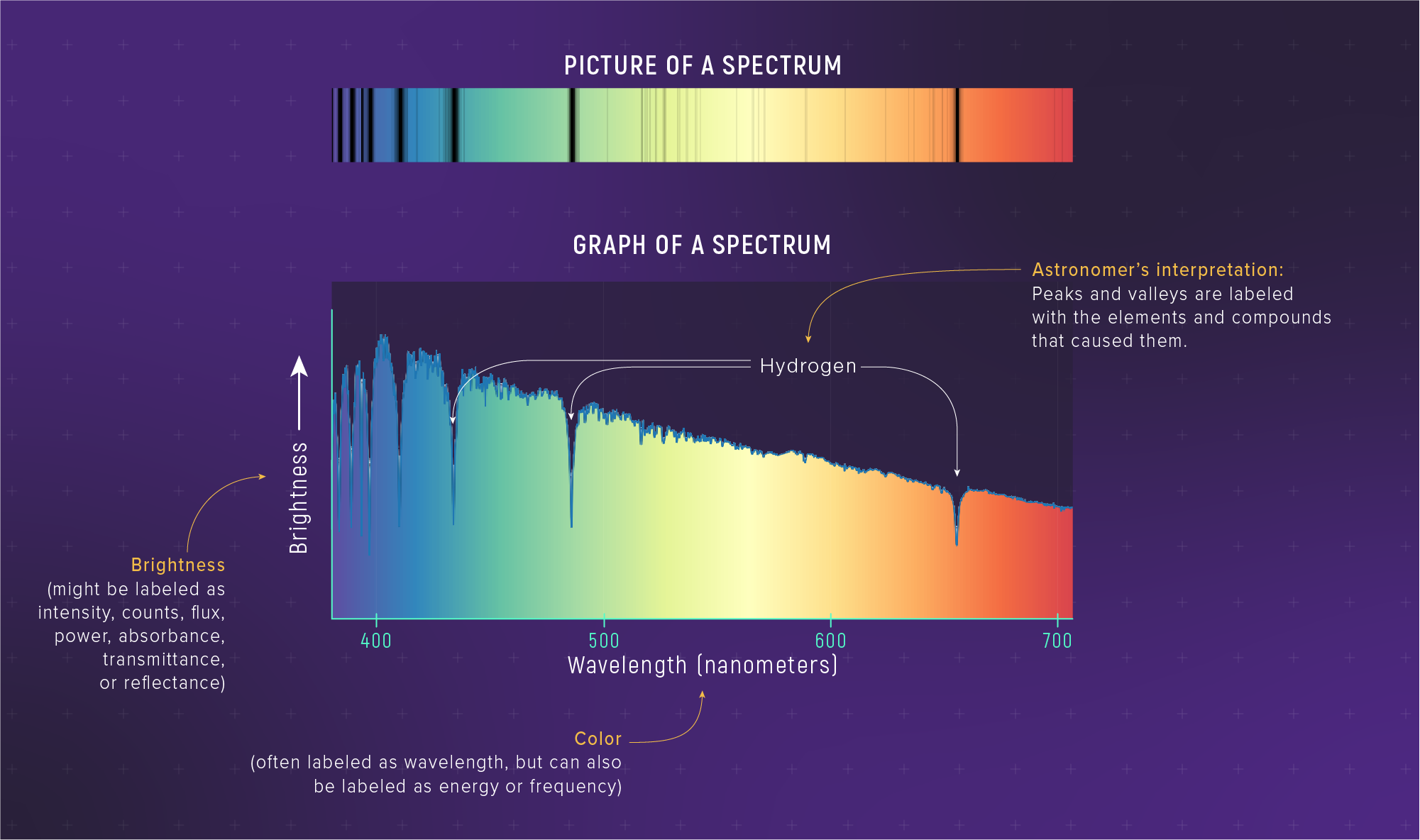
The spectrum of Altair (an A-type star) shows the smooth blackbody shape plus sharp absorption dips from hydrogen and other elements — two inference tools in one observation: the curve shape gives temperature, the line positions give composition.
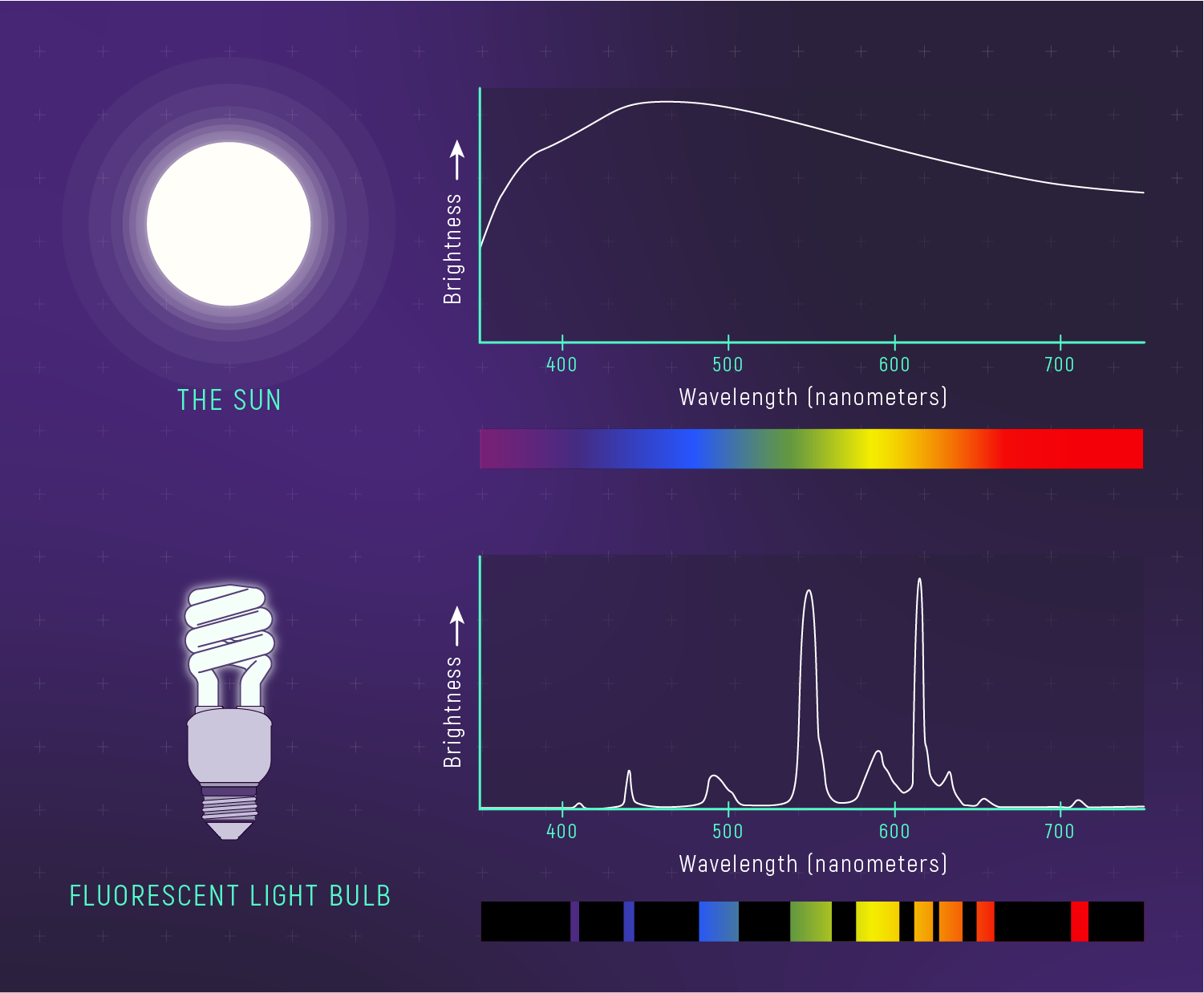
Compare the Sun’s spectrum (approximately continuous, like a blackbody) with a fluorescent bulb (discrete emission lines): the shape tells you the emission mechanism — thermal versus non-thermal.
Doppler Shift: Motion in Spectral Lines
Spectral lines are also speedometers. If a source moves toward or away from us, its lines shift slightly, encoding the line-of-sight velocity — we measure motion using nothing but light.
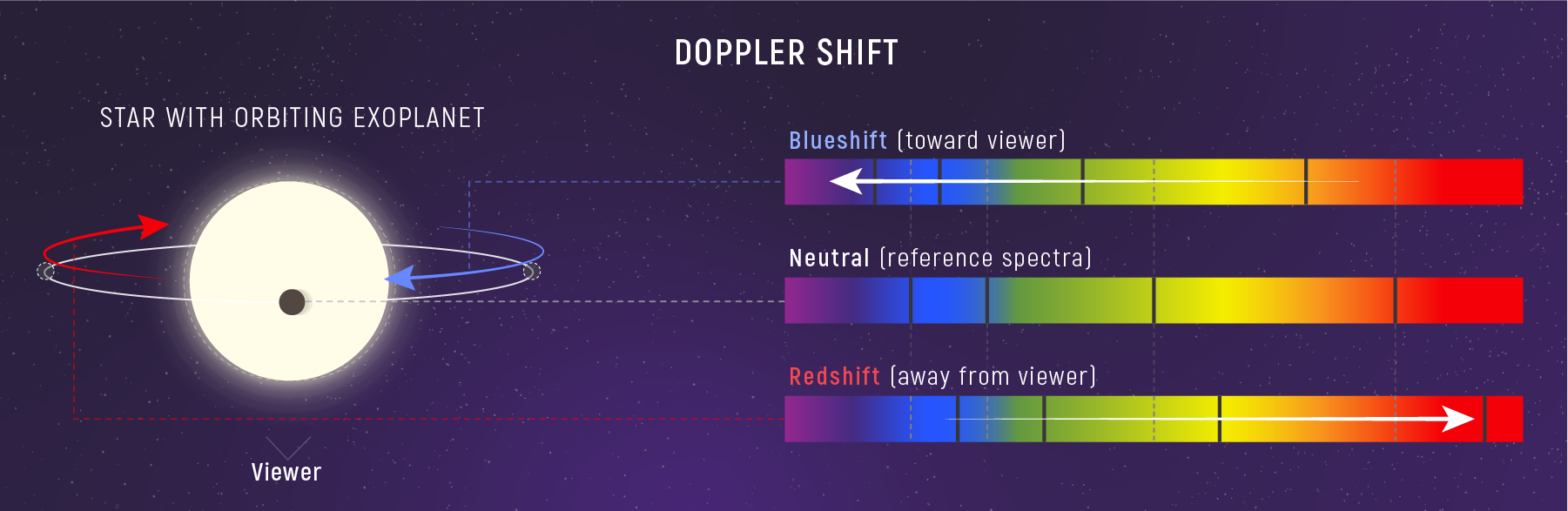
For speeds much smaller than , the non-relativistic Doppler shift is:
Here , is the rest wavelength, and is the radial (line-of-sight) velocity. If the lines redshift (longer ); if is negative they blueshift. Accurate when ; very large cosmological redshifts need a relativistic treatment.
This tiny shift unlocks some of the biggest stories in astronomy: a star’s wobble reveals exoplanets; binary Doppler shifts give orbital speeds and masses; line shifts across a galaxy map its rotation (and point to dark matter); and overall redshift shows the universe is expanding.
A spectral line is observed at a slightly longer wavelength than its lab value. Is the source approaching or receding?
Receding — a shift to longer wavelength is a redshift, meaning positive radial velocity (motion away from us).
Pause & Predict
JWST has a 6.5 m mirror; Hubble has a 2.4 m mirror. Think about how area and resolution scale with diameter.
Part 8 makes both quantitative.