Galaxies as Ecosystems
Section 3 of 9
The Milky Way as a Close-Up Laboratory
Part 2: The Milky Way Is Our Close-Up Laboratory
The Milky Way is the galaxy we know best and the one we know most awkwardly. We live inside its disk, which means we cannot simply step outside and take a clean photograph of the whole structure. Instead, we infer the Milky Way’s anatomy from star counts, gas maps, dust extinction, stellar motions, and multiwavelength observations.
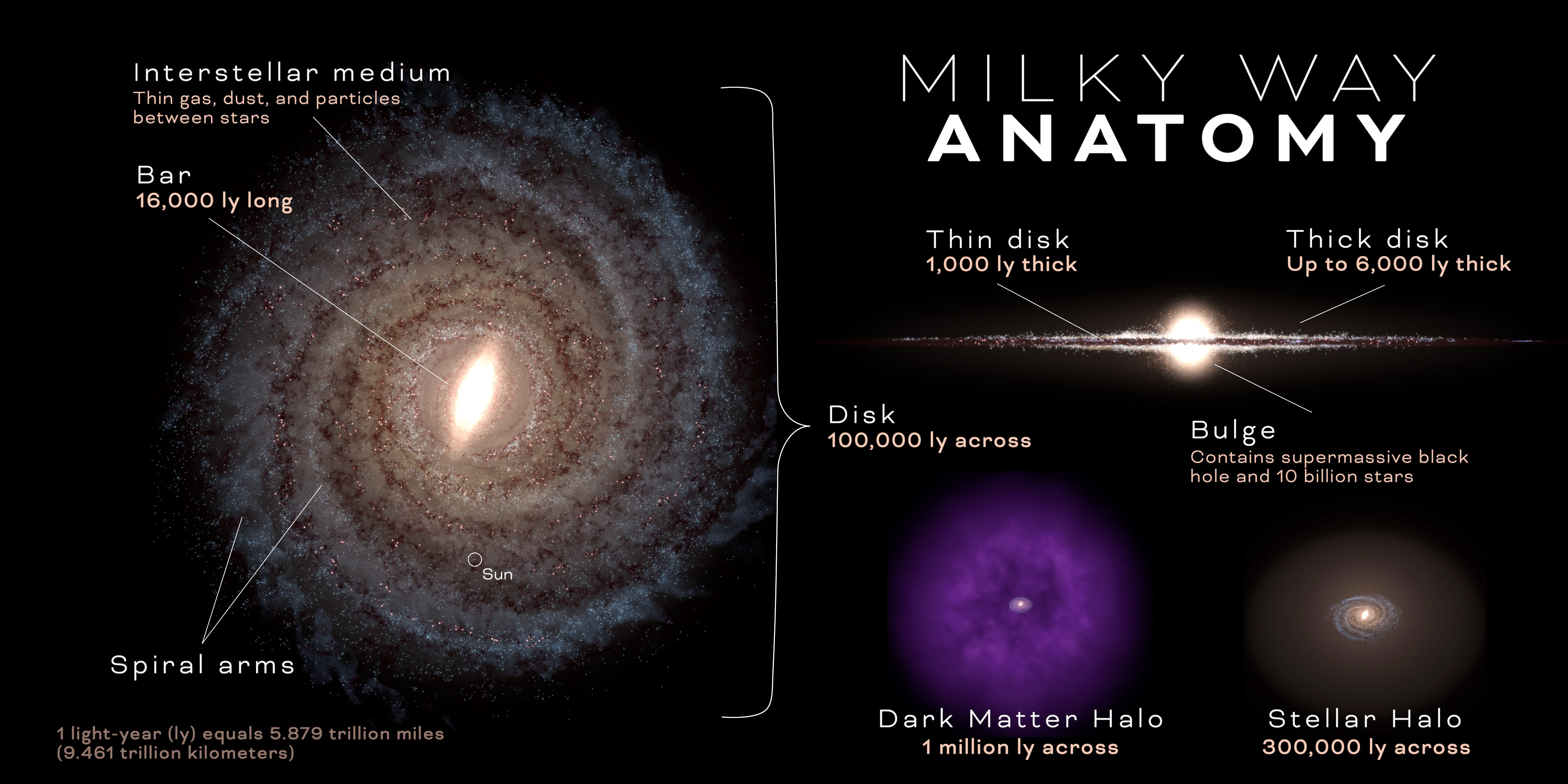
This figure is useful, but it can also mislead if we read it as a static object. A labeled galaxy diagram can make the Milky Way look like a machine with fixed parts: disk, bulge, bar, spiral arms, halo. A better reading is that these are components of an evolving system. The disk contains gas and young stars. The bulge and halo contain older stellar populations. The spiral arms are not rigid material arms like the blades of a fan; they are patterns where gas and stars respond to gravity. The
Dark matter
Matter that does not emit, absorb, or scatter light but contributes most of a galaxy’s gravitating mass. We do not see it directly; we infer it from its gravitational effect on visible matter and motions — the central thread of the next reading, which is its canonical home.
We should also be honest about the challenge: the Milky Way is partly hidden from us by its own dust. Optical light cannot pass cleanly through the Galactic plane. That means visible-light maps alone are incomplete. To map a galaxy from the inside, we need wavelengths that reveal components optical light misses.
Quick check
Why is the Milky Way both our best-studied galaxy and one of the hardest galaxies to map cleanly?
It is best-studied because we can measure individual stars, gas clouds, and motions from inside it. It is hard to map because we are embedded in its dusty disk, so optical light gives an incomplete view of the full structure.